Devpost
Participate in our public hackathons
Devpost for Teams
Access your company's private hackathons
Grow your developer ecosystem and promote your platform
Drive innovation, collaboration, and retention within your organization
By use case
Blog
Insights into hackathon planning and participation
Customer stories
Inspiration from peers and other industry leaders
Planning guides
Best practices for planning online and in-person hackathons
Webinars & events
Upcoming events and on-demand recordings
Help desk
Common questions and support documentation
Sort by:
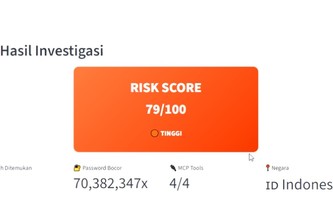
Bilingual AI agent that helps Indonesian citizens detect personal data breaches, powered by Splunk
AI agents that autonomously detect anomalies in Splunk, analyze root causes, and auto-create GitHub PRs to fix code
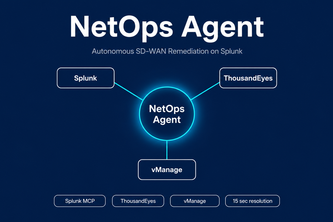
"Stop watching the network break. Start fixing it."
Co>dev is an AI-powered Splunk Copilot that prevents costly searches, automates CIM onboarding, deploys dashboards from natural language, and monitors itself through a closed-loop telemetry system.
An autonomous incident root-cause agent built on Splunk AI. It finds the real root cause, maps the blast radius, and writes the runbook in seconds turning 45 minutes of triage into one click.
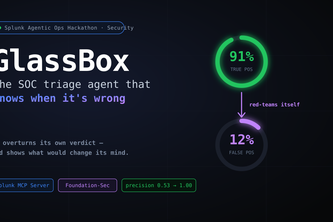
An agentic SOC analyst for Splunk: investigates alerts via the MCP Server, reasons with Foundation-Sec, red-teams its own verdict, and proves it cuts false alarms without missing attacks.
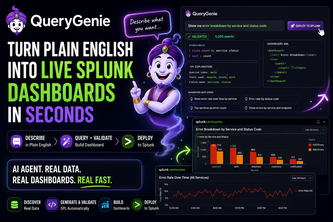
Talk to your data: instantly generate Splunk dashboards from natural language.
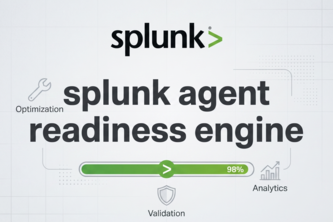
Splunk MCP Server connected AI to Splunkbase,without semantic descriptions,most apps remain unusable by agents.Our solution autogenerates this missing semantic data,making any Splunk app agent ready
TITAN HELIX turns Splunk into a super-agent — six AI agents reason through MCP to find the silent root cause and blast radius in seconds, citing every SPL. Not alerts; AIOps that shows its work.
breach-bot is an autonomous security pipeline: Claude analyzes Splunk logs, detects brute-force attacks, and auto-opens a GitHub PR + Slack alert.
Splunk's AI explains failures; this copilot resolves, validates, and remembers them—self-healing loops from raw logs to AppInspect-green to cost-clean SPL, validated through the Splunk MCP server.
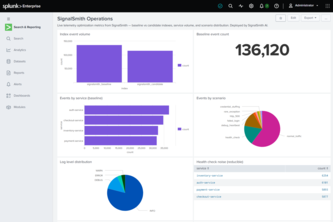
Splunk bills get loud. Alerts must stay loud. SignalSmith cuts noisy ingest with multi-agent shadow proof, then exports deployable OTel config after you approve.
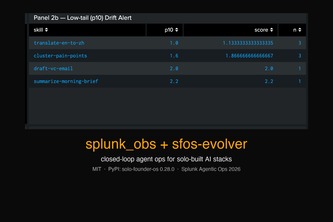
Splunk reads 11 agents' eval drift live. An evolver agent proposes PR fixes when drift fires. Stdlib HEC adapter. MIT. Shipped 6 months before Claude Skills became an open standard.
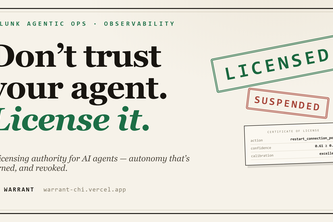
ls measure how smart an AI agent is. Warrant decides how much rope to give it: a per-action license earned by evidence, revoked the moment it's wrong or its model changes.
AI-driven attack detection for Splunk ES. Layered behavioral detection mechanisms, a triage agent, and a human-in-the-loop investigation loop. Validated against synthetic AI-attack data.
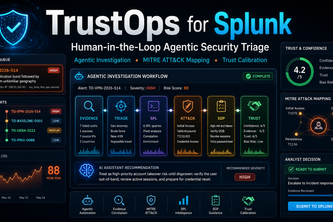
Splunk investigates the alert. TrustOps measures and improves human decisions.
Your CI/CD pipeline added a backdoor last Tuesday. Splunk caught it — and blocked the build. An agentic supply-chain guard that detects CVEs & typosquatting and blocks risky builds, NIS2-ready.
Production incident, two contexts, one answer — composes the Splunk MCP Server + SigMap MCP Server in parallel, fused by a Splunk-hosted model (gpt-oss-120b) into one grounded, scored answer.
Your LLM got worse last night. Splunk saw it — and rolled it back. An AI agent that detects, root-causes, and auto-remediates production LLM quality regressions on Splunk.
PRISM predicts production failures using Cisco CDTSM + Splunk MCP, investigates root causes with multi-agent AI, and auto-generates GitHub fix PRs — resolving incidents before users are impacted.
AgentReady scores how well AI agents can use a Splunk app via the MCP Server, auto-fixes the metadata (App Inspect–gated), and proves it: F→A+, +59.9 points, 12 of 13 agent tasks.
The Datadog for AI agents, real-time detection of prompt injection, hallucinations & runaway cost, with autonomous containment, built on Splunk
Multi-agent incident command: detect, prove, predict, remediate.
It automates threats by converting Splunk alerts into reports with Llama3 agents. It captures webhooks, parses CPU spikes and maps payloads to the MITRE ATT&CK framework, updating a Dashboard.