Inspiration
Supply-chain attacks — XZ Utils, SolarWinds, Log4Shell — all enter the same way: a dependency that wasn't there before, or one that silently changed. Security teams pour effort into monitoring network traffic, yet almost nobody watches where these attacks actually enter: the CI/CD build pipeline. A manual typosquat/CVE audit across repos takes weeks; pipelines ship hourly. I wanted Splunk — already the system of record for machine data — to watch the supply chain in real time and act.
What it does
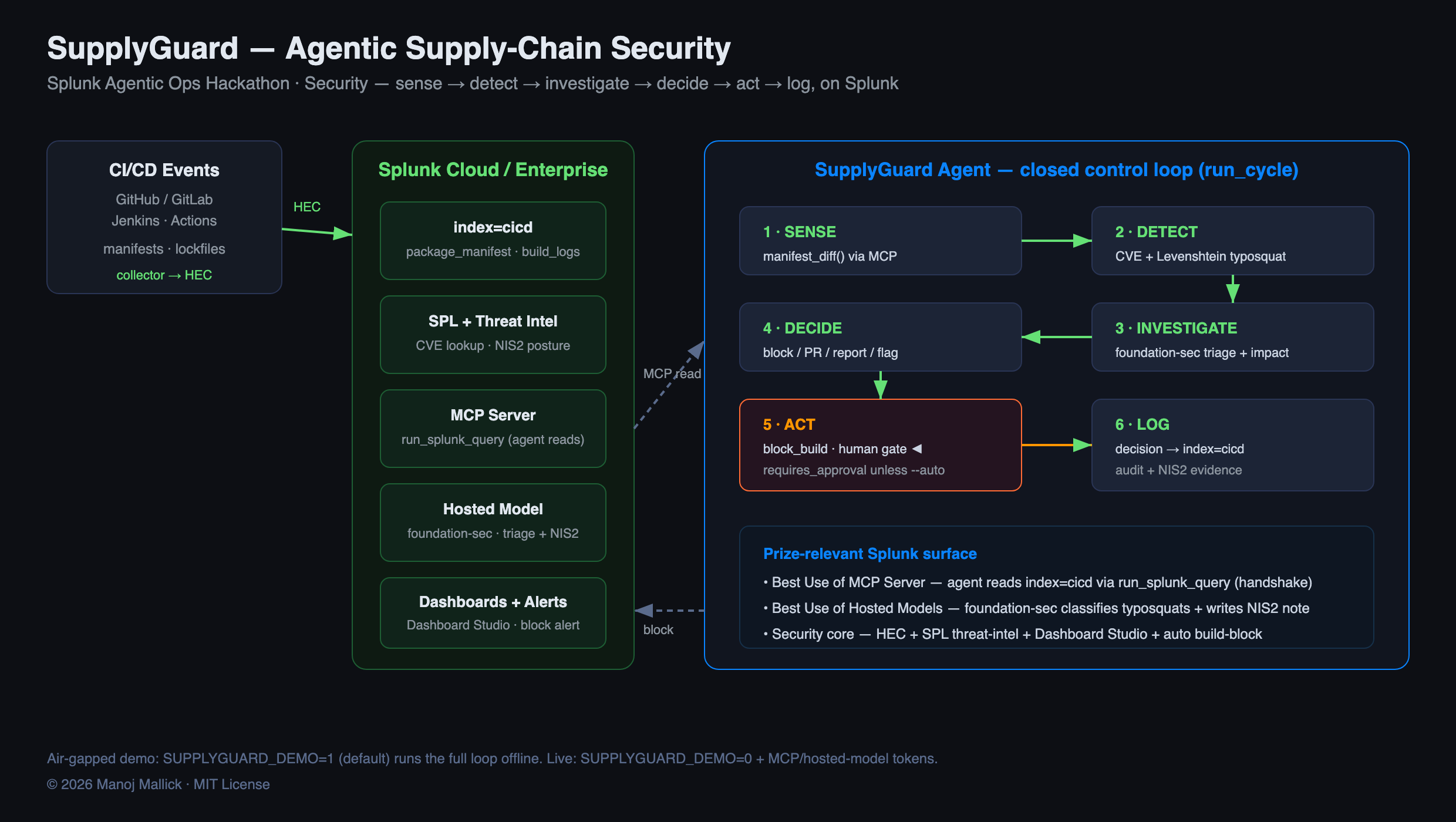
SupplyGuard ingests CI/CD events into Splunk and runs an autonomous agent on every build:
- SENSE the dependency-manifest diff from Splunk via the Splunk MCP Server
- DETECT known CVEs and typosquatting (real Levenshtein distance — e.g.
requrstsvsrequests) - INVESTIGATE with the
foundation-secSplunk hosted security model (malicious? confidence?) and map cross-repo impact - DECIDE block the build / open a remediation PR / file a report / flag
- ACT — block the build, behind a human-approval gate
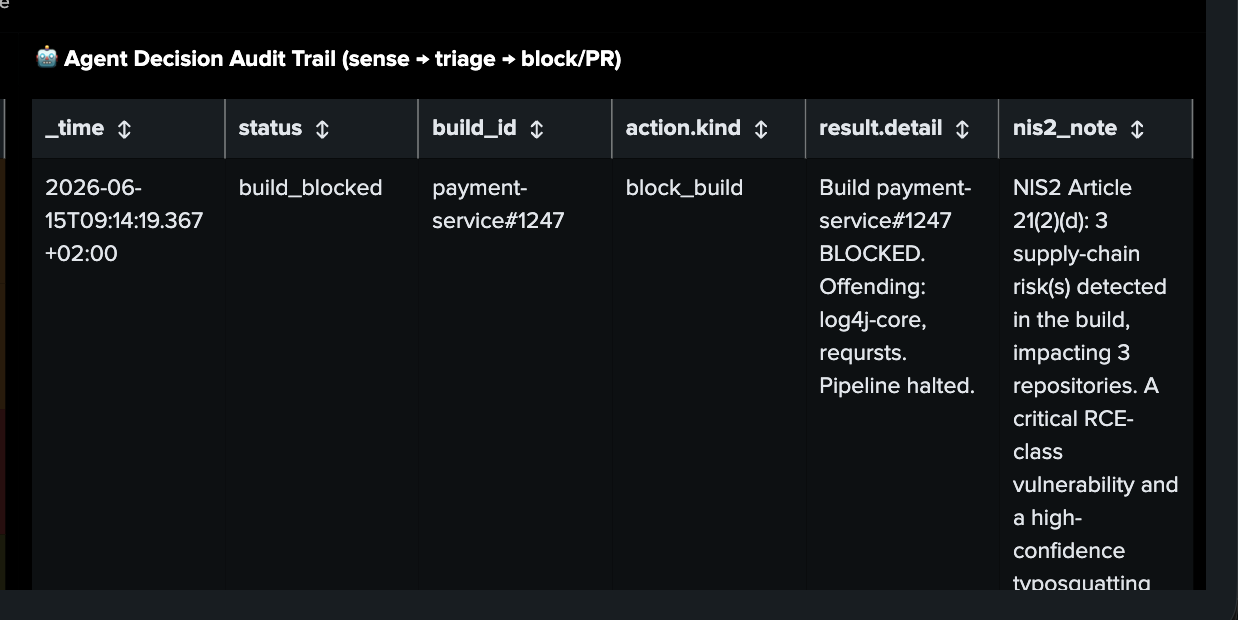
- LOG the decision to
index=cicdas an audit + NIS2 Article 21 evidence trail
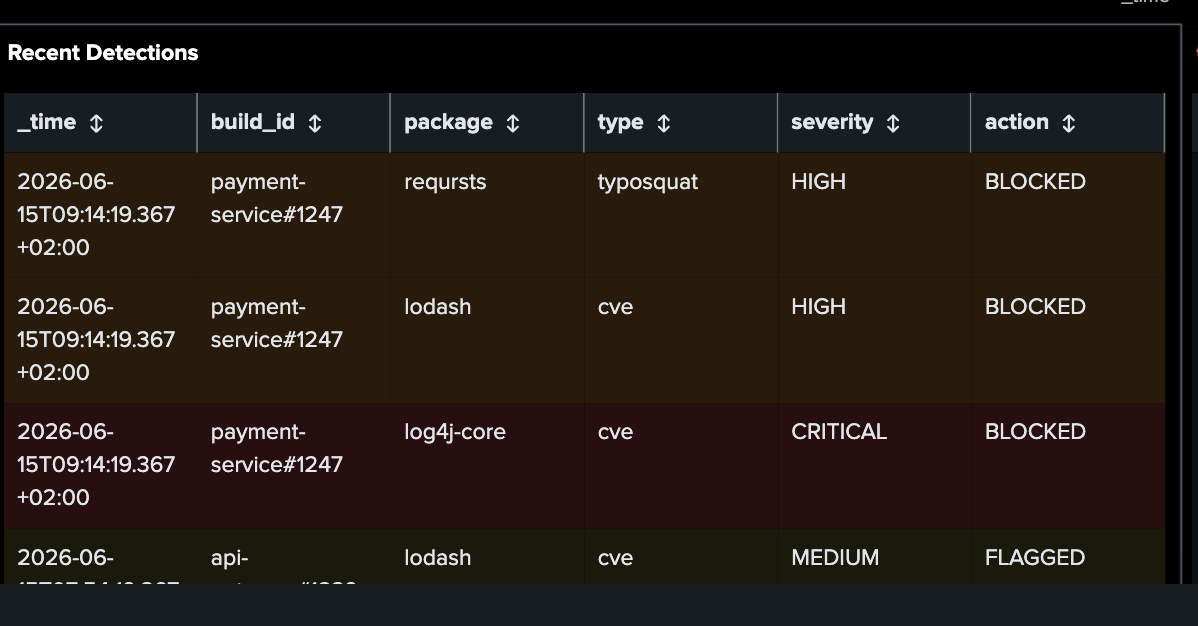
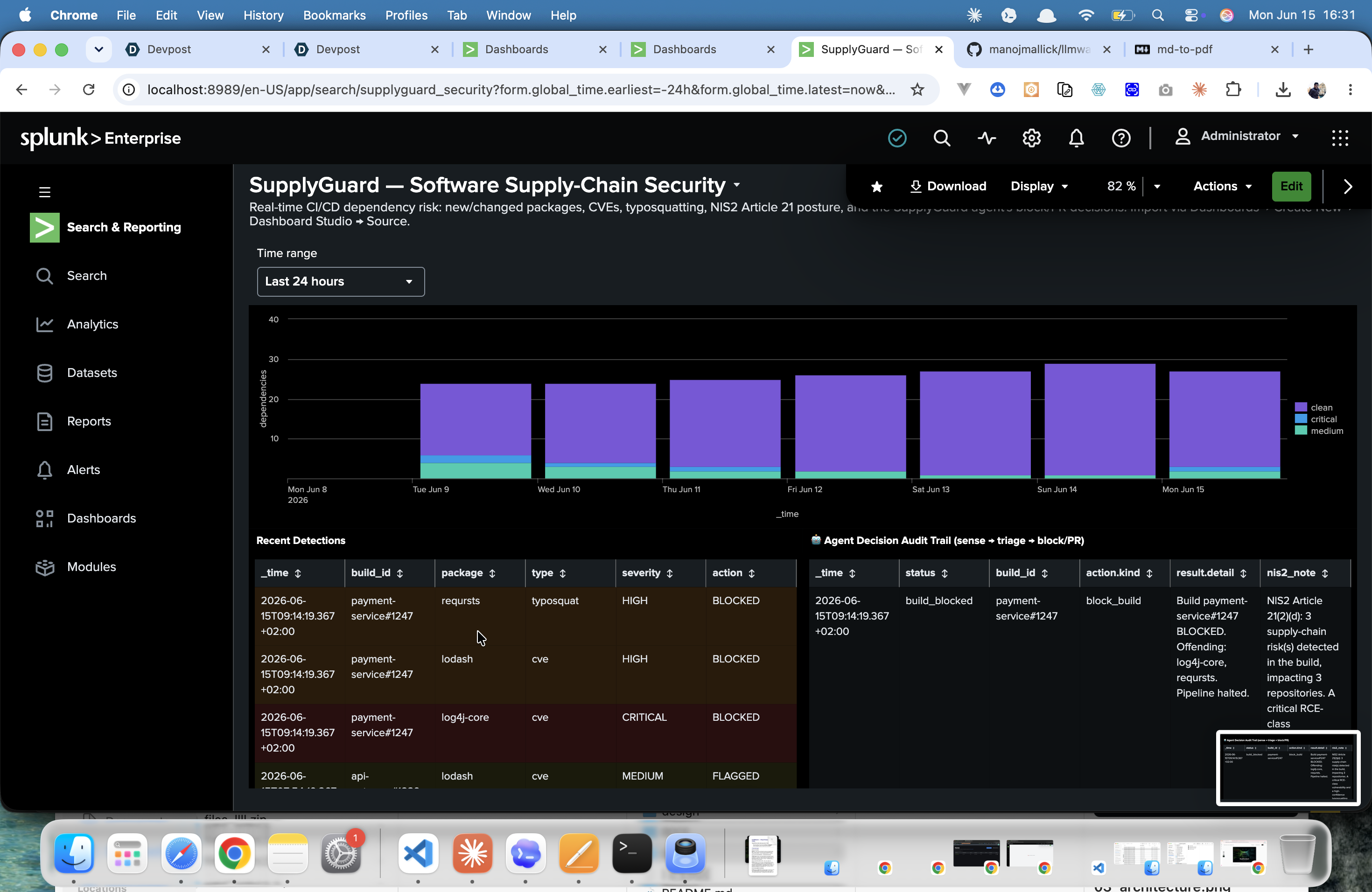
In the demo it catches build payment-service#1247, which added [email protected] (one edit from requests) and log4j-core 2.14 (CVE-2021-44228, CVSS 10), triages with the hosted model, maps 3 affected repos, and blocks the build.
How we built it
- Splunk MCP Server — the agent reads
index=cicdviarun_splunk_query, with the full streamable-HTTPinitializehandshake + Bearer-token auth. - Splunk Hosted Models —
foundation-sec-1.1-8b-instructclassifies typosquats and writes the NIS2 narrative. - HEC + SPL — a Python collector streams CI/CD events to
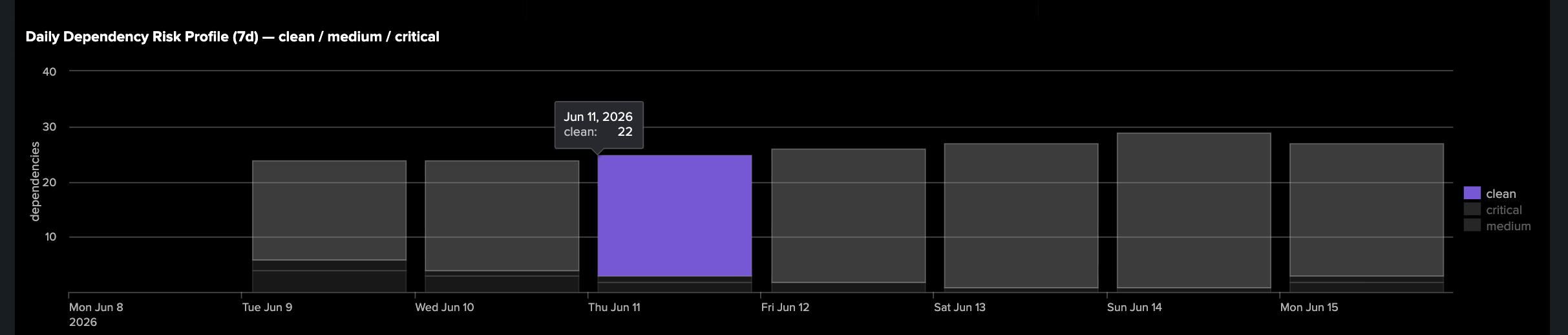
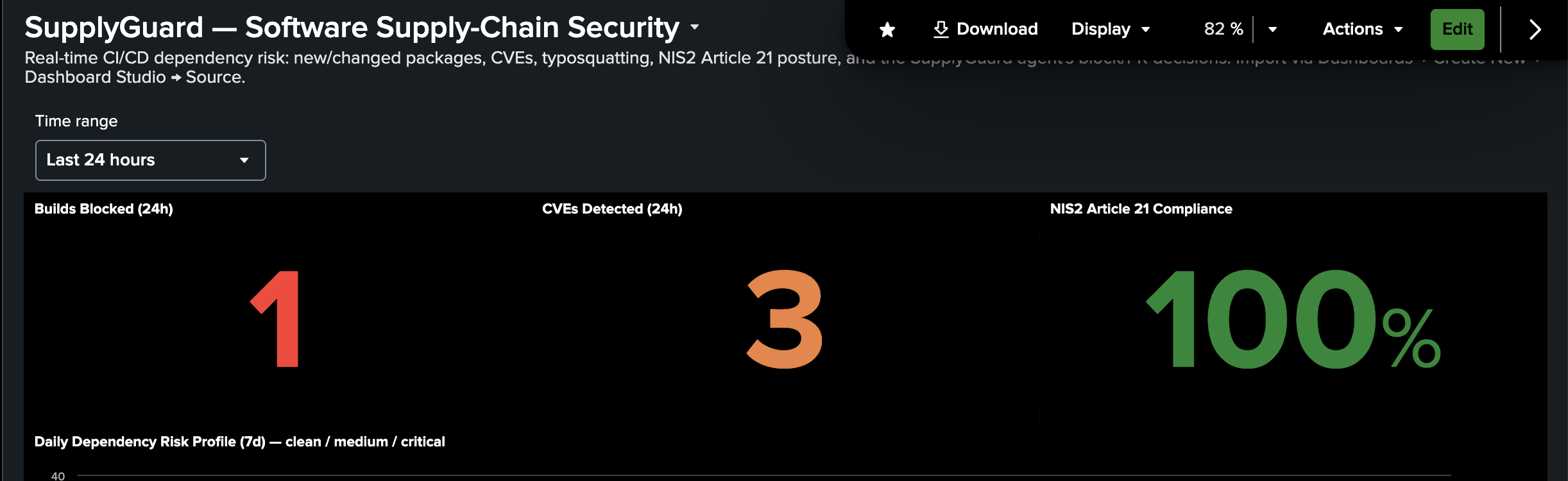
index=cicd; SPL does CVE correlation (lookup), install-spike detection (eventstats), and NIS2 scan-coverage posture. - Dashboard Studio — a live SOC dashboard shows builds blocked, CVEs, NIS2 %, a 7-day risk profile, and the agent's decision audit trail.
- A responsible-autonomy approval gate; air-gapped demo (zero network) by default.
Challenges we ran into
- The Splunk MCP Server exposes one query tool (
run_splunk_query), not separate metrics/alert tools — so everything is SPL, and the client must perform the MCPinitializehandshake before any tool call (the #1 thing that silently breaks a client that "works" offline). - SPL has no native
levenshtein()— typosquatting distance is computed in Python, and the oldjoincorrelation was replaced withlookup/eventstatsto avoid the subsearch anti-pattern. - Keeping the whole pipeline runnable air-gapped for judging while still wiring real Splunk Cloud paths.
Accomplishments that we're proud of
- A genuinely agentic loop that doesn't just alert — it blocks the build, with a human-approval gate.
- Runs live on real Splunk: a populated Dashboard Studio dashboard backed by
index=cicd. - A net-new Splunk data source (the build pipeline), net-new detection (dependency CVEs + typosquatting), and a net-new compliance angle (NIS2 Article 21).
- Honest engineering: real MCP handshake, real hosted-model calls, no fabricated SPL, no hardcoded secrets.
What we learned
- The build pipeline is a rich, underused Splunk data source.
- MCP makes Splunk a clean read-surface for an AI agent — the handshake +
run_splunk_queryis all you need. foundation-secis well-suited to security-domain triage and compliance-narrative generation.
What's next for SupplyGuard
- Wire live remediation to real GitHub/GitLab PRs.
- Ingest SBOMs (CycloneDX/SPDX) and transitive-dependency graphs.
- Expand typosquatting beyond Levenshtein (homoglyphs, keyboard distance) and pull OSV / GitHub Advisory feeds via Splunk Threat Intelligence Management.

Log in or sign up for Devpost to join the conversation.