Devpost
Participate in our public hackathons
Devpost for Teams
Access your company's private hackathons
Grow your developer ecosystem and promote your platform
Drive innovation, collaboration, and retention within your organization
By use case
Blog
Insights into hackathon planning and participation
Customer stories
Inspiration from peers and other industry leaders
Planning guides
Best practices for planning online and in-person hackathons
Webinars & events
Upcoming events and on-demand recordings
Help desk
Common questions and support documentation
Sort by:
SOCMind AI – An Agentic Security Operations Platform that autonomously investigates threats using Splunk telemetry and AgenticAI.
**SentinelOps**: 3 AI agents debate your incident, a judge picks the root cause, maps blast radius, forecasts SLO breaches, and auto-remediates — with rollback.
A journey-trust layer for the clinical lab, built on Splunk with a human-gated AI agent.
SplunkSense: From Alert to Resolution in Seconds.
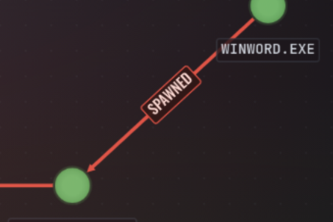
Unravel reconstructs an active intrusion (phishing to domain compromise) from live Splunk telemetry and tells us what happened, why it matters, and what to do, while the attack is still in progress.
Pharmaceutical Equipment Simulation Engine
Hunts for software supply chain compromises by correlating package installs, process trees, and outbound calls in Splunk
Predict what engineers will need before they ask- an AI-powered proactive context prediction engine built on Splunk.
11 detections. 4 are blind. Backstop is an AI agent that reads your real Splunk detections, proves which ones silently stopped firing, and re-runs every verdict in your own search bar.
Ask Splunk questions in plain language — Claude generates the SPL, runs it, and explains the result back in simple terms.
SPL Forge is a VS Code workspace that writes SPL, runs it against Splunk, repairs common mistakes, and outputs reviewable dashboards, alerts, and app artifacts.
A secure Model Context Protocol (MCP) server that intercepts, validates, and optimizes AI-generated SPL queries to protect Splunk infrastructure from destructive and boundless operations.
From incident noise to approved action.
Ask "who owns this data and whose sign-off do I need?", but in Claude, not Splunk. The Data Dictionary turns Splunk governance into MCP tools, giving non-Splunk users instant, grounded answers.
Autonomous AI agent that investigates supply chain attacks in minutes — hunts IOCs, maps blast radius across Splunk, and generates remediation. You stay in control.
SENTINEL transforms Splunk alerts into autonomous action. It uses multi-agent AI to instantly triage threats, investigate IPs, and execute remediation playbooks in real-time.
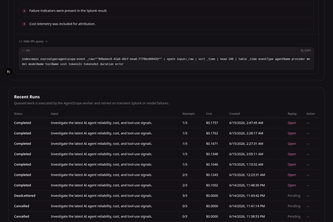
A control plane that queues agent work, a black-box recorder that captures every model call and tool invocation through the Splunk MCP Server to produce a risk-graded operations report.
Talos is a self-healing agentic SRE loop that intercepts error events, queries Splunk telemetry using MCP, scores anomalies, and uses Gemini to generate & notify code-diff hotfixes.
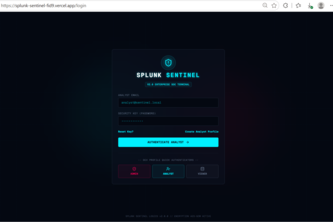
Splunk Sentinel transforms raw security logs into actionable incident intelligence using AI-powered threat detection, investigation workflows, timeline reconstruction, and response automation.
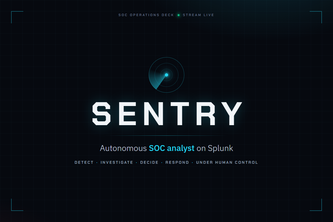
Autonomous SOC analyst on Splunk: it triages, investigates via the official Splunk MCP Server, decides threat vs noise, and acts — only behind a hard human-approval gate.
An AI‑powered system that detects failures across logs, containers, and infrastructure, then maps how those failures spread across microservices to reveal the true blast radius of an outage.
AI compliance copilot that cuts suspicious transaction reviews from 10 minutes to 10 seconds. LangChain ReAct agent + banking-grade security (RBAC, SHA256, PBKDF2, LLM Guard).
Autonomous AI agent that cuts Splunk costs by finding unsearched logs, tracing them to code, and opening fix PRs.