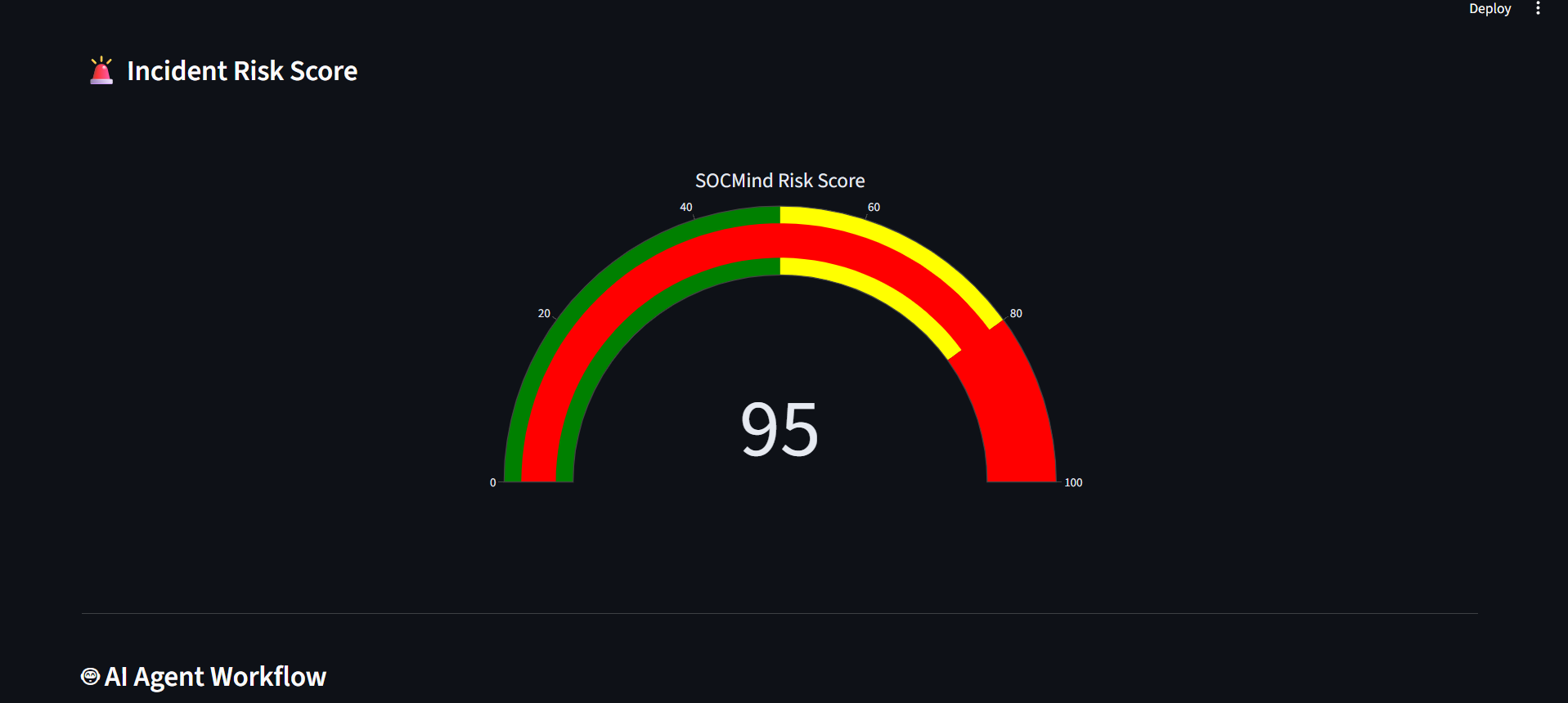
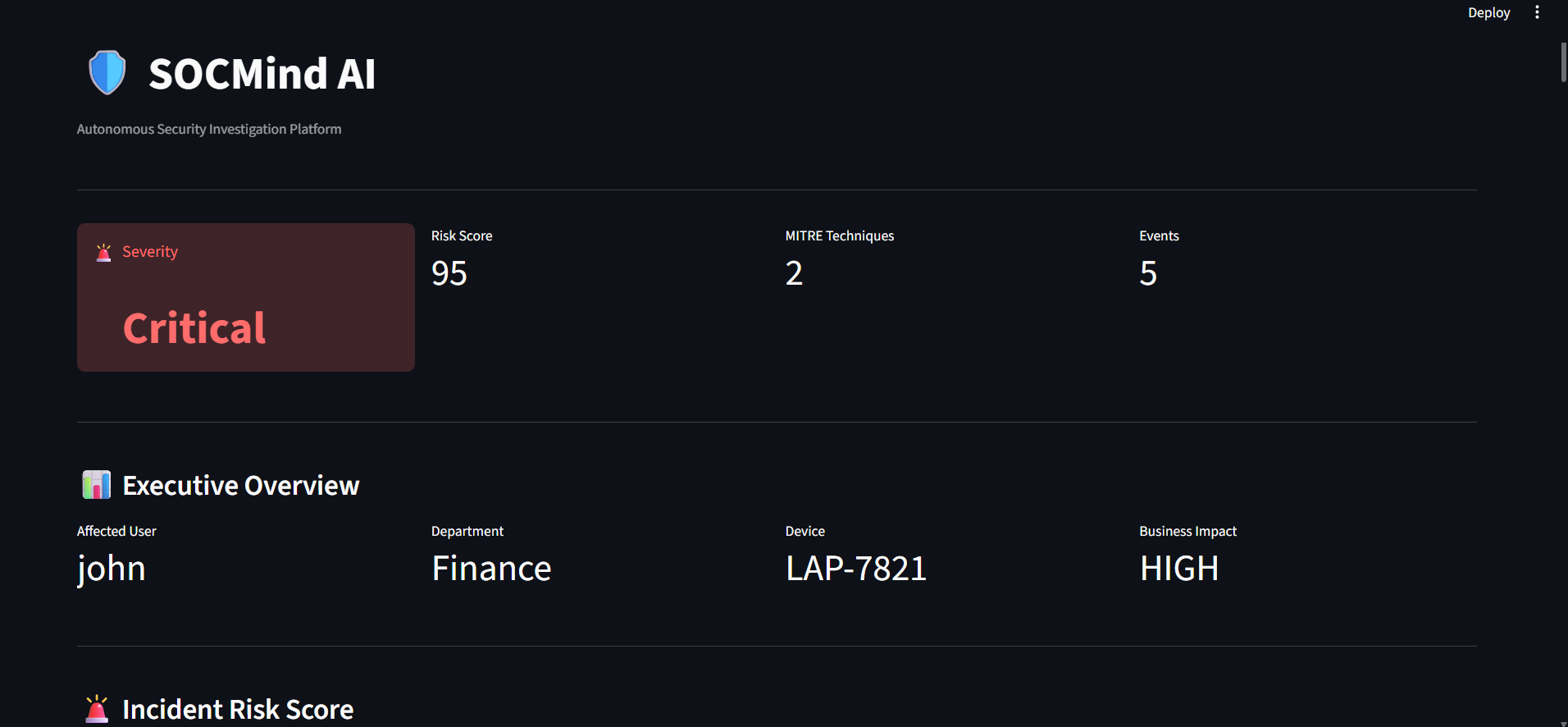
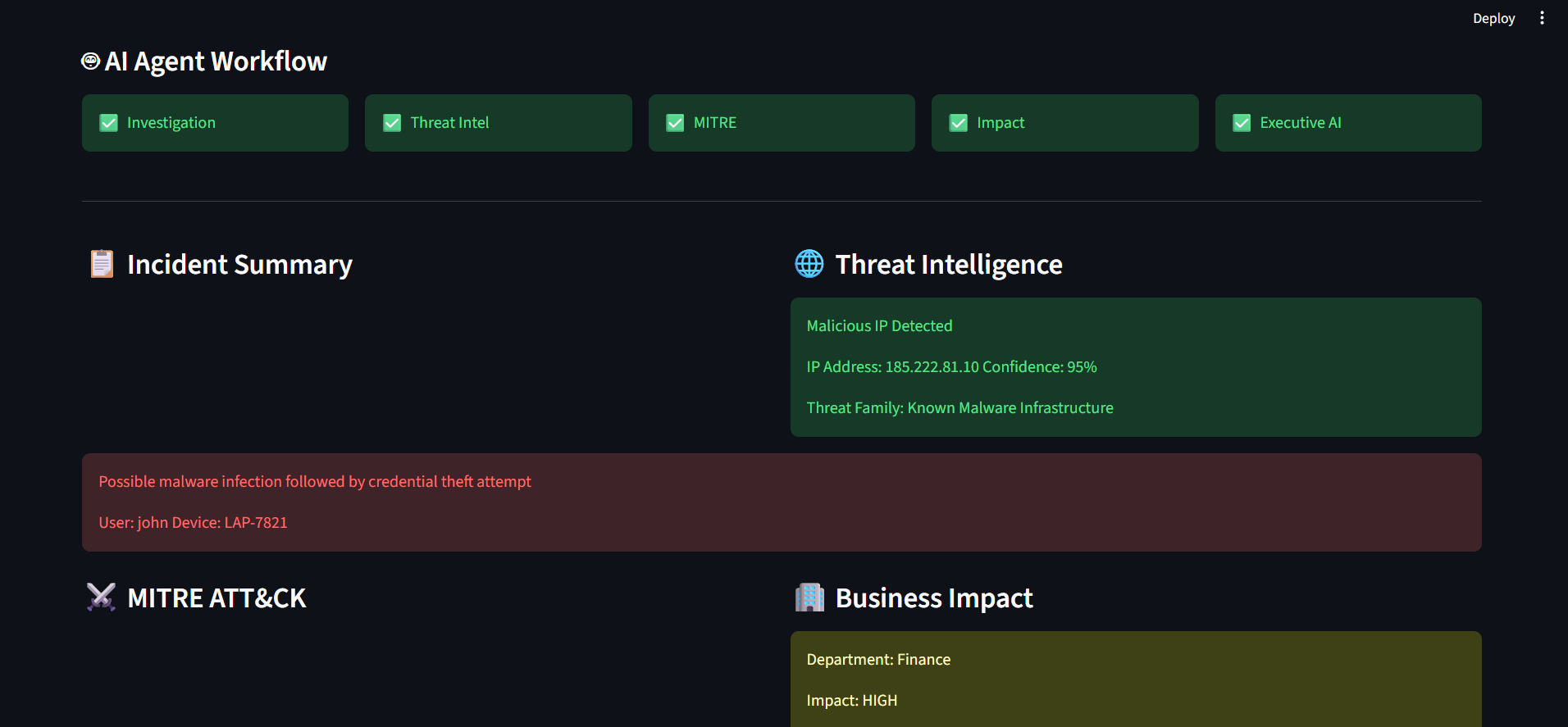
SOCMind AI – Transforming Splunk Alerts into Autonomous Security Investigations
Inspiration
Modern Security Operations Centers (SOCs) are overwhelmed by thousands of security alerts every day. While SIEM platforms like Splunk provide excellent visibility, analysts still spend a significant amount of time manually investigating incidents, correlating events, checking threat intelligence, mapping MITRE ATT&CK techniques, assessing business impact, and preparing reports.
We asked ourselves:
What if AI agents could perform the first level of investigation automatically and provide analysts with a complete incident story within seconds?
This idea inspired us to build SOCMind AI, an Agentic Security Operations Platform powered by Splunk telemetry and Generative AI.
What it does
SOCMind AI autonomously investigates security incidents using a coordinated team of AI agents.
When security events are received from Splunk, SOCMind AI:
- Collects and correlates security events
- Reconstructs the attack timeline
- Identifies malicious indicators such as suspicious IP addresses
- Maps attacker behavior to MITRE ATT&CK techniques
- Assesses business impact based on affected users and departments
- Generates executive-ready security reports
- Recommends containment actions
- Provides a conversational AI Security Copilot for analysts
Instead of manually reviewing logs, analysts receive an end-to-end investigation within seconds.
Example attack flow detected by SOCMind AI:
- PowerShell Execution
- Connection to Malicious IP
- Malware Download
- Credential Dump Attempt
SOCMind AI automatically converts these events into actionable intelligence.
How we built it
We designed SOCMind AI using an Agentic AI architecture.
Core Components
Splunk Enterprise
- Security event source
- Incident telemetry provider
SOCMind Orchestrator
- Central coordinator
- Controls communication between agents
AI Agents
Investigation Agent
- Determines severity
- Identifies root cause
- Builds attack timeline
Threat Intelligence Agent
- Detects malicious IPs
- Performs threat enrichment
MITRE Mapping Agent
- Maps attacker activity to MITRE ATT&CK techniques
Impact Assessment Agent
- Evaluates business impact
- Identifies affected departments
Executive Report Agent
- Generates management-ready reports
Containment Agent
- Recommends response actions
Gemini AI Security Copilot
- Provides natural language incident analysis
- Answers analyst questions
Technology Stack
- Splunk Enterprise
- Python
- Streamlit
- Gemini AI
- REST APIs
- Multi-Agent Architecture
Challenges we ran into
One of the biggest challenges was designing an effective agent orchestration workflow.
Instead of building a simple chatbot, we wanted multiple specialized agents that could collaborate to investigate incidents.
Additional challenges included:
- Correlating security events into a meaningful attack timeline
- Designing an extensible agent architecture
- Mapping attack behaviors to MITRE ATT&CK techniques
- Creating an intuitive analyst experience
- Integrating Splunk data with AI-driven workflows
We also had to balance automation with explainability so analysts could understand how conclusions were reached.
Accomplishments that we're proud of
We are proud that we successfully built a working Agentic Security Operations Platform within the hackathon timeframe.
Key achievements include:
- End-to-end Splunk integration
- Multi-Agent Security Investigation Framework
- Automated threat intelligence enrichment
- MITRE ATT&CK mapping
- Business impact assessment
- Executive security reporting
- Gemini-powered AI Security Copilot
- Interactive SOC dashboard
Most importantly, we transformed raw security logs into actionable investigations.
What we learned
This project taught us that AI becomes significantly more powerful when specialized agents collaborate instead of relying on a single large language model.
We learned:
- How to design agent orchestration patterns
- How to build AI-assisted security workflows
- How to transform SIEM telemetry into actionable intelligence
- How Generative AI can accelerate incident response
- How to combine security analytics with conversational AI
We also gained deeper experience working with Splunk APIs, threat intelligence workflows, and AI-driven security operations.
What's next for SOCMind AI
We believe SOCMind AI is only the beginning.
Future enhancements include:
Autonomous Response
- Automatic endpoint isolation
- User account suspension
- Firewall rule updates
- Security orchestration workflows
External Threat Intelligence
- VirusTotal integration
- AbuseIPDB integration
- Open Threat Exchange integration
Multi-Incident Investigation
- Simultaneous investigation of multiple alerts
- Alert prioritization
- AI-driven incident clustering
Agent Memory
- Historical incident learning
- Threat pattern recognition
- Cross-incident correlation
Enterprise Security Operations
- Splunk ES integration
- SOAR integration
- Advanced threat hunting workflows
Our vision is to evolve SOCMind AI into a fully autonomous Security Operations platform that helps organizations detect threats faster, investigate incidents more efficiently, and respond with confidence.

Log in or sign up for Devpost to join the conversation.