Devpost
Participate in our public hackathons
Devpost for Teams
Access your company's private hackathons
Grow your developer ecosystem and promote your platform
Drive innovation, collaboration, and retention within your organization
By use case
Blog
Insights into hackathon planning and participation
Customer stories
Inspiration from peers and other industry leaders
Planning guides
Best practices for planning online and in-person hackathons
Webinars & events
Upcoming events and on-demand recordings
Help desk
Common questions and support documentation
The Anderson localization of a quantum particle was simulated using the fourth-order Runge-Kutta method (RK4) for lattices with different degrees of disorder.
We created a multilayer perceptron neural network that calculates the diameter of an asteroid with accuracy on par with NASA’s current two-variable formula for diameter.
The mold that you might see in your next graph theory course.
We just PONGED General Relativity
We implement Ray tracing simulations to get a Black Hole picture. We also show lightlike geodesics as a way to easily observe the physics behind everything.
WE ARE GRAVIDATRIC PEEPS!!!!
Simulation of a relativistic electric field where the parametres can be changed from the interface.
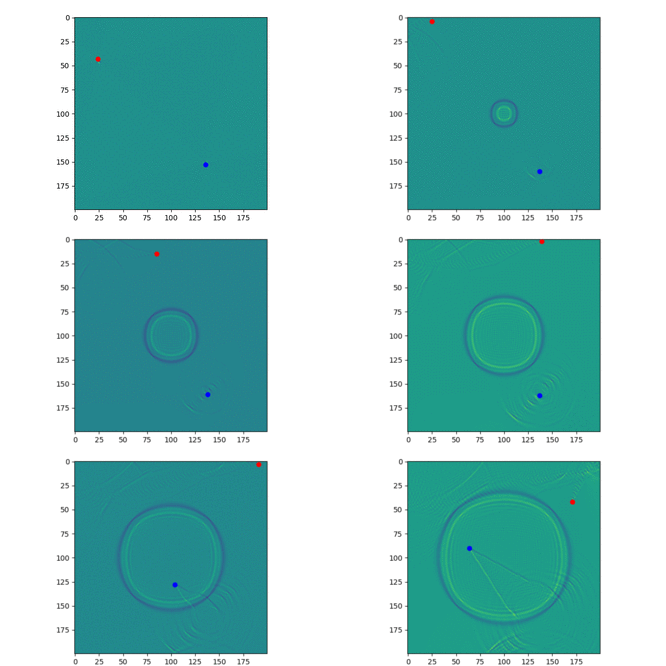
Membrane vibration with energy dissipation based on temperature
We implemented the Gray Scott mathematical model of reaction-diffusion into an arduino simulation to show the result on a simulated 16x16 LED board.
It's about drive, it's about power.
Data from a simplified GEANT4 based simulation of electron-proton inelastic scattering is used alongside various ML algorithms to successfully identify positrons, kaons, muons, and protons.
An interactive globe with NASA meteorite landing data plotted on it.
Using a CNC machine, we created a to-scale solar system model based on the real orbit data from NASA.
Simulating the interactions of charged particles with an EM field using Finite-Difference Time-Domain (FDTD) method.
Kaboom!
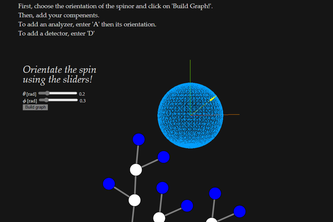
Simulation to understand spin measurement and statistical interpretation in quantum mechanics.
We make cellular automata to model supercooled frost spreading. This minimal model captures the phase transition observed and patterns found in experiments.
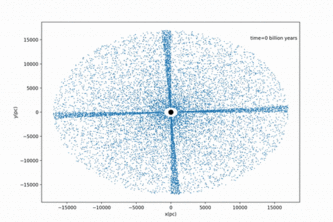
In this project, we use a simple model to simulate the formation of spiral arms in galaxies.
Use machine learning to model the set of coupled differential equations that govern the patterns of Earth’s temperature, Ice coverage, and CO2 based on the data acquired during the last half-century.
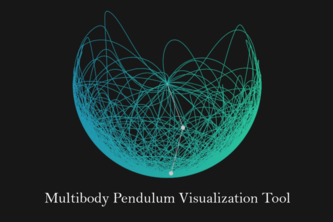
Most pendulum simulators focuses on single and double pendulums, but what would happen as you increase the amount of bobs in the system? How chaotic could this get?
A desktop interface that allows users to record their own audio and will identify the notes played and show the chromagram of the audio recording.
Coughing Simulation: Exploring the Effectiveness of Wearing Masks
We implement Post-Newtonian general relativistic corrections to the orbit of planets in the three-body problem. In addition, we also obtain the gravitational waves for particular configurations.