-
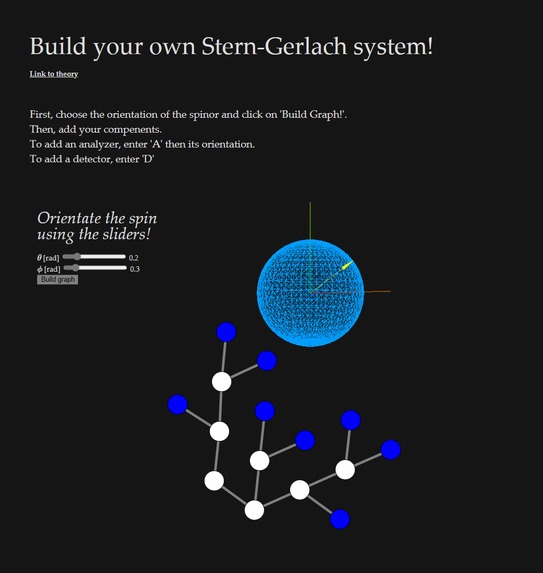
Main website preview
-
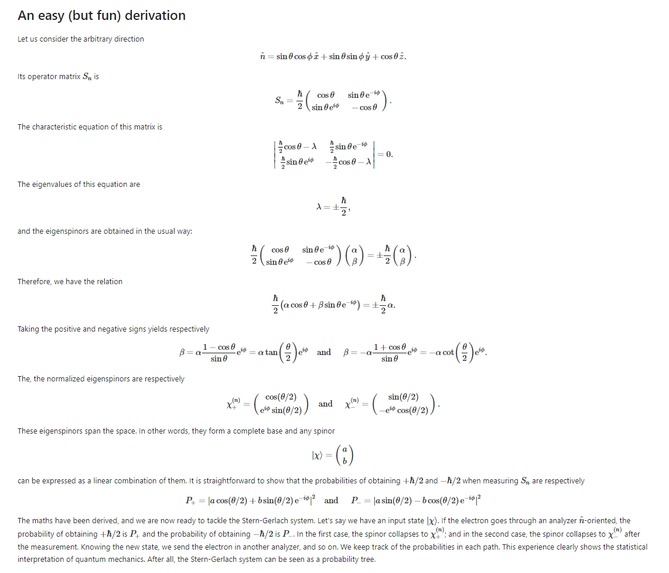
Theory behind the experiment
Inspiration
Quantum mechanics is confusing. Richard Feynman said, "I think I can safely say that nobody understands quantum mechanics." The purpose of this project is to get a better understanding of this counterintuitive theory. To do so, we take a look at Stern-Gerlach experiment, which demonstrated spin quantification.
What it does
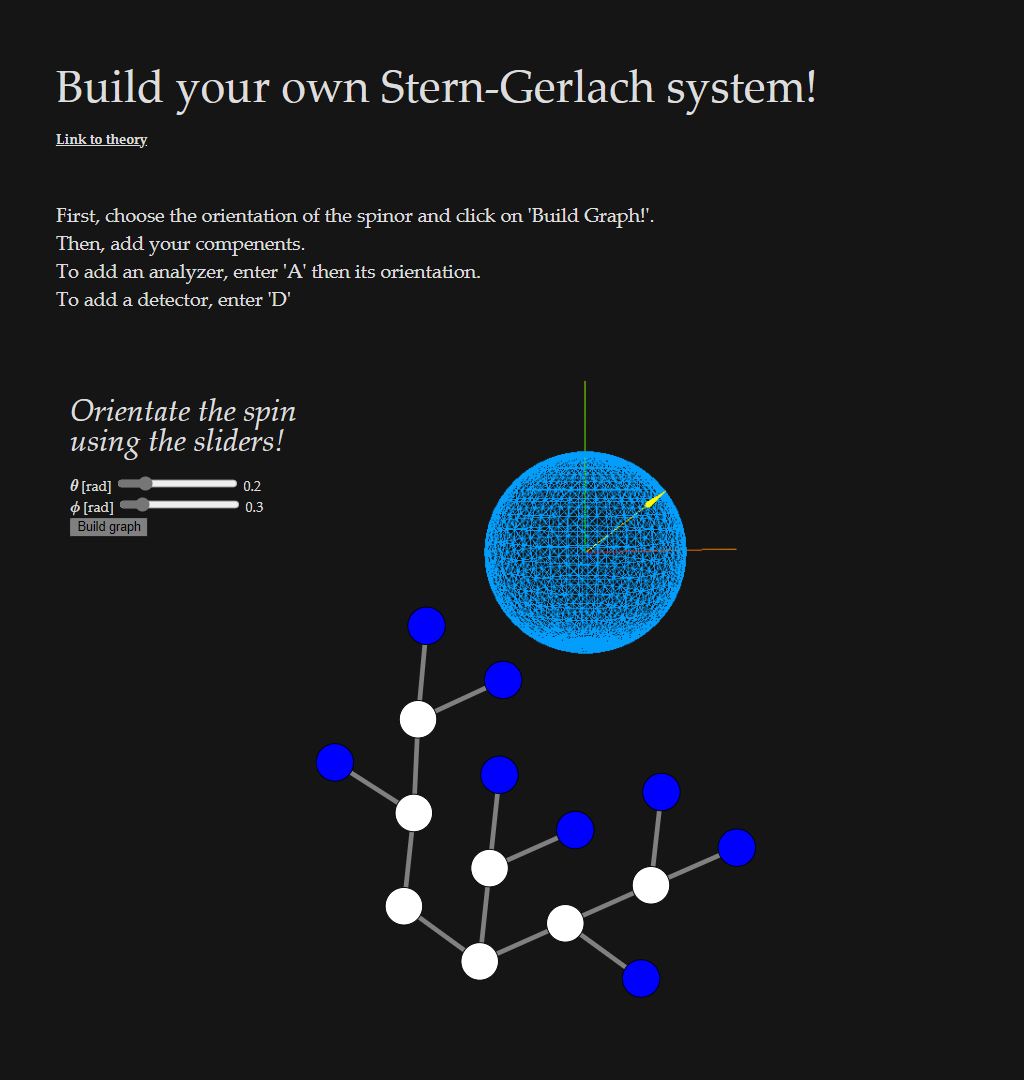
The simulation is interactive. First, the user picks a spinor state for an electron (spin 1/2) by selecting the two spherical angles (phi and theta). Then, the user builds its own Stern-Gerlach system by adding analyzers and detectors. Physically, an analyzer is an inhomogeneous magnetic field which allows to measure the spin in an arbitrary direction. Therefore, when adding an analyzer, the user must specify its orientation (phi and theta). A detector displays the probability of collecting the particle at its location. When running the simulation, the user visualizes the particle's evolution in the system.
How we built it
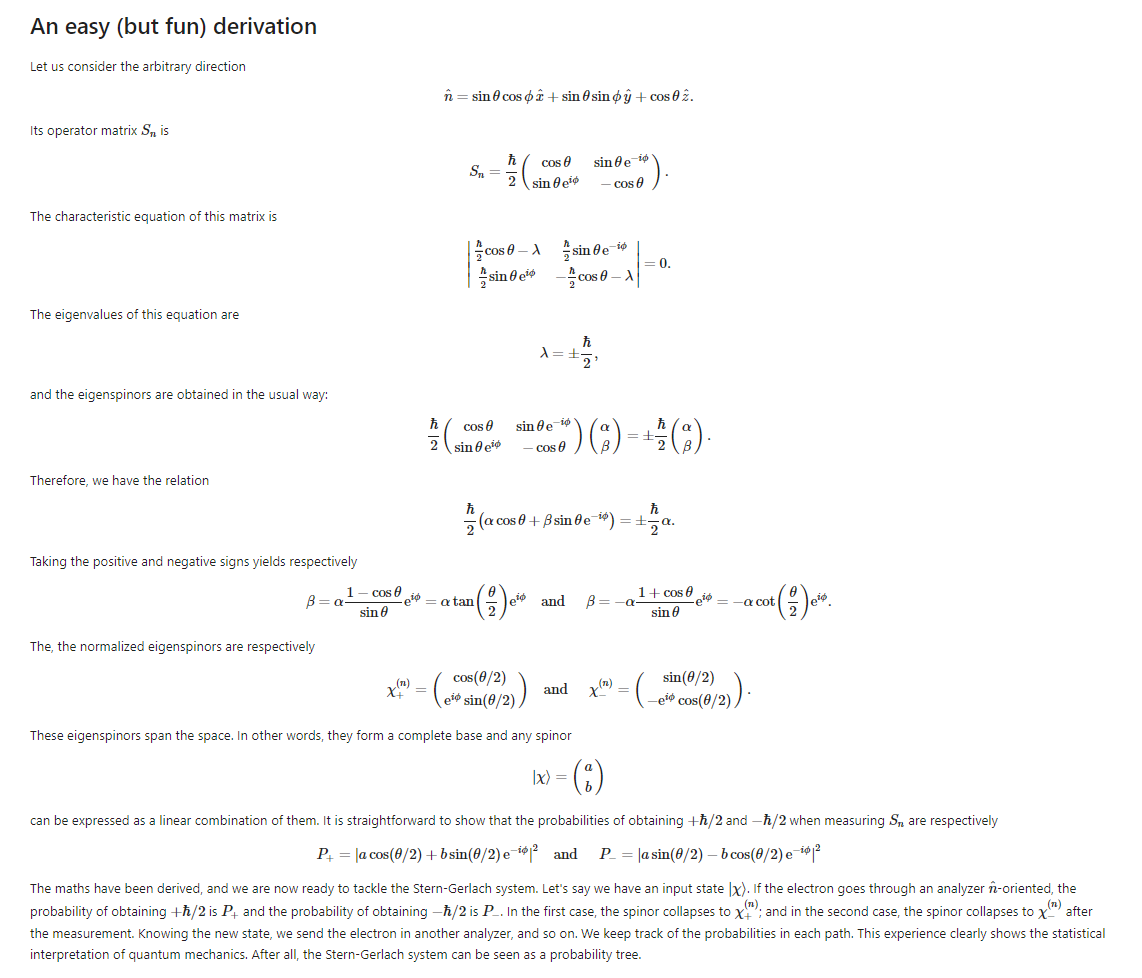
First, maths were derived. We considered the eigenspinors of a spin 1/2 particle for an arbitrary direction. From these, we computed the probabilities of measuring respectively $+\hbar/2$ and $-\hbar/2$ when the particle passes through an analyzer (also having an arbitrary direction). After a measurement, the spinor collapses on the eigenspinor associated with the measured eigenvalue. Therefore, we can compute the electron state after each measurement, and keep track of its evolution.
The Stern-Gerlach system is built under a recursive algorithm. Generally, a user could build an infinite system, but this would be of no interest. Typically, a system of two or three layers is appropriate to see what's really going on. The probabilities are also computed under a recursive algorithm.
The computation part was implemented in Python. We used NetworkX library to build the graph associated with Stern-Gerlach system. The front-end part was coded in JavaScript.
Challenges we ran into
Classically, sleep deprivation. Also, our team has only one full-stack (props to Etienne), and the rest of us are engineering physics students with (very) limited knowledge of front-end development.
Accomplishments that we're proud of
Having a sum to one ending probability.
What we learned
Web development is not easy.
What's next for Stern-Gerlach apparatus
Generalize our approach to particules of higher spin (1, 3/2, 2,...).


Log in or sign up for Devpost to join the conversation.