Inspiration
Most galaxies in the Universe are in spiral shapes, but how they are making these arms? For answering this question, people usually run costly N-body simulations. We wanted to find a simple model to see how spirals form in galaxies.
What it does
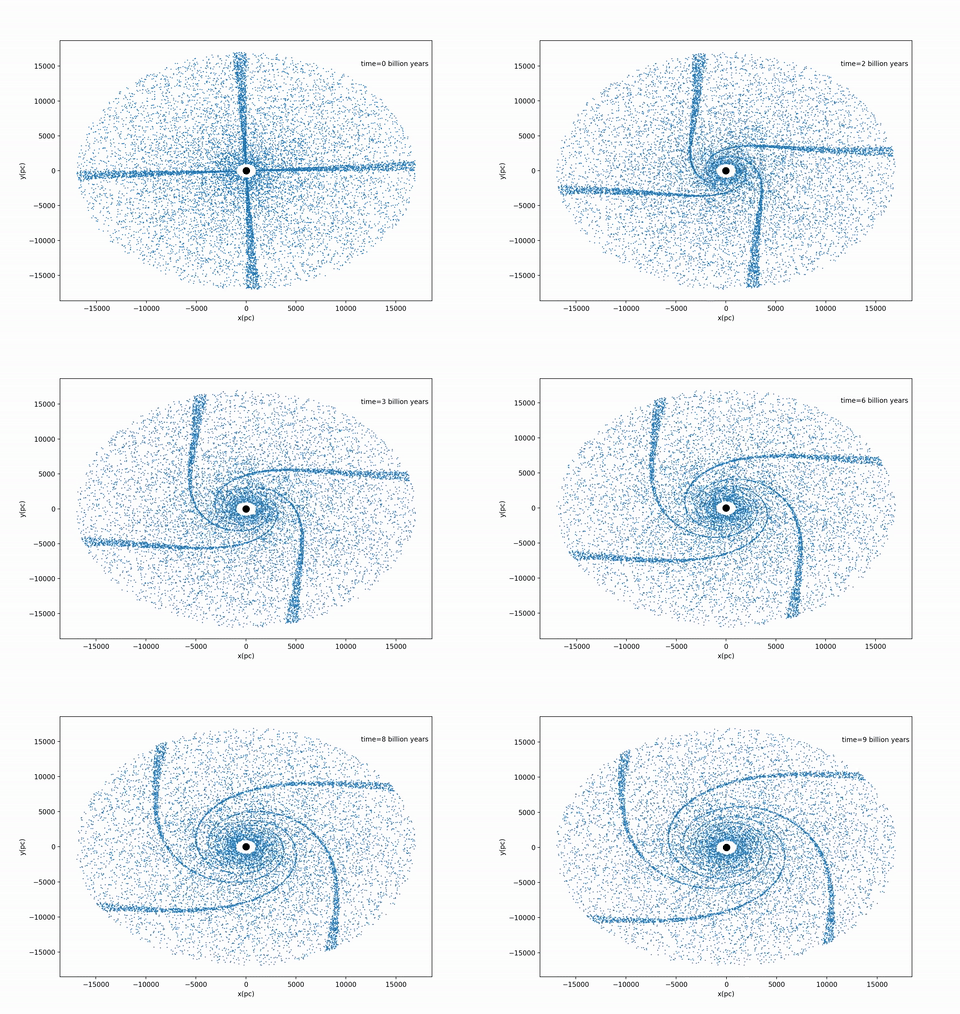
Our program is generated based on a simple model for spiral arm formation. We begin with a homogenous 2-dimensional disk with slight perturbations of mass in some directions. After running our code we see that spiral arms form around those perturbations.
How we built it
We modeled our galaxy by generating random particles on a circle. The speed of each particle is determined from its distance to the central point according to Newtonian gravity. We picked a number of directions and add extra particles to those regions which account for perturbations in our homogenous disk model. Then we let the code evolve and we see that spiral arms form.
Challenges we ran into
1- building a simple model. 2- graphical challenges 3- making the code more efficient
Accomplishments that we're proud of
1- our code shows spiral patterns very well. 2- The time scale for the formation of spiral arms in our code is close to what we expected. (around 10 byr)
What we learned
We learned a lot about different models for galaxy formation and their implementation. While we were brainstorming, we came up with different ideas for building models and visualizing them for different phenomena. We learned about visualization nd making animation using Python,
What's next for Spiral Galaxy Formation
A more realistic model can be one that contains interaction between the overdense region and other particles so that we can absorb more particles in arms.


Log in or sign up for Devpost to join the conversation.