-
-
ManagerGym Logo
-
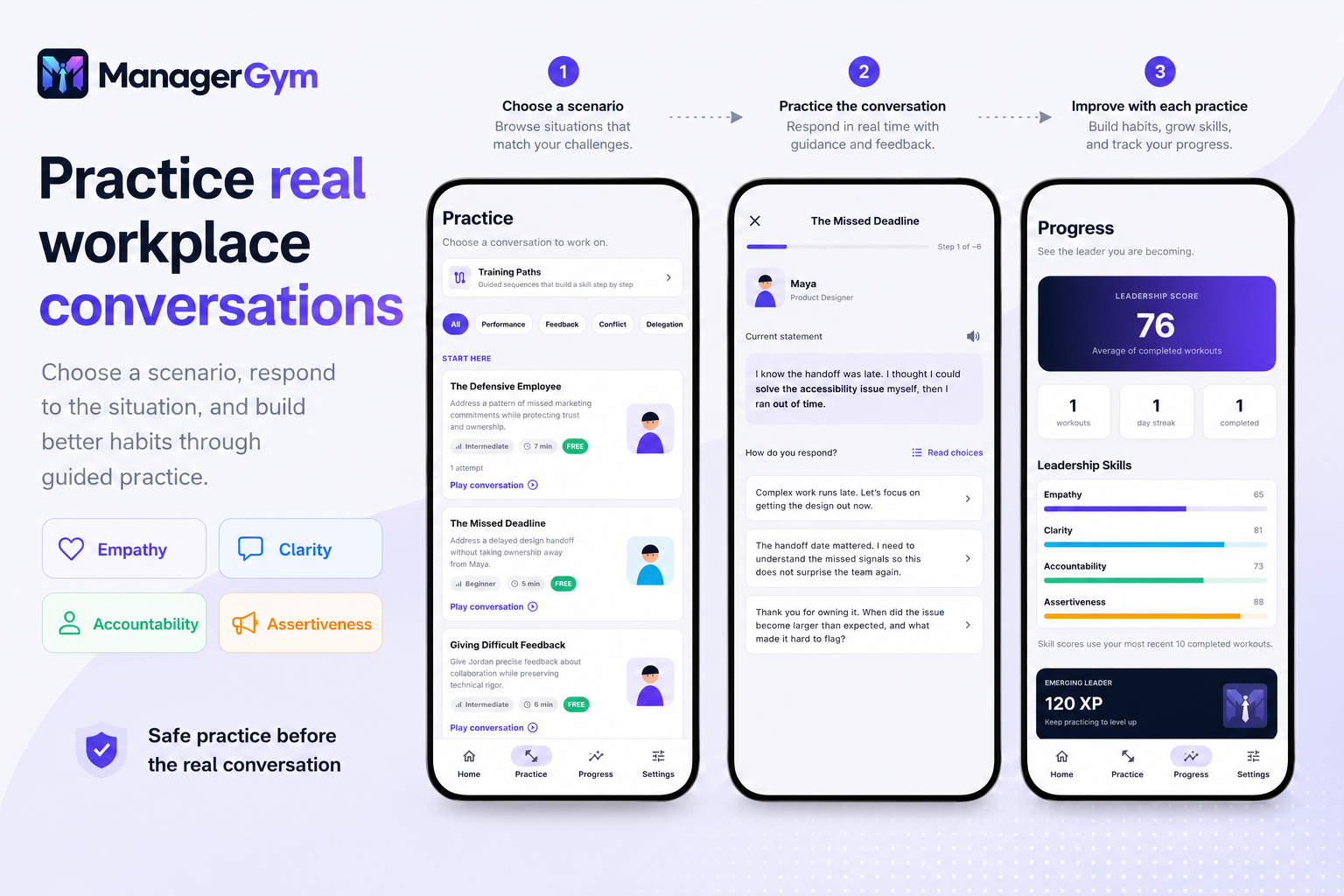
ManagerGym - Practice real workplace conversations
-
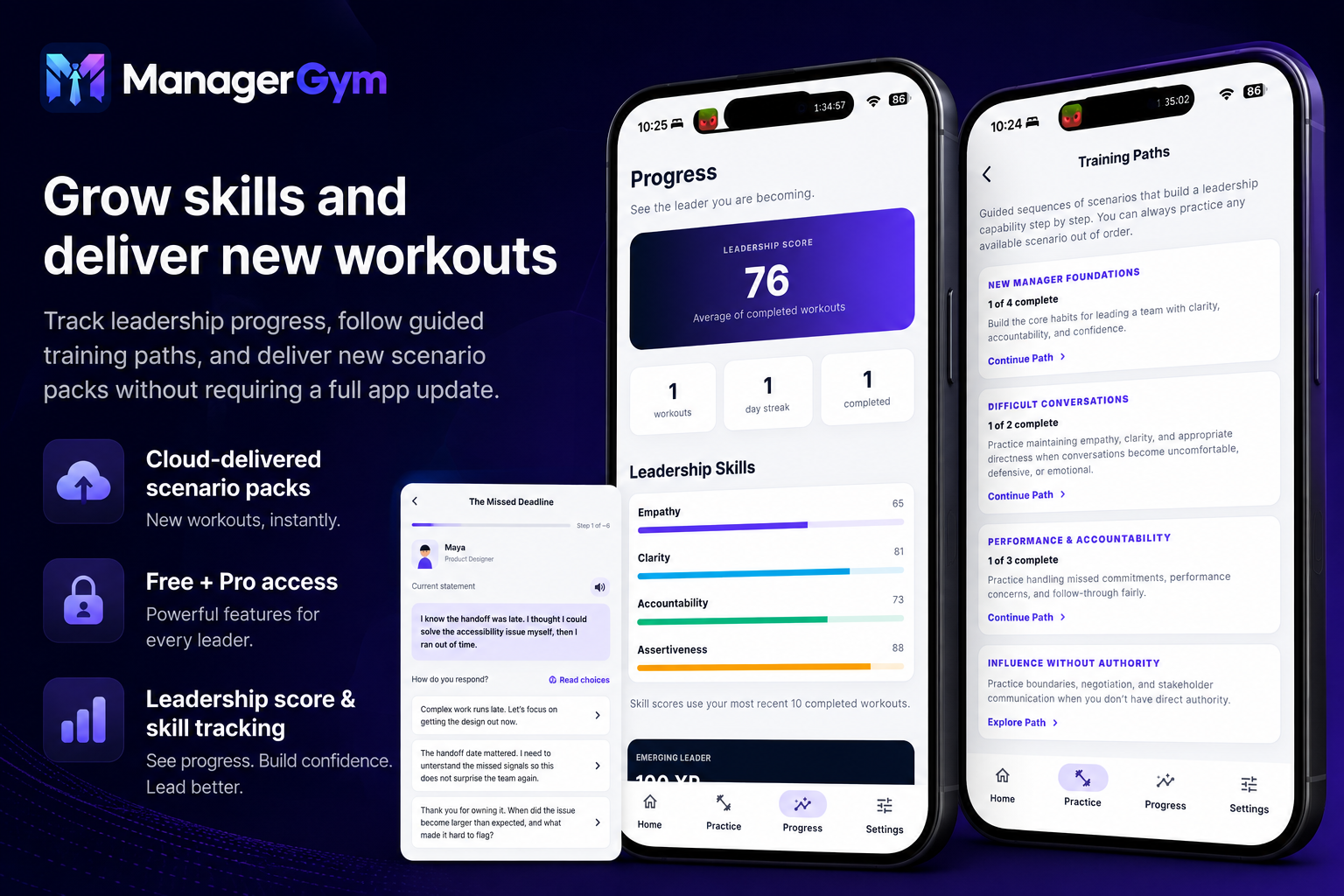
ManagerGym - Grow Your Leadership Skills with New Workouts
-
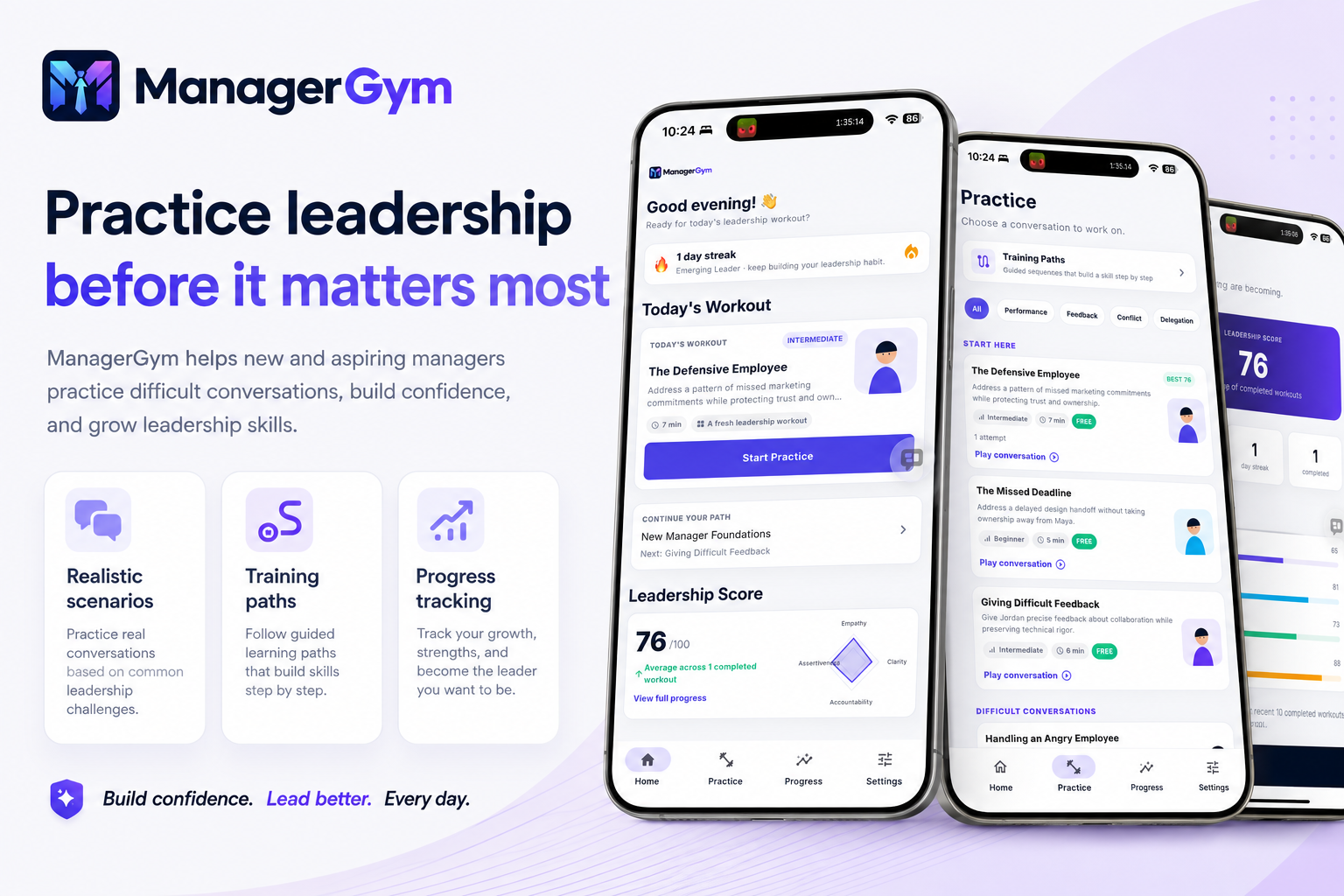
ManagerGym - Practice Leadership before it matters most
-
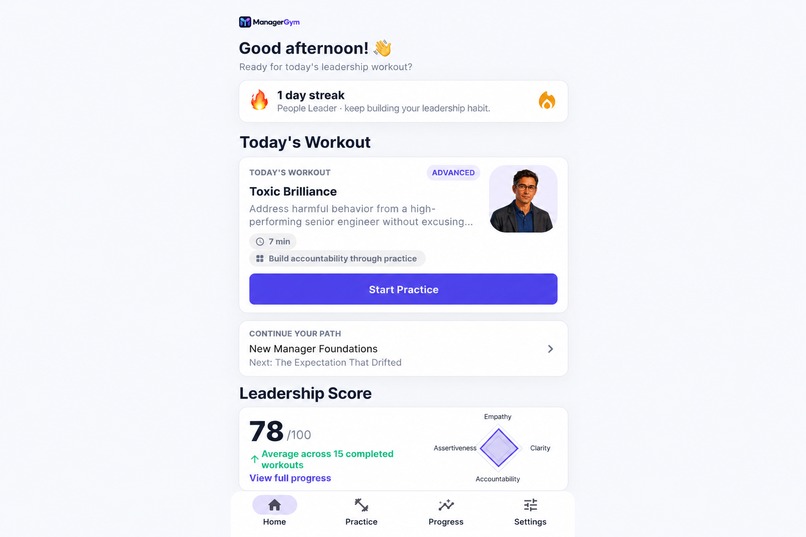
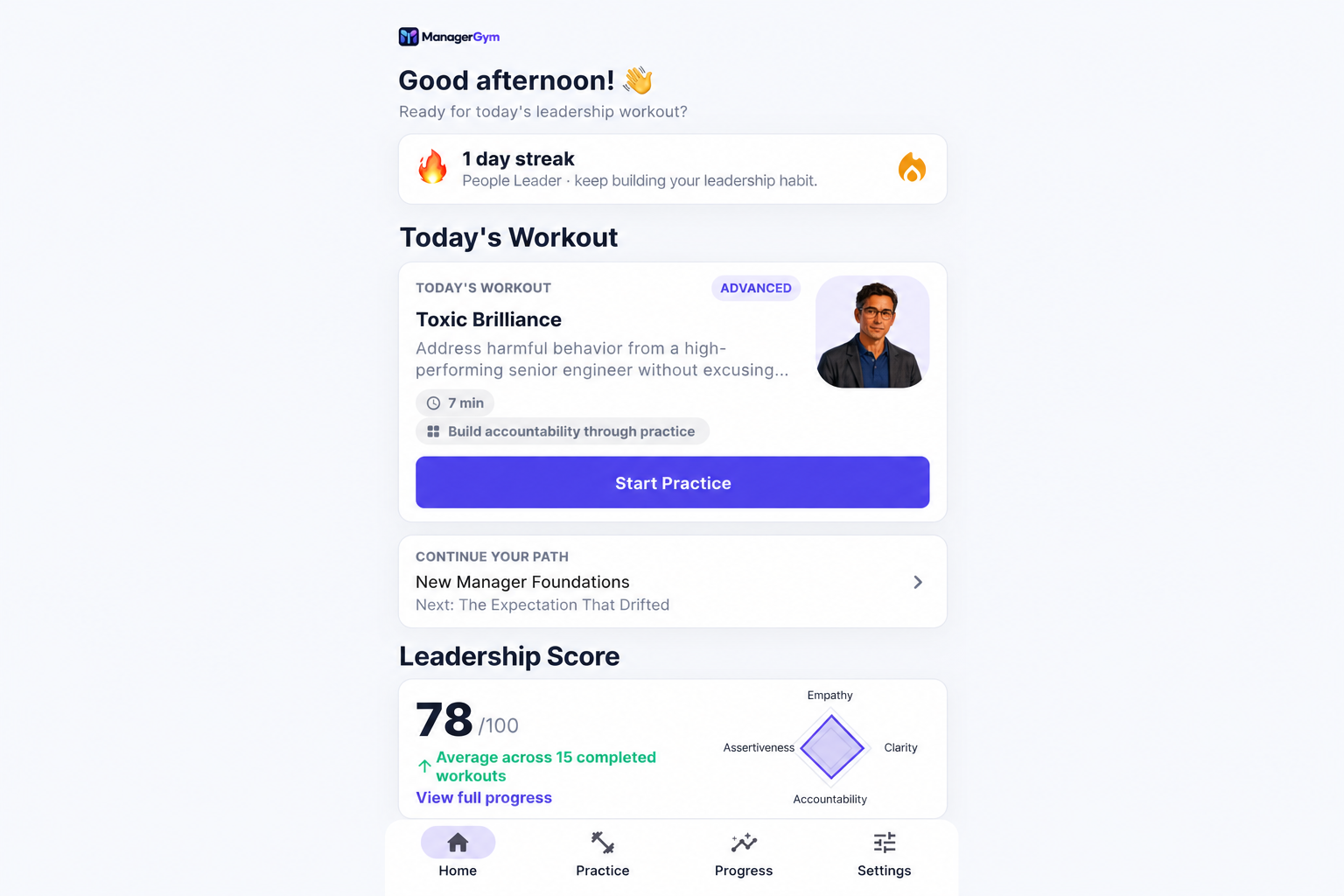
ManagerGym - Home
-
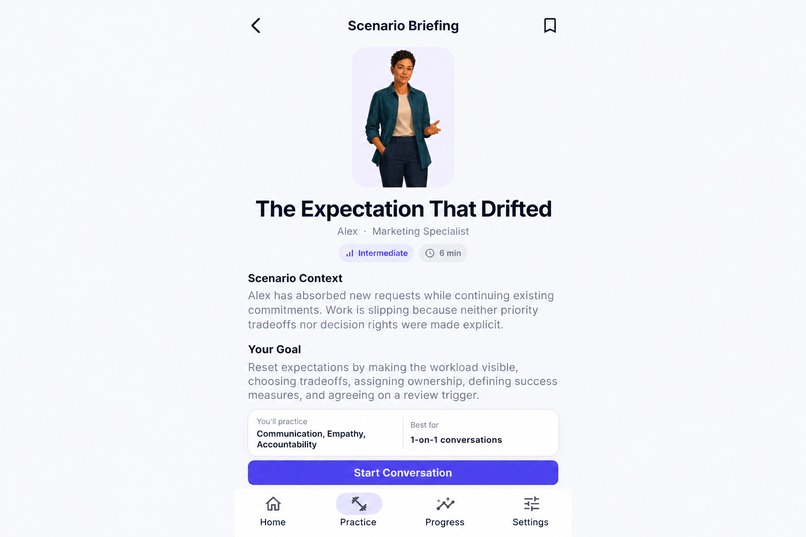
ManagerGym - Practice
-
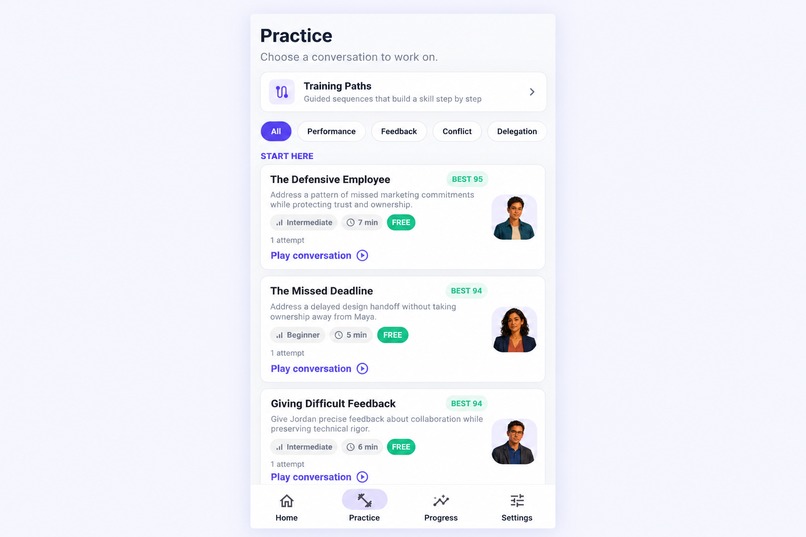
ManagerGym - Practice
Inspiration
ManagerGym started with a problem I understood personally.
When I first became a manager, there wasn’t really a place where I could practice the difficult conversations that suddenly became part of the job.
Giving tough feedback. Dealing with missed deadlines. Addressing poor performance. Resolving conflict. Setting expectations. Pushing back professionally. Having a conversation with someone who simply wasn't delivering.
You were often expected to know how to handle these situations simply because you had become the manager.
I learned the way many managers do:
By doing it, reflecting on what worked, adapting, and getting better as I took on bigger leadership responsibilities.
Over the years, I learned how to handle difficult conversations through experience. Some went well. Some taught me what I should have done differently. Eventually, those experiences became part of how I lead.
But looking back, I wish I had somewhere safe to practice those conversations before they happened for real.
Years later, while looking for something meaningful to build for RevenueCat Shipathon 2026, I asked ChatGPT for ideas—something achievable within the competition window, useful beyond the hackathon, and naturally suited for monetization rather than having a paywall added as an afterthought.
One idea immediately stood out:
A training app that helps new and aspiring managers practice difficult workplace conversations.
That idea hit home because it addressed something I had personally experienced.
Leadership is full of conversations that are difficult to prepare for. Giving negative feedback, dealing with missed deadlines, addressing poor performance, resolving conflict, setting expectations, or saying no professionally are skills people are often expected to learn while already doing the job.
You can read books about leadership, attend management training, and watch videos about difficult conversations.
But knowing the theory is very different from sitting across from someone and having to decide:
“What would I actually say?”
That became the idea behind ManagerGym.
Instead of another management course, I wanted to create a gym for leadership skills—a safe place where managers can practice difficult conversations, see the consequences of different approaches, learn from the experience, and try again before the conversation matters in real life.
Our guiding line became:
Practice the conversations leadership requires.
What it does
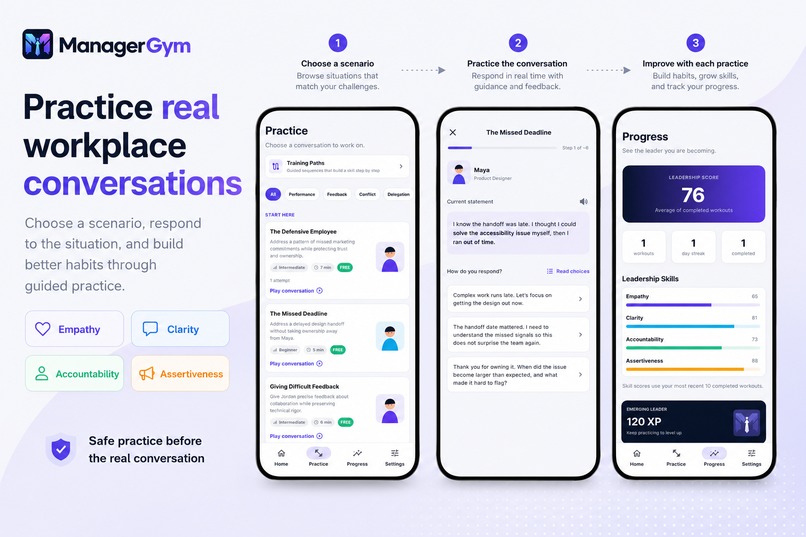
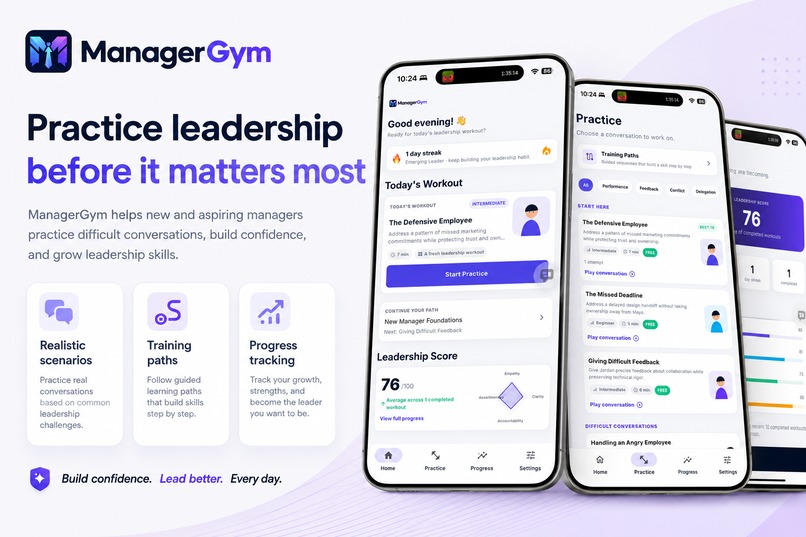
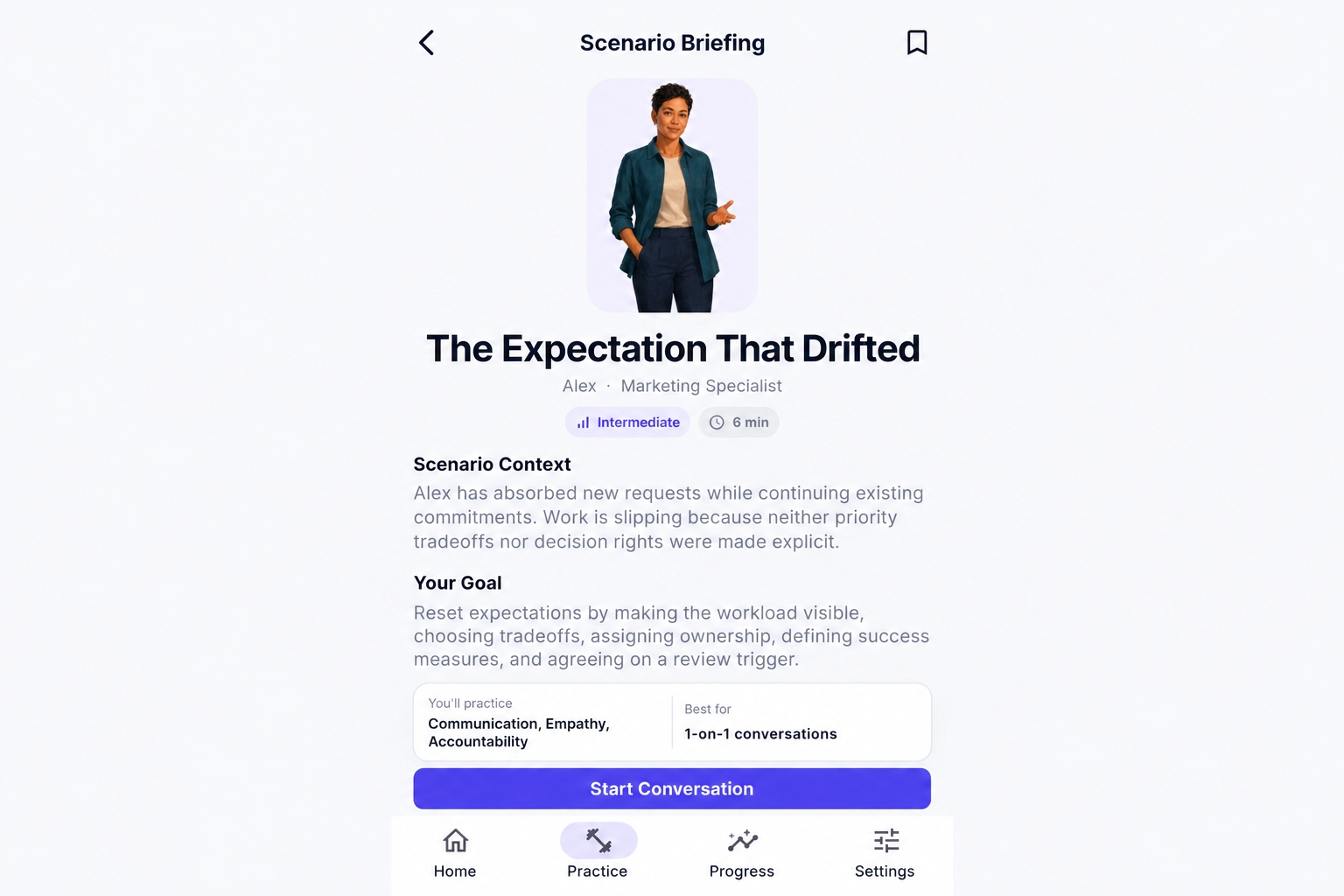
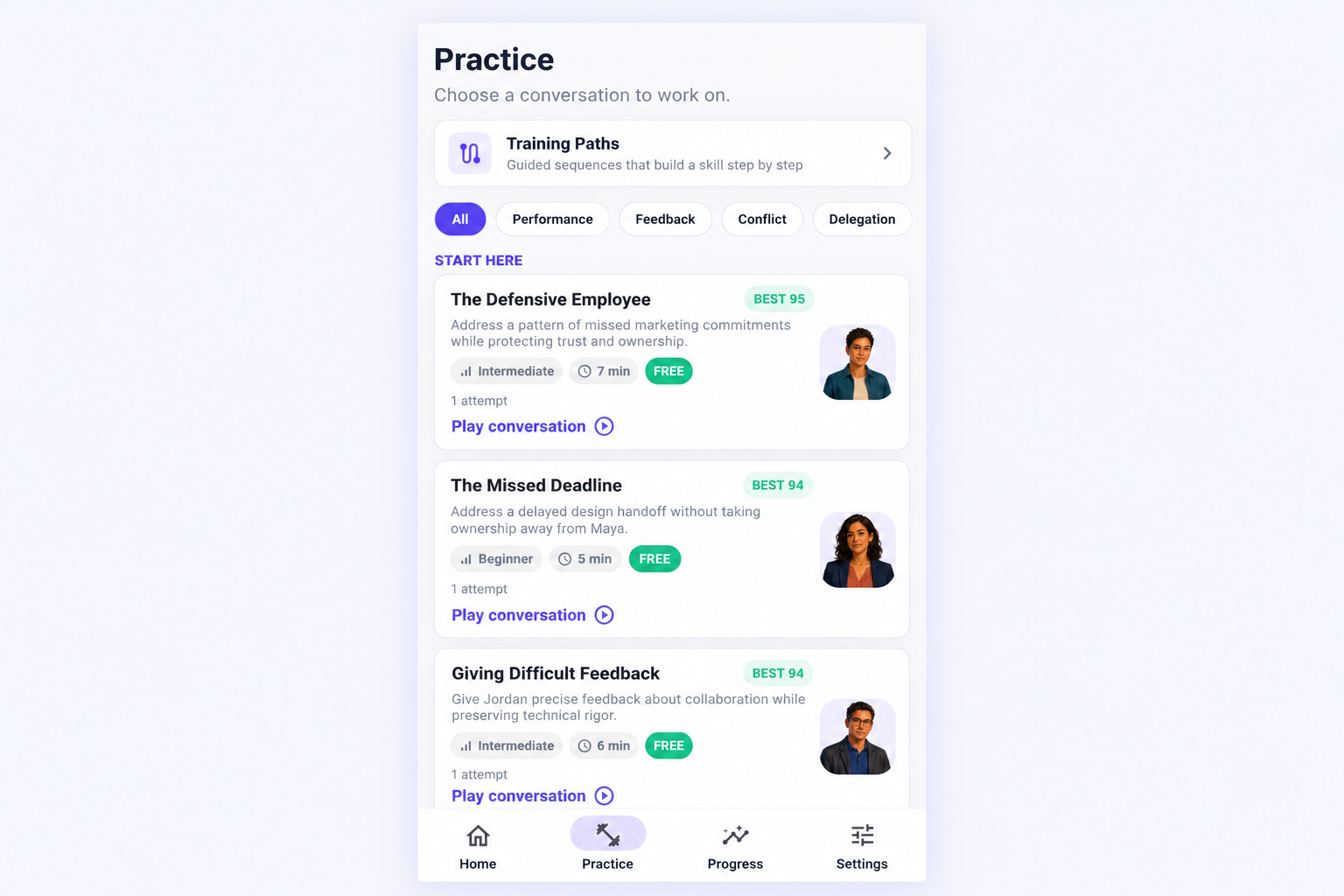
ManagerGym turns common workplace leadership situations into short, interactive leadership workouts.
A manager chooses a scenario such as:
- The Defensive Employee
- The Missed Deadline
- Giving Difficult Feedback
- Handling an Angry Employee
- Setting Clear Expectations
- Resolving Team Conflict
- Coaching a High Performer
- Conducting a Performance Review
Each workout begins with a situation, a character, and a goal.
For example, an employee may strongly disagree with feedback about declining performance. The manager has to decide how to respond.
Rather than simply telling the user the “correct” answer, ManagerGym lets the conversation unfold based on their choices.
Behind the scenes, those decisions affect leadership dimensions such as:
Empathy, Clarity, Accountability, and Assertiveness.
At the end of the workout, users receive a Leadership Score and feedback showing where they performed well and where they can improve.
The idea is simple:
Scenario → Conversation → Decision → Consequence → Feedback → Replay
Users can repeat a workout, try a different approach, improve their score, and gradually build confidence across different leadership situations.
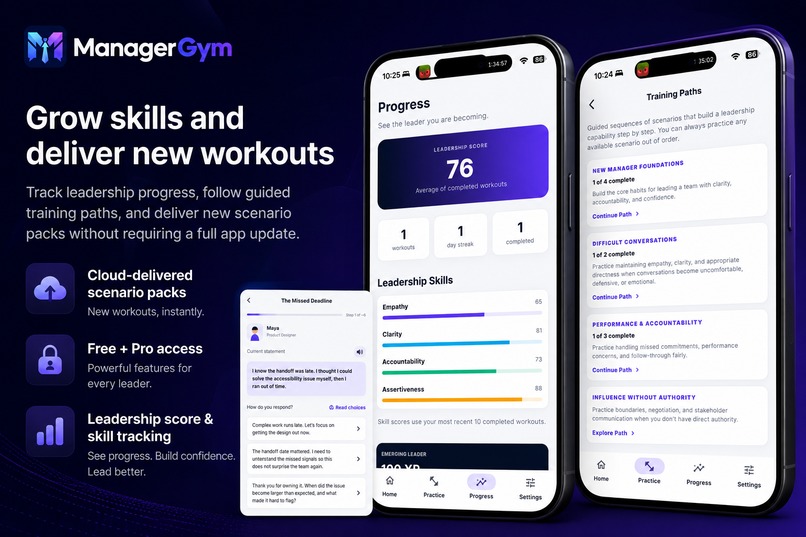
ManagerGym also includes progression, practice streaks, leadership skill tracking, free and premium scenarios, and a growing library of workplace conversations.
RevenueCat powers ManagerGym Pro and the monetization layer, giving us a foundation for subscription access and future specialized scenario packs.
How we built it
One of our first decisions was to avoid making ManagerGym dependent on AI from day one.
The first version was designed around a deterministic branching-conversation engine.
This makes the experience fast, predictable, inexpensive to operate, and usable without requiring an external AI service for every conversation.
The mobile app is built with Flutter, giving us a shared codebase for Android and iOS.
For application architecture we use:
- Flutter and Dart
- Riverpod for state management
- GoRouter for navigation
- SQLite with Drift for structured local data
- SharedPreferences for lightweight app preferences
- RevenueCat for monetization
We also made an important architectural decision around scenario content.
Scenarios are not hard-coded directly into Flutter screens or treated as database rows that have to be manually maintained.
Instead, scenarios are authored as versioned JSON content packages.
The flow is:
Bundled JSON → Scenario Importer → SQLite → Scenario Engine
Each scenario package can define:
- scenario metadata
- characters
- conversation nodes
- possible responses
- branching paths
- leadership score effects
- terminal outcomes
- content version
That architecture keeps ManagerGym local-first while allowing the scenario library to grow independently from the core application.
The same architecture was intentionally designed so that scenario packs could eventually be delivered remotely without rewriting the conversation engine.
We also designed the content model from the beginning to eventually support different types of workouts:
Structured — deterministic branching scenarios.
AI — free-form conversations with AI role-playing the employee.
Hybrid — structured scenario goals and scoring combined with dynamic AI conversation.
The important principle is that the training experience should remain useful even when AI is unavailable.
Challenges we ran into
The biggest challenge has been controlling scope.
It is very tempting to turn ManagerGym immediately into a full AI leadership coach with speech recognition, generative conversations, analytics, cloud accounts, remote scenario delivery, and dozens of training modes.
But every additional system creates another opportunity to spend time building infrastructure instead of improving the actual practice experience.
We kept coming back to one question:
What is the smallest version of ManagerGym that proves the idea?
That led us to focus on one strong loop:
Choose a scenario → make decisions → experience consequences → receive feedback → try again.
Another challenge was designing the scenario architecture so it was simple enough to ship quickly but wouldn't become a dead end later.
We wanted the initial experience to work completely with structured conversations while still leaving a clean path toward more intelligent coaching and future AI-powered experiences.
Separating scenario content from the Flutter application itself—and creating a reusable scenario importer—became an important part of solving that problem.
We also had to think carefully about scoring.
Showing users something like “Empathy +3” after every response would make the experience feel like a quiz and encourage people to game the system.
Instead, the conversation itself provides the immediate consequence.
The leadership scores and coaching feedback come afterward, encouraging users to reflect on what happened, understand where the conversation changed, and replay the scenario with a different approach.
Accomplishments that we're proud of
One thing we're especially proud of is that ManagerGym developed into a real product rather than simply a Shipathon demo.
The name, UX, progression model, scenario architecture, monetization model, and future intelligence direction all reinforce the same central idea:
Leadership improves through practice.
We're also proud of creating a content architecture that separates scenarios from application code.
That means ManagerGym can grow from a small bundled library into a much larger catalog of leadership situations without requiring the core app to be redesigned every time new training content is introduced.
The project also forced us to think about monetization early instead of treating it as the final step.
Free workouts allow people to understand the experience first, while ManagerGym Pro can unlock more advanced conversations, deeper progression, and additional scenario collections through RevenueCat.
Most importantly, we're building around a problem that exists whether or not AI is involved.
Managers need somewhere to practice.
The technology supports that experience rather than being the reason the product exists.
What we learned
One of the biggest lessons has been that AI doesn't have to be the first version of an AI-capable product.
A well-designed deterministic system can prove whether users actually find value in practicing leadership conversations before introducing the cost, unpredictability, and complexity of generative AI.
We also learned how valuable it is to separate:
content, application logic, user progress, and monetization.
The scenario system decides what the training experience contains.
SQLite stores the local runtime state and progress.
The conversation engine controls how the workout behaves.
RevenueCat determines what premium content a user can access.
Keeping those responsibilities separate gives ManagerGym much more room to evolve.
Another lesson has been the importance of designing monetization alongside the product experience.
Instead of randomly showing a subscription screen, ManagerGym can let users experience complete workouts first, discover additional scenarios, understand their leadership progress, and then decide whether unlocking more of the gym is valuable to them.
There was also a more personal lesson.
Building ManagerGym made me think back to when I was a new manager myself.
A lot of leadership development happens after the difficult conversation has already taken place. You reflect on what happened, figure out what worked or didn't, and try to do better next time.
ManagerGym asks a different question:
What if some of that learning could happen before the real conversation?
That idea has become increasingly important to the product.
What's next for ManagerGym
The core experience is built around:
Practice → Decide → Learn → Improve.
The next step is to keep making that loop more valuable.
That means expanding the scenario library, improving coaching and progression, delivering additional training content, and continuing to develop ManagerGym Pro through RevenueCat.
Longer term, ManagerGym can evolve beyond predefined branching conversations.
We want users to eventually be able to speak or type what they would genuinely say in a situation while keeping ManagerGym's deterministic leadership framework responsible for the important training decisions.
A future intelligent scenario could understand:
- who the employee is
- what they want
- how defensive or cooperative they are
- what the manager needs to accomplish
- which leadership skills are being evaluated
- how the character should respond as the conversation changes
That could allow ManagerGym to evolve from branching workouts into increasingly realistic leadership simulations.
We also plan to continue expanding scenario collections around areas such as:
- New Manager
- Difficult Conversations
- Performance Management
- Conflict Resolution
- Executive Communication
- Coaching and Development
These scenario collections can grow independently of the core application while RevenueCat manages premium access and entitlements.
Long term, I see ManagerGym becoming more than an app people open when they have spare time.
I want it to become something a manager opens before an important conversation and thinks:
“I've practiced this. I know how I want to handle it.”
That is the real goal of ManagerGym.
Train. Improve. Lead.


Log in or sign up for Devpost to join the conversation.