Devpost
Participate in our public hackathons
Devpost for Teams
Access your company's private hackathons
Grow your developer ecosystem and promote your platform
Drive innovation, collaboration, and retention within your organization
By use case
Blog
Insights into hackathon planning and participation
Customer stories
Inspiration from peers and other industry leaders
Planning guides
Best practices for planning online and in-person hackathons
Webinars & events
Upcoming events and on-demand recordings
Help desk
Common questions and support documentation
Sort by:
Same outputs, 7.1x faster: hand-tuned Triton kernels and CUDA graphs for Transformers on a Tesla T4.
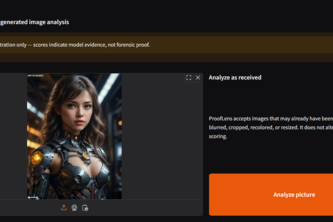
ProofLens detects AI-generated images while remaining robust to real-world transformations such as compression, blur, cropping, color changes, and resizing.
"A situation of scanning a DNA sample for disease markers in seconds instead of days. That's what our Genome Disease Detector does."
It is an agent that does the research, not just the training. It forms a hypothesis, writes the code, scores it with the official metric, and keeps only what clears the bar.
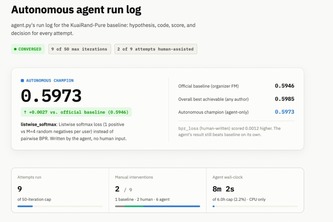
An LLM-driven agent that runs the ML research loop without a human in it: propose a hypothesis, write a complete training script, execute it in a sandbox, score it, reflect on the result, repeat.
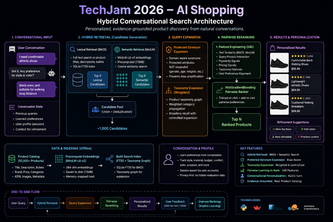
ContextCart — Turning every conversation into the right product.
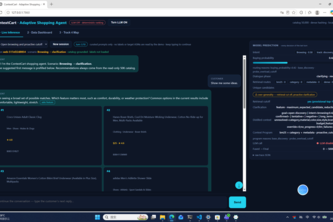
An intent-aware conversational shopping agent that remembers evolving customer needs, asks high-value questions, and combines exact, lexical, and semantic retrieval to return a better Top 10.
We gave an AI agent a dataset and a scoring rule without hints. It proposed, coded, and tested its own recommender models, which beat the official baseline entirely on its own.
A shopping copilot that treats every product it shows as a commitment rather than a list, and every question it asks as a turn it has to earn.
An LLM-driven research harness that edits, evaluates, and reverts a from-scratch NumPy Factorization Machine, discovering a statistically verified within-user ranking improvement on KuaiRand-Pure.
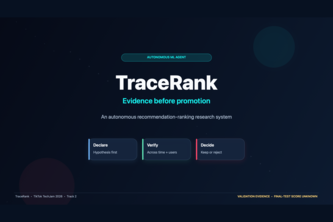
An autonomous ranking agent that tests ideas across time, rejects fragile gains, and preserves reproducible evidence.
An autonomous ML research agent. It verifies its own results instead of trusting them, and beats the baseline where a greedy agent scores below it.
An autonomous ML research agent for recommender systems that tries to disprove its own findings. It found a +0.0314 result, proved it was worth +0.0023, and reported the smaller number.
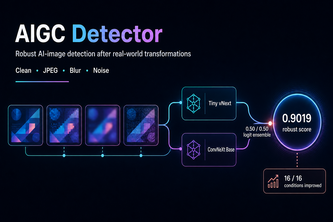
A reproducible parameter ensemble for AI-image detection that stays robust under JPEG, blur, resize, noise, color jitter, and crop.
We built a 21.7M-parameter ViT detector for robust AI-image detection, scoring 0.9362 across unseen generators, with deployment via Chrome extension and future TikTok integration.
An autonomous ML scientist that safely proposes, tests, diagnoses, and preserves recommendation-model improvements for KuaiRand-Pure.
The harness measures; the agent decides.
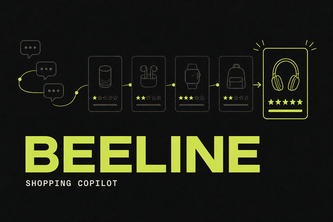
Beeline: turn buying intent into purchase before the next swipe.
A council of AI models votes on whether your YouTube video is about to go viral with SHAP-powered explanations showing exactly which stats drove the score.
AI-image detectors often fail after images are compressed, resized, or reposted. InvariantGuard keeps working anyway.
A conversational AI shopping assistant that understands natural preferences, remembers context, and intelligently ranks the products that actually match.
An agent that talks to a shopper the way a good in-store assistant would, understand what they say, ask sharp questions, and narrows a catalog down to the right product in a handful of turns.
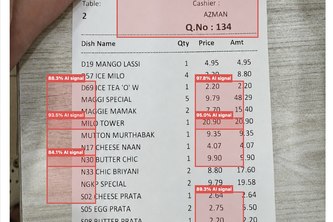
A localized AI forensic pipeline to detect and demarkate human and generative document tampering.
RecommenderForge autonomously tests ranking ideas, learns from validation, recovers from failures, and ships checkpoint-backed predictions—making recommender research fast, safe, and easily traceable.