-
-
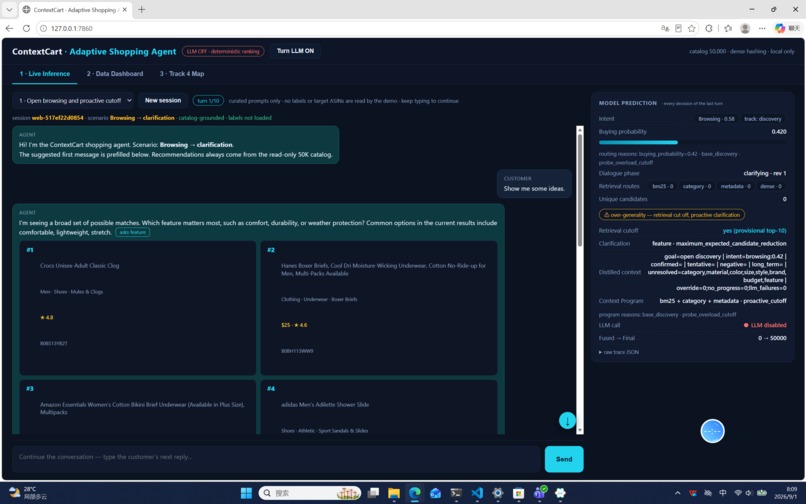
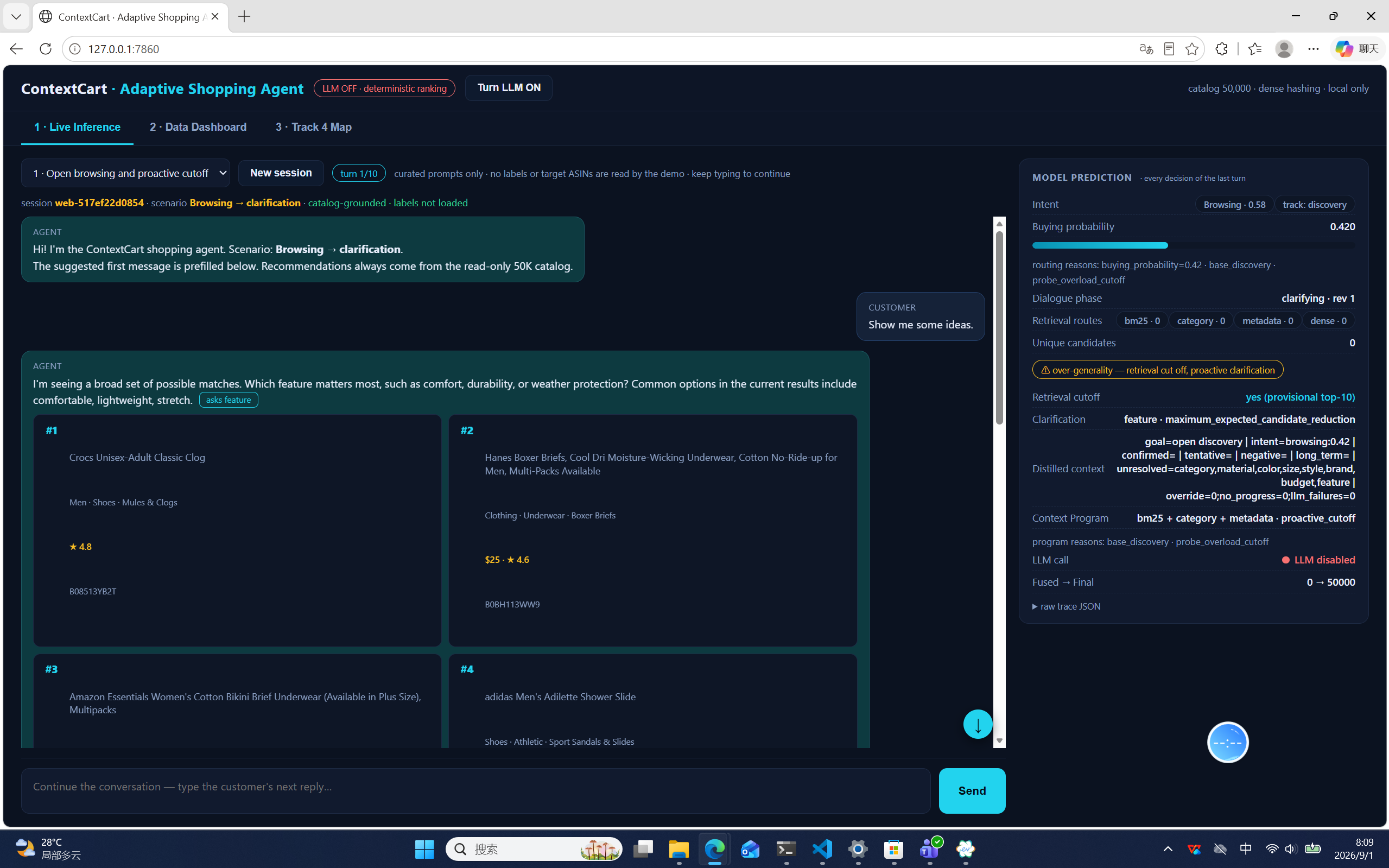
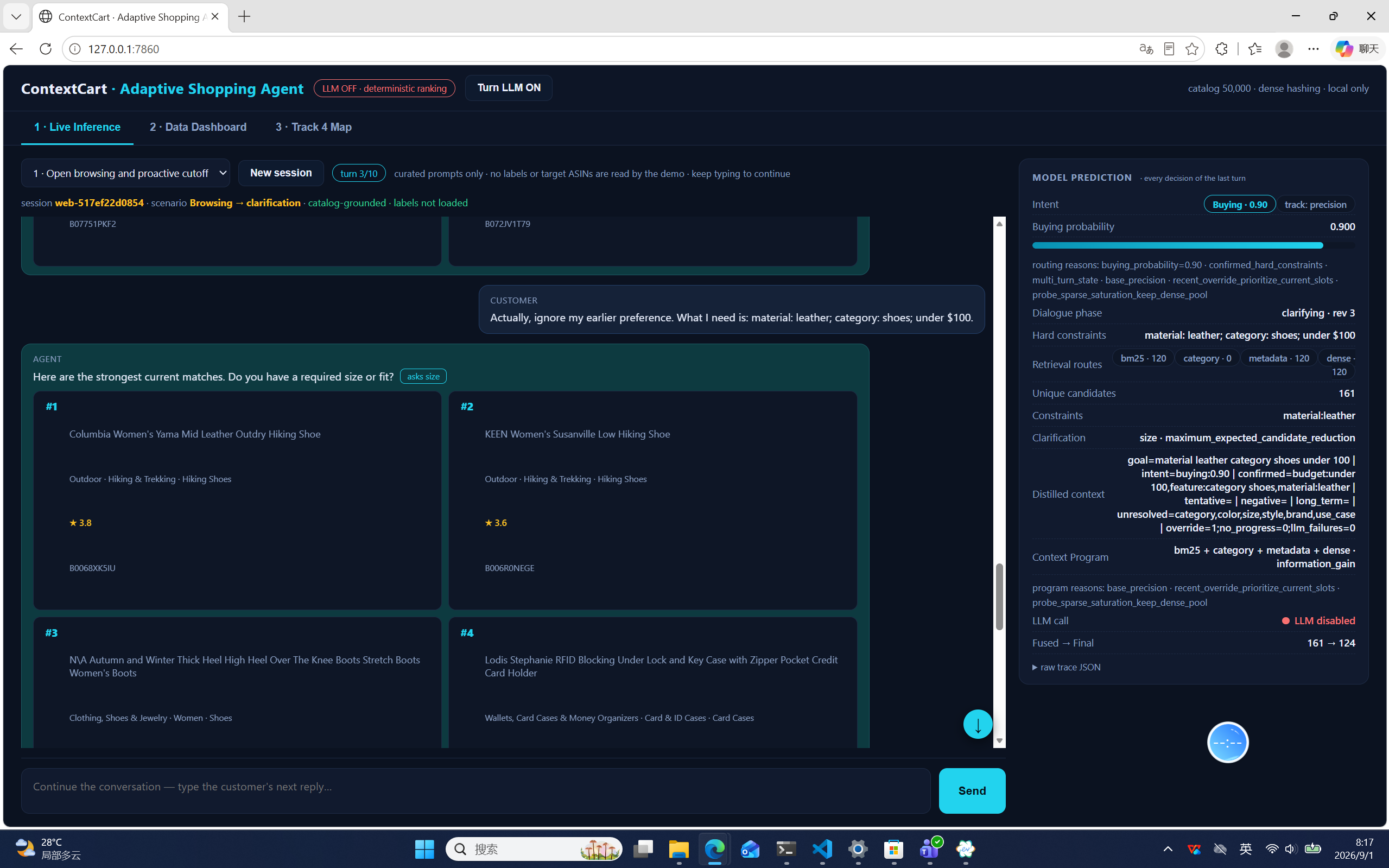
The system detects an intent that is too broad, so to save compute, it truncates and asks for clarification.
-
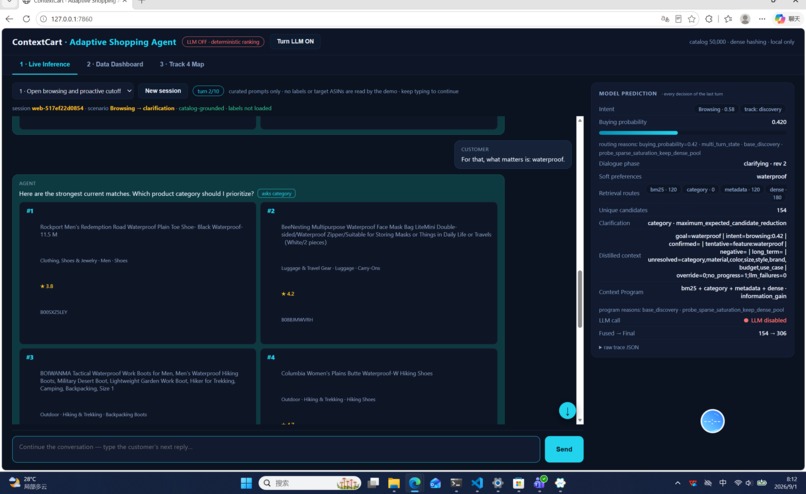
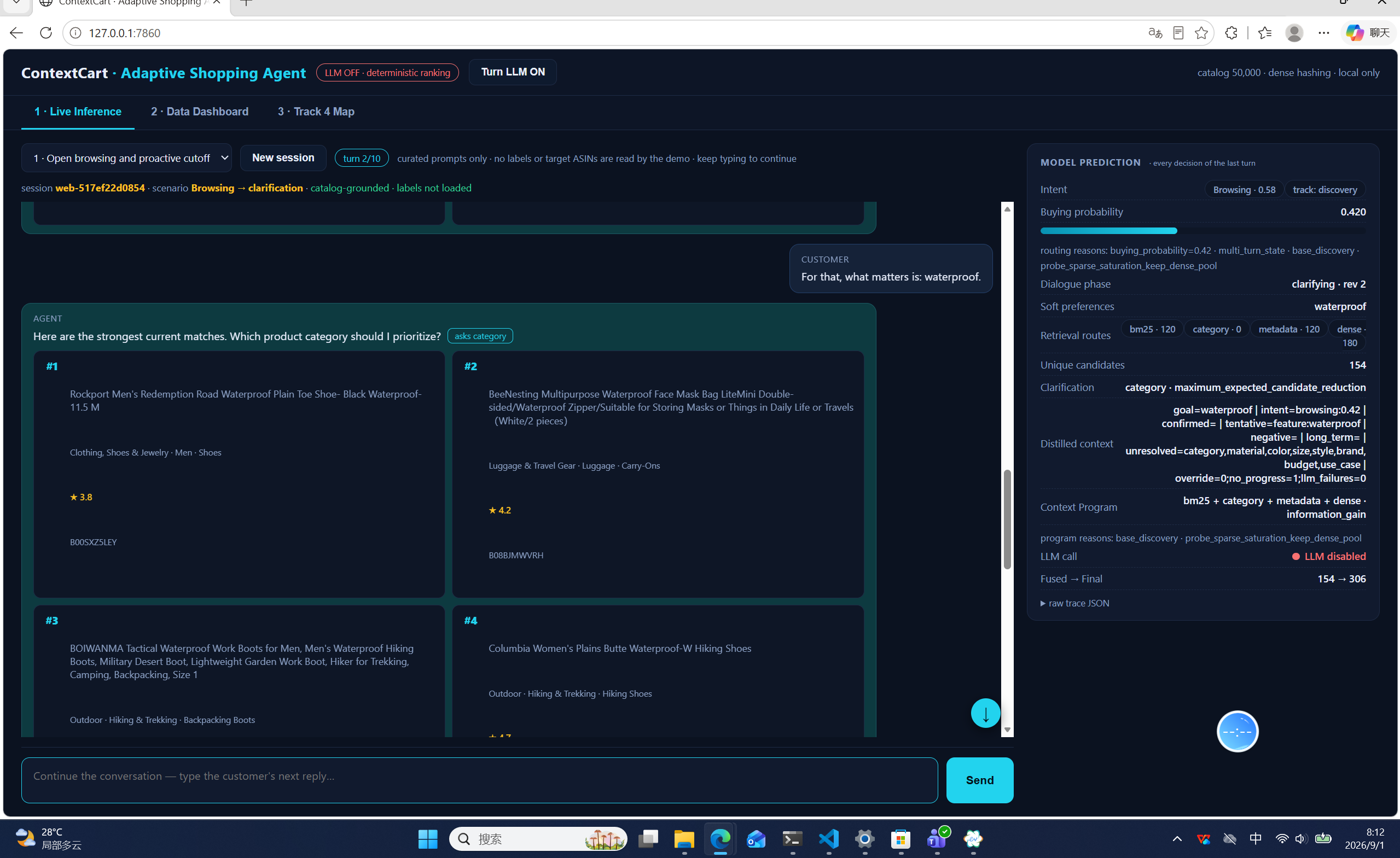
The user supplies one keyword, and the candidate pool jumps from zero to one hundred and eighty.
-
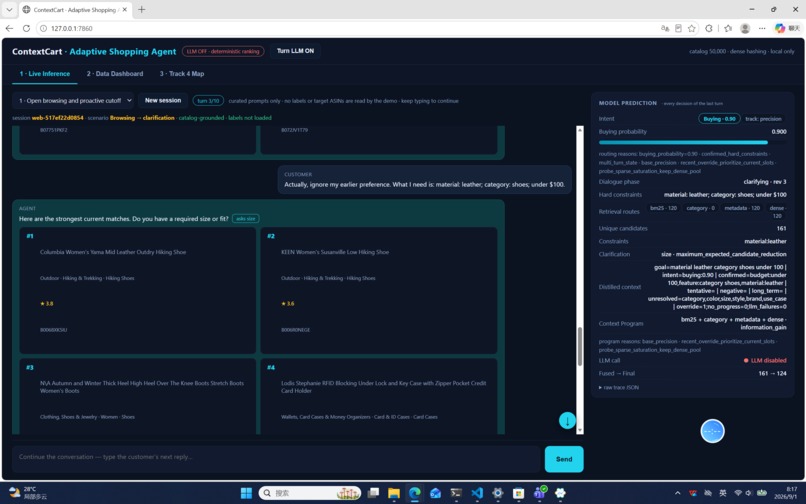
The old constraint fades away, the new one pops in bold — the intent is fully overwritten.
-
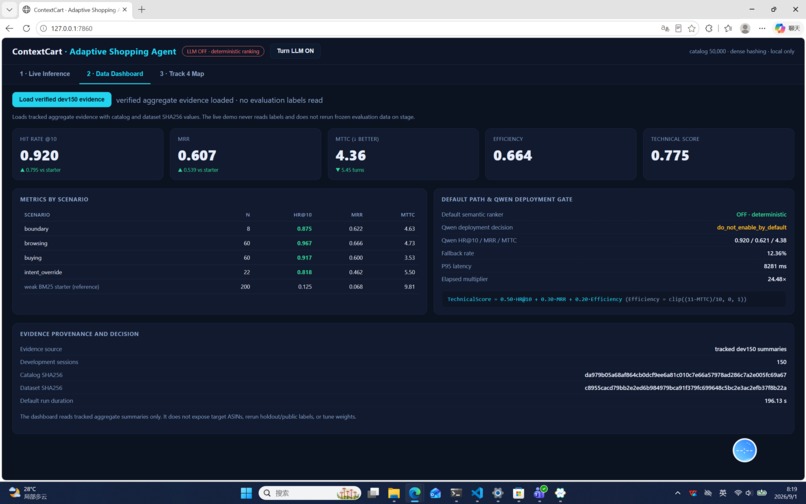
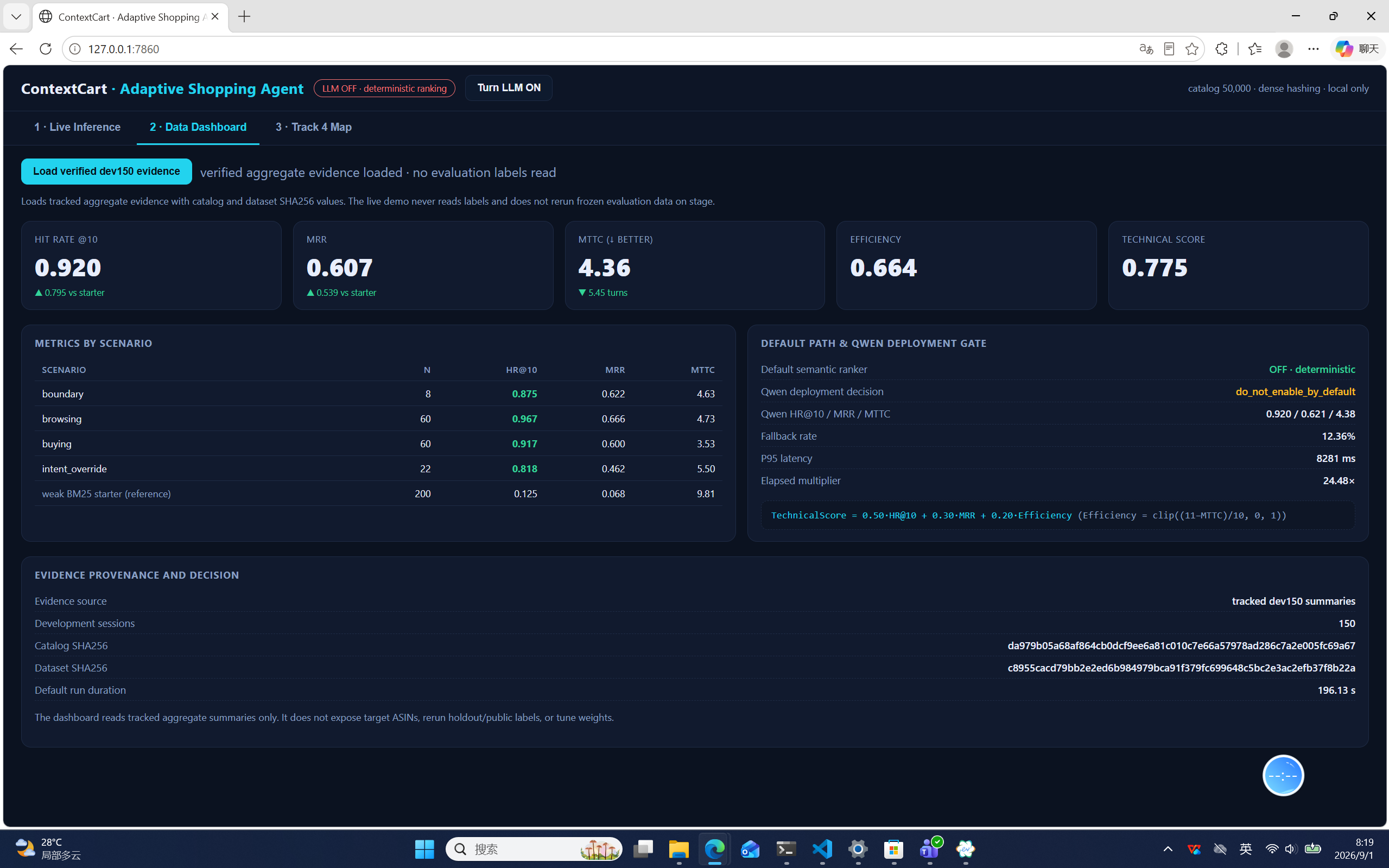
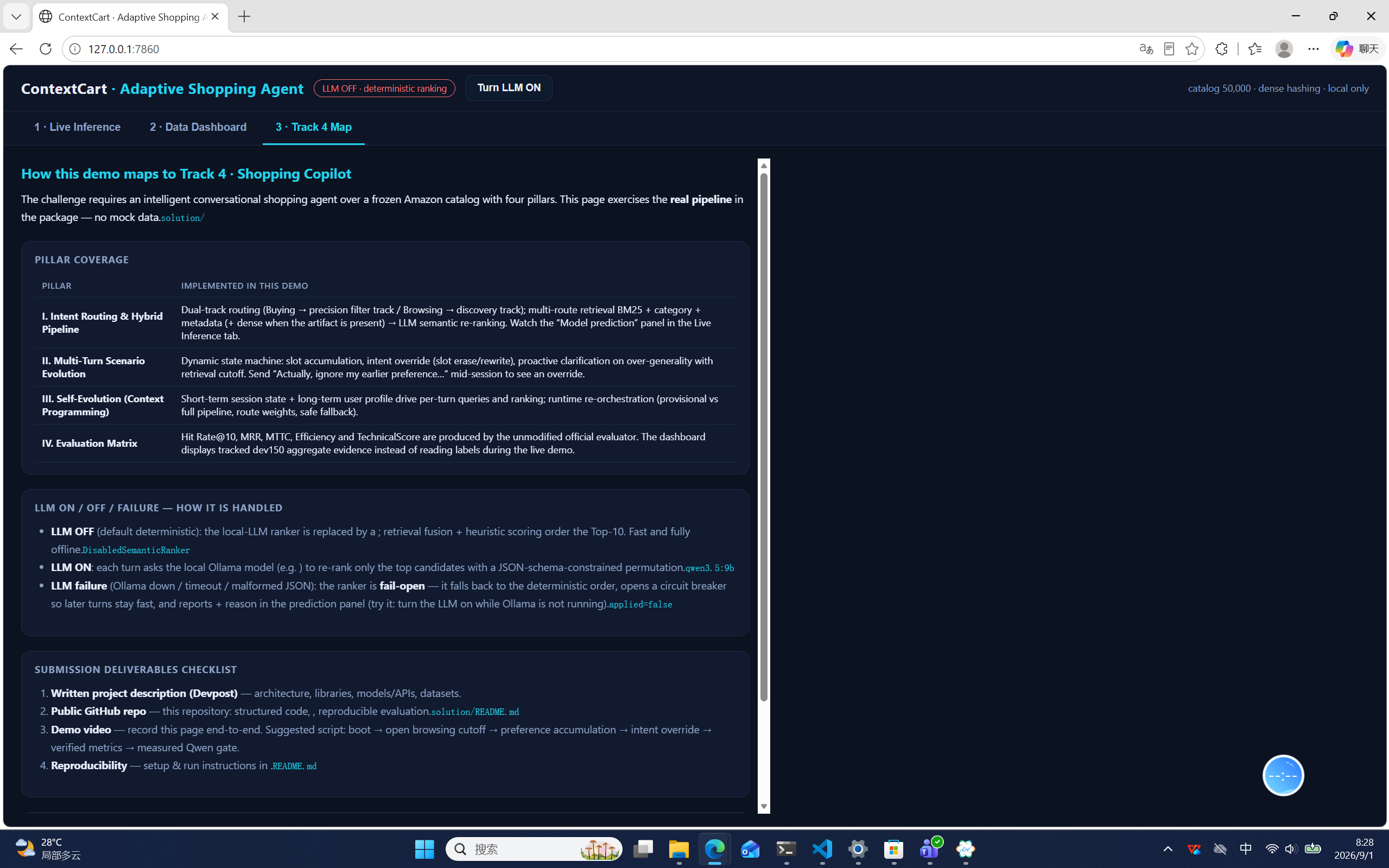
A 24.48× latency penalty — our honest engineering trade-off for leaving the LLM off by default.
-
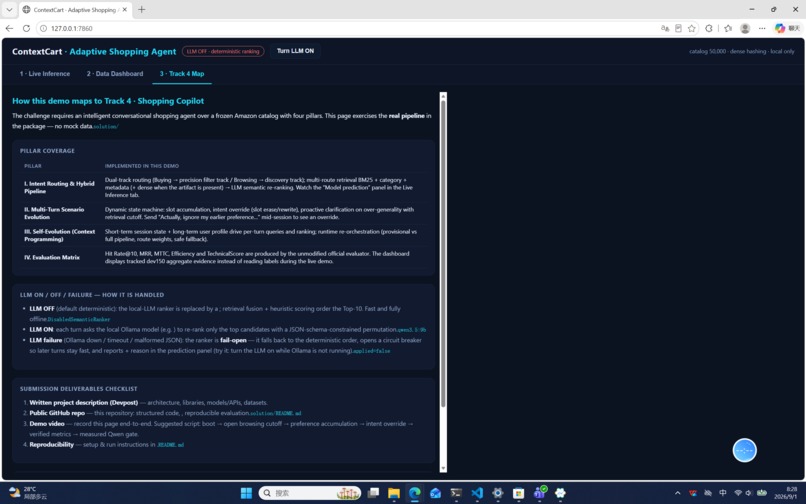
Track 4 architecture overview — adaptive inference for honest commerce.
ContextCart — Devpost Submission
- Public GitHub:
https://github.com/BUALANPT/Shopping-Copilot-AI-Conversational-Search-and-Recommendations - Public YouTube demo:
https://youtu.be/l_-QkaCQzIY
Tagline
An adaptive, offline-capable shopping agent that changes its retrieval and clarification strategy as customer intent evolves.
Inspiration
E-commerce search often assumes that a shopper already knows what to type. Real shopping conversations are less orderly: someone may begin with “show me some ideas,” add a weather requirement later, reject the first results, and then switch to a specific product and budget. A static keyword query cannot represent that changing decision process.
ContextCart was built around a different idea: context should be an executable program, not just text appended to a prompt. Every turn should update an explicit state, distill only the evidence that still matters, and select the cheapest retrieval and dialogue strategy that fits the current intent.
What it does
ContextCart is a next-generation conversational product-search agent for the frozen 50,000-product Amazon Reviews 2023 Clothing, Shoes and Jewelry catalog. It returns up to ten valid catalog products on every turn while optionally asking one structured clarification question.
The system has two primary tracks:
- Buying / Precision: locks reliable material, category, price, and other constraints, then relaxes them only when the candidate pool would otherwise collapse.
- Browsing / Discovery: supplements sparse retrieval with dense candidates and category diversity to support open-ended, cross-category exploration.
An over-general request triggers an early cutoff before expensive Dense or LLM stages. The agent still returns provisional recommendations, but asks a high-information question to help the shopper converge. When the next answer adds a useful slot, the full retrieval path is restored.
Across turns, ContextCart accumulates structured preferences, supports full and attribute-level intent overrides, tracks rejected results, and keeps anonymous sessions isolated. With an explicit profile ID, repeated or explicitly remembered preferences can enter a privacy-safe in-memory long-term profile; current-session instructions always win conflicts.
How we built it
Each request passes through the following in-memory pipeline:
- A deterministic state machine extracts and mutates typed slots.
- A bounded context distiller combines recent messages, current constraints, profile evidence, prior recommendations, and strategy outcomes.
- An adaptive orchestrator compiles an immutable per-turn Context Program.
- Independent BM25, category, metadata, and vector routes retrieve candidates.
- Reciprocal Rank Fusion and a local reranker combine relevance, constraints, profile evidence, ratings, popularity, and discovery diversity.
- An optional local Qwen3.5 stage may reorder only the supplied candidate set.
- The agent returns Top-10 catalog IDs and one non-repeated clarification.
- Candidate reduction, repetition, override, rejection, fallback, and LLM outcomes feed the next Context Program.
The default dense route uses a reproducible signed-hashing index. Full BGE support is implemented with resumable index construction, catalog SHA256 validation, CPU/CUDA provider checks, and safe degradation when files or dependencies are unavailable. No external vector database is used.
The optional Ollama adapter uses qwen3.5:9b with temperature zero and structured
JSON output. The LLM cannot invent products: its output must be a complete,
duplicate-free permutation of known candidate ASINs. Invalid JSON, unknown IDs,
missing IDs, timeouts, or connection failures return the original deterministic
ranking. Two consecutive failures open a session-local circuit breaker.
Measured results
On the frozen 150-session development split:
- Hit Rate@10: 0.920000
- MRR: 0.607254
- MTTC: 4.360000 turns
- Efficiency: 0.664000
- TechnicalScore: 0.774976
- End-to-end elapsed time: 196.13 seconds
The result is tied to dataset SHA256
c8955cacd79bb2e2ed6b984979bca91f379fc699648c5bc2e3ac2efb37f8b22a
and catalog SHA256
da979b05a68af864cb0dcf9ee6a81c010c7e66a57978ad286c7a2e005fc69a67.
These are development metrics and are not presented as a prediction of the
organizer's private 800 sessions.
We also completed a full Qwen3.5 dev150 ablation. Qwen improved MRR to 0.620931, but did not improve Hit Rate, slightly worsened MTTC to 4.38, fell back on 12.36% of requests, and made the run 24.48 times slower. We therefore kept Qwen as a fully implemented optional capability instead of enabling it in the default submission. For us, declining a more complicated model when it failed a measured deployment gate is part of the engineering result.
Challenges we ran into
The hardest challenge was balancing recall, precision, and conversation length without leaking target information from the public evaluator. Increasing Dense influence could recover candidates but also displace exact sparse matches. Hard price filtering looked attractive until we audited the catalog's incomplete price coverage. We introduced conservative relaxation guards and separated retrieval membership from reranking influence.
Intent override was another difficult edge case. Resetting too much discards a valid budget; resetting too little leaves stale material or category preferences. We implemented auditable full, category, and attribute-level mutations rather than treating “actually” as another query token.
Finally, local LLM integration required strict failure handling. A syntactically valid answer can still duplicate one candidate or omit another. Catalog-grounded permutation validation and deterministic fallback were necessary before the model could safely enter the pipeline.
Accomplishments that we are proud of
- One default offline evaluator command runs the final Agent without changing the organizer's evaluator.
- Every recommendation is catalog-grounded, unique, deterministic, and capped by the requested Top-K.
- The same Agent handles open discovery, precise buying, preference accumulation, boundary answers, rejection, and abrupt intent override.
- Dense and LLM paths have explicit integrity gates and safe degradation.
- The experiment harness records code state, hashes, latency, scenario metrics, token usage, and failure artifacts.
- A lightweight repository-native web page makes intent, routes, context, constraints, and Top-10 results visible without putting UI code into the Agent.
What we learned
More model calls do not automatically create a better agent. Dynamic context is most valuable when it changes executable decisions: which routes run, whether a constraint is hard, whether diversity is useful, whether to ask a question, and when a costly model should be skipped. We also learned that fallback behavior must be evaluated as a first-class path rather than documented as an exception.
What's next
We would quantize or ANN-index the full BGE matrix, distill the semantic ranker into a faster local scorer, improve typed category and price extraction from audited failures, and add encrypted revocable profile persistence with explicit consent. After freezing all weights, we would run one confirmation on a newly created unseen split.
Built with
- Python, SQLite FTS5, NumPy
- FastEmbed and ONNX Runtime
- FlashRank
- Ollama and Qwen3.5 9B
- HTML/CSS/JavaScript and Python's standard-library HTTP server
- VS Code and Git
Data and resources
The frozen competition catalog and sessions are derived from Amazon Reviews 2023 by McAuley Lab, UCSD. We use only text and structured metadata from the organizer's participant kit. The repository does not publish the 50K catalog, private evaluation data, model weights, API keys, or credentials.
Team contributions
The team members are LIU BOANG, JI CHENGYU, and LI XIZI. All three members contributed equally across every part of the project: problem framing, system architecture, retrieval and ranking, multi-turn dialogue state, dynamic context programming, BGE and Qwen integration, evaluation and failure analysis, testing, documentation, the local demo, and submission preparation. The work was developed collaboratively rather than divided into exclusive individual components.
Built With
- amazon-reviews-2023
- bge
- bm25
- conversational-ai
- css
- cuda
- dense-retrieval
- fastembed
- flashrank
- fts5
- html
- hybrid-search
- javascript
- llm
- natural-language-processing
- numpy
- ollama
- onnx-runtime
- python
- qwen3.5
- reciprocal-rank-fusion
- recommendation-system
- semantic-search
- sqlite

Log in or sign up for Devpost to join the conversation.