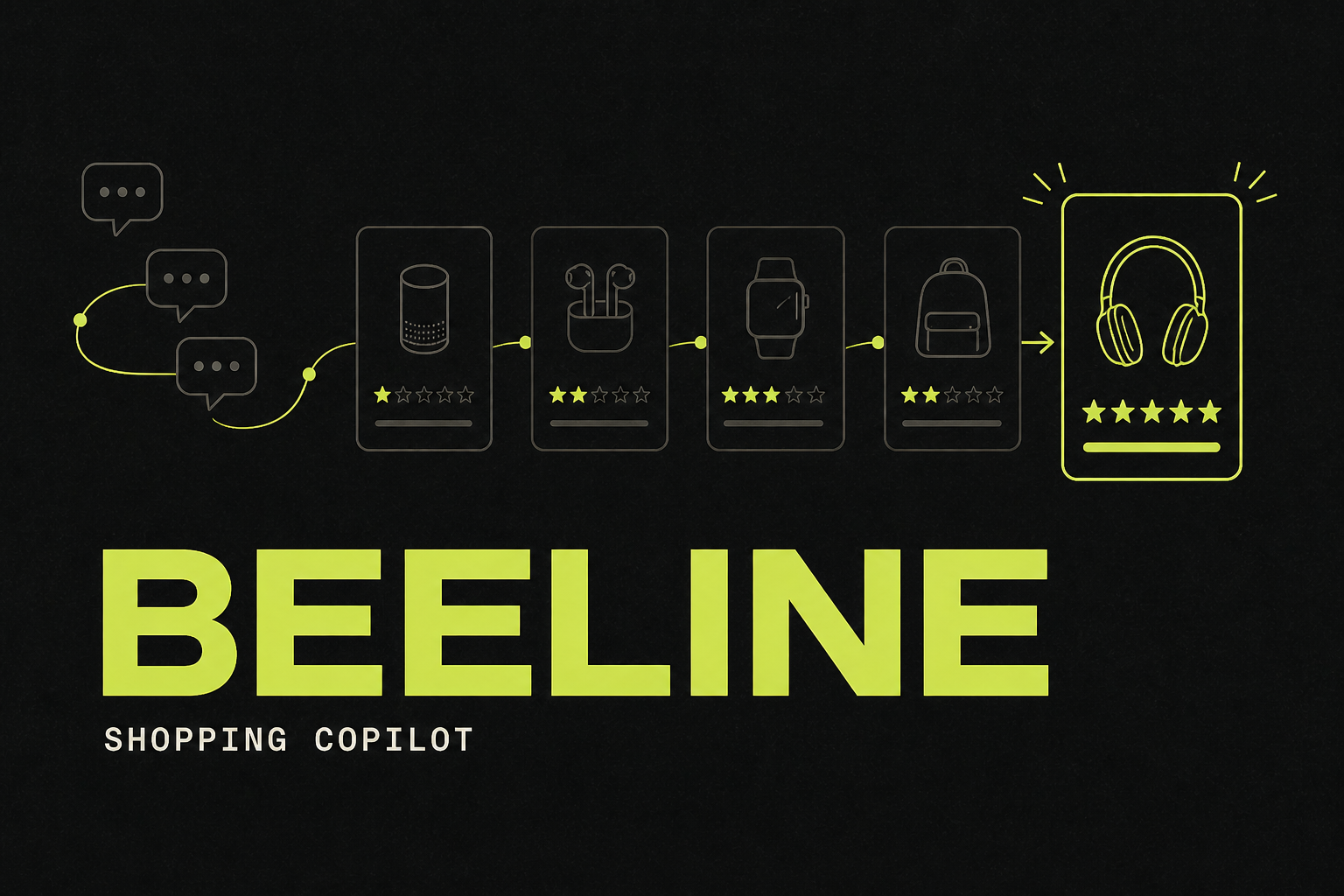
Beeline — Turn buying intent into purchase before the next swipe
Beeline is a conversational shopping agent that turns vague, changing, everyday requests into ranked, catalogue-valid product recommendations. It remembers what matters, lets shoppers change their minds, asks useful questions, and keeps working even when the network or an external model does not.
Built by Team TechBros for TikTok TechJam 2026 — Track 4: Shopping Copilot.
Inspiration
Shopping rarely begins with a perfect query. A customer might start with “I need boots,” later mention a budget, say that waterproofing is essential, and then change the request to slippers altogether. Traditional search treats those messages as isolated keyword queries. A free-form chatbot may understand them, but it can also forget a constraint, invent a product, or fail when its model is unavailable.
We wanted to bridge that gap.
The name Beeline captures our goal: find the shortest trustworthy path between a shopper’s attention and the product they actually want. That felt especially relevant to live and social commerce, where every unnecessary question or slow response gives the shopper another chance to scroll away.
The challenge made this goal measurable. The official evaluator rewards finding a hidden target product, ranking it highly, and finding it early:
TechnicalScore = 0.50 × HitRate@10 + 0.30 × MRR + 0.20 × Efficiency
But we did not want to build something that only understood the evaluator. We wanted the score to reflect real shopping competence: remembering a conversation, handling ambiguity, surviving paraphrases, and behaving reliably under failure.
What it does
On every turn, Beeline returns a natural-language response, an optional clarification attribute, and up to ten ordered product recommendations from the frozen 50,000-item catalog.
It can:
- carry requirements across a multi-turn conversation;
- distinguish hard constraints from soft preferences;
- retire stale requirements when the shopper changes intent;
- respect “no preference” answers and avoid asking the same question again;
- understand common budget language such as “under $50” or “around $60”;
- retrieve exact, lexical, and semantic matches in parallel;
- ask the question expected to eliminate the most uncertainty in the current candidate pool;
- use aggregate profile hints only while the shopper’s current intent is vague;
- rank a broad candidate pool locally and add a low-cost LLM tournament automatically when connected; and
- fail open to a complete offline agent if a model, network call, index, or reranker is unavailable.
The result is not a hosted storefront or a UI wrapper. It is a runnable Python shopping agent built directly around the competition’s official Agent.reset(...) and Agent.respond(...) contract.
How we built it
We split Beeline into a control plane and a data plane, then placed a validated ranking pipeline between retrieval and the official response contract:
Customer message
  → typed Turn Plan and atomic Constraint State
  → structured + BM25 + dense retrieval
  → trained Fusion Policy
  → local cross-encoder reranking
  → parallel LLM ranking tournament when connected
  → catalog-valid Top 10 + highest-information-value question
1. A validated conversational control plane
The control plane interprets the latest message together with prior dialog and the shopper’s active constraints. It creates one typed Turn Plan describing additions, replacements, dismissals, and the next clarification.
The important design decision is that probabilistic interpretation does not directly mutate customer state. Deterministic validation checks the entire Turn Plan against an unchanged snapshot and either commits every transition atomically or commits none of them. This prevents malformed, contradictory, or stale model output from partially corrupting the shopper’s intent.
Constraints retain their source turn and status, so an override preserves history while removing old requirements from live retrieval. Hard constraints affect eligibility; soft preferences influence ordering without hiding otherwise valid products.
2. Hybrid retrieval with trained fusion weights
The data plane gathers independent evidence from three retrieval routes:
- Structured retrieval matches known catalog attributes and hard requirements.
- SQLite FTS5 BM25 searches both the accumulated conversation and the newest message, keeping the stronger score per product.
- Dense retrieval uses
sentence-transformers/all-MiniLM-L6-v2embeddings with embedded Qdrant Local Mode to recover semantic matches and paraphrases.
We did not guess how much each route should matter. We cached every route's normalized scores and cross-encoder results, then trained one non-negative Fusion Policy whose weights sum to one. A coarse search evaluated all 66 points on the three-route simplex at 0.10 increments; a local search evaluated 91 more candidates at 0.02 increments around the best region.
Selection prioritized target recall inside the 50-product rerank pool before final TechnicalScore, HitRate@10, and MRR. That ordering matters: a reranker cannot recover a relevant product that fusion has already removed. We then validated the candidate weights across four scenario-balanced development folds and selected the center of a stable five-neighbor plateau, rather than a brittle single-run maximum.
The frozen runtime policy weights structured evidence at 0.02, BM25 at 0.64, and dense retrieval at 0.34. It retrieves up to 100 candidates per route and admits 50 for reranking. The selected policy reached 0.825 session-level pool recall during training and improved Intent Override HitRate@10 from 0.375 to 0.500 across the development evaluation.
Candidate admission also includes a catalog-derived popularity prior. When several near-identical listings satisfy the same request, products with stronger purchase-proxy evidence deserve consideration. That prior decays as the shopper provides more specific evidence.
3. Two-stage reranking: local cross-encoder plus an LLM tournament
Fusion decides which products remain reachable; reranking decides their final
order. First, the 50-product fused pool is scored by
cross-encoder/ms-marco-MiniLM-L-6-v2 in a persistent local worker. We
benchmarked candidate models and depths against quality, p95 latency, memory,
and package size, then imposed an absolute 1.5-second deadline. If the worker
crashes, times out, or fails to load, Beeline returns the valid fused order.
When an OpenAI API key is available, Beeline automatically adds a semantic
LLM reranking stage. Several gpt-5.4-nano calls inspect chunks of the
48-product pool in parallel, then the chunk leaders meet in one final
listwise ranking. This tournament architecture lets the LLM read the entire
pool within a fixed wall-clock budget instead of trading latency for serial
depth.
The tournament raises the official score from 0.756 offline to 0.806, with
0.960 HitRate@10, 3.4-second p95 turn latency, and an estimated cost of
about $0.01 per session. Every call uses strict structured output,
store=false, token and cost caps, no retry loop, and unconditional fail-open
behavior: a provider failure returns the local cross-encoder order, never an
invalid response.
4. Clarification by information value
Beeline does not ask attributes in a fixed order. For every eligible clarification, it estimates how much a definitive answer would split the live candidate pool, then asks the highest-value unanswered question. Active, dismissed, and previously asked attributes are excluded.
5. Evaluation as part of the architecture
We kept the official evaluator byte-identical and placed all experiments in separate tools. Every serious change was measured across three conditions:
- the released sessions;
- the same sessions with every customer message paraphrased; and
- generated sessions whose target products never appear in the public labels.
The agent’s production path imports no evaluator code and contains no per-session answers, scenario labels, or simulator-template branches.
Challenges we ran into
Candidate recall and final ranking are different problems
We initially focused on reranking, then discovered that no reranker can recover a target excluded from its candidate pool. We reordered our optimization work: first maximize honest target reachability, then improve final ordering.
More candidates were not automatically better, either. Expanding the rerank depth from 50 to 80 introduced enough distractors to reduce the score. That taught us to treat candidate depth as a precision–recall and latency decision, not a “larger is better” setting.
Reproducible embeddings were unexpectedly subtle
Dynamic batch padding caused vector outputs to depend on batch composition. We fixed the embedding length at 256 tokens, pinned model revisions, checksummed the catalog and artifacts, and staged index publication so a failed rebuild could never overwrite the last valid version.
Model intelligence could not be allowed to become a dependency
Connected models sometimes returned invalid plans, asked no useful question, exceeded latency budgets, or became unavailable. We built a deterministic fallback first and forced every connected stage to degrade to it. The agent’s worst case is therefore still a complete, schema-valid offline shopping system.
Measurement noise was large enough to mislead us
Repeated identical runs varied by roughly ±0.013 TechnicalScore because of floating-point and threaded reranking effects. We treated effects below about 0.02 as noise and rejected several plausible ideas—including deeper reranking, broad soft-preference boosts, and rank blending—when measurement did not support them.
What we are proud of
The weak BM25 starter baseline scored 0.107. On all 200 public sessions through the official evaluator, Beeline now reaches:
| Configuration | TechnicalScore | HitRate@10 | MRR | Mean turns | p95 latency | Cost/session |
|---|---|---|---|---|---|---|
| Fully offline | 0.756 | 0.910 | 0.588 | 4.79 | 0.8 s | $0 |
| Nano ranking tournament | 0.806 | 0.960 | 0.628 | 4.13 | 3.4 s | about $0.01 |
We are even prouder that the gains survive distribution shift:
| Configuration | Released sessions | Paraphrased sessions | Unseen target products |
|---|---|---|---|
| Fully offline | 0.756 | 0.725 | 0.718 |
| Nano ranking tournament | 0.806 | 0.763 | 0.756 |
The connected path is optional. If credentials or network access disappear, the same evaluator command automatically falls back to the zero-cost offline configuration instead of failing.
What we learned
We learned that reliable AI systems need a clear boundary between what a model may suggest and what the product must guarantee. LLMs are valuable for semantic judgment, but state integrity, catalog validity, deadlines, cost limits, and fallback behavior belong to deterministic code.
We learned that conversational search is a state-management problem as much as it is a retrieval problem. Remembering “blue,” understanding that “actually, slippers” retires an earlier request, and respecting “I don’t care about material” all change which products should remain eligible.
We learned that honest evaluation is itself an engineering feature. A leaderboard gain that disappears under paraphrasing is not generalization. Keeping failed experiments, measuring scenario regressions, and quantifying runtime noise gave us more confidence in the final system than the headline score alone could.
Finally, we learned that production constraints can inspire better architecture. A strict latency budget led us to parallel model calls. Offline requirements led us to embedded retrieval and local reranking. The need for valid output under every failure led us to typed plans, atomic commits, pinned artifacts, and fail-open stages.
What is next
Beeline’s main remaining weakness is distinguishing the exact purchased item among near-identical variants. Our next steps would be:
- improve final ranking text and benchmark a stronger compact cross-encoder within the same latency gate;
- expand catalog-derived attribute understanding without turning preferences into filters;
- retrain fusion weights on the final accumulated-dialog trajectories; and
- add transparent recommendation explanations grounded only in active constraints and catalog fields.
Beyond the competition, the same architecture could support conversational discovery in TikTok Shop–style live commerce: low-latency intent capture, safe mid-conversation changes, proportional model cost, and a useful offline floor rather than a blank error screen.
Built with
Python, OpenAI Responses API, PyTorch, Hugging Face Transformers, Sentence Transformers, embedded Qdrant, SQLite FTS5, NumPy, MiniLM embeddings, and a MiniLM cross-encoder.
Development and review used VS Code, GitHub, Claude Code, and OpenAI Codex. We used ElevenLabs to generate the voiceover for our three-minute demo video; it is a presentation tool and is not part of the shopping agent or evaluation path. Product data comes from the organizer-frozen Amazon Reviews 2023 Clothing, Shoes, and Jewelry catalog.
Team TechBros
- Dharshan2004: offline agent contract, dense retrieval integration, hybrid fusion and training, connected-model benchmarking, packaging, ranking tournament, and robustness gates.
- dylothx: constraint handling, intent overrides, boundary responses, validated planning, session-mode experiments, and conditional model calls.
- likalight: versioned dense index, reranker benchmarking, depth selection, and live local reranking.
Built With
- ai-agents
- bm25
- conversational-ai
- hugging-face
- hybrid-search
- information-retrieval
- natural-language-processing
- numpy
- openai-api
- python
- qdrant
- reranking
- semantic-search
- sentence-transformers
- sqlite
- transformers
- vector-search


Log in or sign up for Devpost to join the conversation.