Devpost submission: KuaiRand Autonomous ML Research Agent
Inspiration
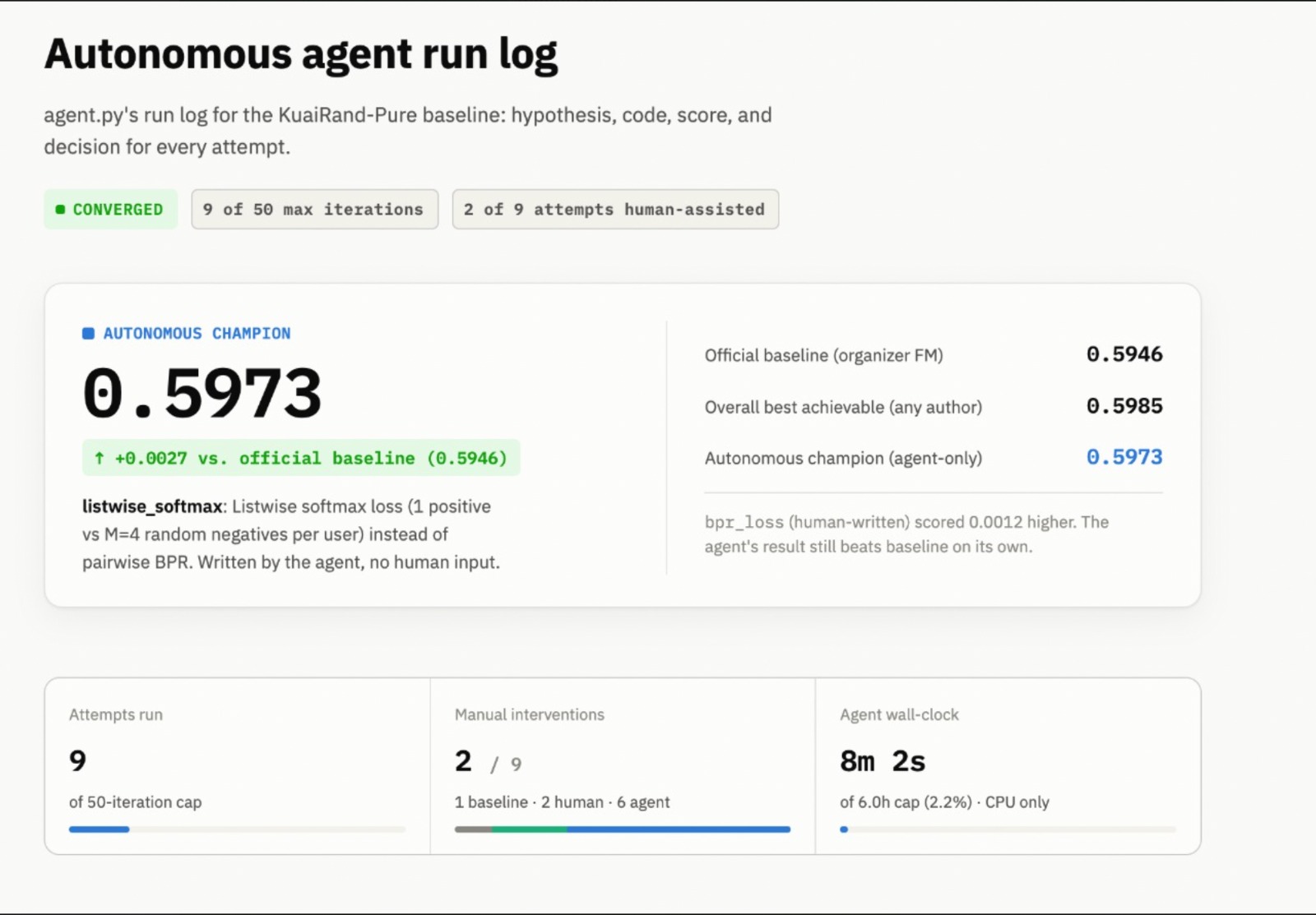
Most entries to a "beat the baseline" task hand-tune a model and report a number. The KuaiRand-Pure starter kit itself warns that this baseline is hard to move: it already eats ~30% of the usable range between random and a perfect oracle, and every feature/capacity tweak the organizers tried failed. So we built the thing that's actually interesting to watch, an autonomous research loop that proposes a hypothesis, writes the code, runs the official scorer, decides keep-or-discard, and moves on, logging every step.
What it does
python run_agent.py runs unattended. Each iteration the agent:
- proposes the next idea from a queue drawn from the README's own "headroom" list: ranking loss, user-history features, multi-task learning, watch-time censored regression, pairwise/listwise BPR, rank-ensembling, each with a written hypothesis citing the method it draws on (LambdaRank, MMoE/ESMM, CWM);
- rewrites
solution.pyto implement it; - runs it in a sandboxed subprocess (timeout + traceback capture);
- scores it with the unmodified
evaluate.py; - decides keep or discard against the current best;
- stops when the dataset's own convergence rule fires — ε = 0.002, N = 3.
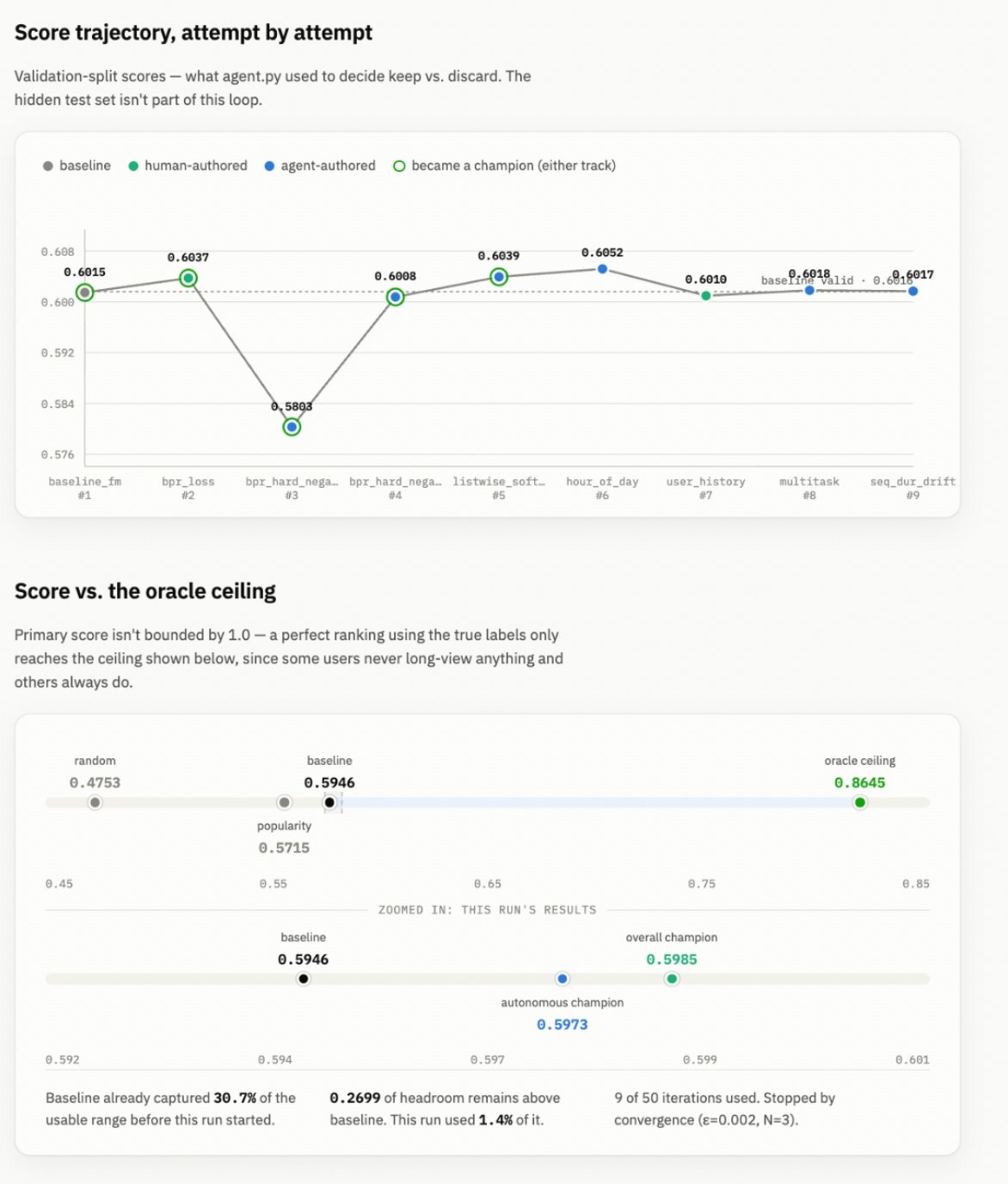
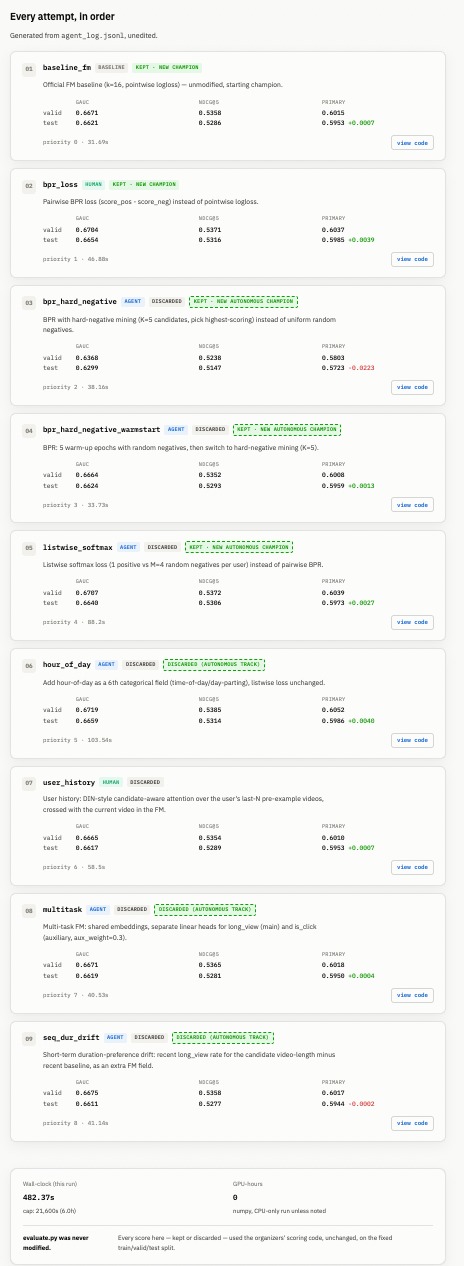
A live dashboard shows the score-over-time trajectory against the oracle ceiling, every hypothesis → diff → score → decision, and the recovery events.
How we frame results
Against the oracle ceiling (0.8484 val / 0.8645 test), not 1.0. The FM baseline already sits at ~31% of that headroom, so "0.60 vs a perfect 1.0" is the wrong mental model.
What we found
The organizers' hypothesis that a ranking loss would be the biggest win did hold : a listwise softmax loss on the same FM architecture beat the pointwise baseline (val 0.6039 vs 0.6015, test 0.5973 vs 0.5946), and the agent correctly kept it. That result took two tries: a more elaborate torch implementation (warm-started, K=24 list sampling) scored only 0.565 with default params, which could easily read as "the idea failed", but the same idea implemented simply, in ~40 lines of plain numpy, is the run's best result. LambdaRank and DIN-style history features did genuinely underperform here, independent of implementation. Rank-ensembling (FM ⊕ LambdaRank) is a real but sub-ε gain, correctly treated as convergence rather than a win. The submission is really about following the process properly: testing actual ideas, only keeping the ones that meet the standard, checking whether a failure comes from the idea itself or just the implementation, stopping when the stated rule says to stop, and doing all of this without any human intervention
How we built it
Python, numpy / pandas / scikit-learn / lightgbm / torch. The agent
(agent/) is model-agnostic; the brain is swappable between a deterministic
offline planner (runs with no API key, for the live demo) and a real Claude
client with token accounting. Leakage was a real bug we hit and fixed, and
target encodings are now leave-one-out on the train split.
Try it
pip install -r requirements.txt     # see requirements.txt for a macOS libomp note
python run_agent.py                 # the loop
python scripts/analyze_runs.py      # the results table
Built With
- anthropic
- claude
- lightgbm
- numpy
- pandas
- python
- pytorch
- scikit-learn


Log in or sign up for Devpost to join the conversation.