Inspiration
AI-image detection often looks strong on clean images and then fails after ordinary platform transformations. JPEG recompression, blur, resize, noise, color changes, and crop can remove forensic traces or shift a model's score distribution. We built a detector and evaluation protocol around those real deployment failures rather than a single clean benchmark.
What it does
The project recursively scores supported images and returns one continuous probability:
[
  {"image_path": "subfolder/example.jpg", "pred": 0.9731}
]
Higher scores mean more likely AI-generated. Unreadable files receive a neutral 0.5
instead of terminating the batch.
How we built it
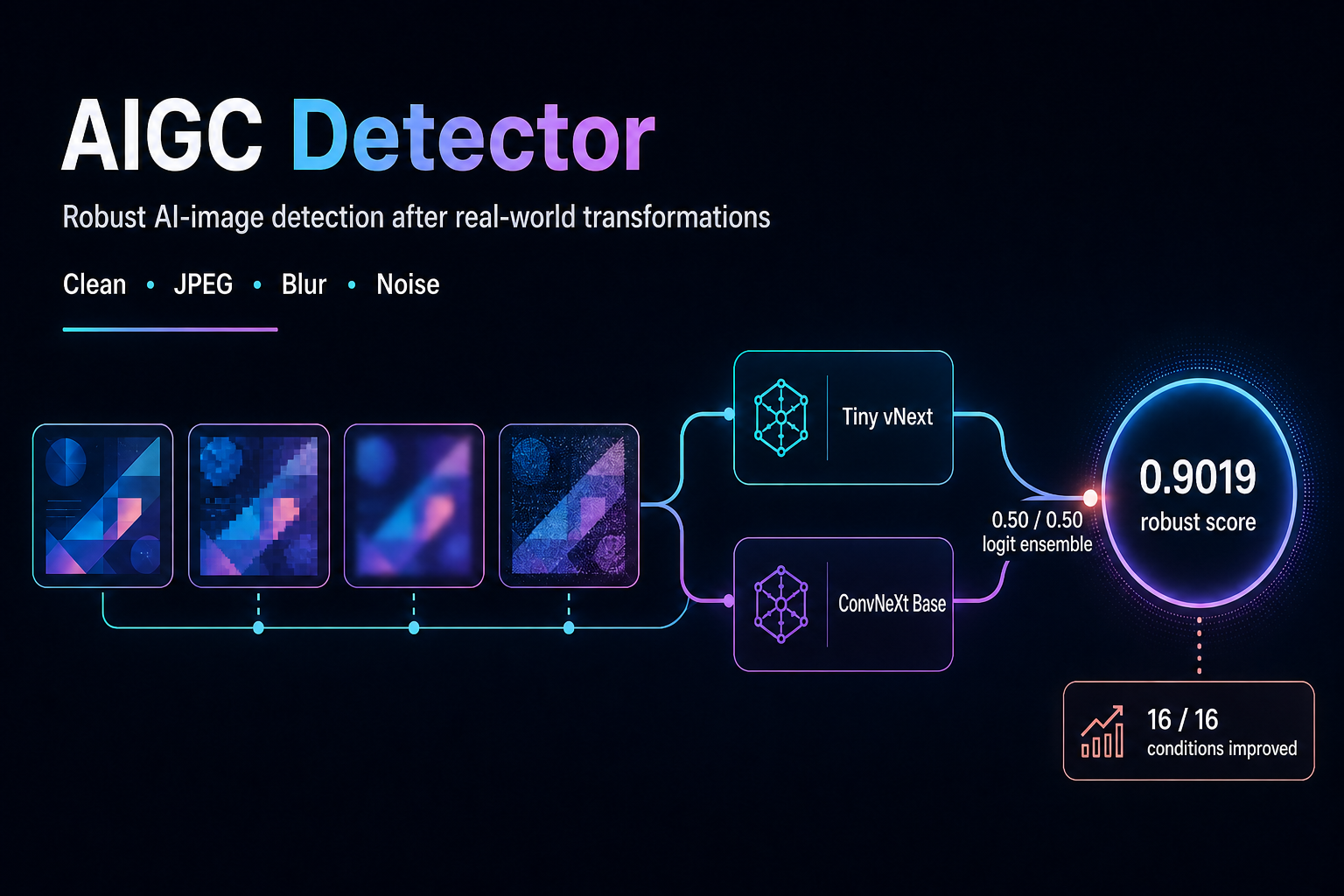
The final candidate is a fixed logit-space ensemble:
image
  ├─ Tiny vNext adapter ─┐
  └─ ConvNeXt Base v1 ──┴─ 0.50 / 0.50 FP32 logit blend ─ sigmoid ─ score
The 28.0M-parameter Tiny member preserves the strongest historical cross-source behavior. The 87.6M-parameter Base member contributes complementary evidence for newer generators. The complete 115.6M-parameter model is frozen and packaged in one hash-pinned checkpoint; inference performs no training, calibration, or test-time adaptation.
We evaluate clean plus 15 deterministic degradations. The robustness score gives 80% weight to mean degraded AUC and 20% to the worst degraded AUC. Source and degradation-family guards prevent a large model from winning globally while silently regressing an older dataset.
Development tools, models, and data
We developed and verified the project with Codex, PowerShell, Git/GitHub, Python virtual environments, PyTorch, timm, scikit-learn, pandas, NumPy, and Pillow.
The final model combines a ConvNeXt Tiny vNext adapter with ConvNeXt Base v1. Training and development used audited manifests drawn from SID_Set, CIFAKE, GenImage, CommunityForensics-Small, SuSy, and MS-COCOAI/Defactify, together with deterministic transformed samples.
The designated WildFake subset was used only as an earlier demonstration and reference benchmark and was never used for training. We did not reopen it to tune the final ensemble.
Fusion decision
On the historical 12,000-image development anchor, alpha values from 0.10 to 0.50
passed. Alpha 0.60 achieved a slightly higher overall score but was rejected because
its SID_Set scale-family drop exceeded the frozen limit
(0.005079 > 0.005000). We selected and froze alpha 0.50.
| Historical metric | Tiny vNext | Ensemble |
|---|---|---|
| Robust score | 0.944886 | 0.978314 |
| Clean AUC | 0.972336 | 0.991032 |
| Worst degraded AUC | 0.916339 | 0.961712 |
We then ran the frozen alpha on a 12,896-image source-disjoint modern development set:
| Modern metric | Tiny vNext | Ensemble |
|---|---|---|
| Global robust score | 0.740077 | 0.901913 |
| Clean AUC | 0.850770 | 0.958501 |
| Generator-macro robust score | 0.718331 | 0.894738 |
| Worst-generator robust score | 0.548970 | 0.796370 |
| Worst generator-condition AUC | 0.322516 | 0.648097 |
All 16 global condition AUCs improved. A 1,000-replicate content-group bootstrap gave
a generator-macro gain 95% interval of [0.171015, 0.182232].
Challenges and lessons
Other Base-only candidates also failed preservation gates. The useful lesson was that capacity alone did not solve domain shift; complementary models plus strict regression guards did.
Packaging introduced another subtle issue: CUDA autocast initially blended half- precision logits, while the direct sweep blended FP32 logits. We made the production wrapper explicitly promote both logits before arithmetic and added direct/package equivalence checks.
Limitations
Strong noise remains the global bottleneck. Midjourney v1/v2 under noise_0.05 is the
weakest generator-condition pair. The ensemble is larger and slower than Tiny vNext,
and its probabilities have not been recalibrated on a new independent set.
The historical confirmation set and WildFake had already been consumed in earlier project stages, so we did not reopen them. These are internal development results, not an official hidden-test or universal-generator claim. The output should support human review, not act as proof of image origin.
Reproducibility and evidence
Built With
- deterministic-robustness-transforms
- git-lfs
- grouped-bootstrap-validation
- numpy
- pandas
- pillow
- python
- pytorch
- scikit-learn
- sha-256
- timm


Log in or sign up for Devpost to join the conversation.