Devpost
Participate in our public hackathons
Devpost for Teams
Access your company's private hackathons
Grow your developer ecosystem and promote your platform
Drive innovation, collaboration, and retention within your organization
By use case
Blog
Insights into hackathon planning and participation
Customer stories
Inspiration from peers and other industry leaders
Planning guides
Best practices for planning online and in-person hackathons
Webinars & events
Upcoming events and on-demand recordings
Help desk
Common questions and support documentation
Sort by:
FlowState: An autonomous ML agentic workflow that diagnoses data, iterates pipeline code, and optimizes recommender systems end-to-end by competing against itself, to make machine learning easier.
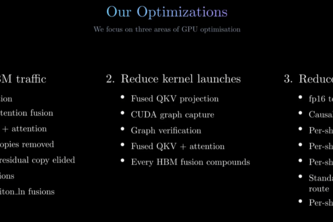
A Transformer layer made 6.54x faster with every optimization measured and every dead end recorded
An AI-image detector that compares an input against real prototypes. Our model performs excellent against multiple transformations, but needs generator specific data to scale.
Making every GPU cycle count
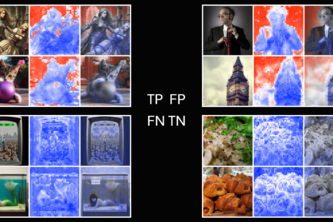
Seeing through the fog of AI 😎
A compact ViT detector that identifies AI-generated images and remains robust after real-world transformations, with confidence scores and fully offline inference.
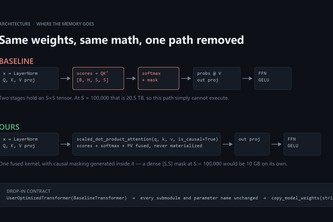
Drop-in PyTorch Transformer layer for Track 3: 1.92× geo-mean speedup, strict state_dict, 932× under tolerance. Shape 14 completes in 5 GB; the reference cannot run (18 TB score tensor per layer).
A drop-in Transformer layer that is 2.28x faster across all 13 graded shapes while staying 1049x inside the tolerance gate — and runs the 100,000-token shape whose reference needs 20.5 TB and cannot.
An LLM agent that runs the full ML research loop on a frozen benchmark: proposes an experiment, edits real model code, trains, and keeps it if a bootstrap test says the gain beats measurement noise.
An optimized transformer layer verified on two real GPUs — three optimizations that looked safe on one backend failed on the other.
We optimized a transformer layer on an NVIDIA laptop and a MacBook. Every change was correctness-checked and timed before being kept; 25 experiments, 11 rejected, 2–15x faster.
Generative AI creates photorealistic fakes at scale. Spotting them in a lab is easy. The hard part is real images get re-encoded, resized, or cropped, erasing the artifacts detectors rely on.
We turn Transformer shape diversity from a performance problem into an optimization opportunity.
A Transformer layer that picks its own kernel — 1.32× average, nothing slower than baseline.
The hardest AI image to catch is the one the internet has already changed. GLowCLIP fuses global context and local forensic traces to detect it after compression, blur, crop, and noise.
TrueSight helps human reviewers assess whether an image may be AI-generated—and whether that prediction is stable, by stress-testing results under common image transformations.
The best optimized GPU Kernel for a transformer layer
KernelKraft is an adaptive Transformer inference accelerator that delivers up to 1.471× end-to-end speedup—with a 1.272× geometric mean across 13 official workloads—on an NVIDIA T4.
CamTrace-6M fuses frozen CLIP semantics with camera-pipeline residuals to detect AI-generated images after JPEG compression, blur, resizing, noise, colour changes, and cropping.
This project speeds up Transformer inference on NVIDIA T4 GPUs with packed QKV, mask caching, and a fused CUDA residual-LayerNorm kernel, achieving up to 1.537x speedup while preserving accuracy.
Coconut House optimises kernel for transformer layer for an Nvidia Geforce RTX 3060 Laptop
Robust Detection of AI-Generated Images Under Real-World Transformations.
Learning-guided search synthesizes, benchmarks, and deploys shape-specialized Transformer programs on RTX 4080, achieving 14.49x geometric-mean speedup over the PyTorch baseline on Shapes 1-13.
A Catalogue-Grounded Shopping Copilot Powered by Intent Transparency