Inspiration The task reads like a speed contest. It is a correctness contest with a speed prize attached.
The grader checks every single output element, and an element passes only if
∣ o i − r i ∣ ≤ 0.002 or ∣ o i − r i ∣ ≤ 0.02 ∣ r i ∣ ∣o i −r i ∣≤0.002or∣o i −r i ∣≤0.02∣r i ∣
One failing element fails the whole shape, and a failed shape forfeits its speed score entirely. So the interesting question was never "how fast can this go" — it was "how fast can this go while the answer provably does not move".
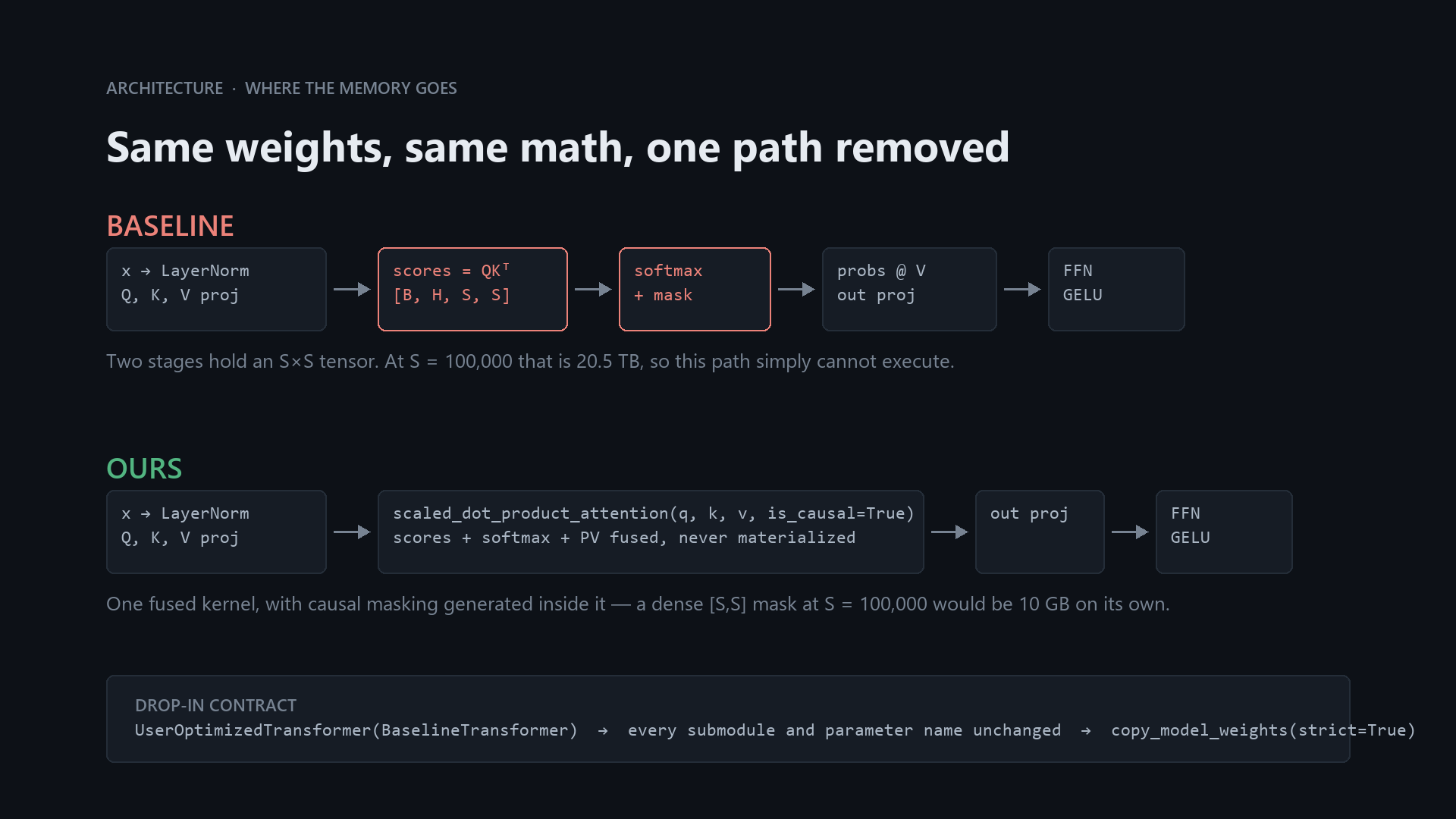
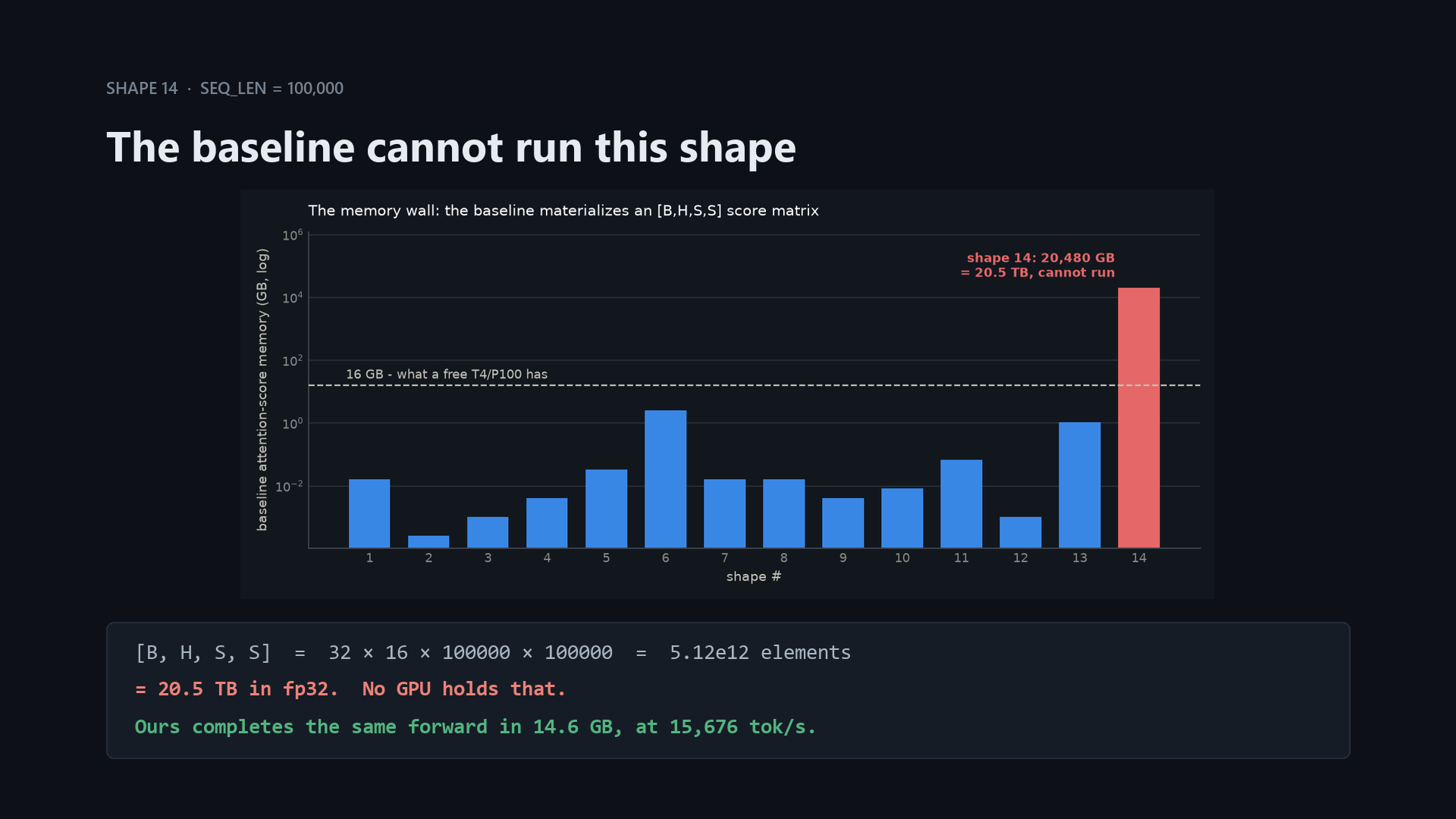
Then we read the shape list. Shape 14 asks for $S = 100{,}000$, and the reference implementation materializes its attention scores explicitly as a $[B, H, S, S]$ tensor:
32 ⋅ 16 ⋅ ( 10 5 ) 2 ⋅ 4 bytes
2.05 × 10 13 bytes ≈ 20.5
T B 32⋅16⋅(10 5 ) 2 ⋅4 bytes=2.05×10 13 bytes≈20.5 TB
No GPU holds that. The baseline does not run slowly on shape 14 — it does not run. That is the shape we wanted.
What it does ExactSwap is a drop-in replacement for the reference BaselineTransformer. It subclasses it, keeps every submodule and parameter name, and rewrites only the forward compute — so the official copy_model_weights(..., strict=True) succeeds and the comparison is apples to apples.
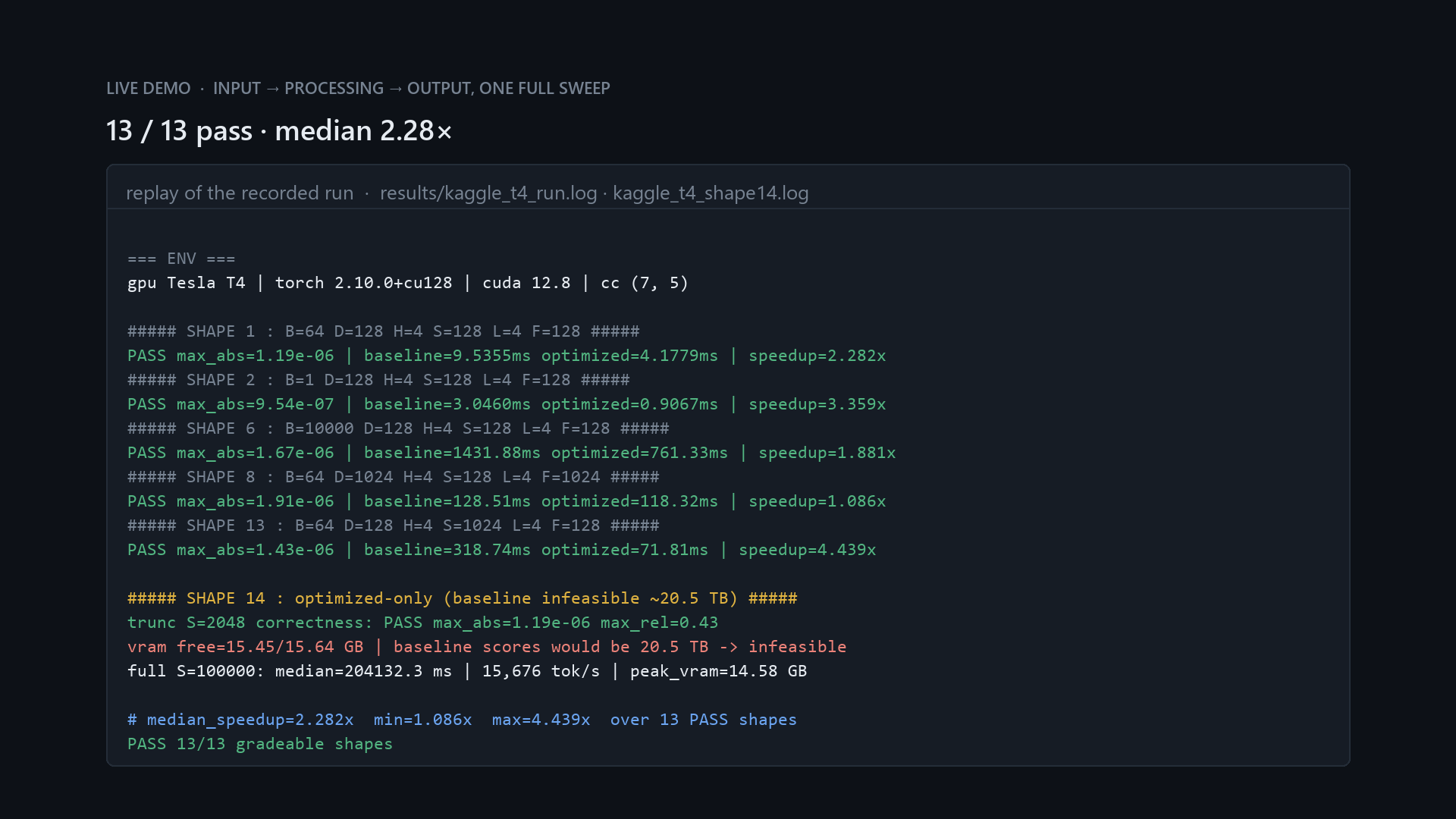
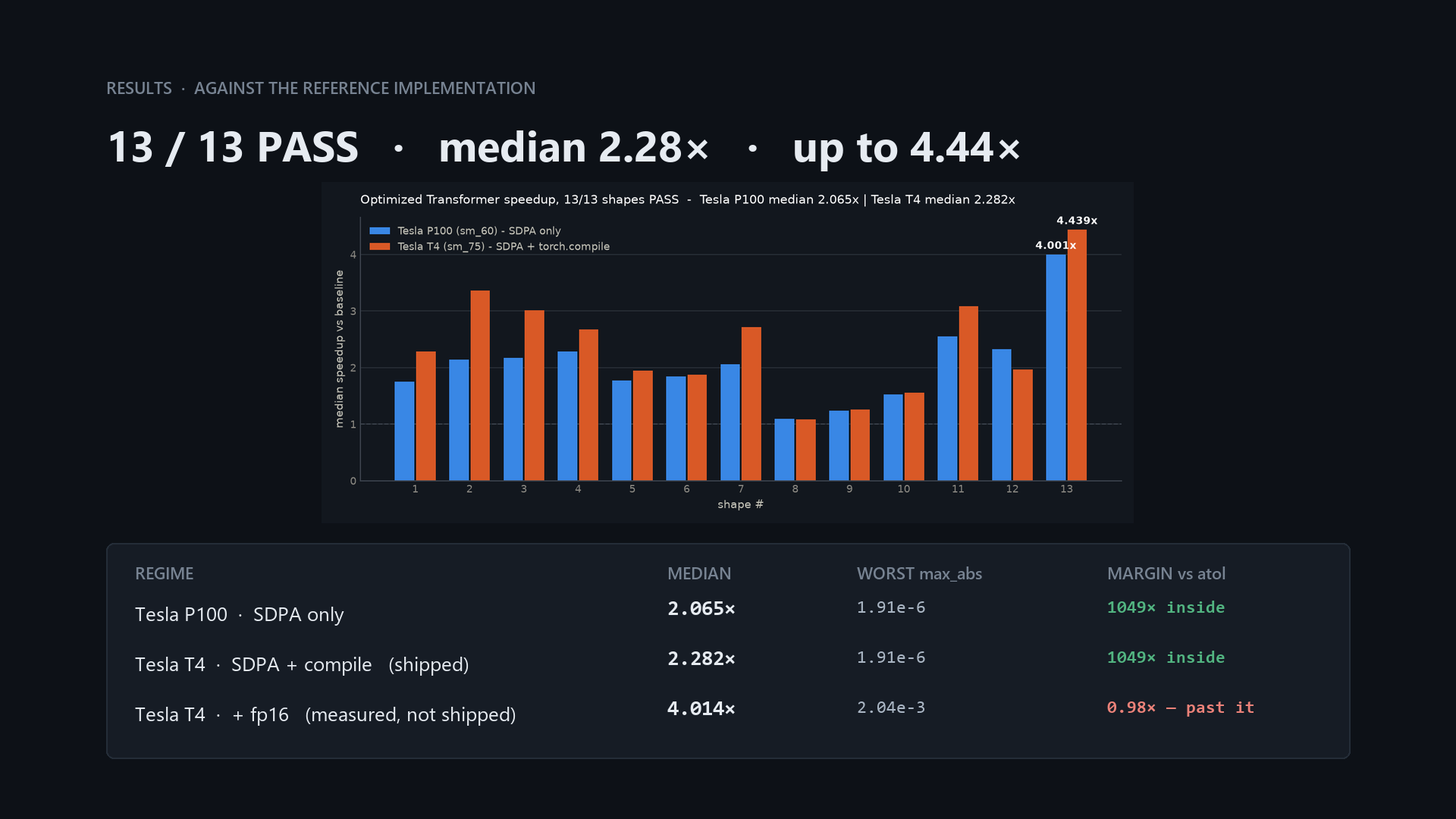
On a free Kaggle Tesla T4 under fp32 grading: 13/13 gradeable shapes PASS, median speedup 2.282× (range 1.086×–4.439×), worst absolute error $1.91\times10^{-6}$. That is a factor of
0.002 1.91 × 10 − 6 ≈ 1049 1.91×10 −6
0.002 ≈1049
inside the tolerance gate.
And shape 14 runs. The full 100,000-token forward completes in 204 s at 15,676 tokens/s, peaking at 14.58 GB — on a card that only has 15.64 GB in total. Against a reference needing 20.5 TB, the meaningful result is not a ratio; it is the difference between cannot run and runs.
Three levers, each selectable by environment variable with no code edits, so the ablation and the delivered path are literally the same code:
F.scaled_dot_product_attention — $O(S)$ memory instead of the baseline's $O(S^2)$. The score matrix is never built. Causality goes through is_causal=True, generated inside the kernel, because a dense $[S,S]$ mask at $S = 10^5$ is $10^{10}$ bytes on its own. Self-applied torch.compile — the model compiles itself on the first forward, so the speedup does not depend on the grader passing --compile-user. Requires $\text{sm} \ge 7.0$. VRAM-planned batch chunking — the chunk size is solved for at runtime rather than tuned: n chunk
⌊ 0.6 ( M free − M out ) b ⋅ k ⋅ S ⋅ max ( D , F ) ⌋ n chunk =⌊ b⋅k⋅S⋅max(D,F) 0.6(M free −M out ) ⌋
with $M_{\text{free}}$ from cuda.mem_get_info plus the allocator's reserved-but-unused blocks, $b$ bytes per element, and $k \approx 8$ live intermediates per block. If that estimate is still optimistic, the chunk halves and the pass restarts.
How we built it Development happened on a laptop with an Intel iGPU and no NVIDIA card. Every GPU run was pushed headlessly to Kaggle and pulled back: a builder inlines the unmodified harness, the optimized model and a sweep driver into a single self-contained kernel, so nothing needs to be attached to the notebook.
Three results that were not obvious going in:
- The shape-14 OOM was not in the attention. After switching to fused attention, shape 14 still died with Tried to allocate 6.10 GiB. The fused kernel was fine. The failure was the last line: chunking the batch and joining the pieces with torch.cat holds the chunks and the joined $[32, 10^5, 1024]$ result simultaneously — a second $\approx 6.5$ GB allocation on a card that already had the 6.5 GB input resident. Writing each chunk straight into a preallocated output removed the copy, and the shape ran. The bug was one line away from where it appeared.
That run is fp16, and for this shape that is forced rather than chosen. In fp32 the input and output alone are
2 ⋅ 32 ⋅ 10 5 ⋅ 1024 ⋅ 4 bytes
26.2 GB
15.64 GB 2⋅32⋅10 5 ⋅1024⋅4 bytes=26.2 GB>15.64 GB
committed before a single activation. Correctness for shape 14 is therefore established separately, in fp32, at a truncated $S$ where the reference still fits — PASS at max_abs $= 1.19 imes10^{-6}$ — and SDPA's mathematics does not depend on $S$.
The Kaggle API silently gives you the wrong GPU. torch.compile, real FlashAttention and fp16 tensor cores were all marked "not measured" for most of this project, because the API-allocated card is a Tesla P100 (sm_60) where Triton will not build. The kernels API does let you choose — machine_shape / --accelerator — but the accepted values (NvidiaTeslaT4, NvidiaTeslaP100, Tpu1VmV38) appear only in the SDK docstring for ApiSaveKernelRequest, and anything unrecognised is silently normalised back to a P100. Our first two guesses looked like successful requests and were not. We confirmed the right one by pushing a throwaway kernel that printed get_device_name.
Two GPUs make an accidental ablation. The same code scores 2.065× on the P100 (SDPA alone) and 2.282× on the T4 (SDPA + compile + FlashAttention). Worth stating plainly: the T4's baselines are slower than the P100's — 318.7 ms against 168.6 ms on shape 13 — because the P100 has more fp32 throughput and roughly twice the memory bandwidth. Our ratio improves on the T4 anyway, because the optimized path gains compilation and FlashAttention there while the baseline stays bandwidth-bound. A speedup is a ratio, and it matters which side moved.
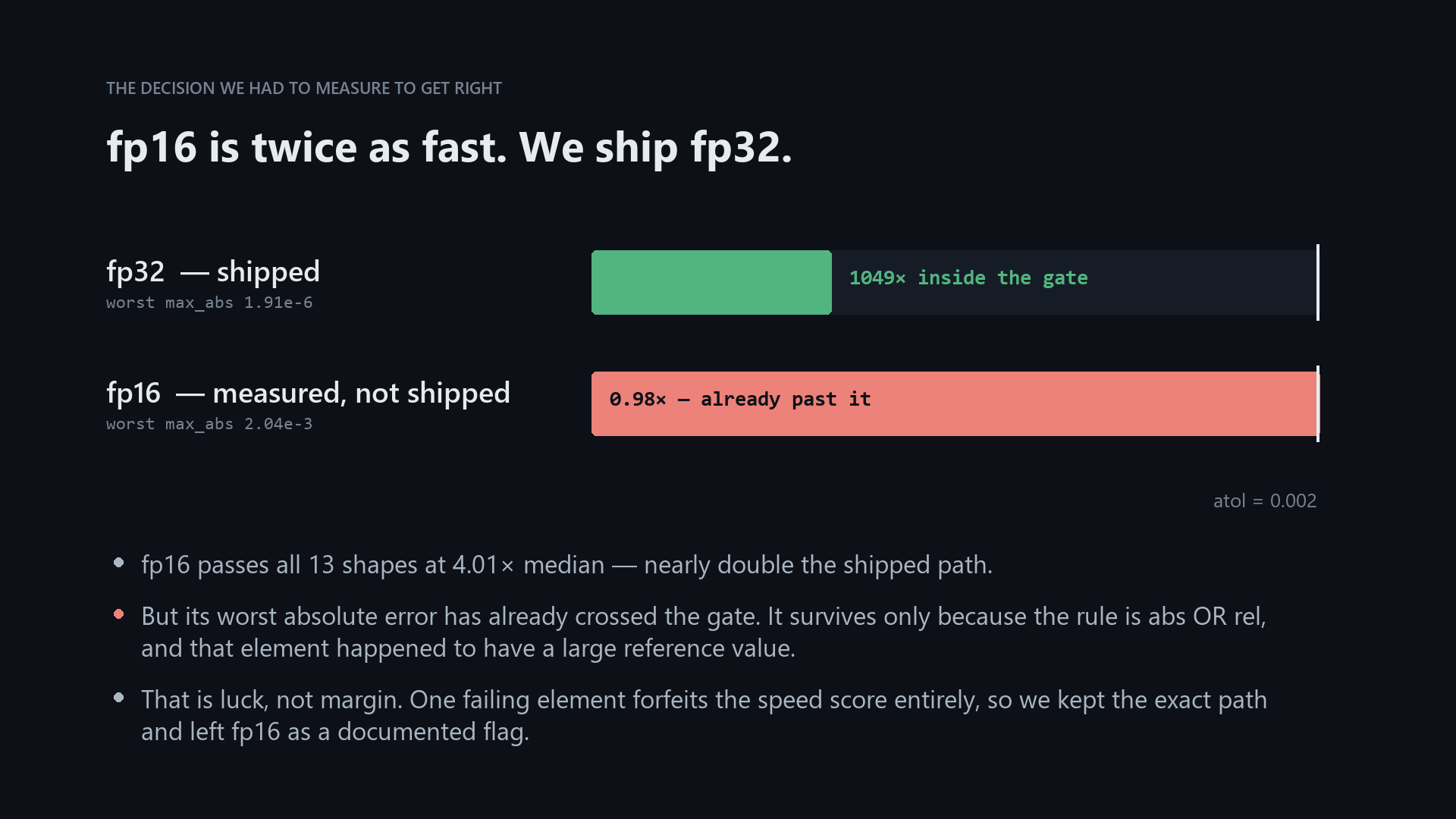
Challenges we ran into We shipped a claim we had never measured, and measuring it proved us wrong. The repository asserted for most of its life that internal fp16 "breaks the strict $\texttt{atol}=0.002$ gate". Once we had a T4 and ran it, fp16 passed all 13 shapes, at a median 4.014× — nearly double the shipped path. The assertion was simply false.
The conclusion survived anyway, for a better reason. fp16's worst absolute error is $2.0388 \times 10^{-3}$ on shape 6, which has already crossed $\texttt{atol} = 2 \times 10^{-3}$. It passes only via the second branch of the gate, which requires
0.02 ∣ r i ∣ ≥ 2.0388 × 10 − 3 ⟹ ∣ r i ∣ ≥ 0.102 0.02∣r i ∣≥2.0388×10 −3 ⟹∣r i ∣≥0.102
— that element happened to have a large enough reference value. Nothing makes that repeatable: put the same error on a near-zero reference and the element fails, and one failing element forfeits the shape. The trade is therefore
2 × speed ⏟ 4.014 × vs 2.282 × for 0.002 2.0388 × 10 − 3 ≈ 0.98 ⏟ margin, i.e. none instead of 1049 4.014× vs 2.282× 2× speed
for margin, i.e. none 2.0388×10 −3
0.002 ≈0.98
instead of1049
We took the margin and left fp16 as a documented, measured flag. The conclusion was right and the reasoning behind it was wrong, and only running it revealed which.
We ran an adversarial audit against our own documentation, and it found four wrong claims. Multiple agents cross-checked every number in the README, report, ablation and Devpost draft against results/*.csv and the raw kernel logs, and every finding was independently verified before being accepted. Confirmed and fixed: shape 14's headline numbers were fp16 while every document framed the run as fp32; the Devpost draft credited speedups to "tensor cores + compilation" on a run whose GPU had neither; a "$\approx 2000\times$ inside tolerance" figure was arithmetic on a number no shape actually hit (the real margin is $\approx 1049\times$); and the README pointed at a kernels/ directory that never existed. The audit also found a real bug in our own tooling — the log parser raised NameError on any log containing a shape-level error — and, with some irony, one audit agent triggered the exact hazard it had just reported, by running the sweep on this CPU-only machine and overwriting the committed GPU results. Nothing reached the remote, the file regenerates from the committed log exactly, and the script now refuses that write.
Two findings turned out not to be defects, and proving that mattered. --dtype bfloat16 fails the gate: 6131 of 131072 elements, max_abs $= 0.047$. So does the reference compared against itself recomputed in fp32 — 7603 elements, identical max_abs. The reason is arithmetic, not implementation:
u l p bf16 ( 1.0
)
2 − 7 ≈ 0.0078 ≫
atol
0.002 ulp bf16 (1.0)=2 −7 ≈0.0078≫atol=0.002
bf16 cannot represent the gate's own precision, so no implementation that reorders a single operation can hold it. That is a property of the configuration; the graded configuration is fp32.
Accomplishments that we're proud of Turning an infeasible shape into a running one, on a free GPU, from a laptop with no GPU at all.
But more than the speedup: declining the 4.014× we had already measured. It passed every test in front of us and would have looked better on a leaderboard. It sits at $0.98\times$ of a hard gate, and shipping it would have been a coin flip dressed up as a result.
And the negative results are first-class citizens of the repository. torch.compile hurts the launch-bound shape ($2.29\times \to 1.46\times$) and is a wash on the GEMM-bound one. The stage ablation is 4 shapes $\times$ 4 configurations with every number published, including the ones that did not help.
What we learned Read the grading contract before optimizing anything. The $\textbf{or}$ in the gate is why a reported max_rel of $2 \times 10^5$ can be a perfectly healthy result — it is computed as
max_rel
max i ∣ o i − r i ∣ max ( ∣ r i ∣ , 10 − 12 ) max_rel= i max
max(∣r i ∣,10 −12 ) ∣o i −r i ∣
over near-zero references — and why a max_abs of $2.04\times10^{-3}$ is disqualifying even on a shape that passed.
A memory bug can surface one line away from its cause. The OOM appeared in the attention and lived in the concat. Cheap infrastructure facts dominate expensive optimization work. One undocumented string, NvidiaTeslaT4, was worth more than any kernel change we made: it unlocked three levers at once. Audit your own claims adversarially. Four of ours were wrong, and all four had survived several careful re-readings by the people who wrote them. What's next Hand-written Triton kernels — a fused LayerNorm+residual and a fused bias+GELU epilogue — beyond what Inductor already fuses; a Turing-specific FlashAttention kernel is a multi-day effort we scoped and did not attempt. The padded fallback still materializes a dense $[B,1,S,S]$ bias, giving back exactly the $O(S^2)$ memory SDPA exists to avoid; the graded path never takes it, but making it memory-efficient is unfinished work rather than a solved problem.
And the experiment we ran out of time for: a mixed assignment — fp16 matmuls with selected fp32 reductions — that keeps most of the $2\times$ while restoring a real margin. Somewhere between $0.98\times$ and $1049\times$ there is a configuration worth shipping.

Log in or sign up for Devpost to join the conversation.