-
-
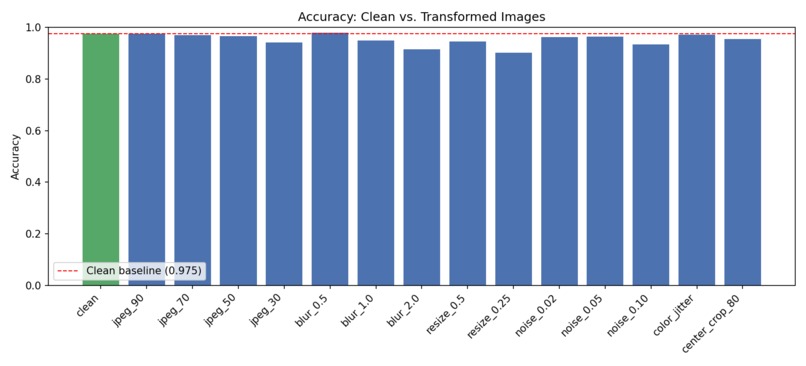
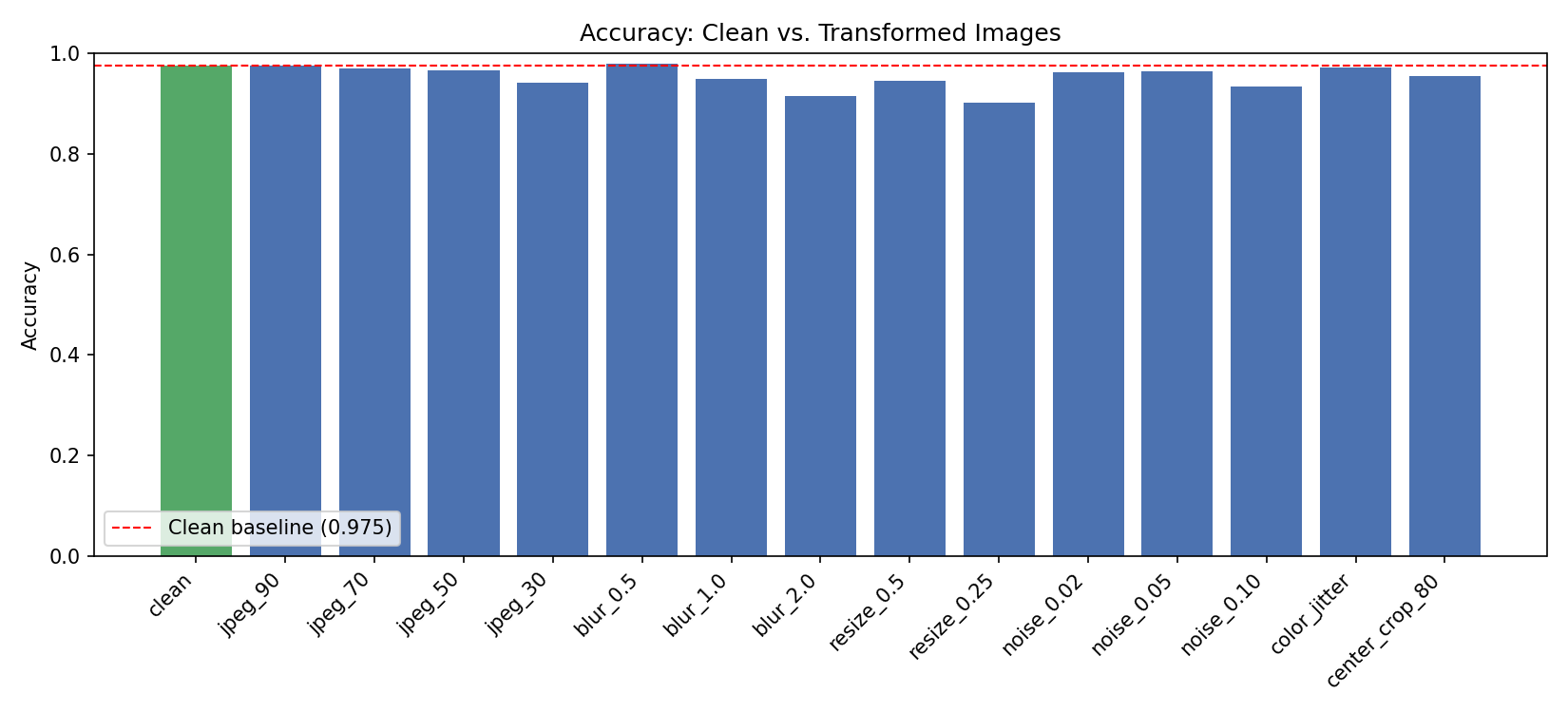
Robustness across 6 real-world transforms — 97.5% clean accuracy, weakest on resize (92.4%) and blur (94.8%).
-
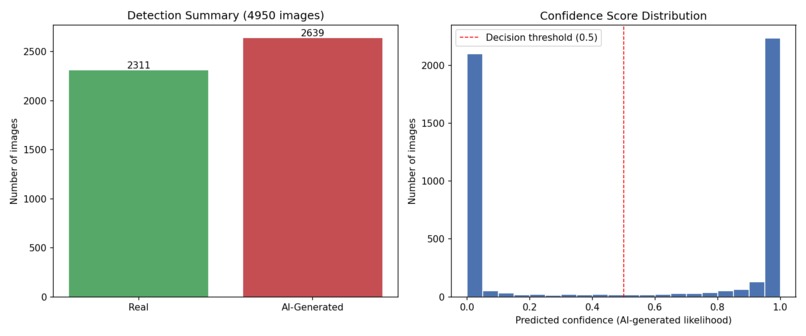
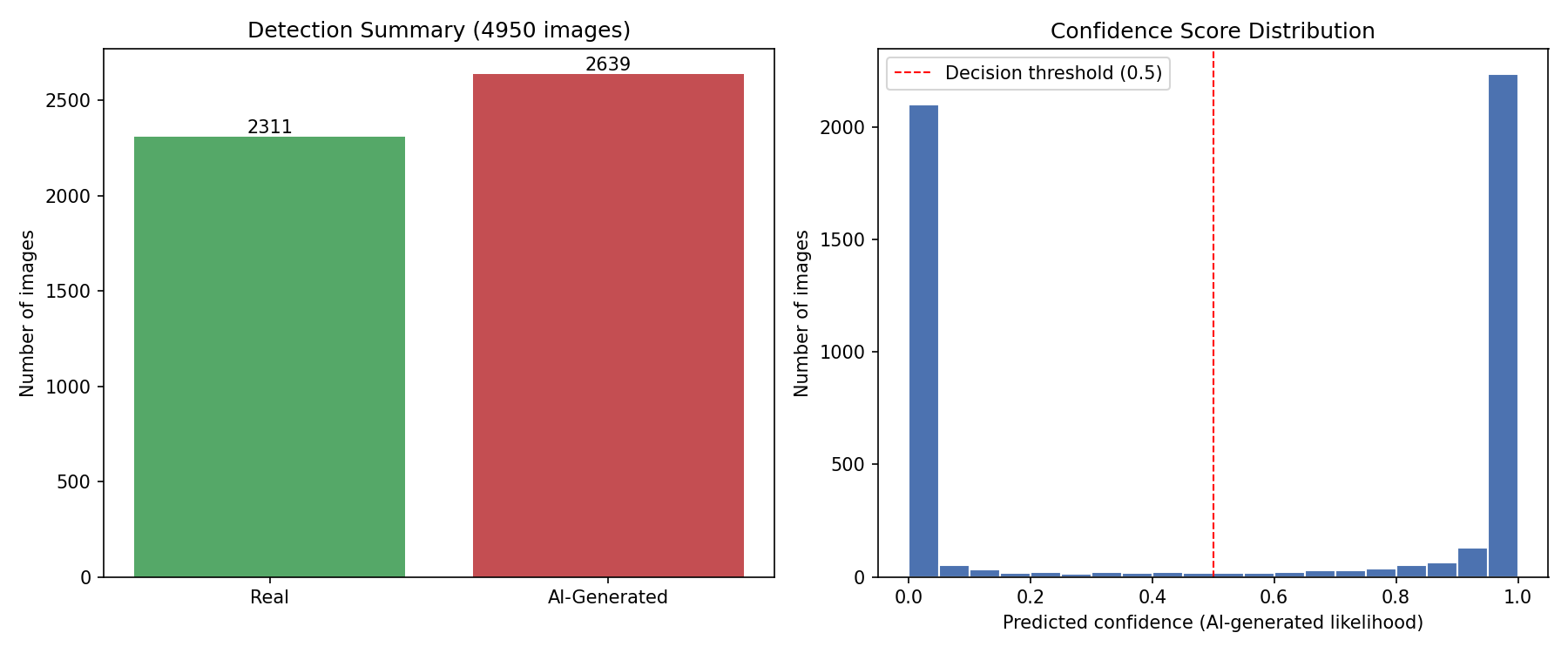
Prediction confidence distribution from a full inference run on held-out test images.
-

An AI-generated image (SD/ADM/Midjourney) after each transform, showing what the detector must see through.
-

A real image after each robustness transform: JPEG, blur, resize, noise, color jitter, and center crop.


Devpost Written Description
Copy/paste and adapt into the Devpost submission form.
Demo Video
Robust Detection of AI-Generated Images Under Real-World Transformations — Demo
Inspiration
Generative AI can now produce photorealistic fake images at scale, resulting in misinformation, impersonation, fraud, eroded trust. The hard part isn't spotting fakes in a lab, it's that every real image gets JPEG re-encoded, resized, cropped or reposted before anyone sees it again, and that's exactly when the pixel-level artifacts most detectors rely on disappear.
What it does
Hence, we built SpectraLens. It's a two-branch model, under 720M parameters, which includes a frozen CLIP ViT-H/14 encoder that reads visual content, a trainable ConvNeXt-Base network that reads the image's FFT frequency spectrum, where generative artifacts often hide even when invisible to the eye. We train on randomly transformed images, ranging from compression, blur, resize, noise, color jitter, crop so the model never learns to lean on cues that vanish in the real world. And instead of one accuracy number, we report three: clean, post-transform, and a fully held-out benchmark (WildFake) the model never trains on, which proves that it generalizes rather than memorizes. Output is a simple JSON scan built to slot into a moderation queue.
That's the bet: a detector trust & safety teams could actually deploy.
How we built it
We trained on CIFAKE and the AIGC Detection Dataset (Kaggle) — real photos paired against images from ADM, Stable Diffusion, and Midjourney — with every training image passed through 0 to 3 randomly-stacked real-world transforms before the model ever sees it, so it never gets to rely on cues that vanish once an image leaves the lab. We evaluate on three tiers instead of one accuracy number: in-distribution clean accuracy, accuracy after each individual transform, and accuracy on WildFake (COCO val2017 + DALL·E "Advanced" fakes), a completely held-out benchmark the model never trains on — separating "is it actually good" from "did it just memorize this dataset's generators" from "does it survive real-world post- processing." The trained checkpoint (~3.6GB) is hosted on the Hugging Face Hub since it's too large for git, and the codebase is split into readable modules (data pipeline, model architecture, transform pool, shared config) rather than one monolithic script.
Challenges we ran into
The model itself came together more smoothly than the infrastructure around it. We hit a real, leaked-credential scare during setup and had to rotate Kaggle and Hugging Face API keys mid-hackathon. We ran into Windows' 260-character path limit crashing mid-download on two separate machines, because our project folder lived deep inside a synced OneDrive path — fixed by making the dataset cache location configurable instead of forcing everyone to enable OS-level long-path support. We also caught a genuine cross-platform bug via our own test suite: a "portable" path identifier function was silently returning Windows backslash paths instead of portable forward slashes, which would have made error-analysis output inconsistent between team members on different OSes. And after a full verified re-run on real GPU hardware, we found our documented robustness numbers were stale relative to the actual checkpoint we were shipping — a good reminder that "the numbers in the README" and "what the model actually does right now" can silently drift apart if you don't re-verify.
On the training side, getting the model onto the GPU at all took longer than training it usually does. PyTorch's default install method silently gives you a CPU-only build with no error — the script would happily start training, just at a small fraction of the expected speed with no warning. We fixed it once, then hit it again weeks later when a routine dependency reinstall quietly overwrote the working CUDA build with the CPU one. Eventually we taught the script to diagnose and explain this itself on startup, rather than relying on someone noticing an oddly slow epoch.
The more dangerous bugs were the ones that didn't crash anything. A naive way of capping how many training images we used accidentally produced a dataset that was entirely real photos with zero AI-generated examples in it — the code ran fine, the loss went down, and every number looked plausible unless you specifically checked the label distribution. We found and fixed that in the training pipeline, then discovered the exact same bug independently in the evaluation pipeline much later — a reminder that fixing a pattern once doesn't mean it's fixed everywhere it got copied. In a similar spirit, we had our own version of the "stale README" problem earlier in the pipeline: for a while, the same held-out images decided which checkpoint counted as "best" and were used to report final accuracy — meaning checkpoint selection was subtly tuned toward the exact data we were about to grade ourselves on. Rebuilding that into a genuine three-way train/validation/test split, with the test portion touched exactly once, was one of the more invasive fixes we made, but it's the difference between a real number and a flattering one.
Resuming training safely across sessions surfaced its own quiet failures. On two separate occasions, restoring a saved optimizer or learning-rate schedule silently overrode a setting we'd just deliberately changed — extending the training length or adjusting the learning rate appeared to do nothing after a resume, with no error to explain why. Both times the fix was the same shape: explicitly re-apply the current setting after loading the saved state, rather than trusting the checkpoint to defer to it. Even our own reporting wasn't immune to this kind of drift — a summary table meant to show how much training data was available double-counted every source's total, since a validation split and its parent training split were both correctly reporting the same pool size, and our summary logic summed them as if they were two different pools. Caught only because the total looked implausibly large next to what was actually used.
Accomplishments that we're proud of
Every number in our robustness table and error analysis came from an actual, verified, end-to-end run of our shipped checkpoint — not recycled or approximate figures. We're proud that our own test suite caught a real bug before it reached a teammate on a different OS, and that we were upfront about a real gap we found in our own evaluation design: training stacks multiple transforms per image, but our robustness evaluation currently only tests one transform at a time, meaning we haven't fully measured how the model holds up against the combined real-world degradation it was actually trained to handle. Catching and documenting our own blind spot felt more valuable than quietly leaving it out.
We're also proud of the architecture decision behind the detector itself. Rather than training one model from scratch and hoping it generalizes, we deliberately paired a frozen, large-scale pretrained vision model with a small trainable component focused specifically on frequency-domain artifacts — a design choice backed by published research on generalizing to AI generators the model has never seen, not just intuition. Getting that pairing to actually work together, through a custom fusion mechanism, and stay within a hard 2-billion-parameter budget while still meaningfully using the headroom, was a real engineering win, not just a checkbox.
We built real safety nets into the training process itself, not just the final output. The pipeline can detect when someone has changed the training data or configuration since a checkpoint was last saved, and automatically decide whether it's safe to keep going or whether it should insist on a clean restart to avoid quietly corrupting the results — the kind of judgment call that's easy to skip under time pressure but that we didn't want to leave to memory or luck. Training can also be safely paused and resumed across sessions without losing progress or silently drifting from the settings we intended, which mattered a lot given how long some of our training runs took.
We also made a real, deliberate choice to hold ourselves to a higher bar on data hygiene than the minimum required. We built a proper three-way separation between training data, the data used to pick our best checkpoint, and the data used to report final results — specifically so our reported accuracy couldn't be quietly flattered by data the model's checkpoint-selection process had already been tuned against. That's an easy corner to cut under a deadline, and we didn't cut it.
Finally, we're proud of how reproducible and handoff-ready the end result is. Every part of the pipeline — which datasets are active, how much data is used, model size, training length — is controlled from one clearly organized settings section rather than scattered through the codebase, and the whole system is documented well enough that a teammate joining late could actually pick it up and understand not just what the code does, but why it's built that way.
What we learned
That frequency-domain signals are a genuinely strong, complementary cue to raw pixel content for this problem — but they're also the first thing to degrade under blur and aggressive resizing, which is exactly where our model's accuracy dips the most (92.4% on resize, still well above chance, but our clearest weak spot). We also relearned a very unglamorous but important lesson: reproducibility infrastructure (deterministic splits, seeded randomness, checkpoint versioning, credential hygiene, environment setup that actually works on a teammate's machine) takes real, deliberate effort, and skipping it is exactly how "it works on my machine" turns into a submission that doesn't reproduce for a judge.
We also came away with a stronger belief in restraint as a design principle. Our instinct going in was that more parameters and more fine-tuning would mean more accuracy. What actually worked better was freezing most of a large pretrained model and only training a small piece on top of it — not because it was cheaper (though it was), but because it generalizes better to AI generators the model has never seen, which is the harder and more important problem than performing well on the exact generators in our training set. Knowing when not to train something turned out to be as important a decision as the architecture itself.
We also learned not to trust assumptions about anything outside our own code without checking. Third-party dataset folder structures, GPU driver behaviour, default package installation behaviour, even how Windows handles long file paths — all of these quietly broke something at least once, and in every case the fix was cheap once we actually looked, but expensive while we were still guessing. Verifying instead of assuming became a habit we had to build deliberately, not one that came naturally under time pressure.
What's next for SpectraLens
Closing the resize/blur gap with a multi-scale frequency representation or an ensemble with a spatial-artifact detector; extending our robustness evaluation to cover stacked-transform combinations, not just single transforms, to match what training already does; adding an explainability layer (e.g. Grad-CAM-style saliency) so a human moderator gets evidence, not just a bare score; and decoupling pure inference from the training-dataset download so the script is faster and easier for a reviewer to run standalone.
Beyond that, we'd like to actually finish validating generalization the way we designed it to be validated: our pipeline already has a slot reserved for a fully external, never-trained-on benchmark, but we haven't populated it yet. Without that, we're still only confident about how well the model does on data related to what it trained on — the harder and more meaningful question of "does this hold up against a generator and photo source it's never seen at all" is still open.
On the engineering side, we want to close a couple of gaps we identified but consciously deferred: verifying that one of our newer data sources' evaluation split is genuinely balanced between real and fake examples before trusting any accuracy number from it, and extending our per-image error analysis so it draws representative examples from every active data source instead of defaulting to whichever one happens to load first.
Longer term, we're interested in exploring whether the model's current size is actually being used efficiently — we have real headroom left in our parameter budget, and it's worth finding out whether that's better spent on a larger frequency-analysis branch, a stronger fusion mechanism between our two branches, or isn't the bottleneck at all compared to simply training on more diverse data.
How our solution addresses the problem statement
Generative AI tools now produce images nearly indistinguishable from real photos, and on a platform at TikTok's scale that creates real risk: misinformation, impersonation, fraud, and erosion of trust in what people see. But detecting AI-generated images in a lab isn't the hard part — it's that every image reaching a real platform has already been re-compressed, resized, cropped, or lightly edited (a JPEG re-encode on upload, a thumbnail generated for a feed, a screenshot-and-repost). Most of the subtle pixel-level artifacts that make an image "obviously fake" to a classifier are exactly the artifacts that get destroyed first by that pipeline. A detector that scores well on clean benchmark images but collapses after one re-compression pass isn't a working solution — it's a demo that only works inside its own dataset.
That's the problem we designed SpectraLens for: not "can we classify AI images," but "can the model still tell the difference after the image has been through what every real upload goes through." Our solution addresses this directly, in three parts:
A two-branch architecture built for different failure modes. Instead of a single network reading raw pixels, each image is processed through two branches in parallel:
- a frozen CLIP ViT-H/14 encoder (~632M params, LAION-2B weights) that reads high-level semantic/visual content, and
- a trainable ConvNeXt-Base (~88M params) that reads the image's FFT log-magnitude spectrum.
Generator artifacts often show up as structured patterns in frequency space even when they're subtle or invisible in raw pixels, and the two cues degrade differently under different transforms — giving the model more than one way to still be right after an image has been altered. A lightweight cross-modal attention layer fuses both signals before the final classification head. Total model size is ~720M parameters, comfortably under the hackathon's 2B-parameter limit.
Robustness built into training, not just measured afterward. Every training image is passed through 0 to 3 randomly-stacked real-world transforms — JPEG compression, blur, resize, noise, color jitter, or center crop, applied in sequence — before the model sees it, so the model never gets to rely on cues that vanish once an image leaves the lab.
Three-tier evaluation instead of one accuracy number. We report (1) in-distribution clean accuracy, (2) in-distribution accuracy after each transform family, and (3) accuracy on a completely held-out external benchmark (WildFake — COCO val2017 real images + DALL·E "Advanced" fakes) that the model never trains on — separating "is it actually good" from "did it just memorize this dataset's generators" from "does it survive real-world post-processing."
On top of the model, the pipeline includes what a real deployment needs: reproducible, deterministic train/val dataset splits (persisted so they stay stable across runs); streaming data ingestion so nothing has to fit in memory at once; mixed-precision training with early stopping and a decision threshold calibrated from held-out data rather than a fixed 0.5 cutoff; and checkpointing that resumes safely (detecting and warning about changes in data sources/volume between runs) instead of silently retraining on drifted data.
The direct beneficiaries are platform trust & safety and content moderation
teams, who need a detector that survives the platform's own image pipeline
rather than one that only works on pristine inputs. The output format
reflects that: a simple JSON scan of an input folder producing per-image
confidence scores (image_path + pred), designed to slot into a
moderation queue rather than requiring a bespoke integration layer. Beyond
platforms, this protects everyday users indirectly — every AI-generated
image caught before it spreads is one less piece of convincing
misinformation or impersonation reaching someone with no way to verify it
themselves.
Headline results
- Clean-data accuracy: 97.5%, ROC AUC: 0.997
- Accuracy retained under transforms: 96.3% (JPEG), 95.3% (noise), 97.2% (color jitter), 95.5% (center crop) — holds up well; weakest cases are 94.8% (blur) and 92.4% (resize), still far above chance
- Full per-transform breakdown in the Robustness Evaluation Summary below
Development tools used
- VS Code
- Python 3.12,
venv - Local NVIDIA GPU (CUDA) for training/inference
- Git / GitHub for version control
.env-based credential management for Kaggle and Hugging Face API access- Hugging Face Hub for hosting the trained checkpoint (too large for git)
Models / APIs used
- CLIP ViT-H/14 (
vit_huge_patch14_clip_224.laion2b, viatimm, frozen) — RGB-branch backbone for semantic feature extraction - ConvNeXt-Base (via
timm, trainable) — frequency-branch backbone for detecting generator artifacts in FFT space - Custom cross-modal attention fusion layer (our own implementation, not pretrained) — combines the two branches before classification
Libraries and frameworks used
- PyTorch / torchvision — model definition, training loop, mixed-precision training, inference
timm— pretrained backbone architectures (CLIP ViT-H/14, ConvNeXt-Base)scikit-learn— ROC-AUC scoring, train/val split utilitiespandas,numpy— data handling and results aggregationpillow— image loading and preprocessingkagglehub— CIFAKE and AIGC Detection dataset downloads from Kaggledatasets,huggingface_hub— streaming SID_Set and hosting/downloading the trained checkpointmatplotlib— robustness summary charttqdm— training/inference progress monitoringpython-dotenv— environment/credential loading
Datasets and assets used
- CIFAKE (Kaggle,
birdy654/cifake-real-and-ai-generated-synthetic-images) — real vs. Stable-Diffusion-generated image pairs; core training, validation, and in-distribution test data - AIGC Detection Dataset (Kaggle,
shxrlenee/aigc-detection-dataset), including its own pre-transformed subset — additional real/fake training data spanning ADM, Stable Diffusion 1.5, and Midjourney generators, plus built-in post-processing variants - SID_Set (Hugging Face,
saberzl/SID_Set, streamed) — additional real/AI-generated image source; disabled by default in the current checkpoint due to streaming reliability during development (see Limitations) - WildFake subset (COCO val2017 real images + DALL·E "Advanced" fake images) — used exclusively as an external, out-of-distribution benchmark; the model is never trained on this data, so it serves as an honest measure of generalization to a generator family the model hasn't seen
Robustness evaluation summary
Held-out validation accuracy/AUC by transform family, from a full end-to-end run of the current checkpoint:
| Transform | Accuracy | AUC | Accuracy drop vs. clean |
|---|---|---|---|
| Clean (no transform) | 0.9750 | 0.9970 | — |
| Color jitter | 0.9720 | 0.9967 | 0.0030 |
| JPEG compression | 0.9630 | 0.9943 | 0.0120 |
| Noise | 0.9530 | 0.9912 | 0.0220 |
| Center crop | 0.9550 | 0.9924 | 0.0200 |
| Blur | 0.9477 | 0.9891 | 0.0273 |
| Resize | 0.9235 | 0.9779 | 0.0515 |
Resize and blur are the weakest transforms — both destroy the high-frequency artifacts the frequency branch relies on — but the degradation is modest (worst case 92.4% accuracy, still well above chance).
Error analysis (brief)
- False positives (real images predicted as fake, confidence up to 0.97): images the model confidently, incorrectly calls AI-generated.
- False negatives (fake images predicted as real, confidence as low as 0.003): fakes the model confidently, incorrectly calls real — frequency artifacts washed out by heavy blur/downsampling, or from generator families underrepresented in training.
- Trade-off: the frequency branch is central to clean-image accuracy but is also the main failure point under transforms that suppress high-frequency content (blur, aggressive resize). A production system would need either a transform-invariant frequency representation or an ensemble with a spatial-artifact detector to close this gap.
Limitations / what we'd improve with more time
- Hackathon-scale prototype, not a production moderation system.
- Resize and blur remain the biggest robustness gaps — a transform-invariant frequency representation, or an ensemble with a spatial-artifact detector, would likely close this gap.
- No explainability layer yet (e.g. Grad-CAM-style saliency showing which pixels drove a "fake" verdict) — the problem statement lists this as an in-scope idea, and it's a natural next step: useful evidence for a human moderator rather than a bare score. It would also only explain a whole-image call, not localize a partially-edited region, which would need training on masked tampered-image data — a scoped extension, not a redesign.
- External OOD evaluation (WildFake) currently depends on a manually supplied labeled CSV rather than an automated download.
- SID_Set is disabled by default due to streaming reliability; enabling it (and other generator sources) would likely improve generalization further.
- Training augmentation stacks 1-3 transforms per image (e.g. blur + JPEG + noise applied together, simulating an image degraded through multiple real-world processing steps), but the robustness evaluation only tests one transform at a time — it doesn't measure how the model holds up against the same kind of stacked/combined degradation it was actually trained on. Extending the evaluation to cover stacked-transform combinations would give a more complete, more realistic robustness picture.
- Pure inference currently still requires Kaggle credentials and a one-time ~12GB dataset download, since the robustness-evaluation pipeline shares a run with inference — decoupling these would make the script easier for a reviewer to run standalone.
Built With
- clip
- convnext
- cuda
- git
- huggingface
- kaggle
- python
- pytorch
- scikit-learn
- timm


Log in or sign up for Devpost to join the conversation.