Devpost
Participate in our public hackathons
Devpost for Teams
Access your company's private hackathons
Grow your developer ecosystem and promote your platform
Drive innovation, collaboration, and retention within your organization
By use case
Blog
Insights into hackathon planning and participation
Customer stories
Inspiration from peers and other industry leaders
Planning guides
Best practices for planning online and in-person hackathons
Webinars & events
Upcoming events and on-demand recordings
Help desk
Common questions and support documentation
Sort by:
Record linkage when two datasets share no join key. Four matchers, token overlap to quantized neural, measured on identical data, so you know what accuracy actually costs on the machine at hand.
Ship a task, not another model: byte-exact quantized updates for adaptive Physical AI on Arm. 12.4 MB instead of 352.2 MB, verified on Raspberry Pi 5.
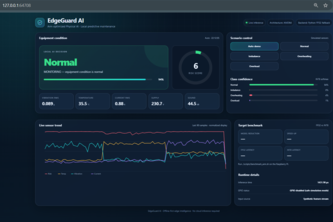
Smarter Machines. Safer Labs. Powered by Arm Edge AI.
Memory of the Utopia™ — On-Device AI Vault That Can't Be Jacked. 4x faster, 100% local, Arm-optimized.
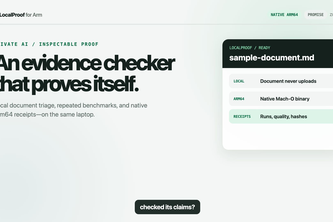
An offline evidence-gap checker whose optimization claims ship with reproducible native Arm64 receipts.
Lingot turns untuned LLMs into faster, cheaper, quality-validated deployments optimized for Arm cloud CPUs.
An ARM Cortex-M Physical AI system combining optimized AI crack detection and multi-sensor monitoring to generate adaptive health scores, component risk maps, and real-time maintenance decisions.
delete
AI SCADA for Floating City. 77% faster on Arm Cortex-M
YOLOX detection and a control policy on a Raspberry Pi 5, measured with the clock pinned. The policy drops from a 3.5 MB Transformer to 75 KB of NEON: 4777 us to 3.67 us on one core.
FLOPs lie about energy — memory access costs ~100× more than compute. Joulehound measures what AI agents actually burn on Arm silicon, proving the NEXUS metric tracks real joules while FLOPs don't.
On-device acoustic intelligence for post-harvest loss prevention.
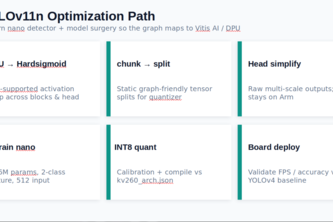
Edge posture AI on Kria KV260: proven YOLOv4 baseline, then YOLOv11 model surgery + INT8 for Arm DPU.
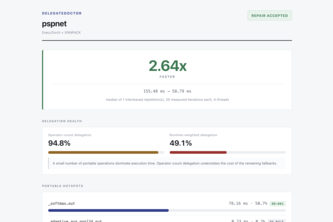
DelegateDoctor finds the ExecuTorch/XNNPACK fallback actually slowing your Arm model, applies proven repairs, and keeps them only if a real Android phone proves they are correct and faster.
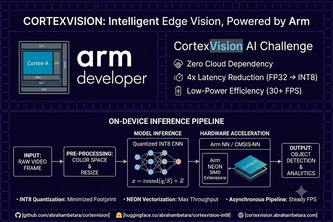
CortexVision: Intelligent edge vision, powered by Arm.
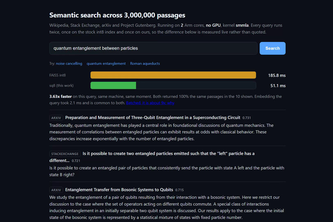
5.8x faster local retrieval on Apple M4 with 74.7% less corpus memory—and an automatic Recall@10 brake pedal.
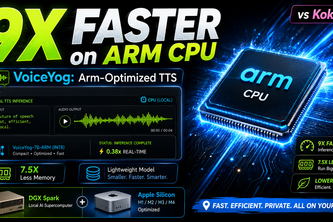
An Arm-optimized TTS model, small and fast enough to run on DGX Spark and Apple Silicon Arm CPU - no GPU, no internet, no cloud API. 4.8x smaller, 8.6x faster than Kokoro. Demo narrated by it.
Capture moments from Reels, YouTube Shorts, or TikTok and turn them into interactive language lessons with on-device transcription, translation, subtitles, and tap-to-learn vocabulary.
FTIR spectral agent retrieval kernel optimized for Arm64 — real cross-architecture benchmark, reproducible on GitHub Actions ARM runners.
Benchmarking energy-efficient vision-language model inference across Arm edge platforms, comparing CPU, NPU, and GPU acceleration for performance, power, and thermal efficiency.
Naive INT8 quantization is 100x SLOWER on Arm without the right kernel. We show the trap and the real fix, benchmarked live on a Raspberry Pi 5.
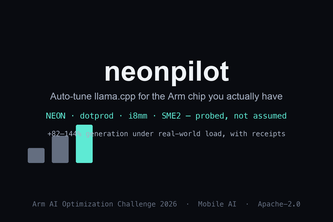
Probes your Arm CPU (NEON, i8mm, SME2), auto-tunes llama.cpp with honest statistics, and proves it: +82–144% faster LLM generation under real-world load — with machine-recorded receipts.
Real-time, camera-based 3D drone localization optimized for Arm edge hardware, combining AI and classical vision for GPS-denied autonomous flight.
Quantizing to int8 on Arm costs 65% of your throughput. We measured why, then built the kernel that fixes it: 9.1x faster than the fastest working FAISS int8 mode, at better recall.