Devpost
Participate in our public hackathons
Devpost for Teams
Access your company's private hackathons
Grow your developer ecosystem and promote your platform
Drive innovation, collaboration, and retention within your organization
By use case
Blog
Insights into hackathon planning and participation
Customer stories
Inspiration from peers and other industry leaders
Planning guides
Best practices for planning online and in-person hackathons
Webinars & events
Upcoming events and on-demand recordings
Help desk
Common questions and support documentation
Sort by:
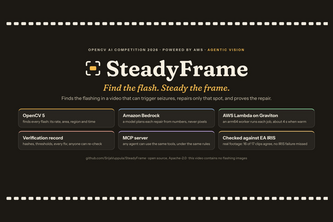
Finds the flashing in a video that can trigger seizures, repairs only that spot, and re-checks its own repair. The model picks the fix; OpenCV decides if it worked.
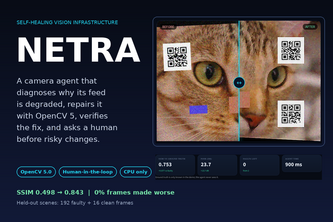
A camera agent that diagnoses why its own feed is degraded, repairs it with OpenCV 5, verifies the repair, and asks a human before risky changes.
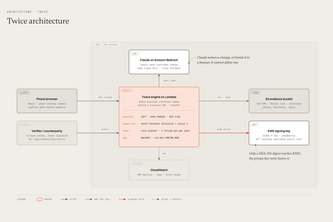
Take the same photo twice. See what really changed. Sign the proof. OpenCV 5 evidence for renters, with an agent that rules out reflections and shadows.
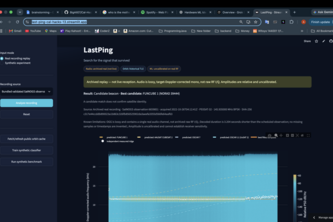
Turning satellite radio recordings into visual evidence of possible matches.
Compact Slack-Free
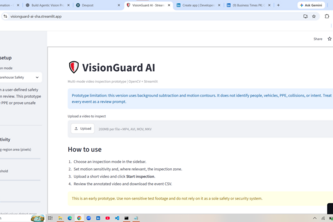
An OpenCV-powered video inspection prototype that detects moving regions in video footage through an interactive dashboard built with Python and Streamlit.
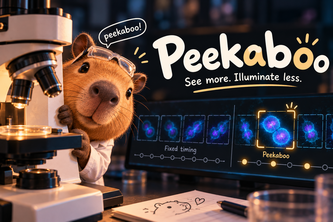
Cells need a break from the spotlight. Peekaboo uses cell shape to choose when a microscope should take its next picture, aiming to capture key moments with fewer light exposures.
Anneal is the agentic F1 asset manager for anything vehicle hardware. In the racing world, Anneal automates every process involved with maintaining an F1 car, with people approving only what’s new.
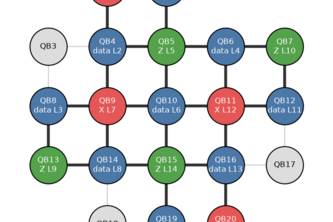
Our project builds that whole pipeline for a distance-3 rotated surface code, which uses 17 qubits, and runs it on IQM's Garnet processor.
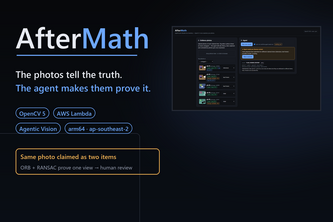
AfterMath — an agentic post-disaster loss inventory. OpenCV 5 cross-examines your photos; an agent turns the findings into decisions. The photos tell the truth; the agent makes them prove it.
We use neutral-atom quantum simulation to group customers and plan delivery routes, reducing the required atom count and testing our results against classical solutions.
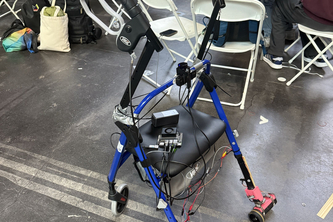
An AI-powered smart walker that uses LiDAR, depth sensing, and autonomous navigation to help visually impaired individuals move through unfamiliar environments with greater confidence and independence
Vehicle routing on neutral atoms: a slack-free QUBO and a provably valid “ladder” atom layout cluster deliveries with 8 atoms, hitting optimal plans 40× more often than random.
EchoRoute: a decision framework that routes each hidden OTOC circuit to exact, MPS or Pauli-propagation simulation and spends compute only where estimates move.
An AI agent that listens to a machine's vibrations, runs its own speed tests to diagnose the fault, keeps production running safely around operator deadlines, and verifies the technician's repair.
Routing delivery fleets with neutral atoms: a CVRP solver that fits the problem to the physics, using as few as 4 atoms per instance.
A classical simulation field guide to quantum echoes—what worked, what failed, and why 38 qubits became the frontier.
“Budget-aware agentic visual inspection: OpenCV 5 + COOL on AWS Graviton4, with a human in the loop.”
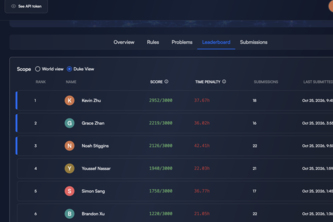
Estimating OTOCs on 36-38 qubit circuits with BlueQubit: exact statevectors, MPS, and per-qubit-tuned Pauli-path methods used. Scored 2,198/3,000, including a perfect 800/800 on a 6x6 grid.
AI finds the creative moments in hours of camp video; staff make the final call.
Photo and video search for Dreams Come True: describe a moment in plain words and find it in milliseconds, privately on one laptop.
Scan your ER bill. See which charges don't match the hospital's own prices, whether California law entitles you to free or discounted care, and get the letters to ask for it.
A highly flexible end-to-end pipeline to create and send logical qubit circuits to IQM, with customizable compiling & optimization options, swappable noise models/decoders, and measuring ε_L error.
Paratransit, minus the guesswork