-
-
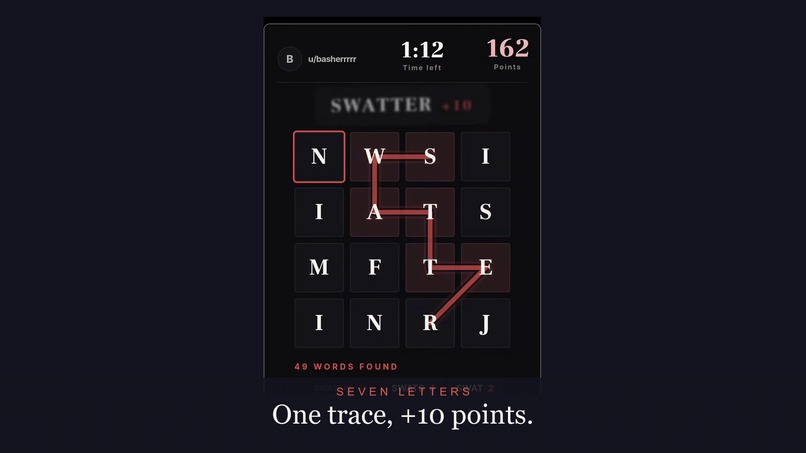
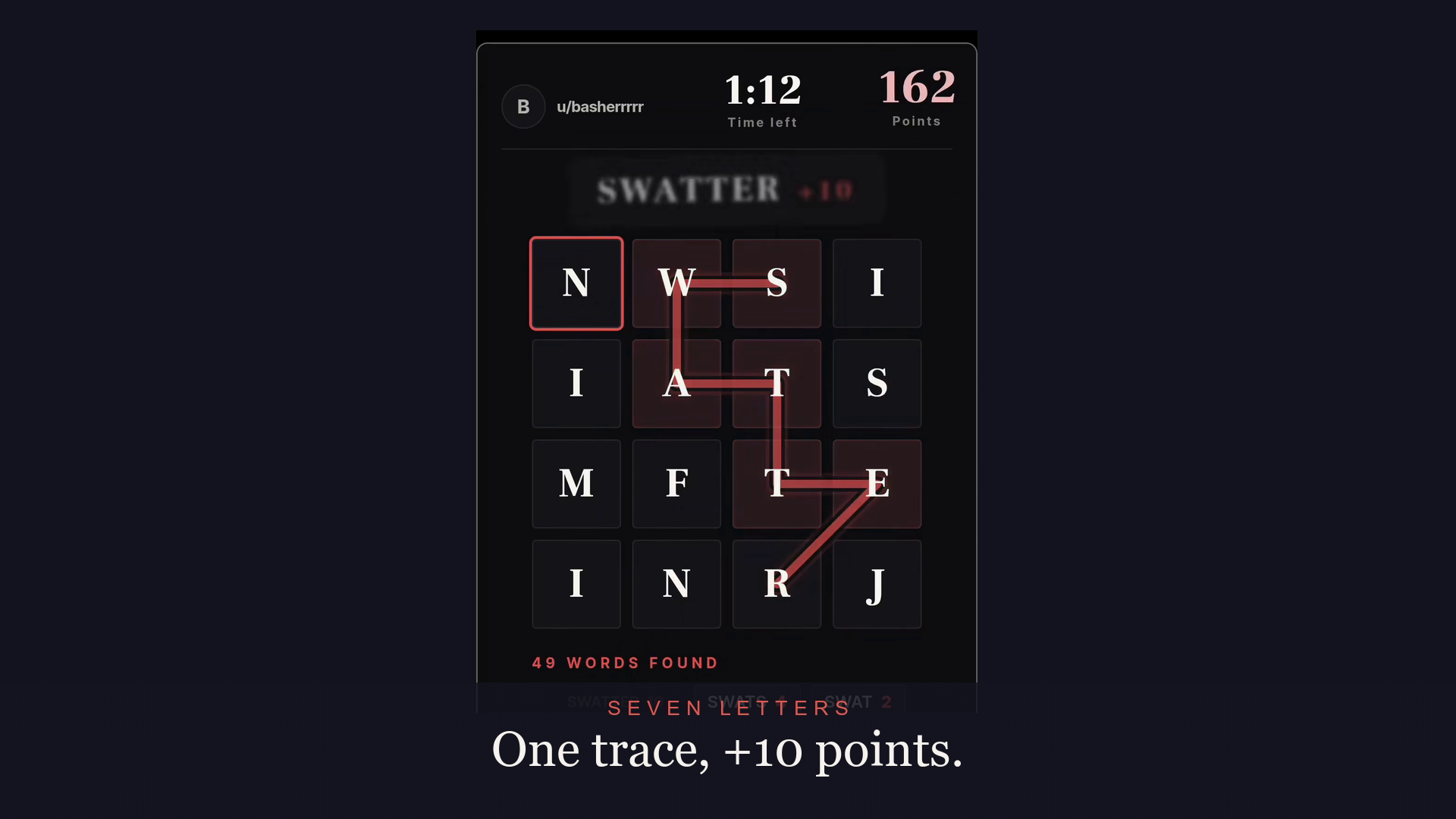
Trace letters across the grid. Longer words score more, and a seven-letter find lands a bonus. The whole game in one move.
-
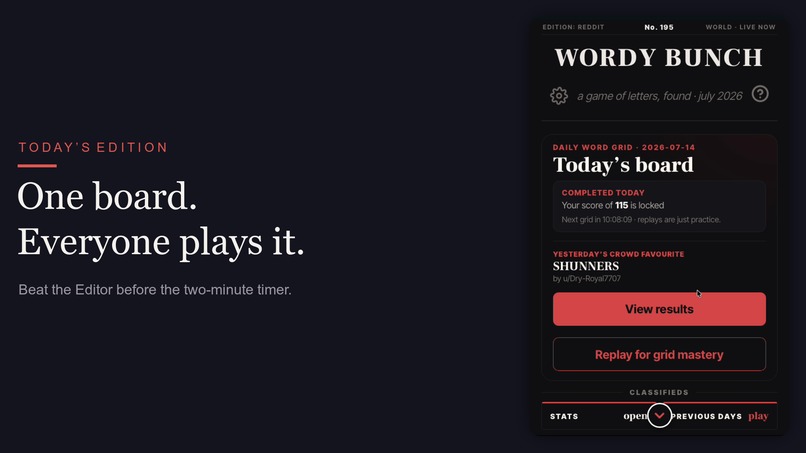
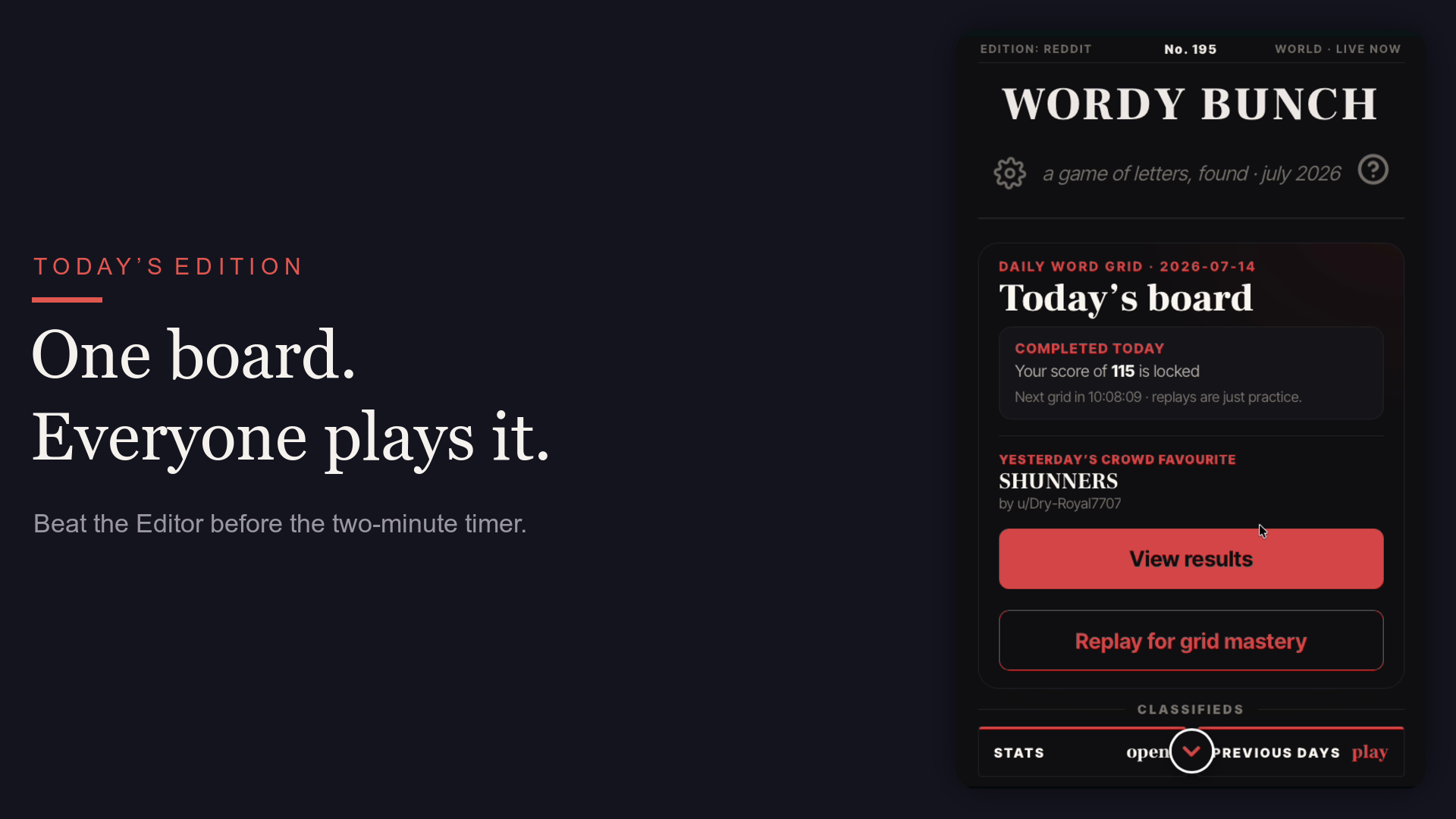
Everyone gets the same grid each day and two minutes to beat the Editor's score. One board, shared by the whole sub.
-
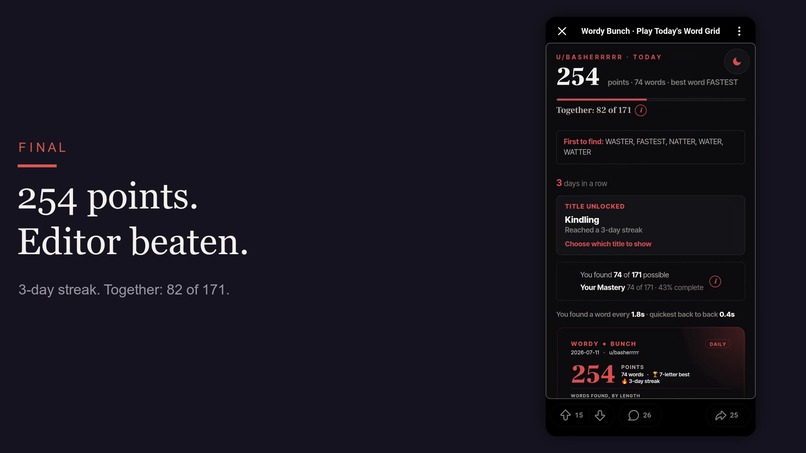
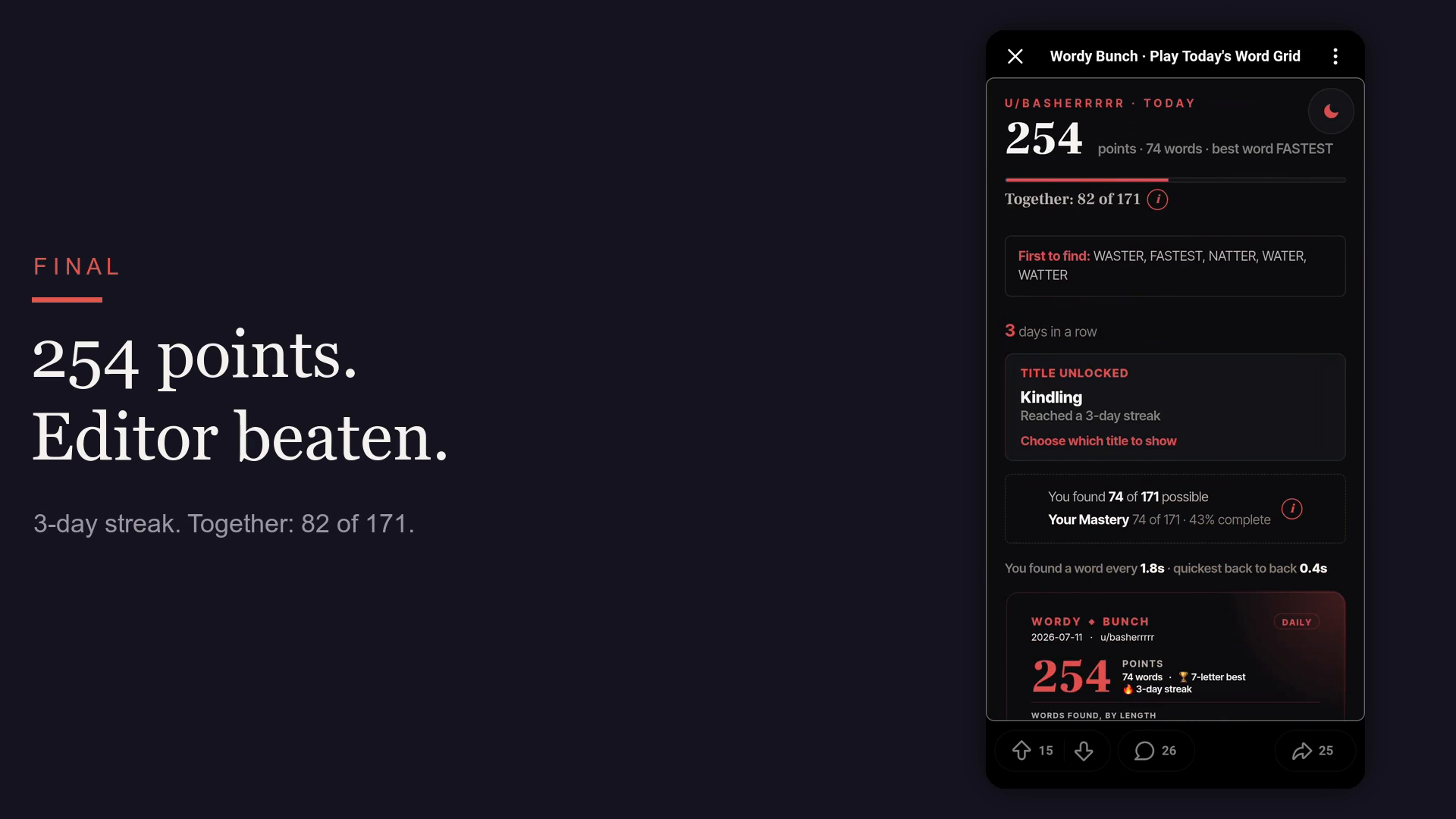
The result screen. Beat the Editor, bank the score, keep the streak alive. A clear reason to come back tomorrow.
-
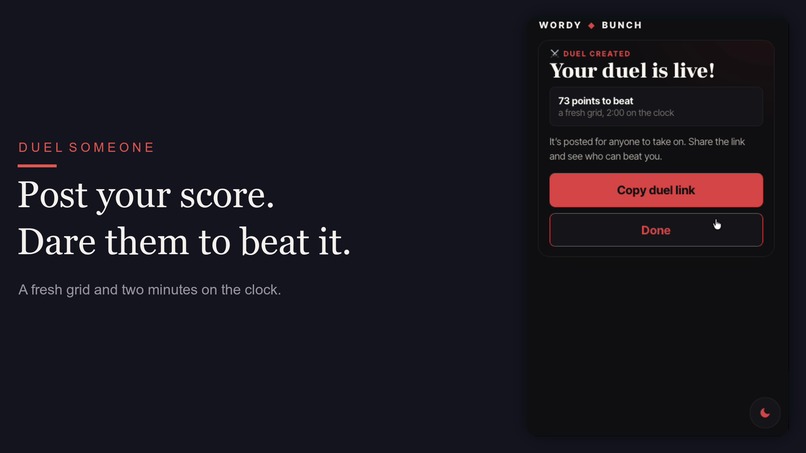
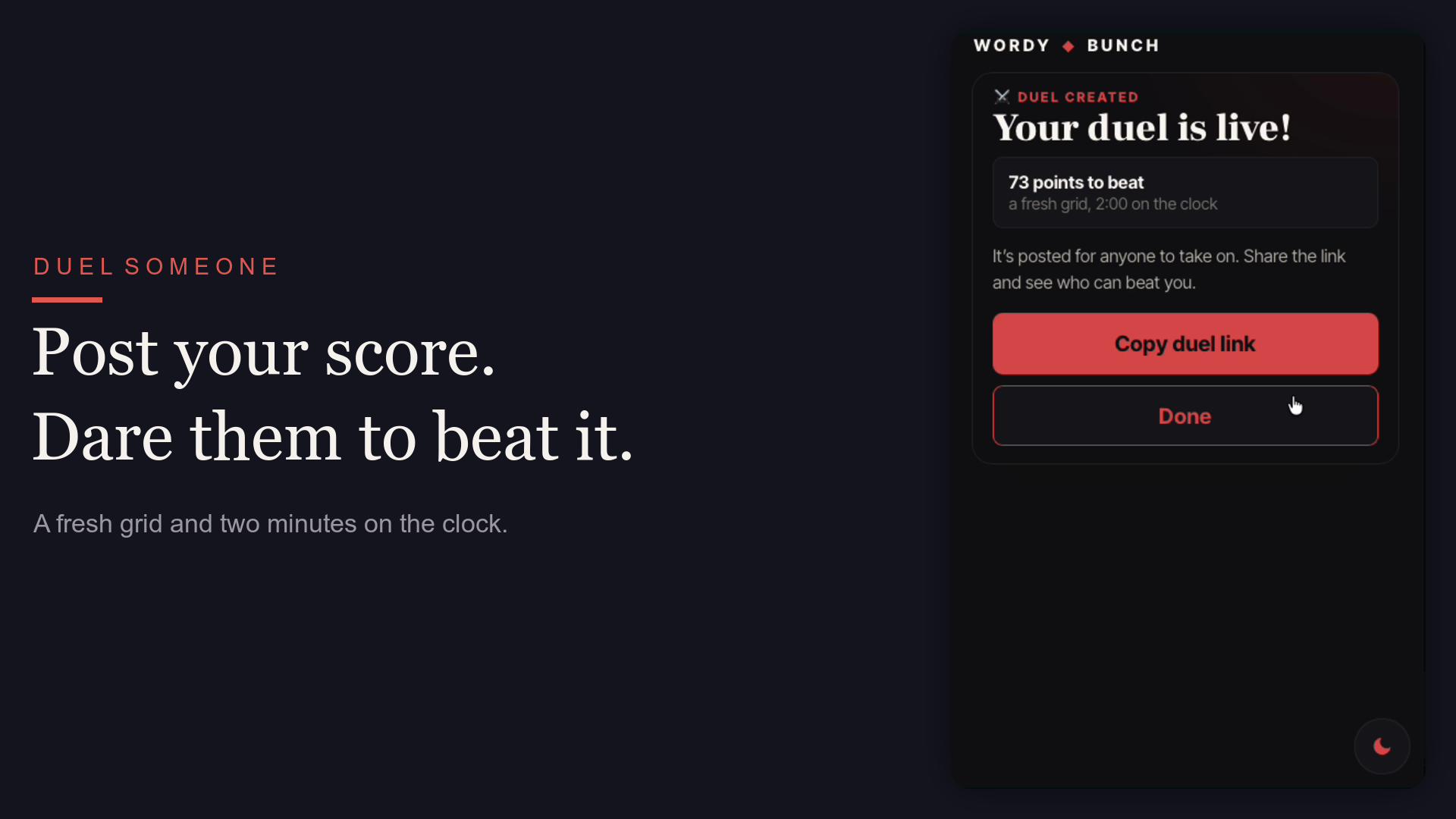
Post your board as a duel. A fresh grid on a two-minute clock, and anyone can take the link and try to beat you.
-
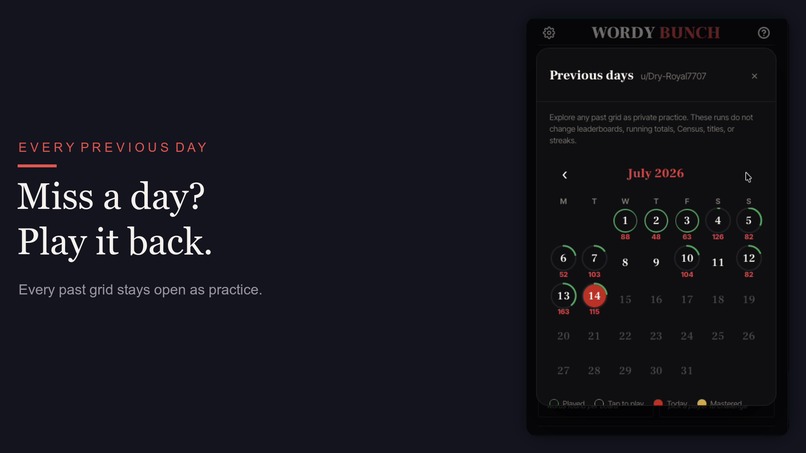
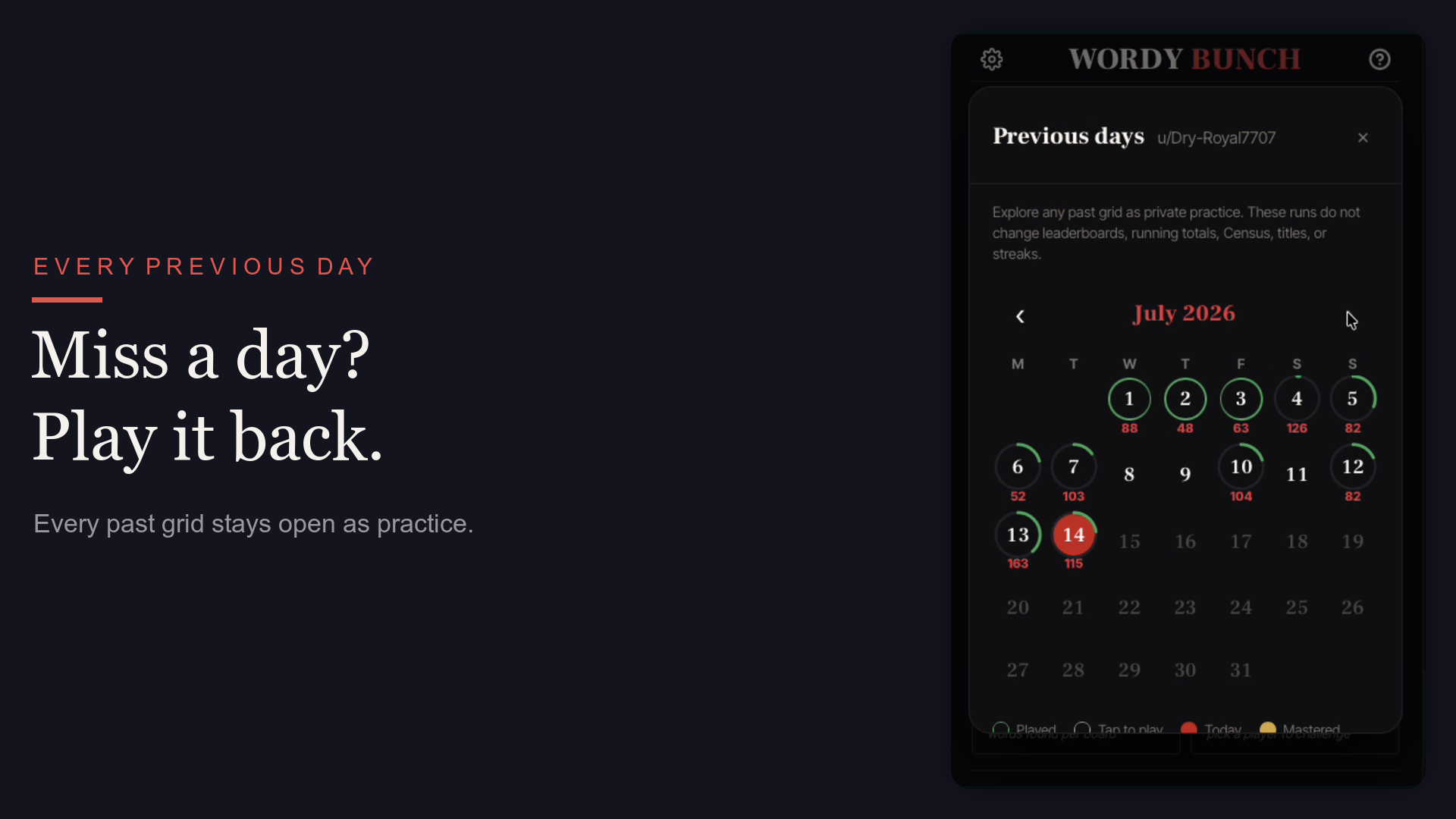
Every past grid stays open as practice, so a missed day never means a locked-out board.
-
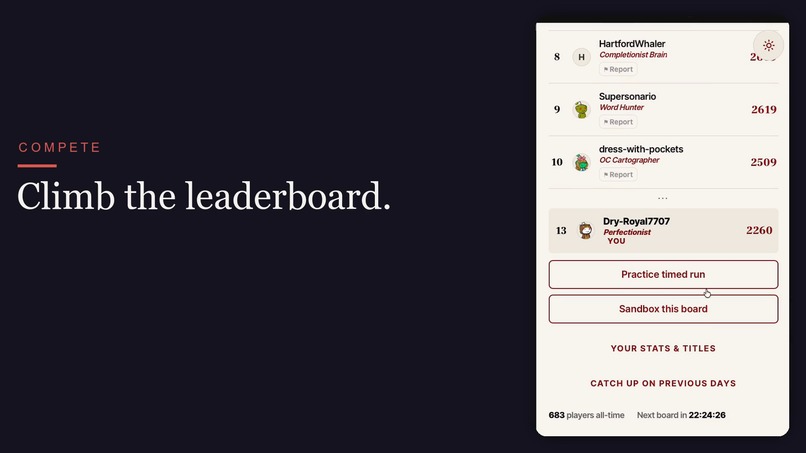
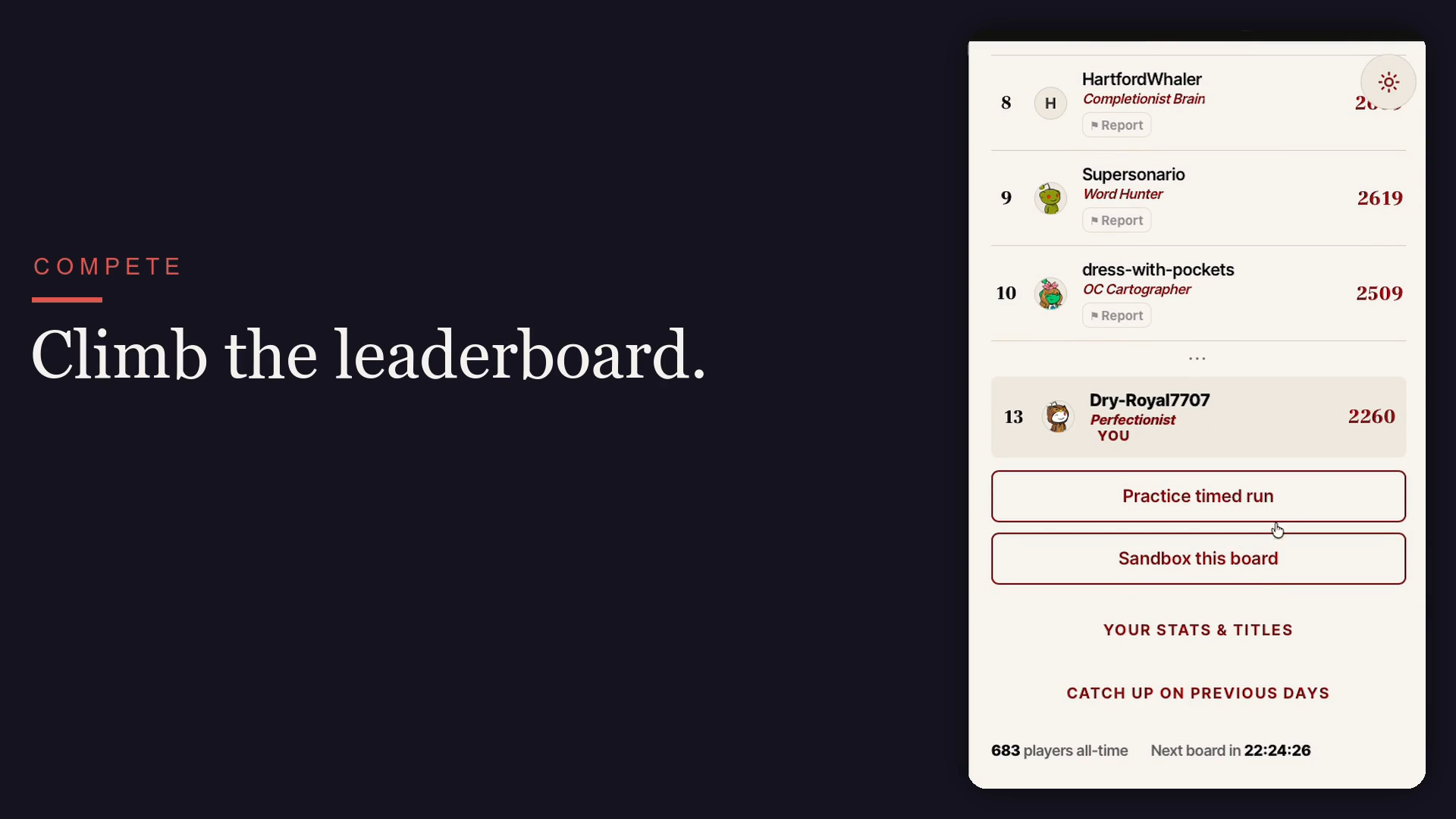
A live leaderboard on every board. Climb past other players and hold your rank before the next grid resets.
-
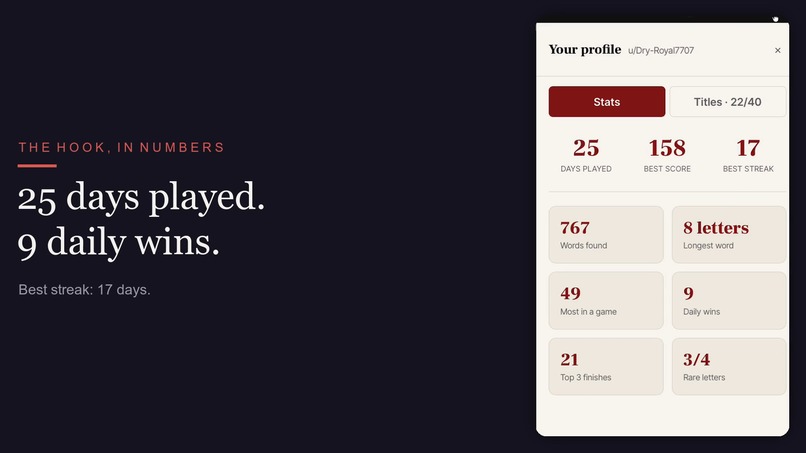
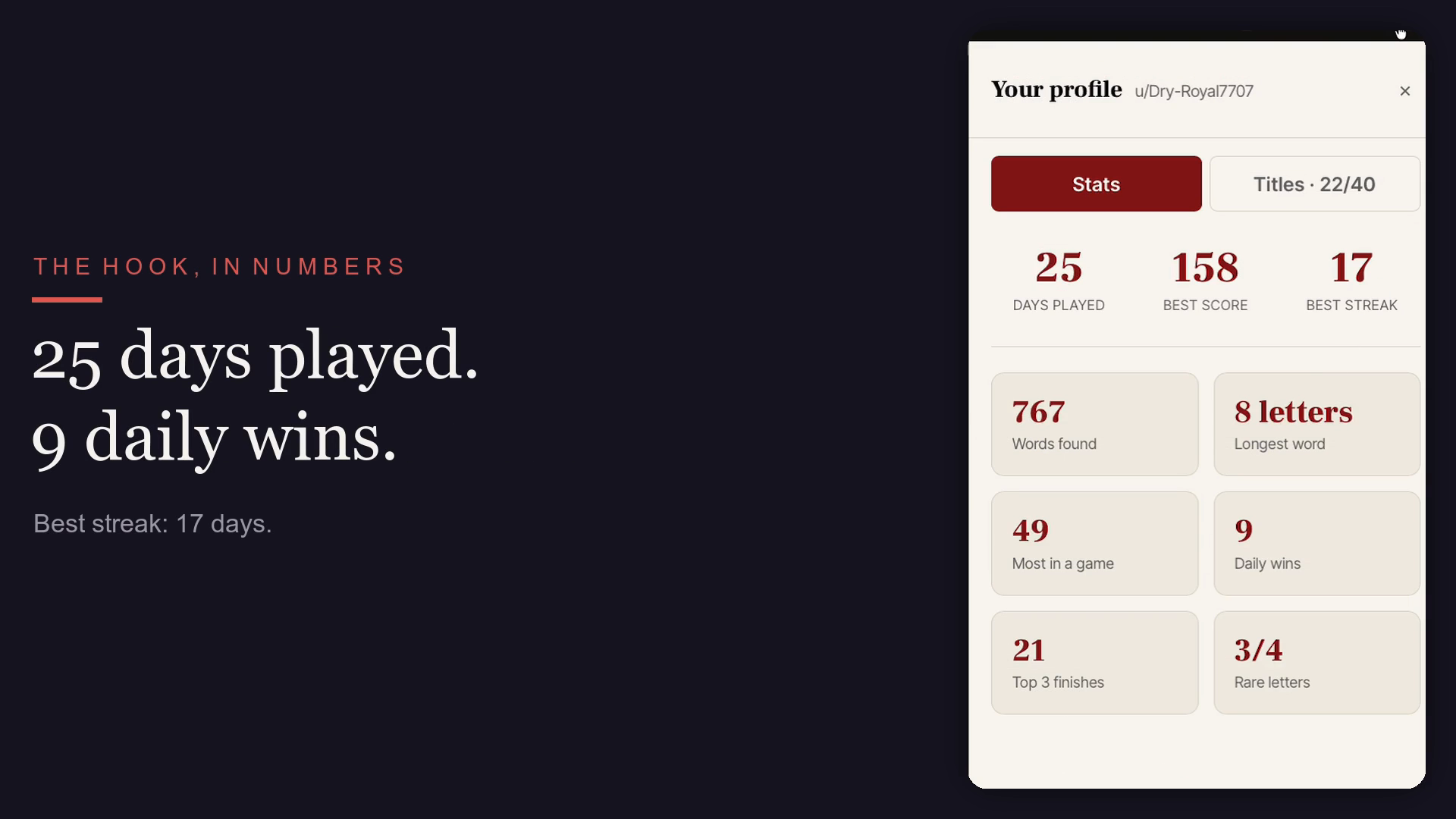
Your profile tracks days played, best score, and longest streak. The numbers are the hook that pulls you back.
-
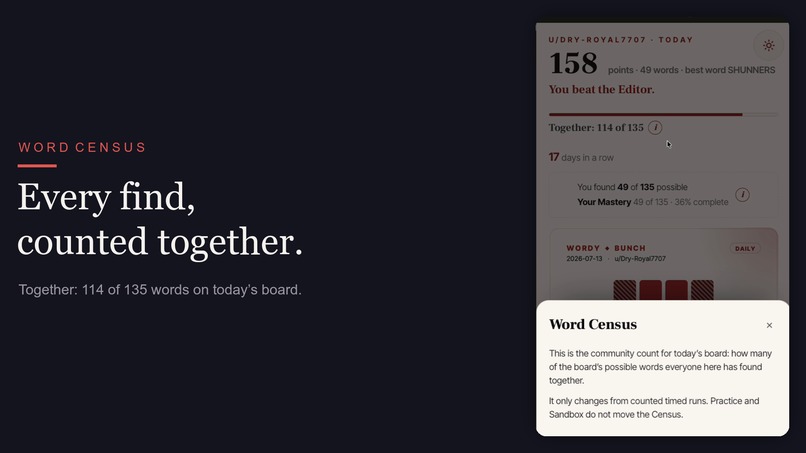
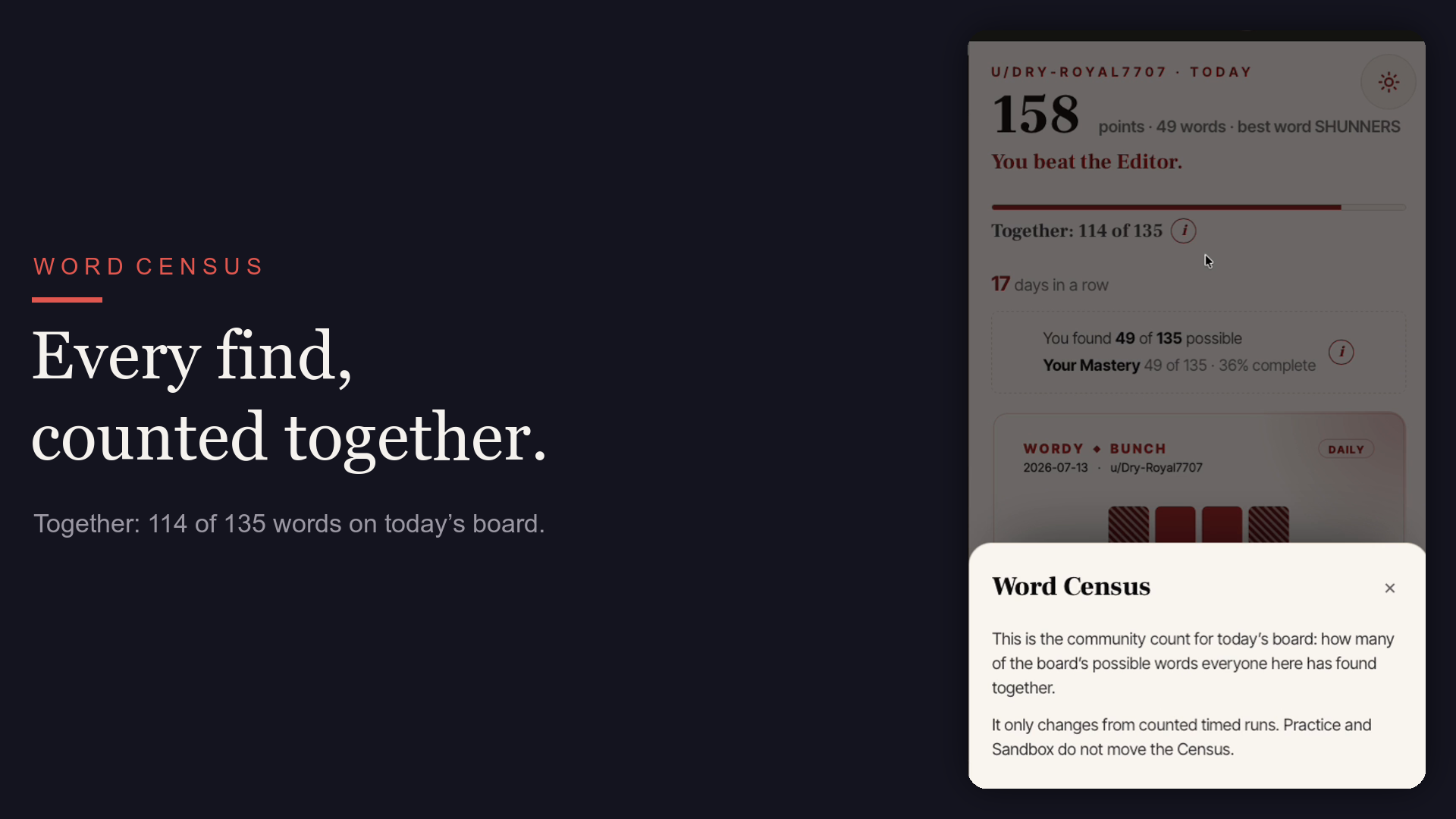
The Word Census counts every find the community makes on today's board. Progress you build together.
-
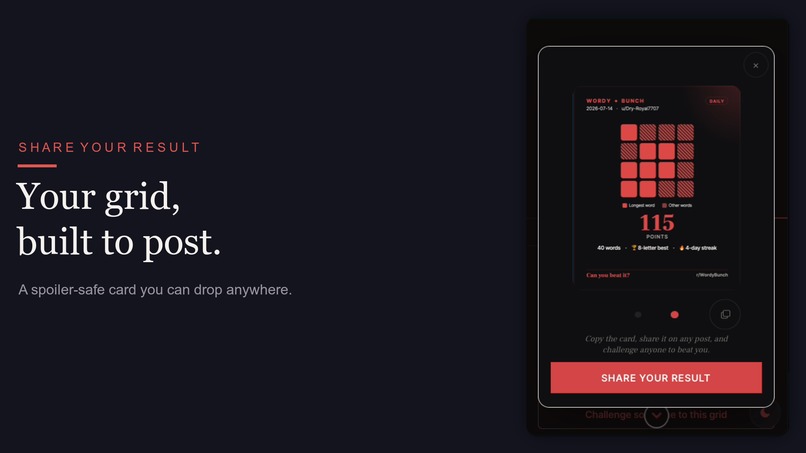
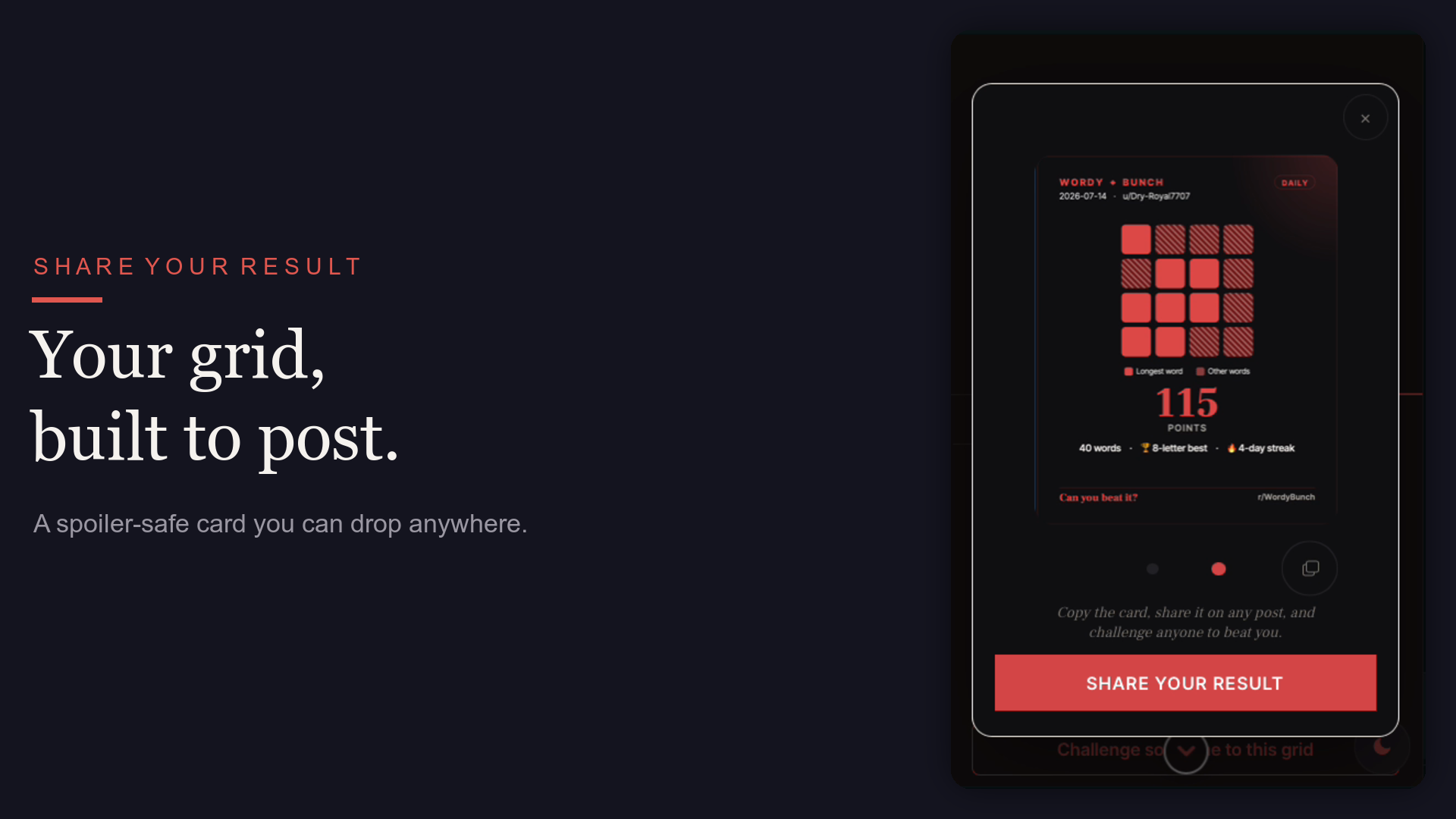
A spoiler-safe result card, built to post anywhere. Share your grid and challenge someone to beat it.
-
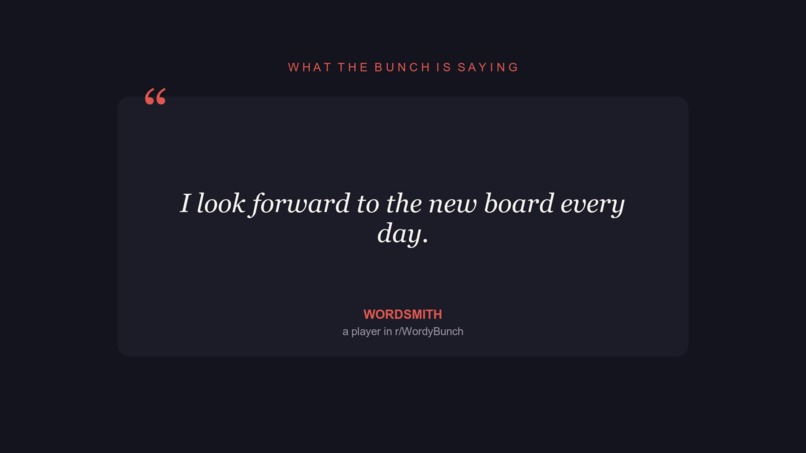
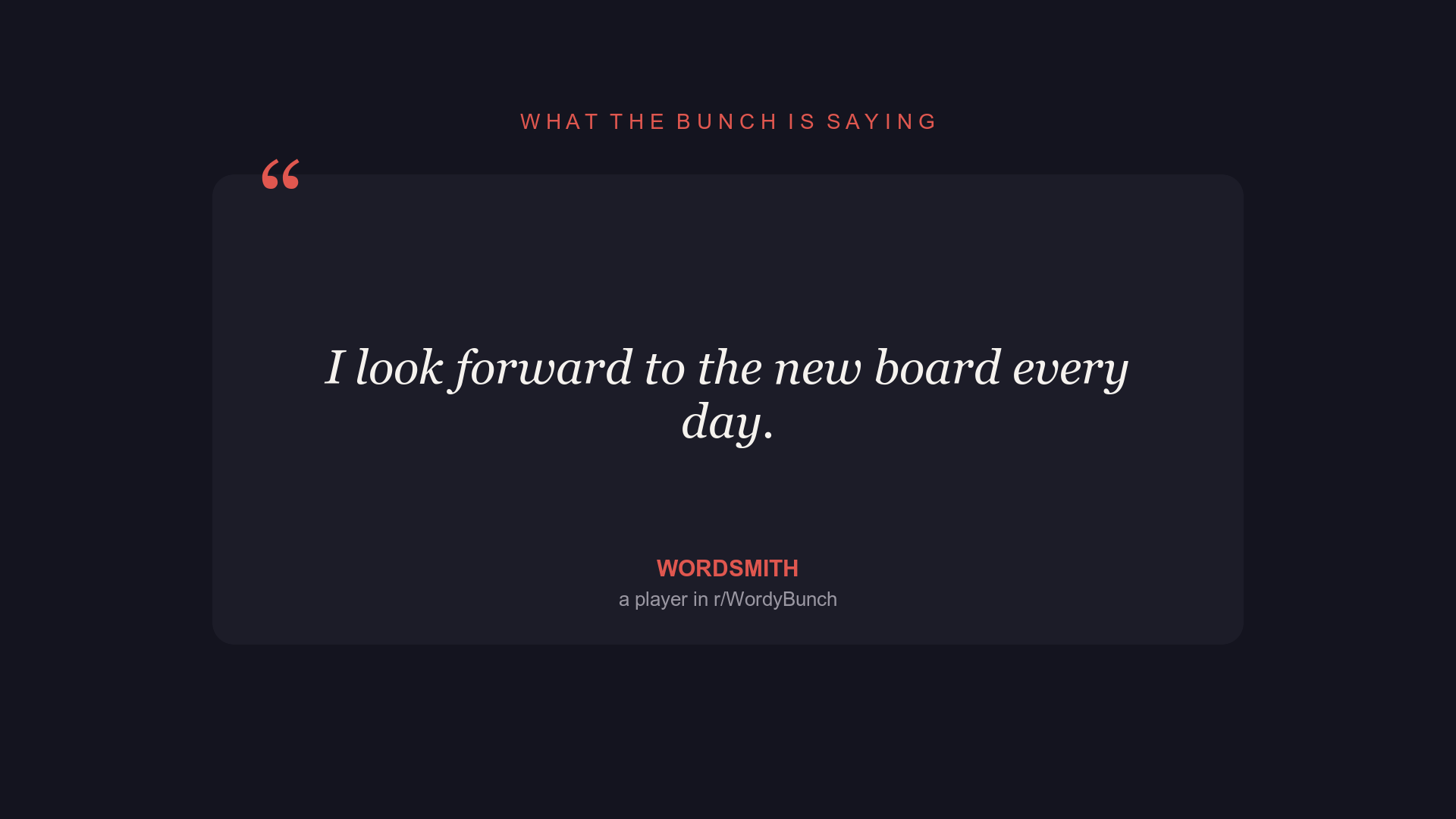
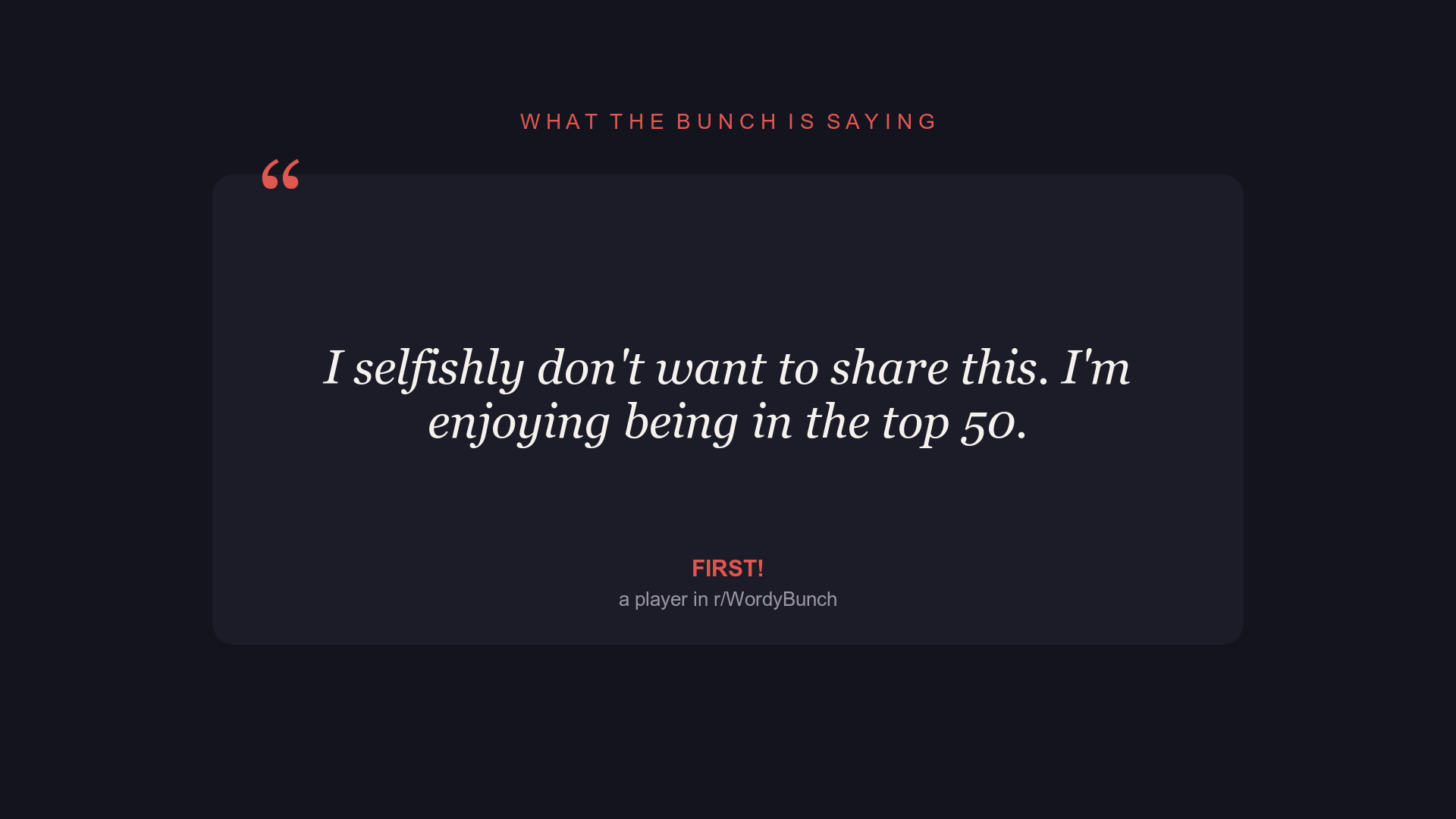
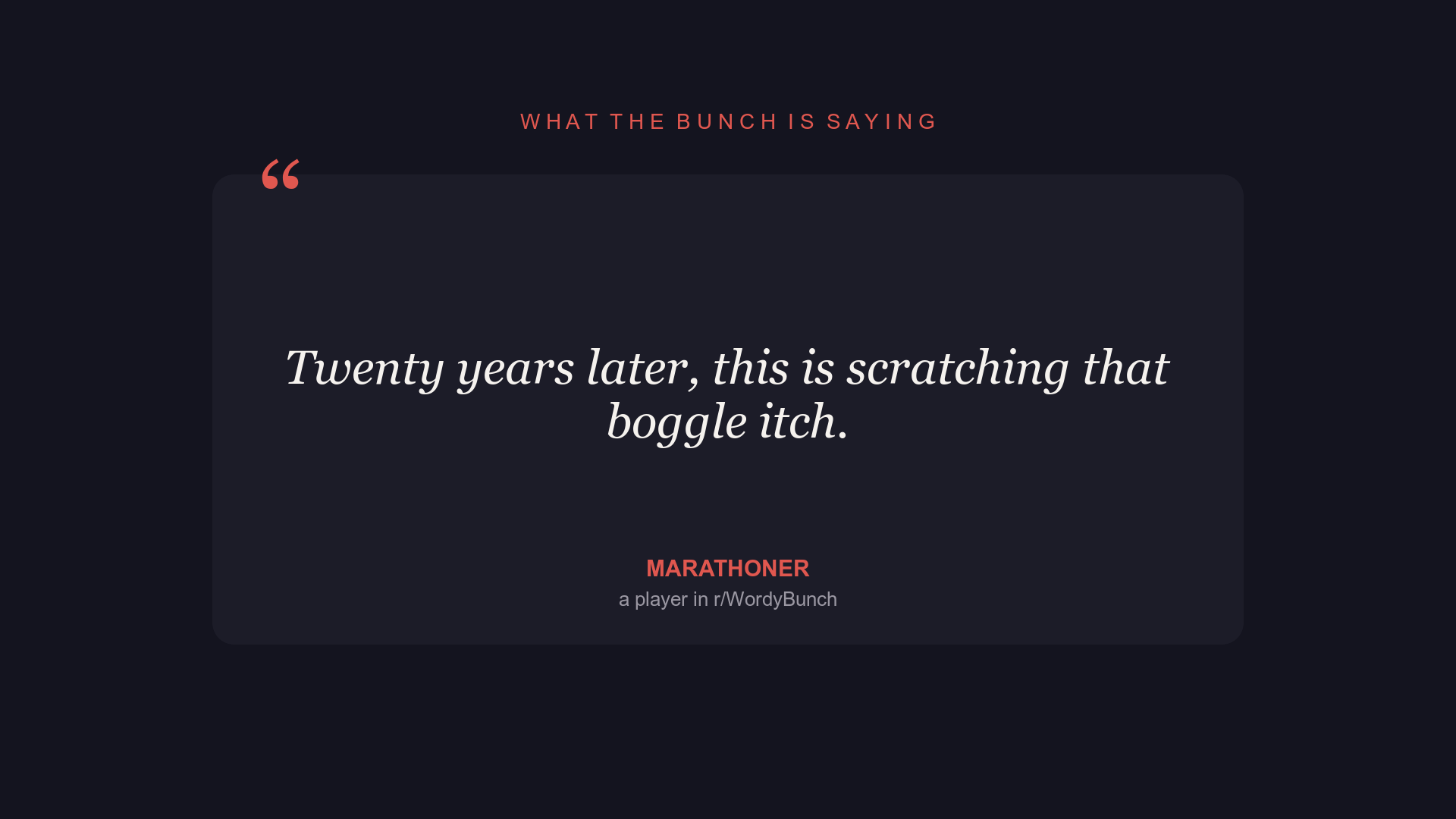
What players say, verbatim from r/WordyBunch. Return intent, straight from the community.
-
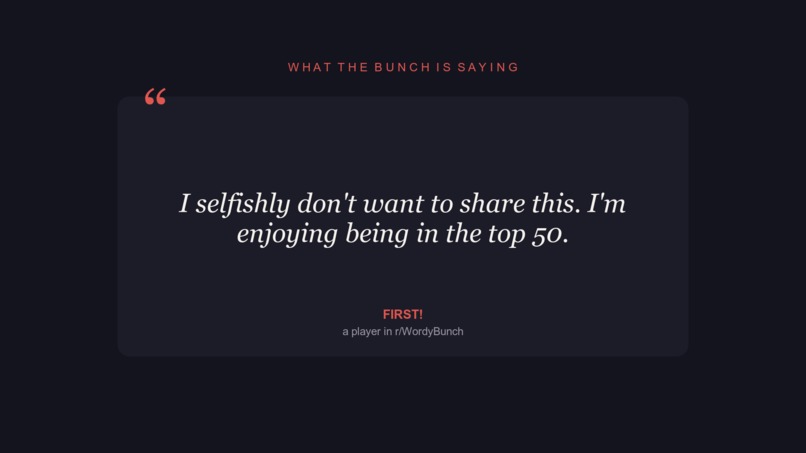
A verbatim player quote from r/WordyBunch.
-
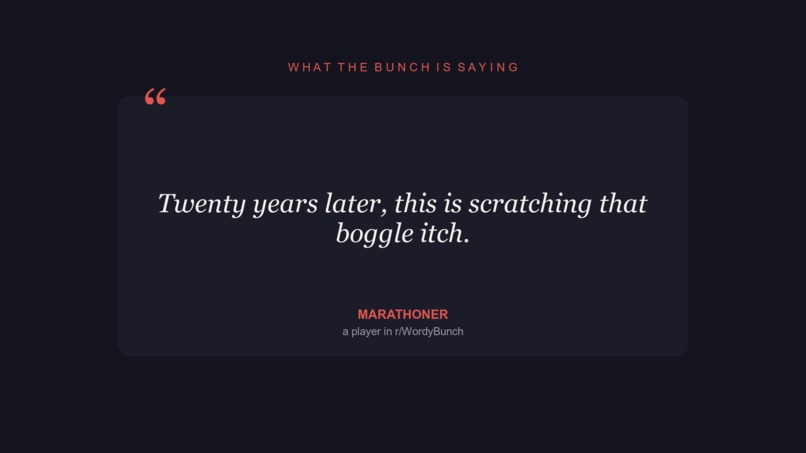
A verbatim player quote from r/WordyBunch.
-


Why I made it
I'm one person, and I built Wordy Bunch because I wanted a small daily word game with nothing in the way. No app to download and no sign up, you just open the post and play. It's free and there are no ads.
Part of what pushed me was reading r/bogglewithfriends, the community around Zynga's Boggle With Friends. Those players love the game underneath but are worn down by it: pay-to-win power-ups that turn a thirty-second round into whoever spent the most, and a game Zynga has clearly left to coast on ad money. That frustration reaffirmed exactly what I wanted Wordy Bunch to be: no ads, no pay-to-win, everyone on the same board, and a game I'd actually keep looking after.
Daily games work because everyone gets the same puzzle and something to compare afterwards. Reddit already has the communities and the friendly rivalry, so rather than send people off to another app, I wanted the whole loop to happen right there in the post.
What it is
Every day a fresh word grid gets posted to the community. You trace through touching letters to spell words, by dragging, tapping or using the keyboard, and the longer the word the more it's worth. You get two minutes.
Your first run is the one that counts on the daily board, and after that you can keep replaying for practice. Every subreddit gets its own daily, weekly, monthly and all-time boards, so the competition belongs to that community instead of one giant global list. It all runs inside the post, with nothing to install.
Coming back day after day (retention)
I wanted the reasons to return built into the game itself, each one feeding the next.
- A brand new grid every day, posted automatically, so there's always a fresh reason to open the post.
- A daily streak, plus a Streak Shield that quietly covers one missed day a month, so a single slip doesn't undo weeks of progress.
- Opt-in reminders that arrive at 9pm in your own local time, so the nudge lands when it's useful instead of the middle of your night.
- Beat the Editor, a house rival who sets a fresh target score every day, so even an empty board nobody's played yet gives you something to chase.
- Seasons: an always-on League hub with live standings, and a Champion crowned at the end of every month.
- A calendar for going back and playing boards you missed, so falling a few days behind never means giving up.
- Sandbox and Mastery: once your ranked run is done, you can play any board with no clock and hunt down every last word, and Mastery tracks how many boards you've fully cleared, for the players who'd rather find everything than race.
- A ladder of 40 earnable titles, so there's always a next thing to aim for.
The community fills the game (user contributions)
Almost everything a player sees other people doing is real play, not content I wrote.
- Battle Duels: when you finish a grid you can post an open "beat my score" challenge seeded with your own result. Anyone can play the same grid to top you, and the app drops a new-leader alert on the duel the moment someone does.
- Best Finds Ballot: players vote for the community's favourite word of the day, and the winner earns a Crowd Favourite title.
- Word Census: after every round the game shows how many other players found each of your words, a live picture built entirely out of everyone's play.
- Shareable result cards: you can share your finished grid as an image with a breakdown of every word you found by length, and every challenge you send carries that card, so the day's puzzle travels in the player's own hands.
- Profiles and flair: earn a title and the game sets it as your subreddit user flair automatically, so your standing shows next to your name across the whole community.
Every leaderboard and league standing comes straight from real player results, so the community generates its own rankings. The more people play, the richer the game gets.
Some of the game exists because of the community too. Because it's built on Reddit, players could tell me what was missing right in the comments. Sandbox Mode is the clearest: that private, no-clock way to keep completing a board came straight from players who wanted to keep going after the timer ran out, and it's one of my favourites now. The alternative share card, a lighter style with a colour legend, came the same way.
Everyone should be able to play
Someone in another daily word game community asked me a plain question: if a person can't use a mouse, can they actually play this? The honest answer was no. The board only woke its keyboard controls after the first tap, so a keyboard only player was locked out before they ever reached the grid. They were right, and that gap had been sitting there the whole time without me noticing it.
So I fixed the whole path, not just the corner they hit. You can play the entire game start to finish with no pointer at all now. The board takes focus the moment a round begins, you move a cursor with the arrow keys, pick letters with enter and undo with backspace. That opened onto a proper pass over everything else: an ARIA grid a screen reader can actually read, spoken announcements for the timer and your words, focus that gets trapped and handed back around every dialog, motion that backs off when the system asks for it, bigger touch targets, and contrast checked against the standard. A test suite walks all of it so it can't quietly rot.
Colour is part of this too, and that's the bit my old trade pushed on. I trained as an optometrist, so a result card that leans on red and green to mean something makes me wince. The tiles carry their state in shape as much as colour, a solid block, a hatched one, a bare outline, so nobody has to read by colour alone.
It isn't finished and there's more I want to do, but I care about this part more than almost anything else in the game. Something that lives somewhere as public as Reddit should be something as many people as possible can genuinely sit down and play.
How I built it
It runs on Reddit's Devvit Web platform, built with React, TypeScript, Vite, a Hono server and Redis.
The client handles the grid, the tracing, keyboard input, the animations and the accessibility states. The tracing is one pure reducer shared across drag, tap and keyboard play, with a custom mobile hit-test so it feels reliable inside Reddit's webview.
Scoring happens on the server. The dictionary and the solver are build-time tools, they never ship to players. The client only gets the board, and the server checks each submitted word against that day's pre-baked answer set before it records a score. The leaderboards are Redis sorted sets, kept separate per subreddit and per time window, and only your first attempt of the day is ranked.
A lot of the work is hidden in the boards themselves. A grid that's fun for a first-timer and one that's fun for someone who plays every day aren't automatically the same, and getting that right is where I leaned hardest on the statistics I studied at college. I generate boards in bulk and measure the distribution across hundreds of them, everything from how many words each one holds to how common or rare those words are. From that I calibrated difficulty profiles, so a beginner's board comes out dense with common words and never dead-ends on an awkward tile, while a tougher board still rewards someone hunting down the long, rare finds. Only boards that land inside those targets get baked in as a daily.
I put as much time into how it feels as what it does. The interface went through pass after pass with one balance in mind: giving Wordy Bunch its own editorial, newspaper-inspired identity instead of the flat look a lot of word games settle for, while staying simple enough that anyone can pick it up and play in seconds. A board you can read at a glance on a phone, and a calm screen rather than a busy one.
The honest answer to how I built it is in every spare minute I had. I came to Devvit knowing none of it, so a lot of the early weeks were reading docs and getting things wrong before they came right. For about eight weeks it was the first thing I opened in the morning and the last thing I closed at night, usually well past 4am.
What was hard
The hardest part was making it feel like it genuinely belongs in a Reddit post. Mobile tracing inside a webview needed far more tuning than a normal browser game, because a single missed tile feels unfair in a timed round. Each tile ended up with two hand-tuned catch zones, one shaped for straight swipes and a rotated one for the diagonals, so a quick flick starts from the exact tile you touched and a lazy diagonal stops grabbing its neighbours. I tuned those by hand on a real phone until the dropped letters and the wrong grabs stopped.
Keeping scores honest was the next problem, and the deep one. The first move was to stop trusting the client at all. When you submit, the server re-runs your whole round from the raw traces against that day's answer set and works out the score itself, so the number your device claims never counts for anything. That kills the obvious cheat. The harder one is a solver that submits perfectly valid words and looks clean on paper, and the only way to catch it is to judge how the round was played rather than what was in it. The server keeps its own record of when each word actually landed, which a faked client can't move, and reads the rhythm of the round from that. A few things are damning on their own, like a round handed in before it could physically have been played, or two traces overlapping in time when one finger can't draw two paths at once. Others are softer, like a long word found quicker than a person could spot it, or a stack of words that only surface at the buzzer, and it takes several of those agreeing before a run is touched, so one odd round never punishes a genuinely fast player. The thresholds sit above a real, verified human game, with room to spare, because a prodigy isn't a cheat.
There's a quieter layer under all of that. Because the game runs on the open web where the client can be poked at, every run carries a one-time tripwire tied to that exact round and player. An honest game never trips it. If it ever fires, the run is held on the spot, and the token can't be lifted and replayed into another game.
When a round does trip the line, nobody gets banned for it. It's held off every leaderboard and put in a queue for a human moderator, who can release it or drop it, and a release puts the score back exactly as if it had counted. Players can report a suspicious result too, and once a few different people flag the same person the mods get one heads-up with that player's history. Every call is reversible, and every call is a person's rather than the machine's.
Getting the result card to post as the player's own comment meant getting Reddit's on-behalf-of-user flow right, and that comment is part of what keeps the game living inside the thread.
The last hard part wasn't code at all. I came to Reddit completely fresh, and standing up my own subreddit from nothing, or getting an established sub to install the game, turned out to be far harder than I expected. Keeping my own community engaged and growing while still building the game became a second full time job, and I won't pretend that part has been easy. But I love Wordy Bunch, and the more I build it the more sure I am that Reddit was the right home for it.
There's one more thing behind all of this. I built Wordy Bunch while two years into rehabilitation after a near fatal motorcycle accident. It's a big part of why the small daily shape of this game came to matter so much to me, and why finishing it at all means more than a submission form can really hold.
What I'm proud of
It feels like a real Reddit game, not a web game with a Reddit link stuck on the front. It posts itself to each community every day, keeps a separate leaderboard for every subreddit, turns your earned title into your flair, drops your result card in as your own comment, and settles duels through Reddit messages with the outcome shown back in the thread. Take Reddit away and there's no version of this that still works, and that's exactly what I was aiming for.
The small stuff is in there too: words pop when you find them, the score ticks up, it plays fine on a keyboard, and it respects reduced-motion settings. On the making side, I'm proudest of the board generator, the quiet statistical engine that keeps every day's grid fair and full whatever your level.
More than any single feature, I'm proud that it's grown into a small community of people who are into the same thing I am. That was the part I wasn't sure I could pull off. And I'm proud of myself for getting it this far. Given what the last couple of years have looked like, the thing I'm most glad about is simply that I didn't give up on it.
What I learned
This taught me more than I expected, and only some of it was technical. I came in never having touched Devvit and came out having shipped a whole game on it, server and all. Devvit Web turned out to hold far more game than I expected inside a single post, and working inside its limits pushed the design somewhere good. The biggest lesson was that retention is a system rather than a single feature: the daily puzzle, fair ranking, streaks, the resets, the titles and the community all quietly feed each other, and pulling on one pulls on the rest.
I learned some things about myself too. That I could start something this big on my own and actually see it through, and that on the days it felt like too much I kept coming back to it anyway.
And I learned a lot about Reddit. Every subreddit is its own tight little world, with its own norms and its own way of talking, and what goes down well in one place gets you side-eyed in another. But underneath that they mostly want the same thing. Show up as a genuine, decent person who actually cares about what the community cares about, and nearly all of them will meet you halfway. That shaped how I built the game and how I show up around it.
What's next
More share-card styles, seasonal events built around the leaderboards, and a proper look at Devvit's realtime layer for small live modes, while keeping the daily post as the main habit.
Further out, and this is more hope than plan for now, I'd love to grow a small family of games under Brainy Bunch, with Wordy Bunch as the first of them. If it finds its people here, that's the direction I'd want to take it.
Built With
- css
- devvit
- hono
- react
- redis
- typescript
- vite



Log in or sign up for Devpost to join the conversation.