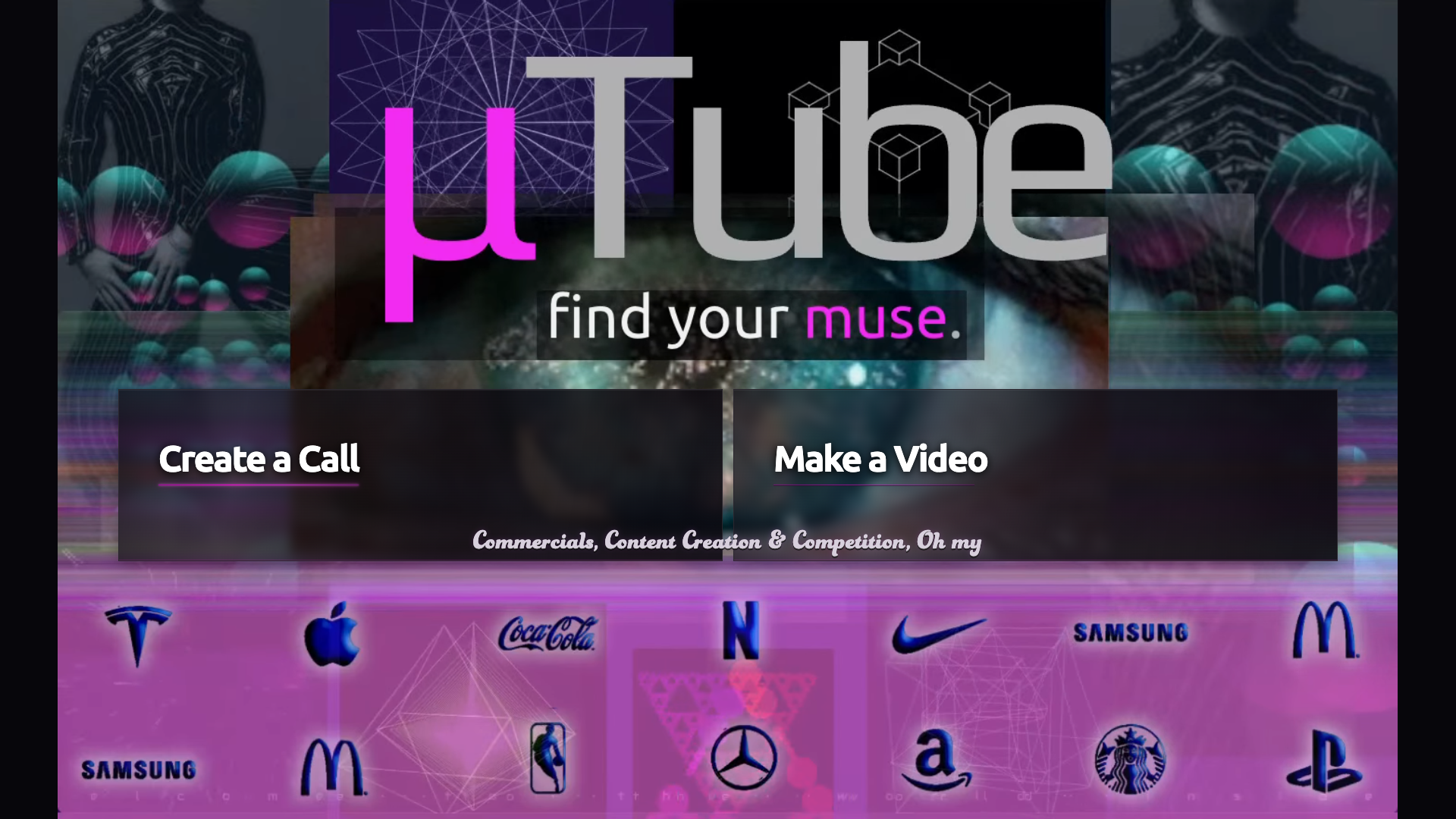
μTube — find your muse.
Inspiration
μTube came into focus during my second and third Devpost challenges. It grew from earlier ideas around smashTAG—a system intended to promote real-world interaction with retail locations through project rewards and personal ownership of metadata.
smashTAG
XMFB: A Presence-Based Protocol
μTube, under the right guidance, scales fast.
The most admirable thing about this vision is its potential to create a sustainable environment. As long as major corporations need and pay for advertising, there will be eager creative people who need both recognition and reward—not only for making something that connects, but for participating in the cultural field itself.
μTube is community-building first and foremost.
While the miracle of AI is filling our hard drives, collectively we are approaching an overflow of new imagination. But imagination alone is not enough. The deal breaker is whether we can innovate: create new systems, new incentives, and new places for people to participate meaningfully.
μTube is the product of innovation.
In 2020, amid a disastrous personal crisis and an ongoing social and cultural one, I became a tech activist. The learning curves were shear-face, each one just ahead of the automation wave we are all now riding.
Without a clear or directly accessible mean to actuate a product—and with an unceasing need to do so—After nearly six years of exploring every-possible path I could find, little was I aware, essentially, I had distilled moonshine.
μTube is the elevator, not the pitch.
On Easter morning in 2024, a single Reddit post about something entirely unrelated reframed a problem I already knew inside and out. It revealed a perspective I could not have reached on my own.
That insight revealed the scale of the idea: from a single-use application into a foundational platform capable of hosting any number of future iterations.
The post that reframed the problem
μTube is Disneyland.
If, by whatever graces exist under heaven, this Devpost challenge decides to declare this theme park open, it will help to know that the rides are only the beginning.
Once the platform is built, its investors are satisfied, and its daily users have made it their own, the more important work will also have been greenlit. What that work is, I can go on about for hours; yet to name it here would be antithetical to its purpose. But enough resources are attached to this Devpost entry that anyone willing to look—and keep digging—may eventually ask the same question I do:
Why does it take so long to set in motion?
What It Does
The symbol at the center of the project is μ. Historically, μ is mu: a letter, a signal, and a unit within a larger system. In μTube, it is also read as muse.
μ = Mu-se = Mu-Tube
μTube turns advertising into a public creative competition: sponsors fund a Call, creators answer it, and audiences determine what earns attention. But those are only the mechanics. How a thing happens—and how it evolves—is more significant than the happening, or even the evolution, alone.
μTube begins from a different premise.
Every theme-park builder worth their salt knows that as long as there is opportunity, and the ride is not half-bad, you are in business. Make the rides exceptional and the line starts here, then there, then there—until it stretches several times around the block.
So why are these rides exceptional? I am glad you asked.
Participation is always rewarded. No one who participates walks away empty-handed. The more one participates, the more one discovers new opportunity. Most importantly, these rules apply equally to everyone.
μTube is not automation. It is attention to user needs.
Content may be commercialized, but what people have to say is much, much more important. We lose the opportunity to listen when we are counting down the seconds until we can skip an ad.
μTube is designed as a system where advertising becomes a public good—and that public good shapes the experience within μTube, not the other way around.
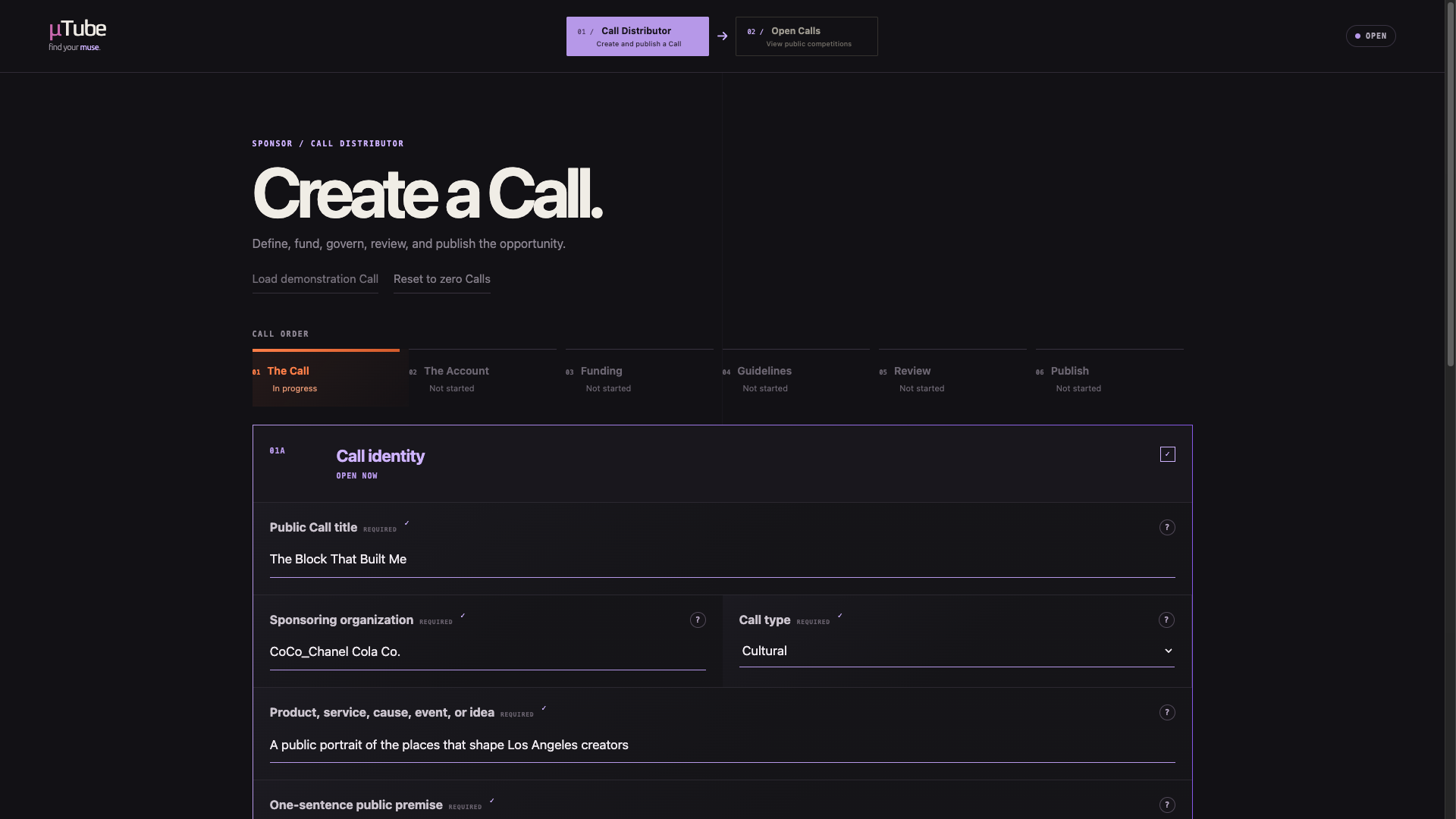
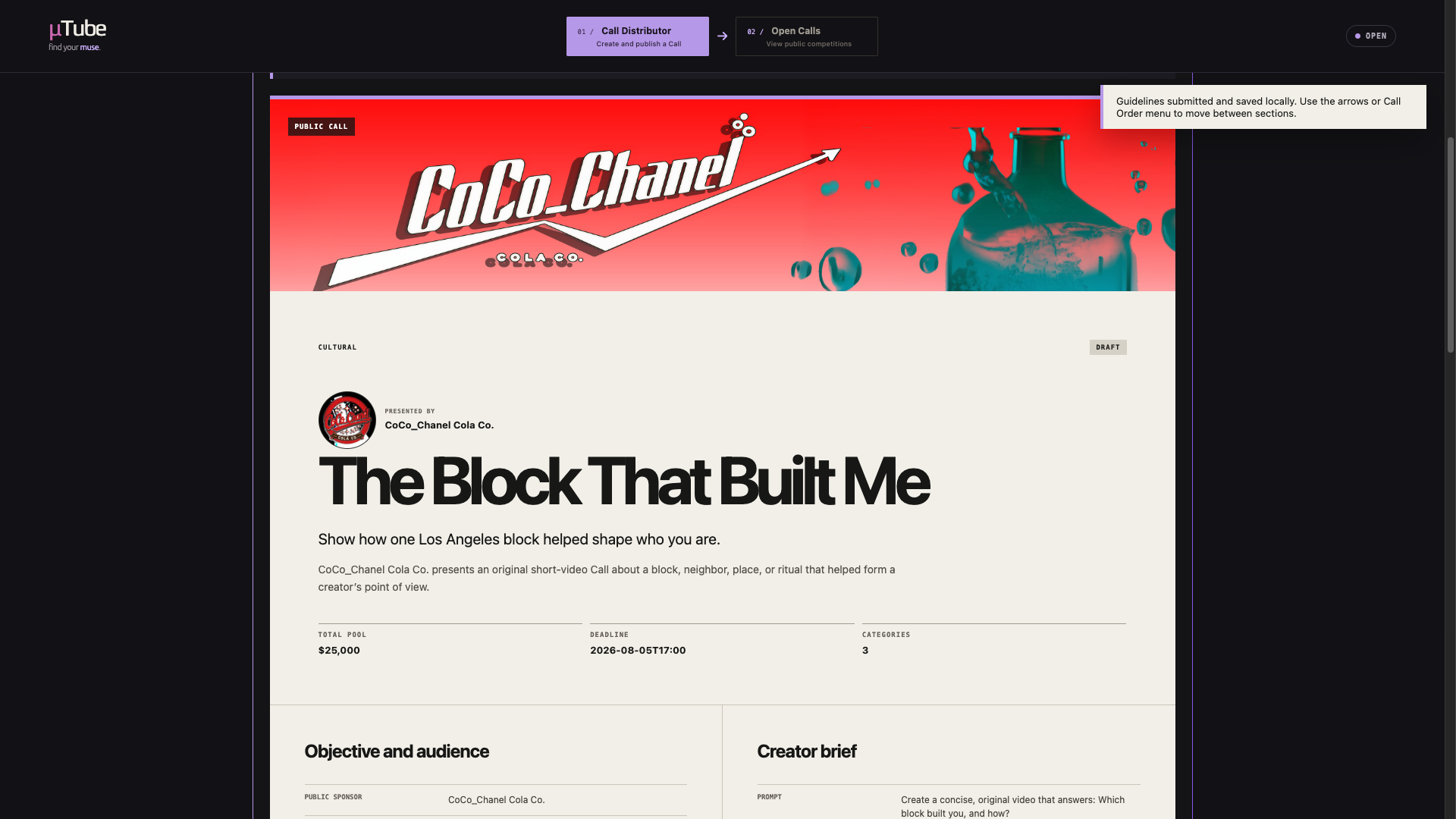
Organizations should be able to state what they need, define and authorize funding, establish clear rules, and invite the world to answer.
Creators should not have to wait for access to an agency, gatekeeper, or private room to demonstrate that they understand an idea.
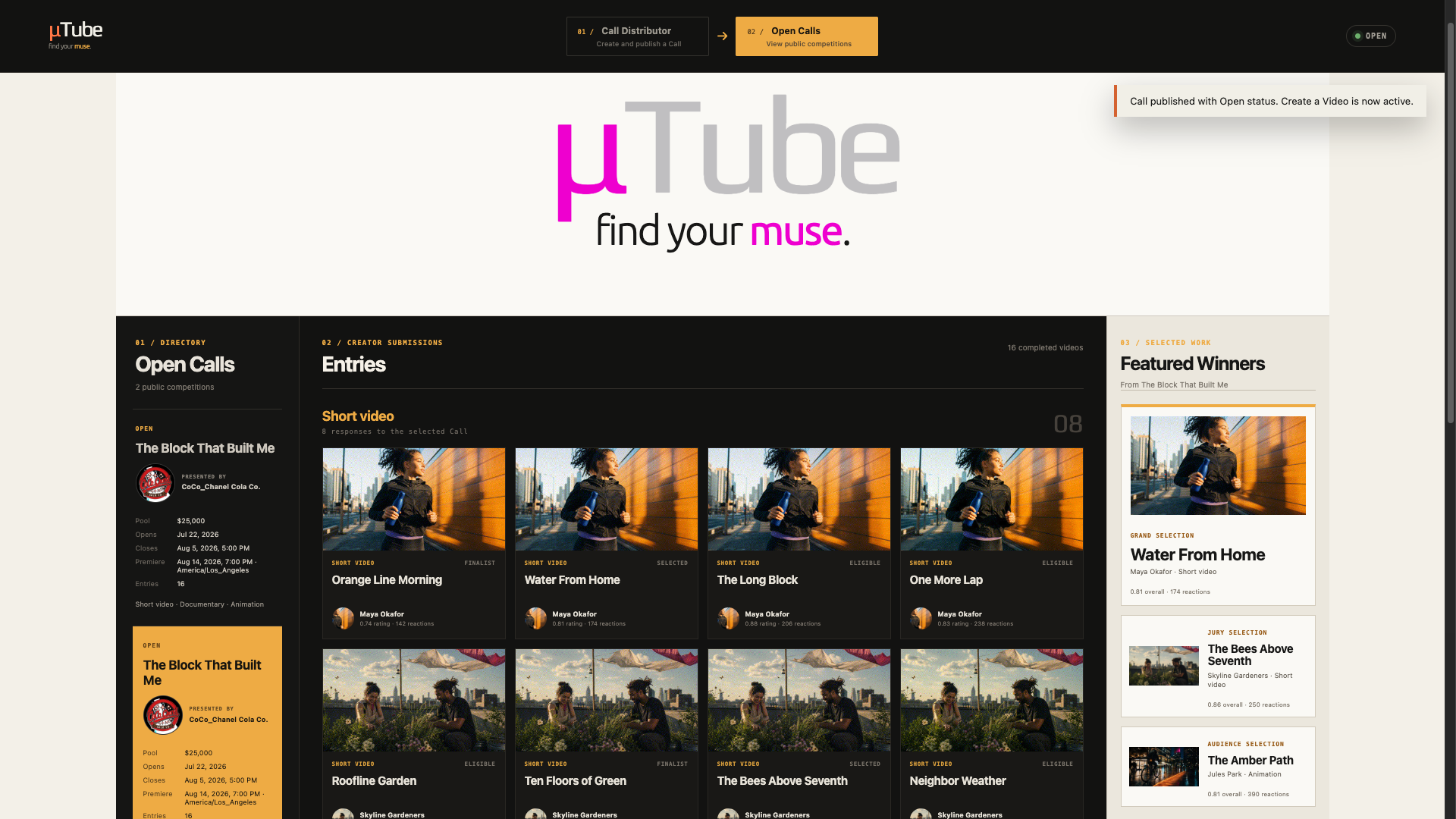
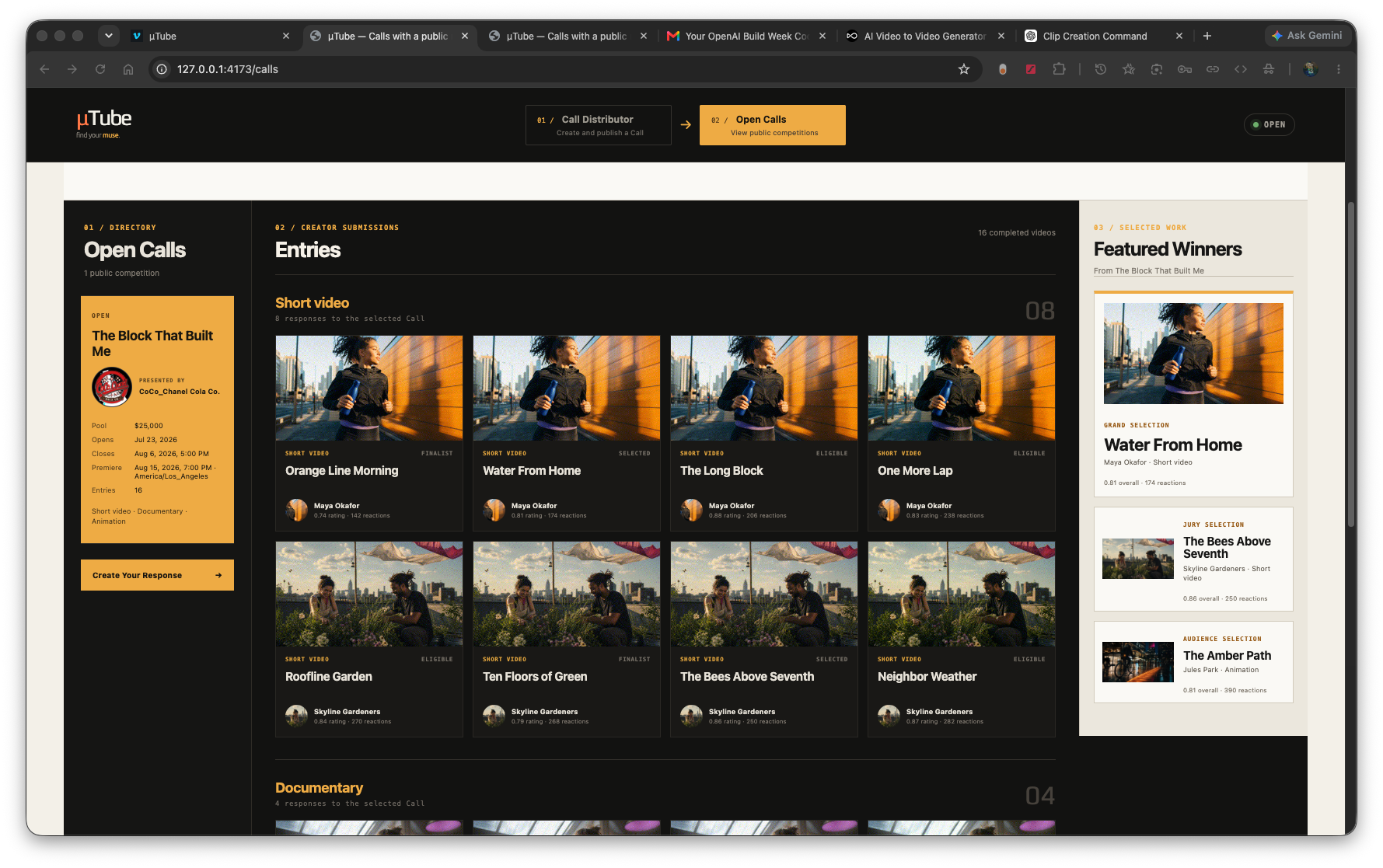
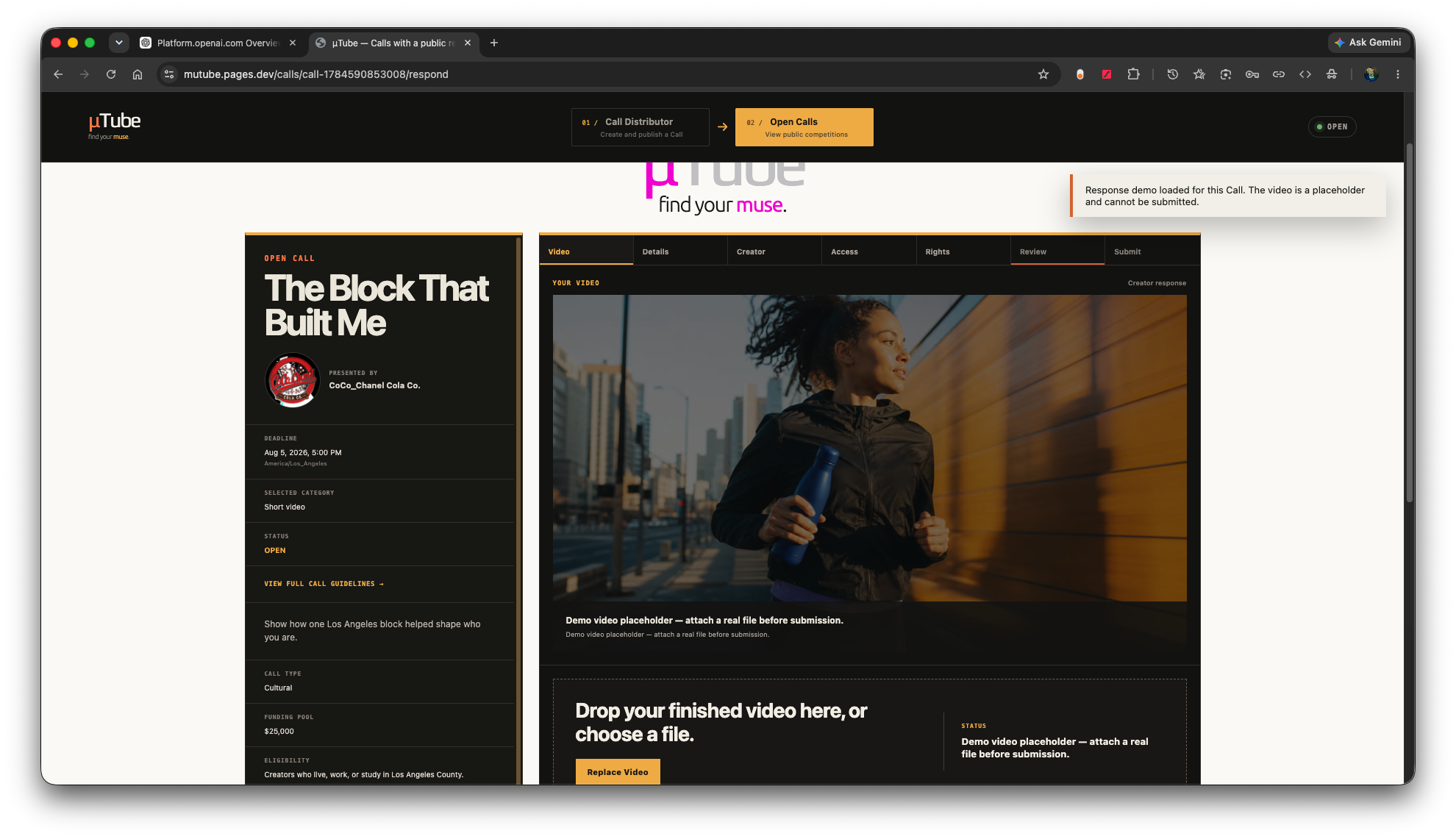
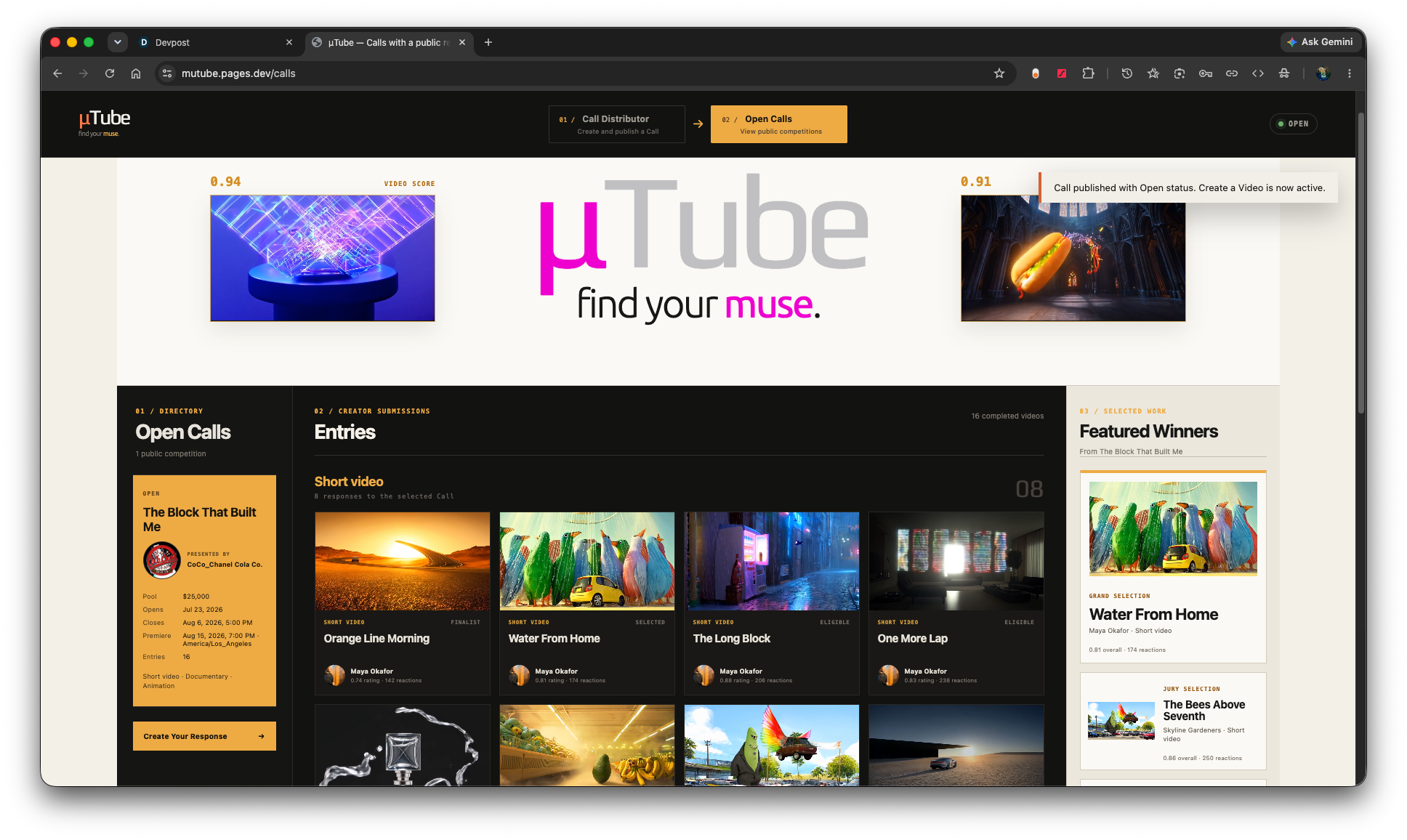
Open Calls is the creator-facing public environment where a published Call becomes a visible competition that an individual can discover and enter.
$$ \text{Call Distributor} \longrightarrow \text{Funded Call} \longrightarrow \text{Open Calls} \longrightarrow \text{Creator Entry} $$
How We Built It
We built μTube as a focused, judge-readable web prototype rather than attempting to imitate the entire future platform at once.
The application uses a React and Vite interface with persistent prototype state. Its architecture is centered on a single Call object that remains consistent as it moves from sponsor creation to public publication and creator entry.
Codex with GPT-5.6 was used throughout the development process to interrogate the concept, translate product doctrine into application structure, implement the interface, diagnose workflow problems, and repeatedly reduce a platform of enormous intended scale into one demonstrable transaction.
The build is organized around four functional surfaces:
- Splash — entry into either the sponsor or creator pathway
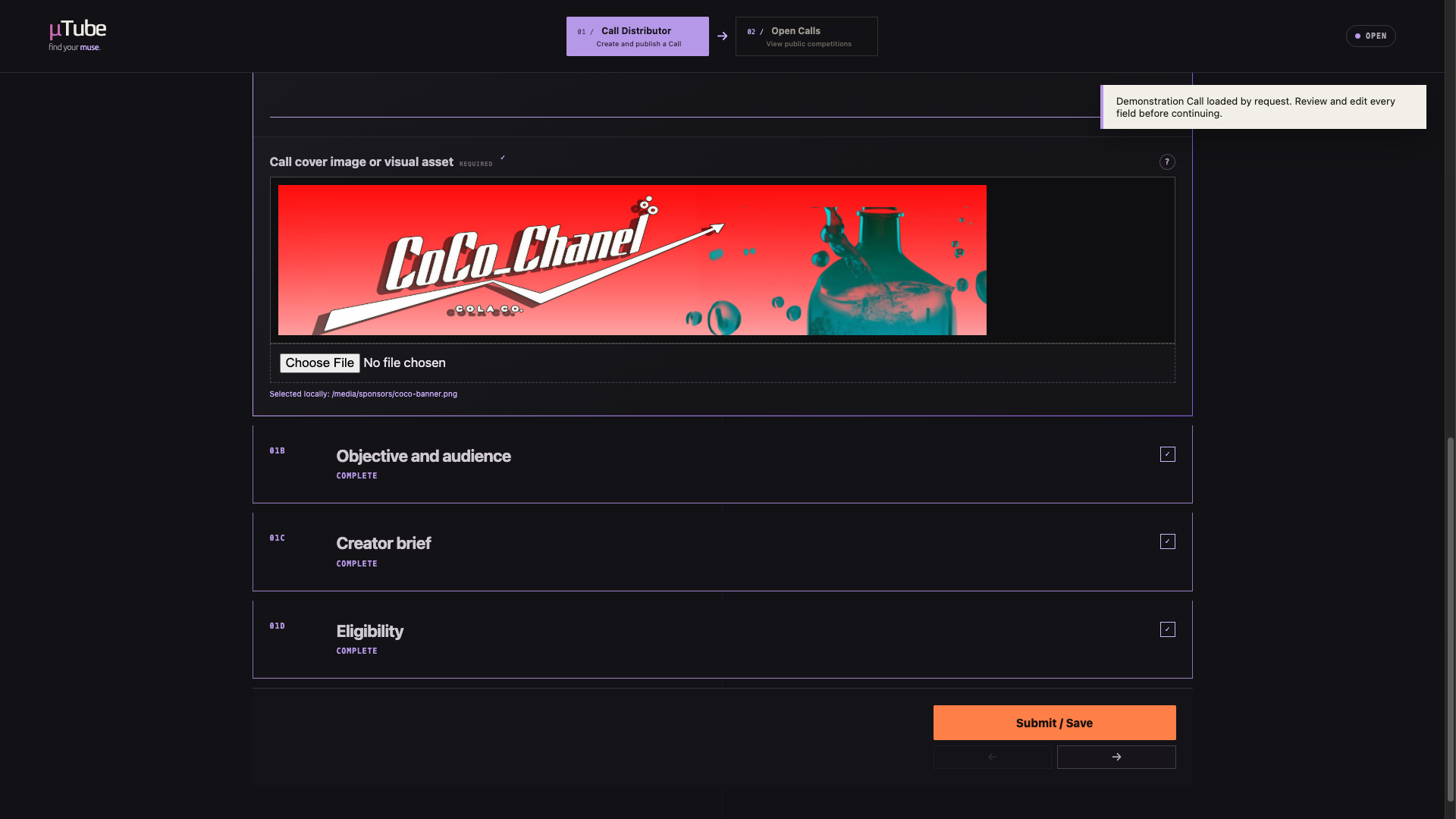
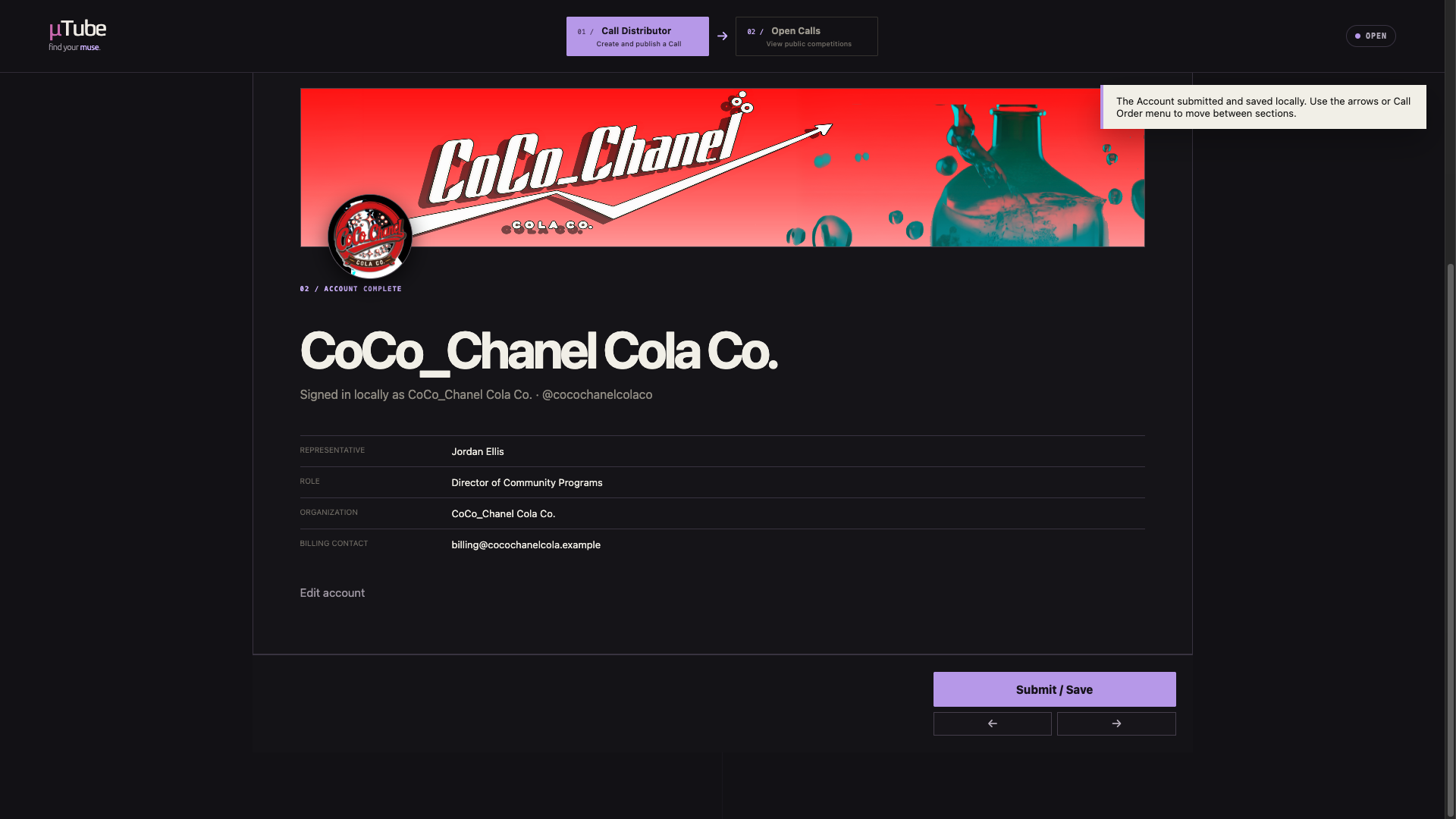
- Call Distributor — account creation, Call construction, funding, guidelines, review, and publication
- Open Calls — public discovery, categorized entries, Featured Winners, ratings, and audience reactions
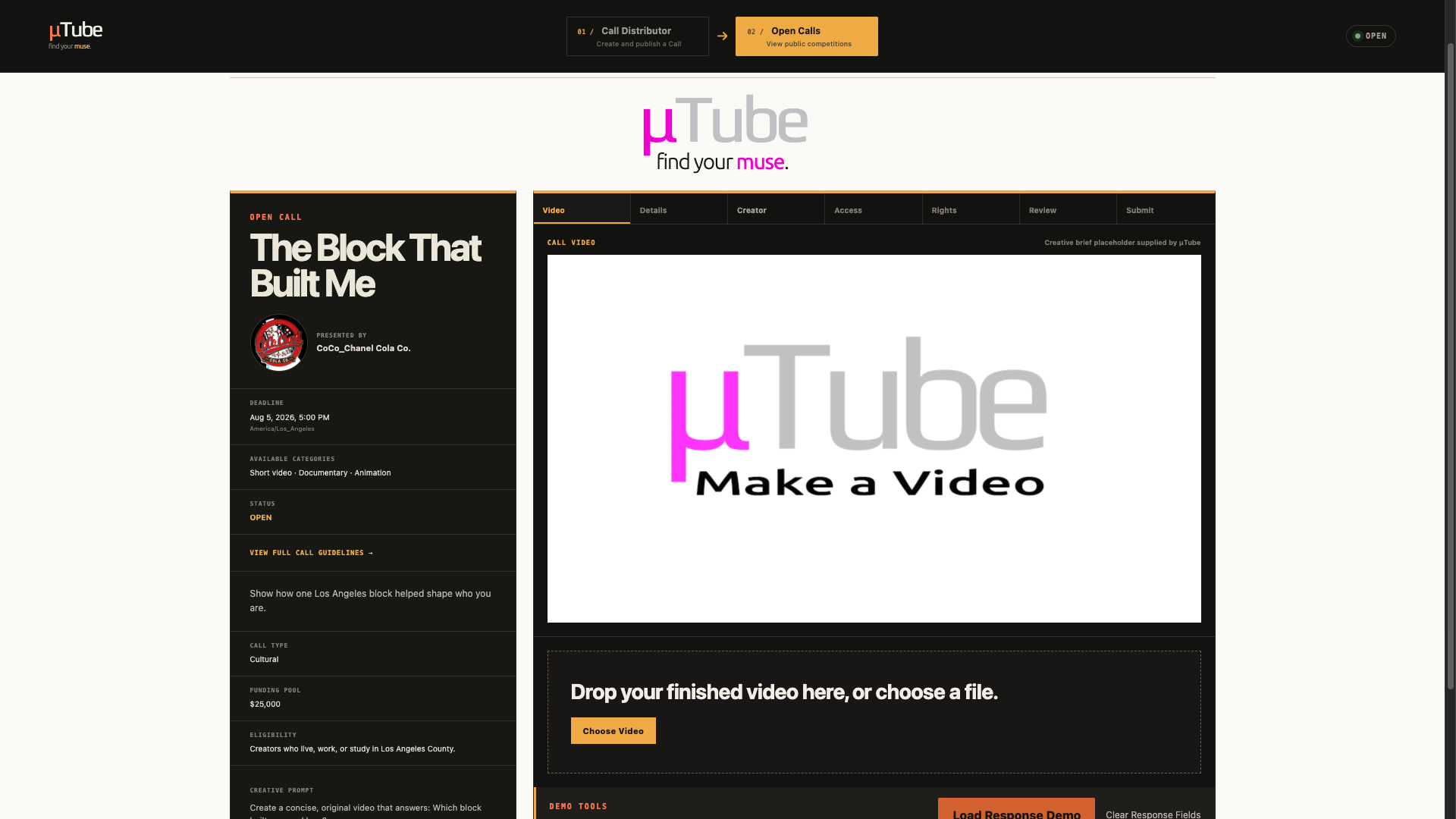
- Create Your Response — video selection, entry information, creator identity, disclosures, review, and submission preparation
Each surface has its own visual identity while remaining part of one continuous μTube system.
The prototype deliberately avoids pretending that every future service already exists. Payments, remote video storage, production authentication, and globally synchronized engagement remain outside the current proof.
Challenges We Ran Into
Production Environment
The challenge was not simply building μTube. It was building it in a production environment that had been reconfigured to the point of being nearly unrecognizable.
Concept
μTube is not a single campaign page or static marketplace. It is a system intended to support advertising competitions that could eventually receive millions of entries. The conceptual challenge was reducing that platform into a proof a judge could understand in under two minutes.
Attempting to demonstrate every future layer at once would have produced either a vague pitch or a polished fiction. Neither was acceptable.
Build
The build challenge was making transactions real without real transactions: production submissions, creator portfolios, verified ratings, engagement micropayments, selection, archival records, annual recognition, and eventual global scale must all grow from this first transaction without obscuring it.
What’s Next
What comes next is, in whole and part, up to you.
To pursue μTube with official sponsorship is to no longer dream this particular impossible dream—and believe me of those I have no shortages. Should this project receive the validation, visibility, resources, and institutional attention needed to move into a working prototype, and should that prototype be allowed to organically come fully to life, I AM ready for that challenge.
Mark Ezra Merrill (MEM)
ChatGPT 5.6
Saturday, July 20, 2026 · 4:38 PM PDT
Los Angeles, CA

Log in or sign up for Devpost to join the conversation.