-
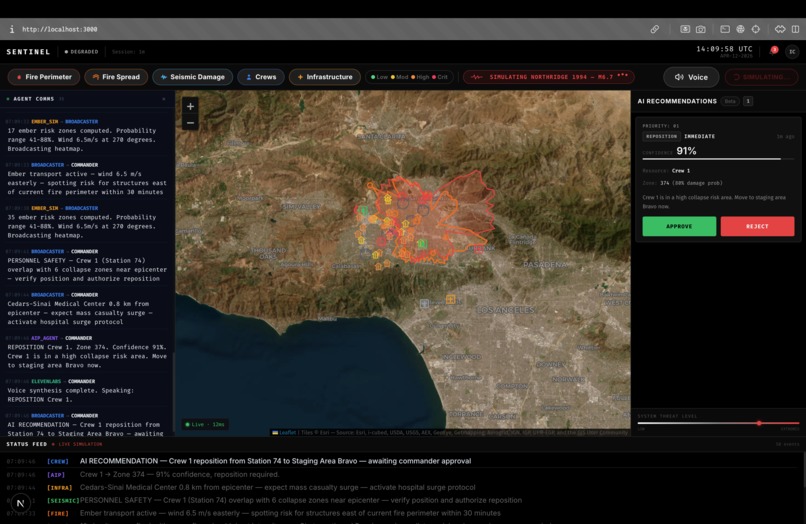
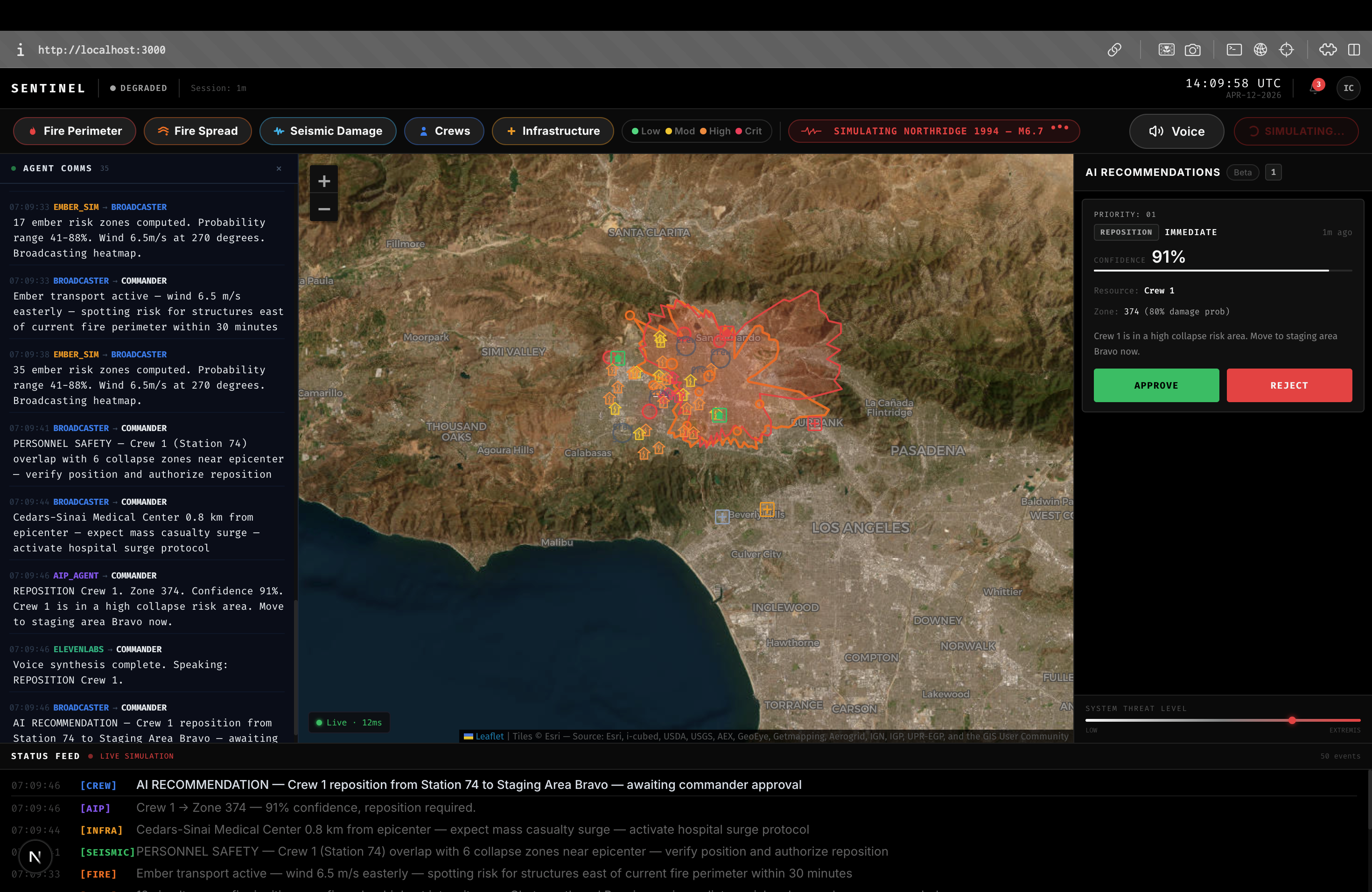
Simulating NorthRidge Earthquake, 1994
-
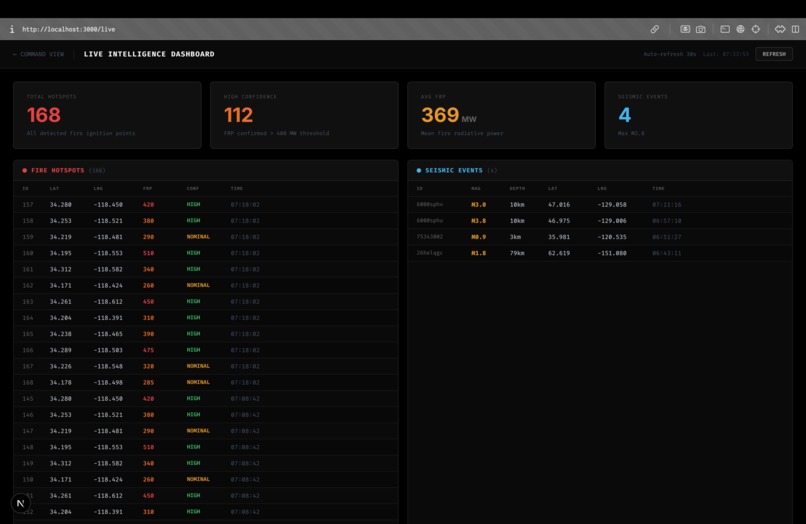
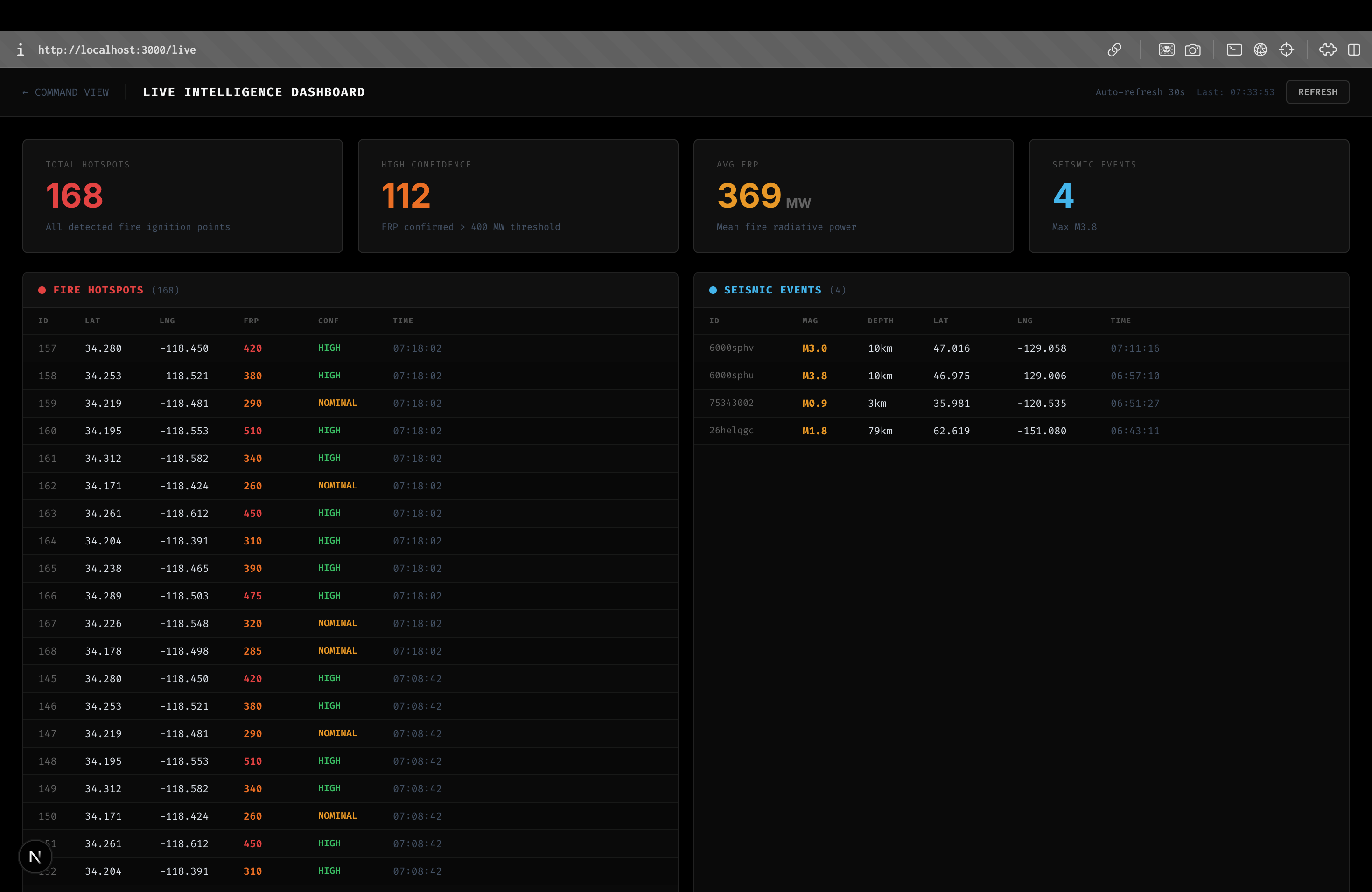
Intelligence dashboard organizing data
-
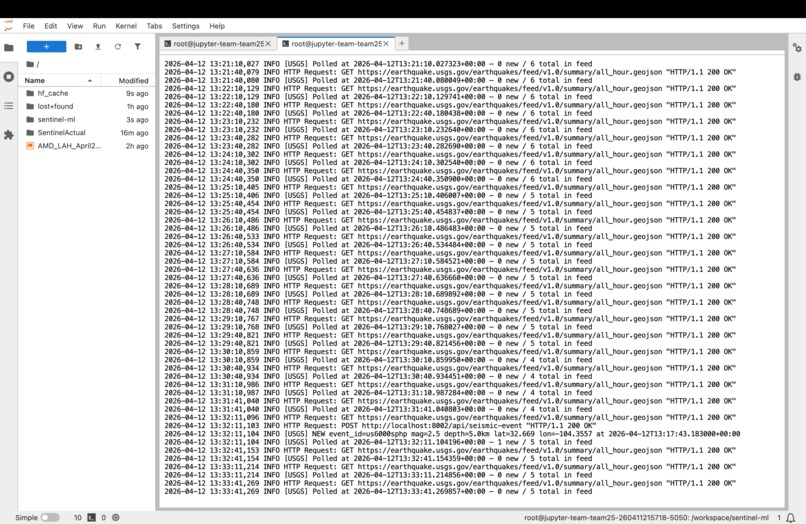
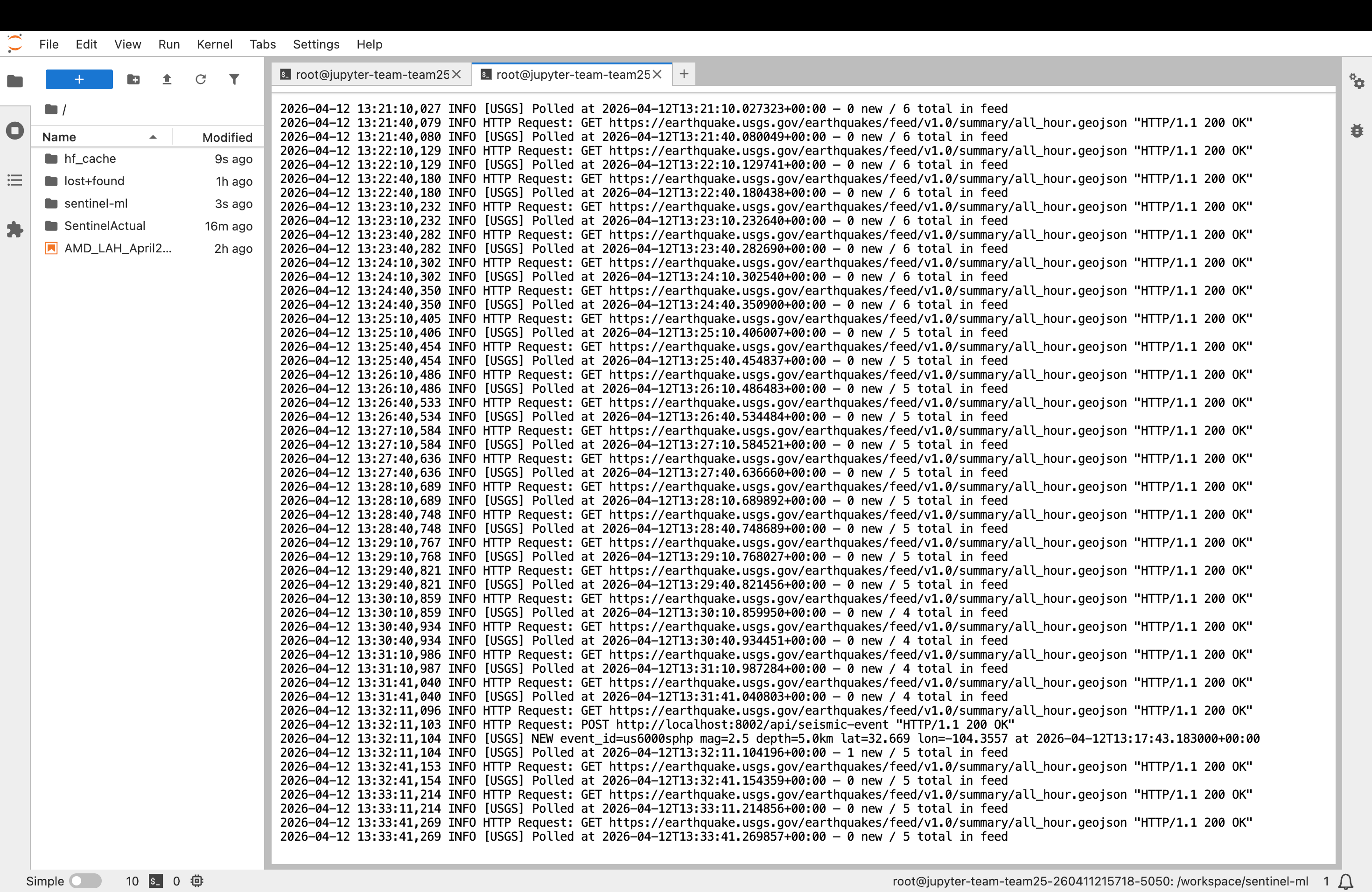
Pulls USGS live data every 30 seconds
-
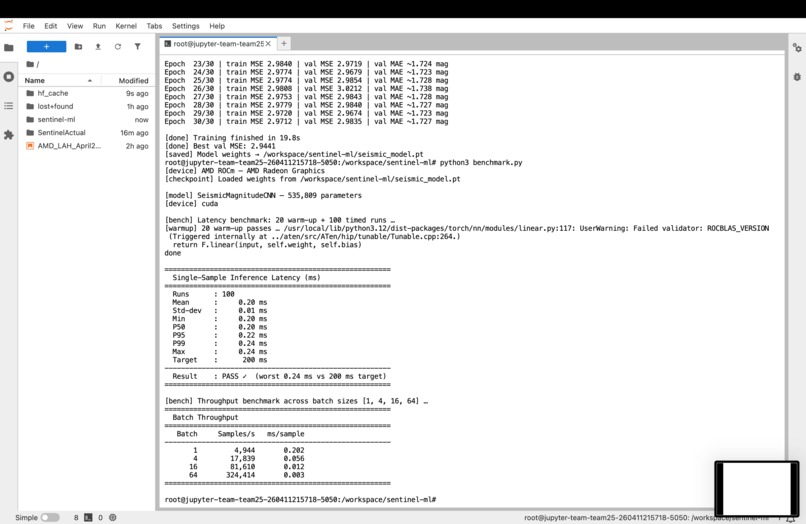
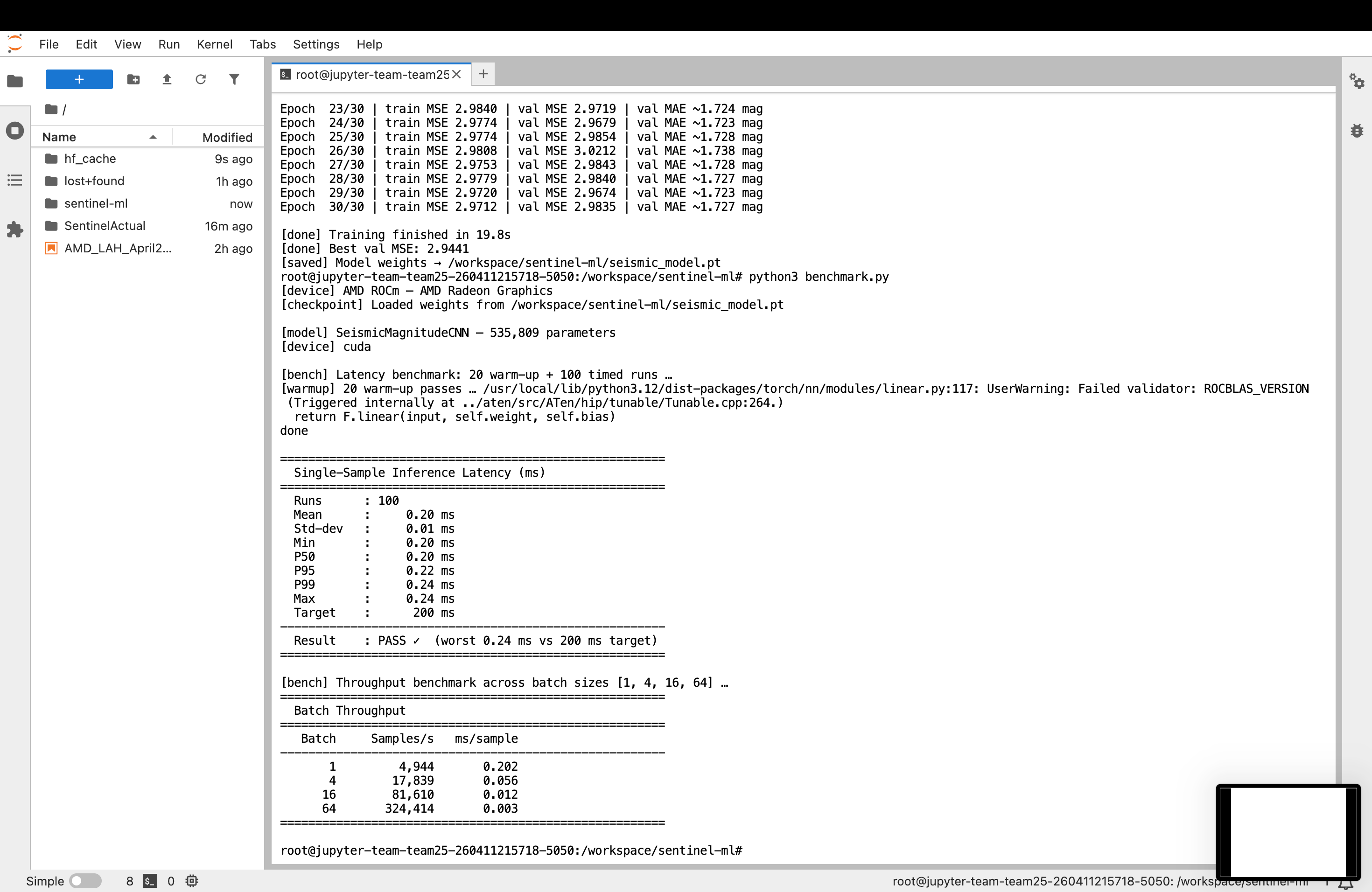
Training the model
Inspiration
On November 8, 2018, the Camp Fire killed 85 people. The incident commander was working from four tools that didn't talk to each other. On January 7, 2025, the Eaton Fire killed 17 more. A post-incident report found that issuing a single evacuation notice took 20 to 30 minutes. We kept coming back to that number. Twenty to thirty minutes, for one notice, while neighborhoods burned. We built Sentinel because that gap has a technical solution and nobody had built it yet.
What it does
Sentinel gives incident commanders one screen instead of four. Every five minutes, it pulls satellite fire data from NASA FIRMS, runs a particle simulation of ember transport, and renders a 30-minute spotfire prediction on a live map — where fires will spread, not just where they already are. When an earthquake hits, it pulls the USGS detection within seconds, runs a convolutional neural network on P-wave data using an AMD Instinct MI300X GPU, and renders a block-level damage probability grid before the shaking stops. Both data streams feed into a Palantir Foundry Ontology where an AIP Agent watches everything simultaneously and generates ranked action recommendations. When a card appears on screen, ElevenLabs reads it aloud. Commanders in active disasters can't always look at a screen.
How we built it
Four pipelines, built in parallel, designed to merge at two checkpoints. The wildfire module uses NumPy to run a stochastic particle simulation over NASA FIRMS hotspot data and Open-Meteo wind fields. The seismic module is a 1D PyTorch CNN trained on P-wave arrivals, running on AMD ROCm, with GMPE ground shaking calculations and a GeoPandas spatial join against USGS liquefaction shapefiles. The coordination layer is Palantir Foundry: eight typed Ontology objects, an AIP Agent Studio reasoning loop that triggers on high-risk object changes, and AIP Automate for executing approved actions. FastAPI wraps the Python services. WebSocket streams the damage grid to the dashboard cell by cell as it computes. ElevenLabs Turbo v2.5 synthesizes the rationale text on every action card.
Challenges we ran into
Getting PyTorch ROCm running on the MI300X under time pressure was rough. The AMD environment works, but it doesn't forgive shortcuts. Coordinating four parallel builds with a shared Ontology schema meant that anyone who coded against the wrong field name wasted hours at merge time — we learned this the hard way. Palantir AIP Agent Studio has a real learning curve. And getting ElevenLabs to feel like it belonged in the product, rather than a demo trick layered on top, required getting the voice profile, speaking rate, and card timing exactly right.
Accomplishments that we're proud of
The seismic pipeline produces a block-level damage map in under three seconds from USGS detection. That timing is only possible with GPU inference and it's demonstrable live. The ember simulation gives commanders a 30-minute spotfire look-ahead that no existing incident command tool offers. The full demo sequence — press simulate, watch the damage grid spread across the map, read and hear the first action recommendation — runs in under ten seconds. The entire stack runs on free APIs. We are in high school.
What we learned
Write the shared contract files before anyone writes code. We knew this going in and it still bit us. The Palantir Ontology is only as useful as the typed relationships between objects — a flat schema would have been a database, not an intelligence layer. GPU inference is not just a speed improvement; on the seismic pipeline it is the difference between warning before the shaking stops and warning after. And emergency communication has its own design rules. The voice profile, the speaking rate, the 200ms delay before audio plays — all of it matters when the person listening is managing an active disaster.
What's next for Sentinel
County emergency management offices can run this today on free APIs. That's the first conversation worth having. Beyond that: tsunami inundation modeling, atmospheric river flood prediction, and integration with real CAD dispatch systems so the closest-unit dispatcher feature works with actual first responder fleets rather than simulated crews. A field version for incident commanders who aren't at a fixed screen is also on the list.
Built With
- 16.2.3
- agent
- aiosqlite
- aip
- boore-atkinson-gmpe
- css
- earthquake
- elevenlabs
- fastapi
- firms
- foundry
- geojson
- geopandas
- leaflet.js
- nasa
- next.js
- ngrok
- numpy
- open-meteo
- openstreetmap
- palantir
- pydantic
- python
- pytorch
- react
- rocm
- sqlite
- studio
- tailwind
- typescript
- usgs
- uvicorn
- vercel
- websocket
- workshop
- zustand


Log in or sign up for Devpost to join the conversation.