-
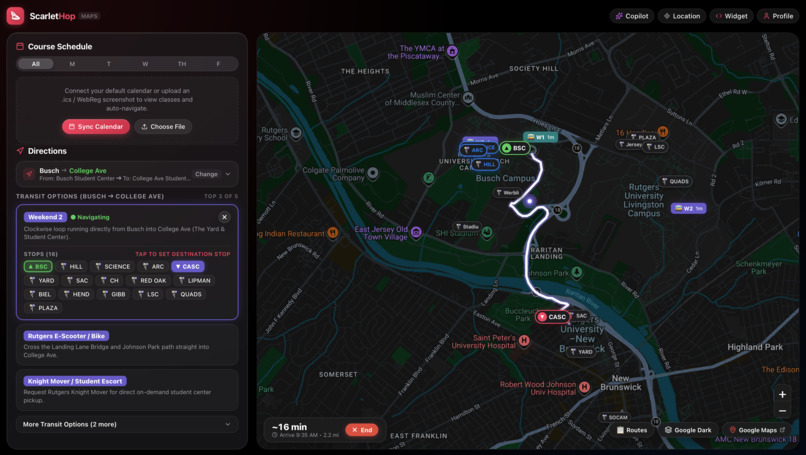
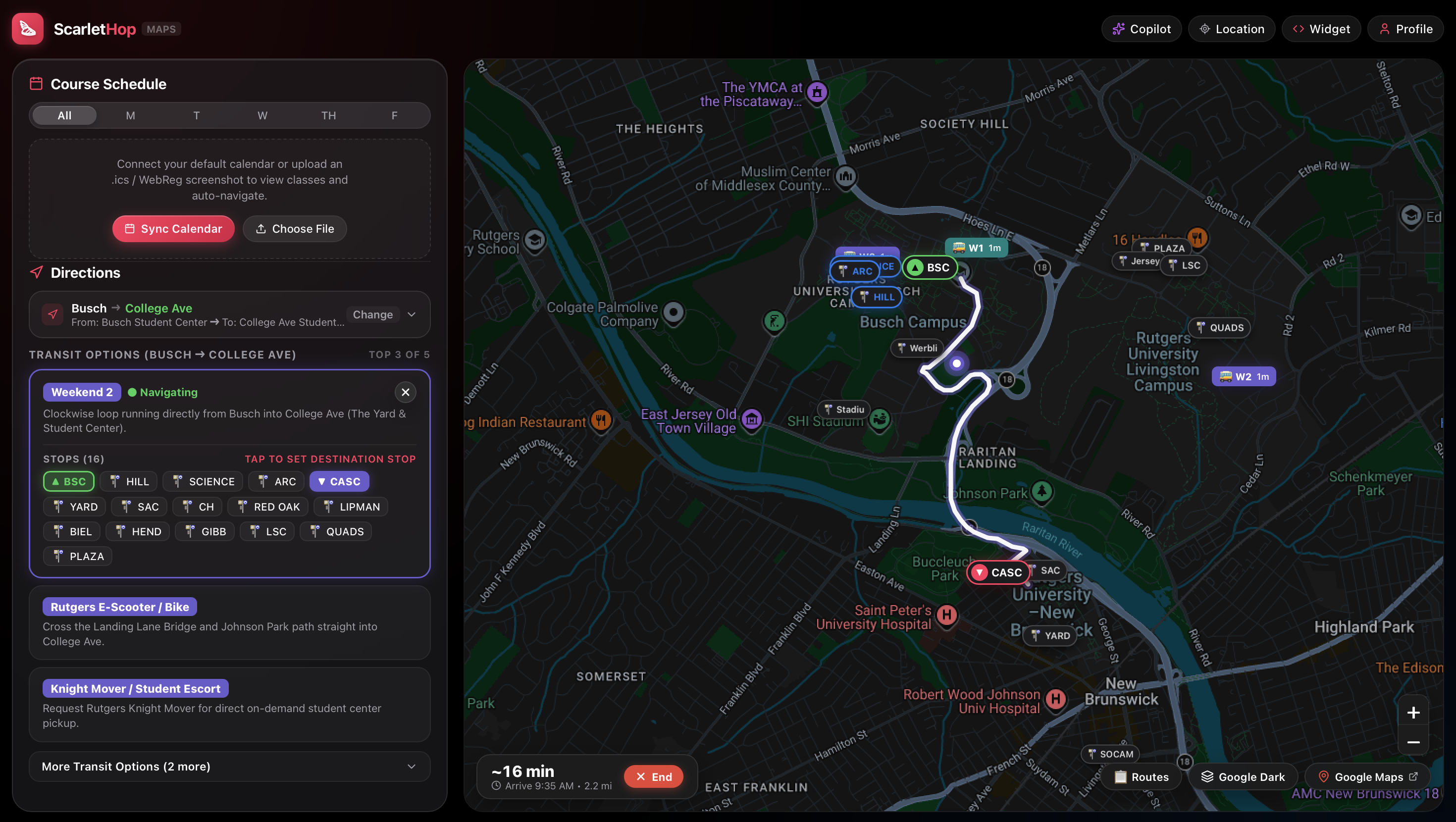
ScarletHop Example
Inspiration
Getting to class across Rutgers New Brunswick is difficult: 5 separate campuses divided by unpredictable bus lines and several minutes of delays. Every semester, several thousand students have confusing WebReg schedule tables, separate calendar exports, and clunky bus tracking apps—often leading to missed lectures or getting stranded at bus stops.
We were inspired by how flight tracking and ride-share apps connect personal itineraries directly to live vehicle telemetry: proactive, predictive, and effortless.
Our idea was to bring that same intelligence to campus transit — turning static course schedules into real-time, automated campus commute navigation using AI.
What it does
ScarletHop bridges a student’s academic schedule directly with live Rutgers bus GPS telemetry using an intelligent framework:
- Extract classes from WebReg screenshots, .ics files, or native iOS calendars using Gemini Vision and custom parsing.
- Resolve cryptic classroom codes (e.g., ARC 103, SEC 202, TIL 232) into actual Google Maps campus landmarks, detecting Zoom links for virtual meetings.
- Continuously calculate the optimal bus line (LX, A, H, B, F, EE, REXB, REXL, Weekend 1/2) or walking route based on class start times and live bus locations.
The result is a unified transit dashboard — real-time, predictive, and interactive.
Students can:
- Upload a raw WebReg schedule screenshot and instantly generate a weekly interactive map agenda.
- Sync their native iOS Device Calendar with one tap.
- View live Rutgers bus fleet tracking powered by Transitstat.us (live GPS, speeds, capacity, and upcoming stops).
- Ask the AI Transit Copilot real-time questions like "Can I make it to Hill Center before 3:50 PM?".
- Personalize walking speed, max walk distances, and bad-weather avoidance modes.
In essence: AI-powered schedule extraction, live bus intelligence, and predictive navigation built specifically for Rutgers students.
What we learned
Students don’t just want to see where a bus is on a map; they need to know which bus fits into their personal schedule and when to step out the door. Combining multimodal vision with spatial geodesic routing bridges that gap. We also learned that handling campus geography requires flexible distance calculations rather than static stop assumptions. Building a cohesive bridge between native mobile device calendars and responsive web dashboards creates an effortlessly seamless student experience.
How we built it
We designed our interface following Apple’s Design Language and implemented the frontend using React, TypeScript, and Vite. Native mobile calendar synchronization was built using Capacitor.
The backend was built in Python using FastAPI, Pydantic, and Uvicorn, with SQLAlchemy and SQLite/PostgreSQL for user profile and schedule persistence. We used Google Gemini 3.5 Flash Lite for multimodal OCR schedule extraction, building geo-resolution, and our natural language Transit Copilot. Live bus GPS positions, vehicle loads, and ETA predictions were integrated via the Transitstat.us REST API, rendered interactively with Leaflet and OpenStreetMap.
Challenges
Student schedules are surprisingly messy. When you export an .ics calendar file from Apple or Google Calendar, it's packed with clutter—like embedded Zoom links, weird formatting artifacts, and outdated recurring meetings from past semesters. Our biggest challenge was cleaning up this noisy calendar data so Gemini could reliably pull out the actual classes, ignore the junk, and accurately match room codes to the right buildings on campus.
What's next for ScarletHop
Phase 1: Create a smart "Time to Leave" push notifications that alert students when their bus is 5 minutes away from their boarding stop.
Phase 2: Add crowdsourced bus fullness reporting so students waiting at stops can flag packed buses in real time.
Phase 3: Integrate Rutgers Dining Hall menus and library study space capacity into commute route planning.
Phase 4: Expand live navigation support to other Rutgers campuses (Newark and Camden).
Long-term: Position ScarletHop as the ultimate campus mobility OS — a universal, intelligent transit layer for university campuses nationwide.
Built With
- apple-hig-design-system
- capacitor
- capacitor-(ios)
- fastapi
- gemini
- gemini-api
- generative-ai
- google-maps
- gps
- icalendar
- leaflet.js
- ocr
- openstreetmap
- postgresql
- pydantic
- python
- react
- sqlalchemy
- sqlite
- transitstat
- transitstat.us
- typescript
- uvicorn
- vite

Log in or sign up for Devpost to join the conversation.