-
-
MODULE 01 - Overview
-
MODULE 02 - Problem
-
MODULE 03 - System Architecture
-
MODULE 04 - Meta Glass Integration
-
MODULE 05 - How AI Works
-
MODULE 06 - Algorithm
-
MODULE 07 - Workflow
-
MODULE 08 - Tag Along and Consent
-
MODULE 09 - Real time data
-
MODULE 10 - Roadmap and Stack
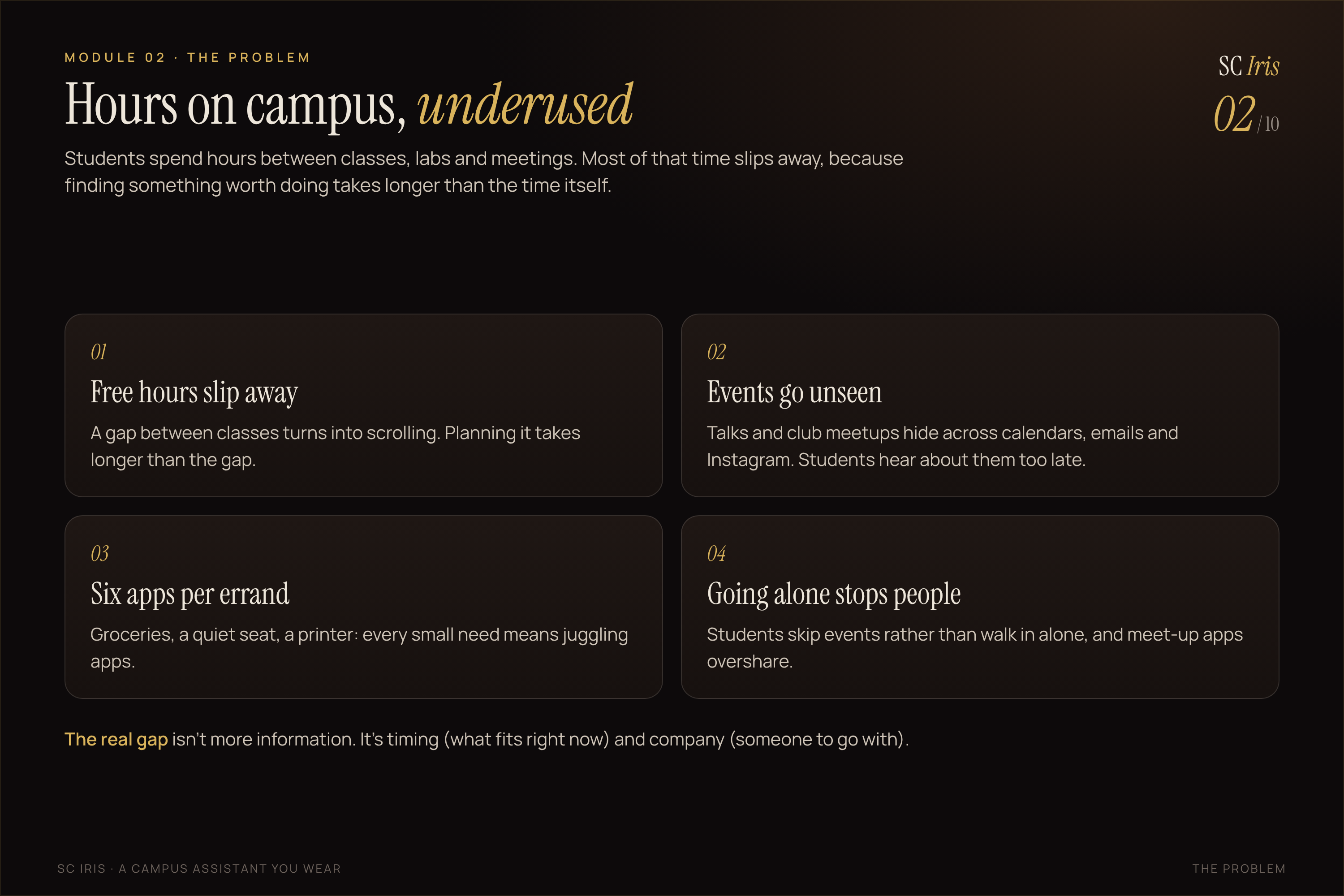
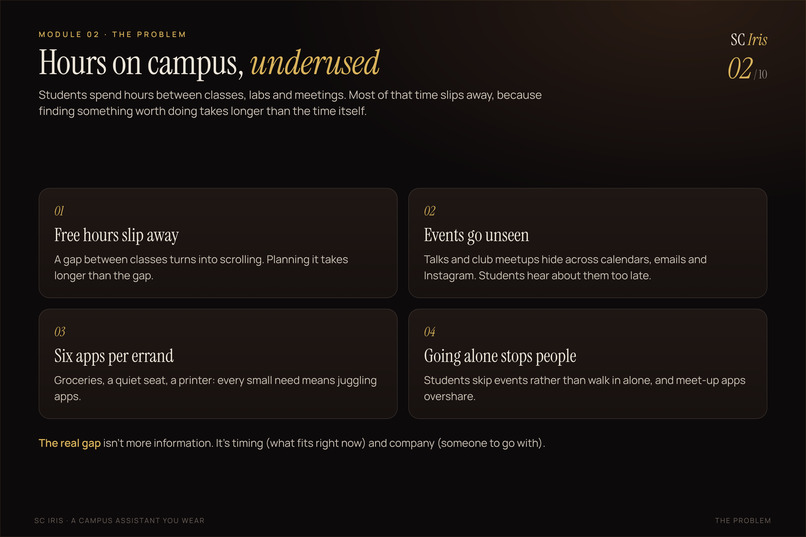
Students lose hours between classes to scrolling, because planning takes longer than the gap itself. Events are scattered across calendars, emails and Instagram. A simple errand can take six apps. And many students skip events rather than walk in alone, since meet-up apps overshare.
The real gap isn't more information. It's timing (what fits right now) and company (someone to go with).
What it does
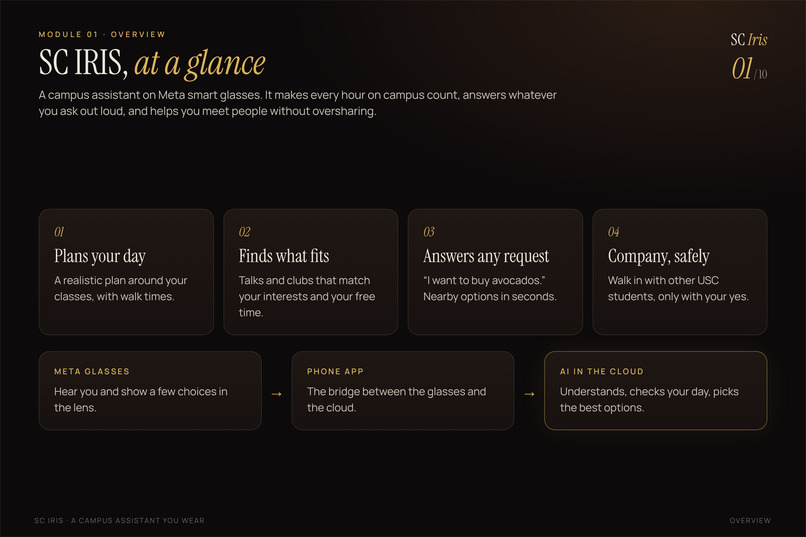
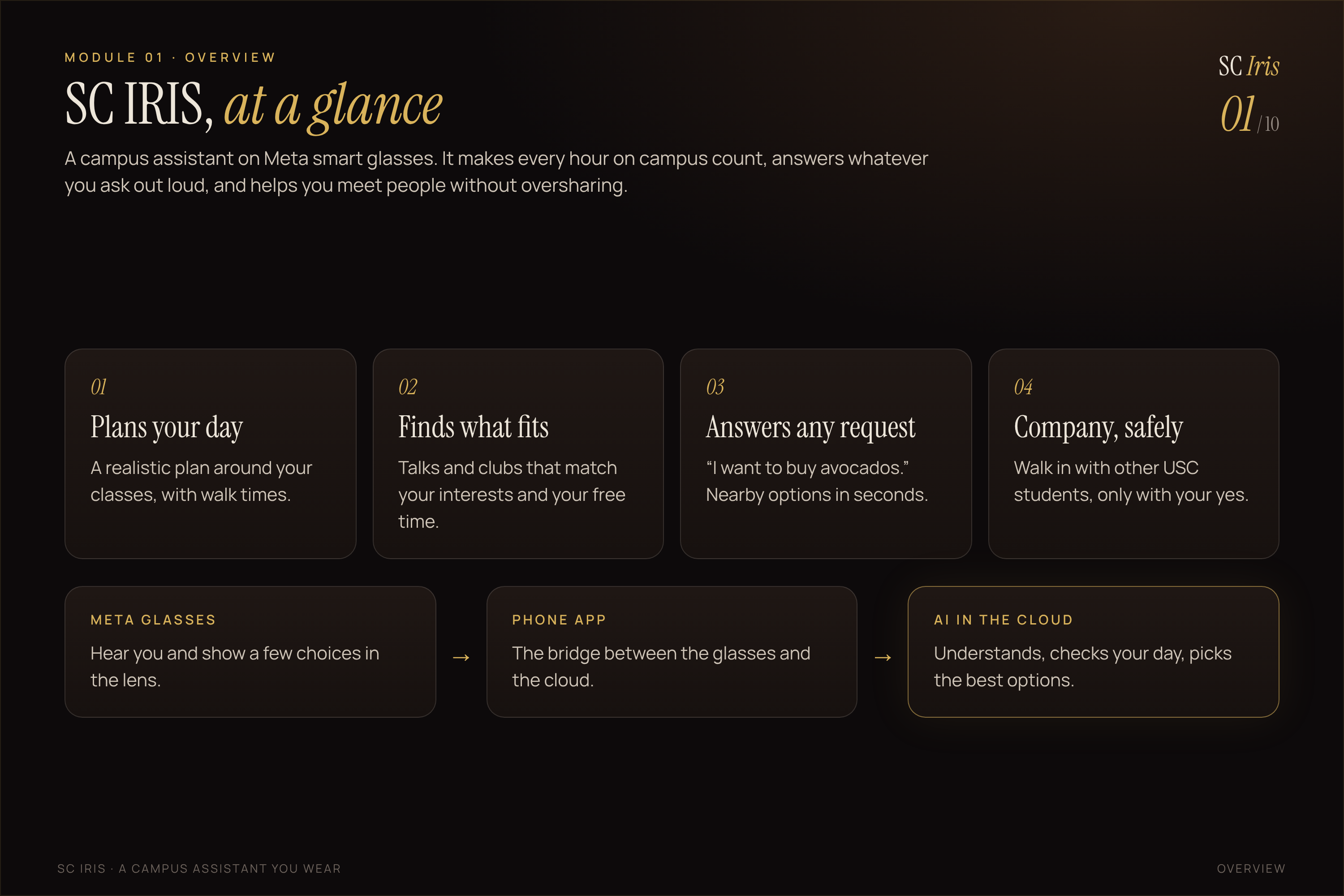
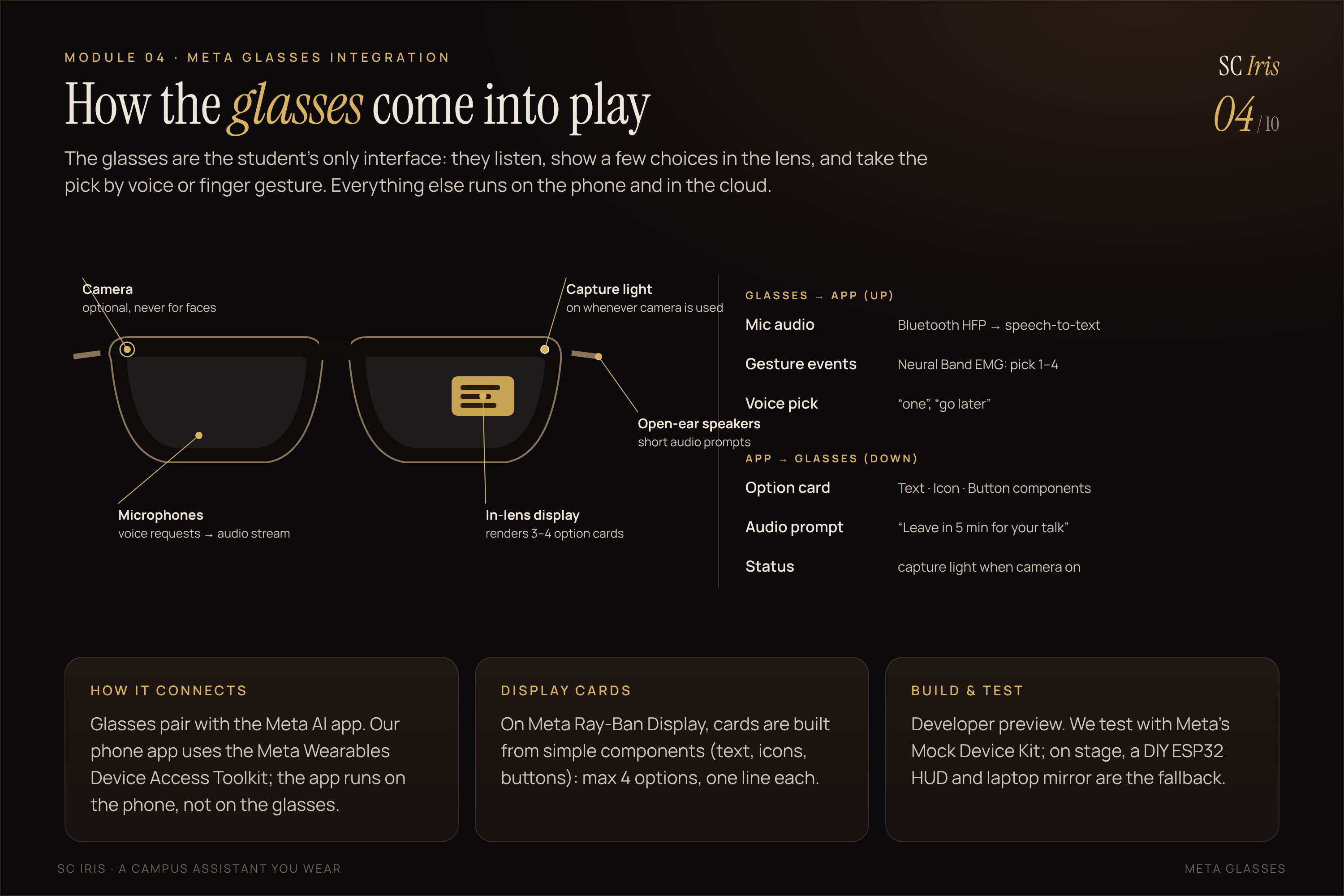
SC Iris is a campus assistant designed for smart glasses. Our prototype simulates the glasses experience in a web app.
- Plans your day around your classes, with walk times.
- Finds what fits: talks and clubs that match your interests and free time.
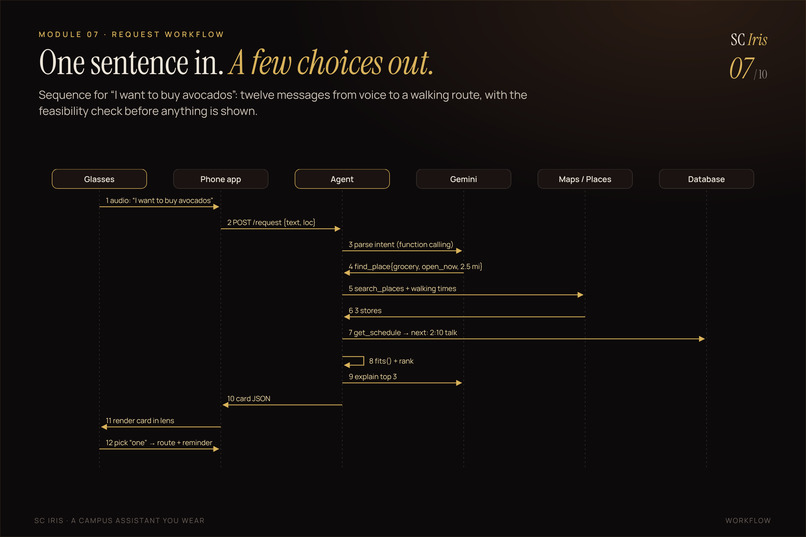
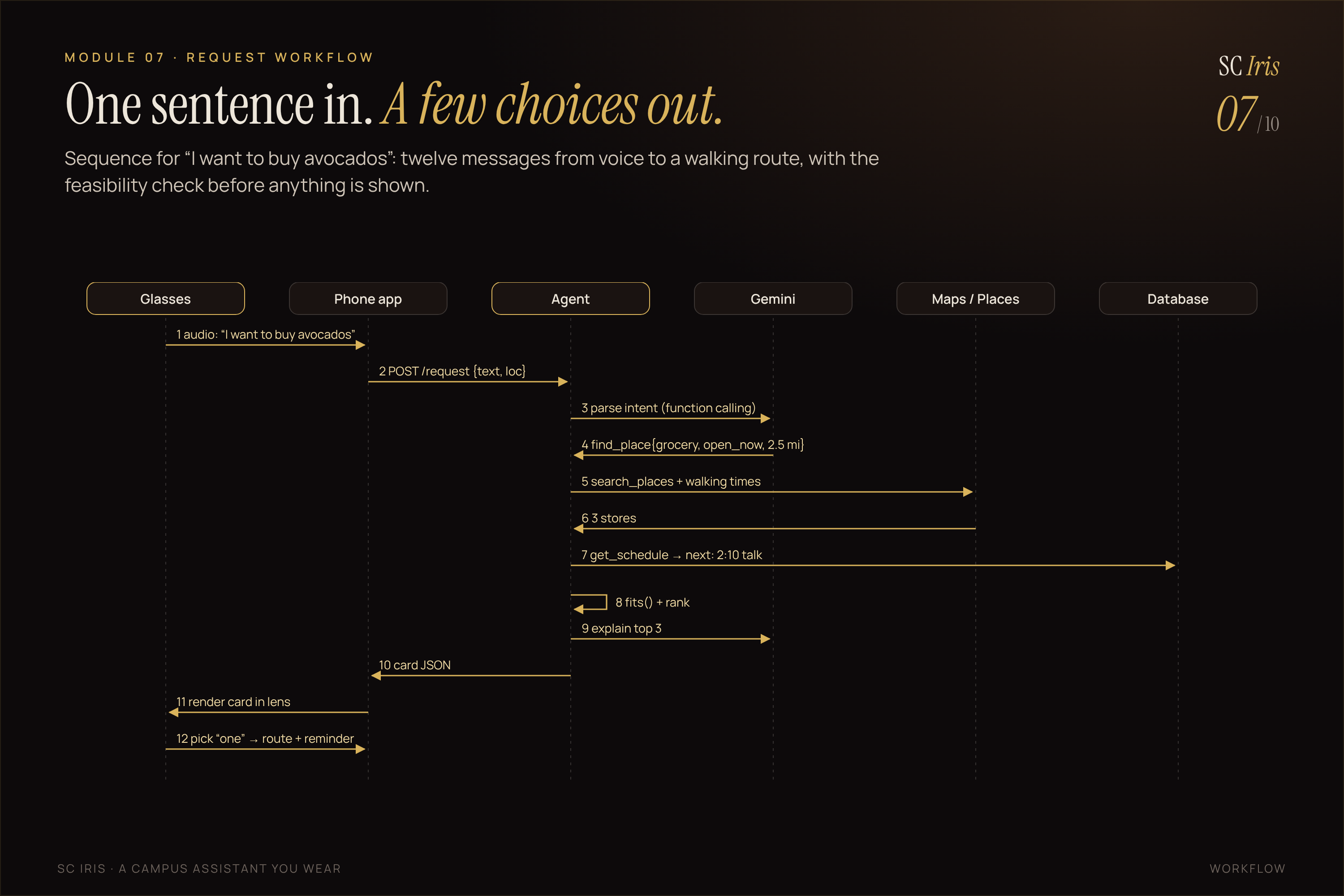
- Answers any request: say "I want to buy avocados" and get open stores within 2.5 miles.
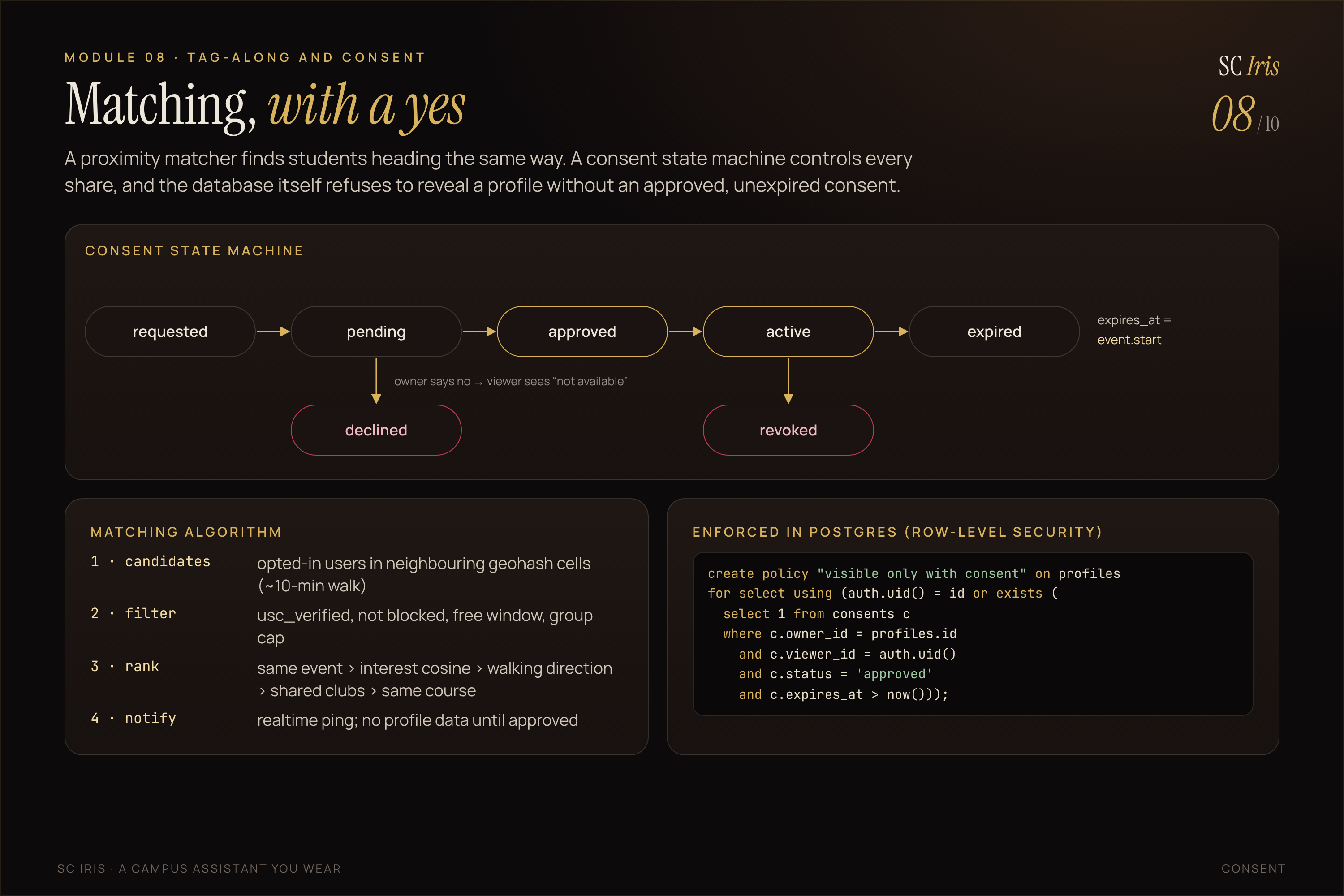
- Offers company, safely: walk into events with other students. Nothing is shared until you approve.
- Built for USC: students are verified with their
@usc.eduemail, and events come from USC calendars and club feeds, ranked by source trust (official, club, student). - Keeps students engaged: tag-along matching gets students out to events instead of skipping them, and a feedback loop learns from every "go" or "skip" so suggestions improve over time.
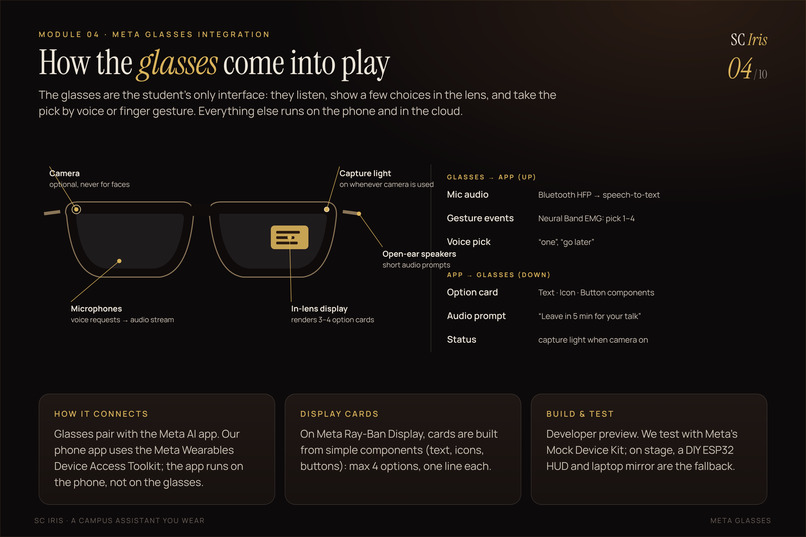
A few option cards appear in a simulated lens view, and the student picks one with a voice-style command (go now, go later, tag along, scenic route).
How we built it
- Simulated glasses interface: a web app that mimics the in-lens display and the voice and gesture picks.
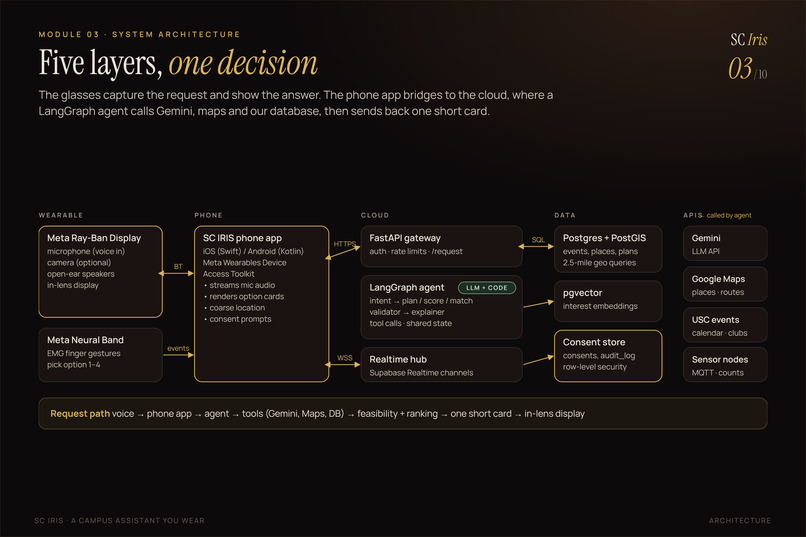
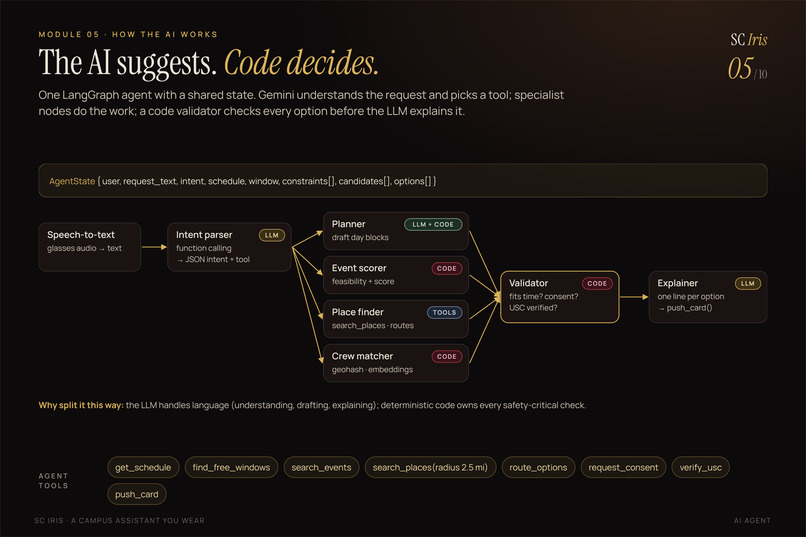
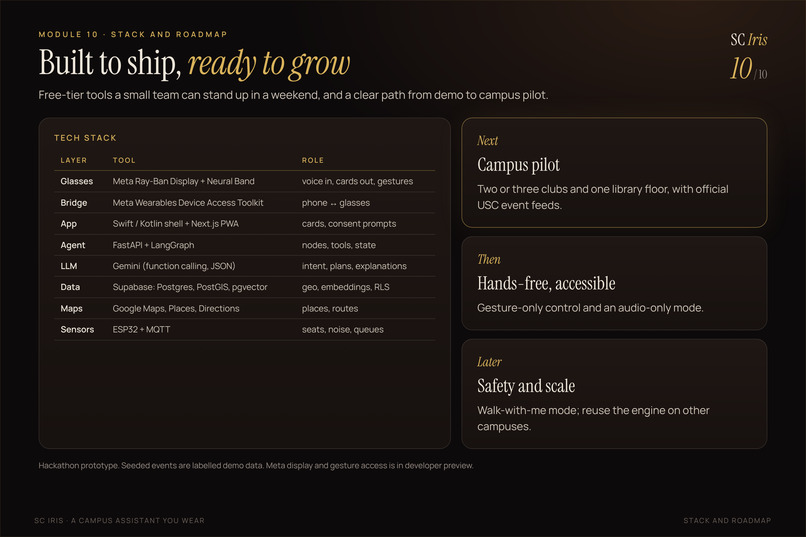
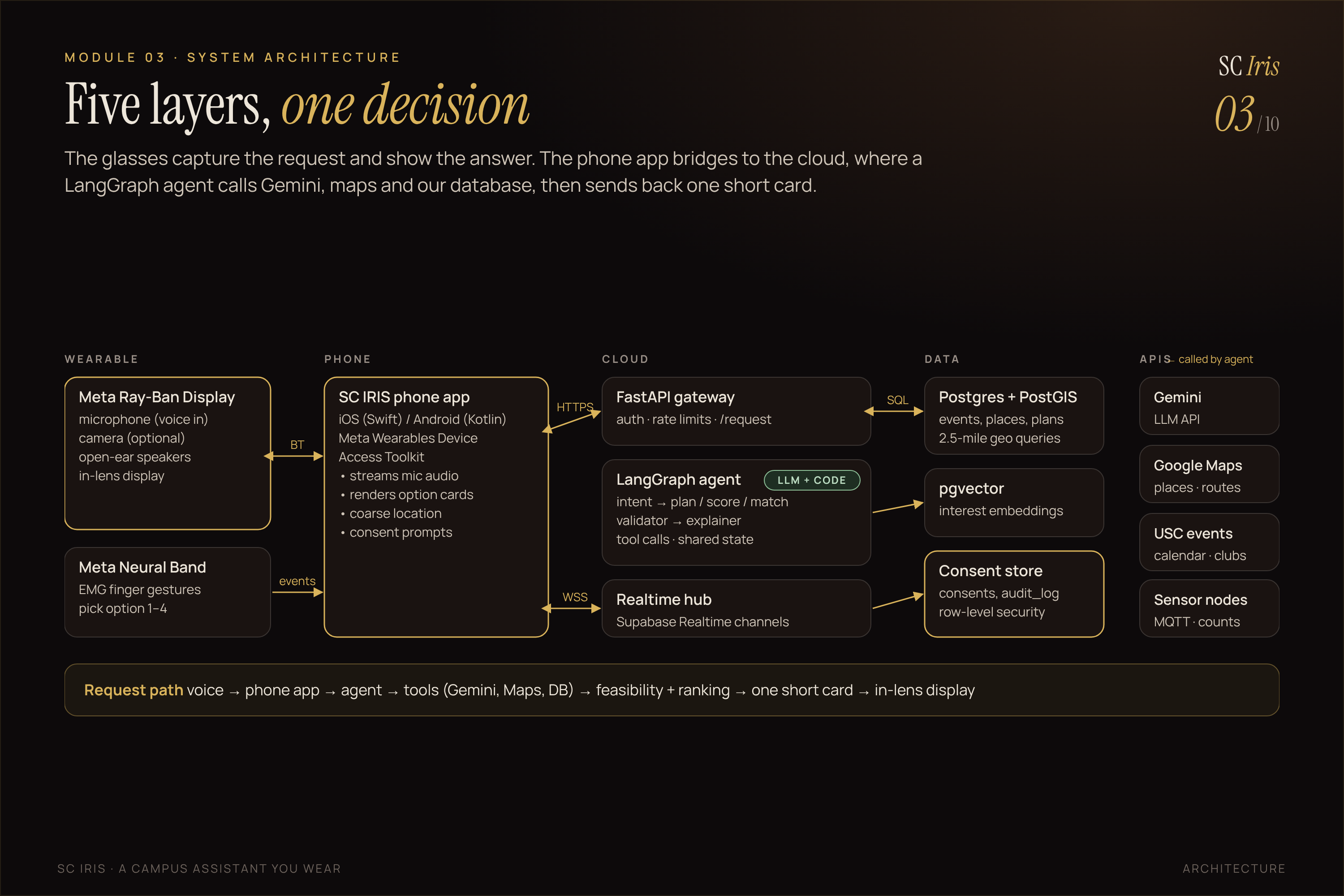
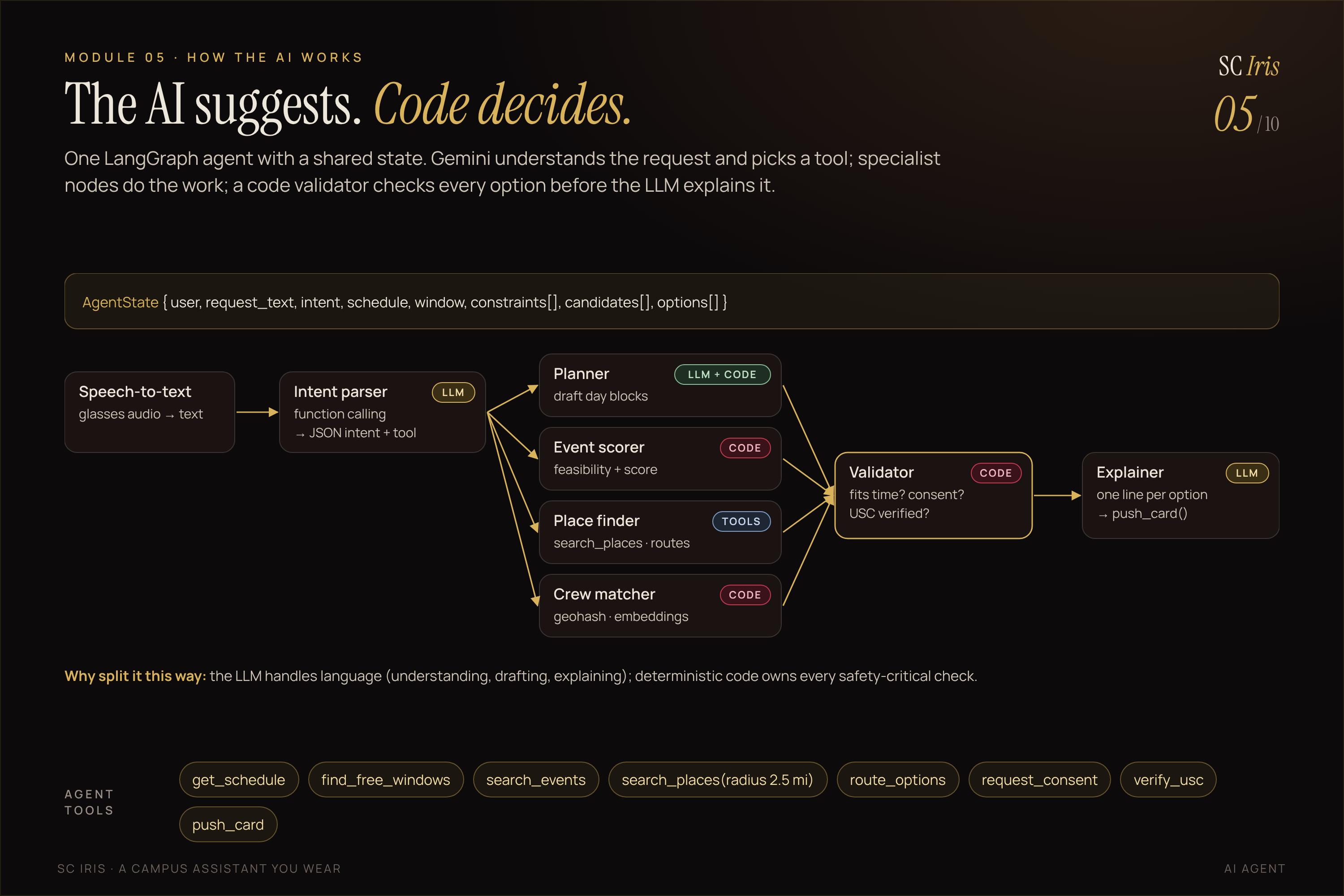
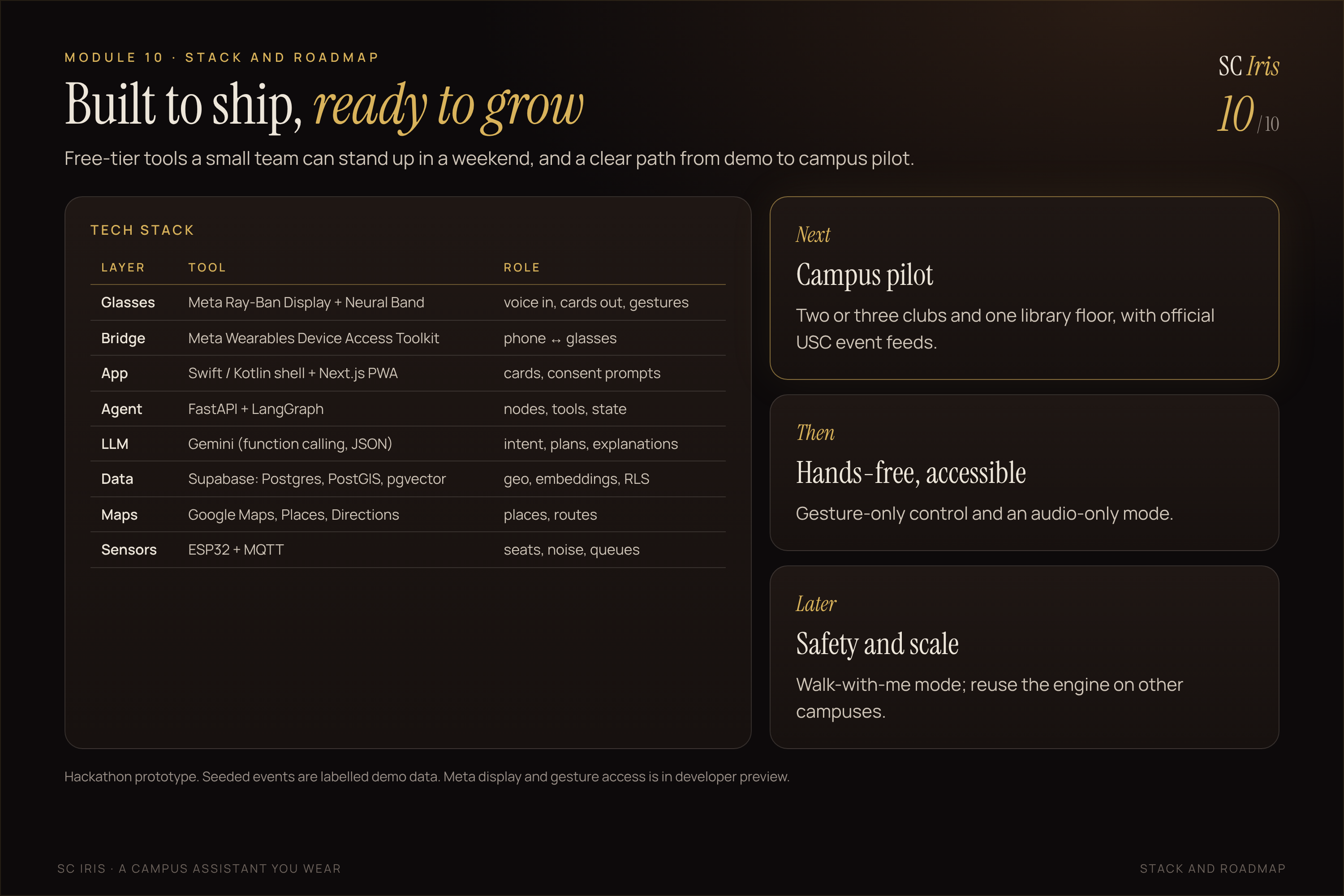
- Cloud: FastAPI and a LangGraph agent, with Gemini for intent through function calling.
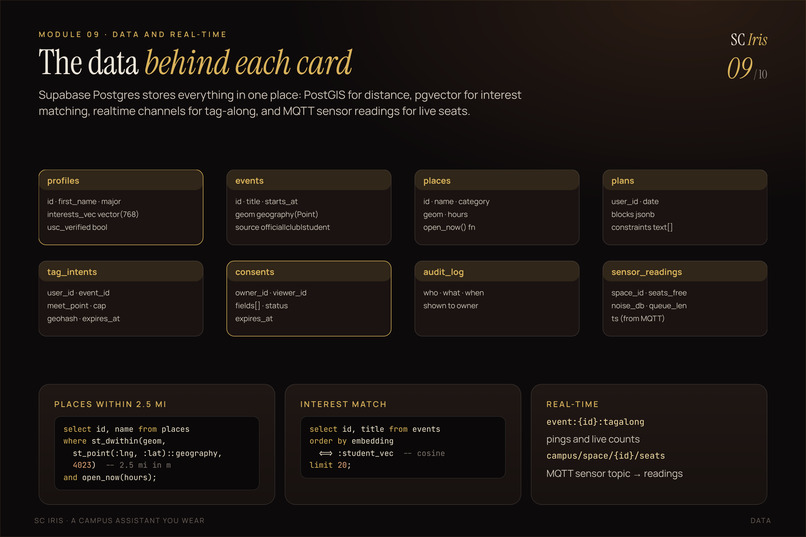
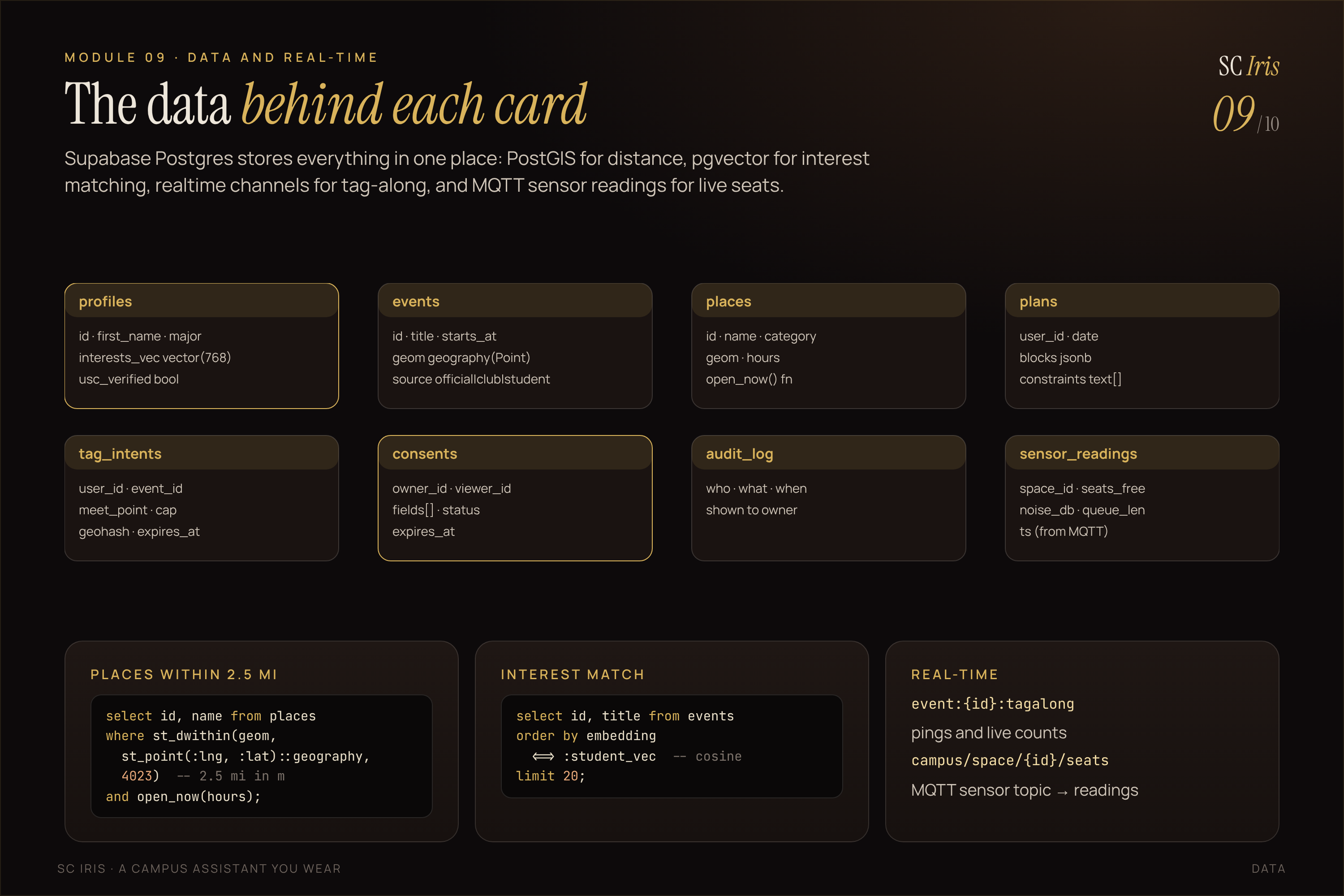
- Data: Supabase Postgres with PostGIS, pgvector and Realtime, plus Google Maps and Places.
- USC integration: a
usc_verifiedflag on every profile, USC event and club feeds (seeded demo data in the prototype), and campus-aware walk times between buildings. - Engagement: realtime tag-along pings through Supabase Realtime, with a live count of who is going.
Our principle is the AI suggests, code decides. Gemini handles language. Code handles every check.
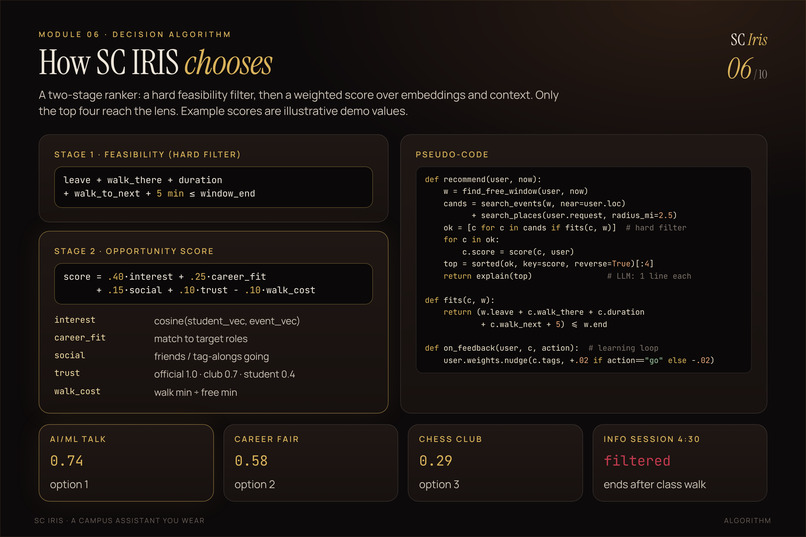
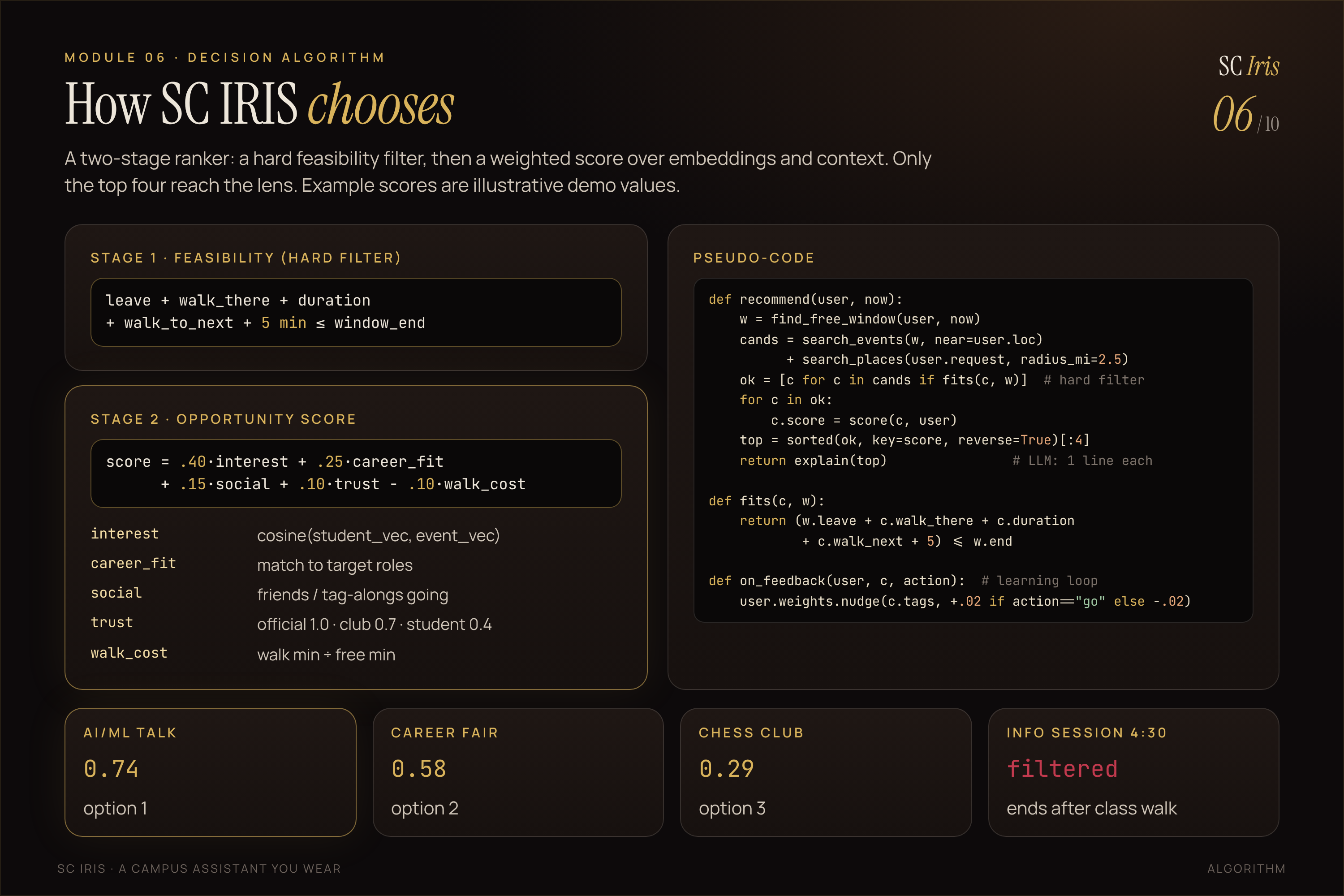
Stage 1: feasibility (hard filter). An option is kept only if it fits inside the student's free window:
$$ t_{\text{leave}} + t_{\text{walk}} + t_{\text{duration}} + t_{\text{next}} + 5\ \text{min} \le t_{\text{window end}} $$
Stage 2: opportunity score. Options that pass are ranked by:
$$ \text{score} = 0.40\,I + 0.25\,C + 0.15\,S + 0.10\,T - 0.10\,W $$
where $I$ is interest (cosine similarity between the student and event embeddings), $C$ is career fit, $S$ is social signal, $T$ is source trust (official $1.0$, club $0.7$, student $0.4$), and $W$ is walk cost (walk minutes divided by free minutes).
Only the top four options are shown. A learning loop nudges the weights by $\pm 0.02$ based on whether the student chooses "go" or skips.
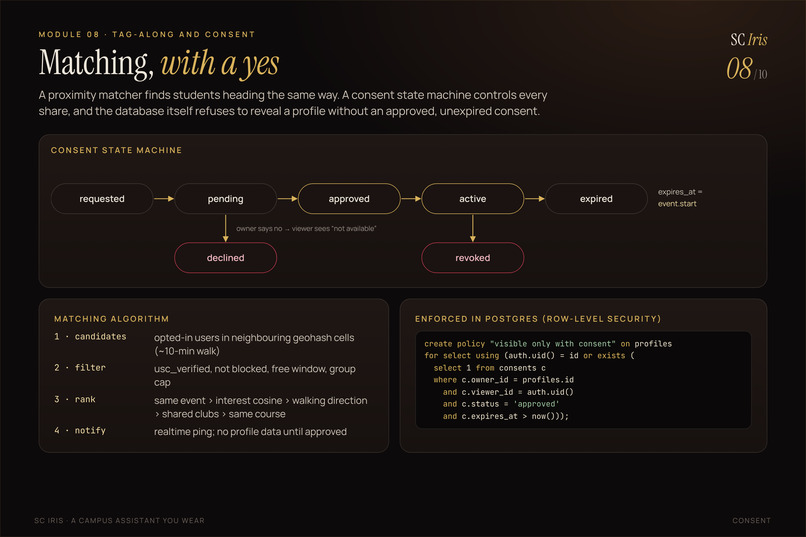
Consent is a state machine (requested → pending → approved → active → expired, with declined and revoked branches), enforced by Postgres row-level security, so the database itself refuses to reveal a profile without approval.
Challenges we ran into
- No physical glasses: Meta's display access is in developer preview, so we simulated the lens experience and designed the system so real hardware can plug in later.
- Tiny display constraints: four options, one line each, even in simulation.
- Trustworthy AI: an LLM can suggest something that doesn't actually fit between classes, so we moved all feasibility and safety checks into code.
- Privacy: matching people without exposing profiles before consent.
Accomplishments that we're proud of
- A working simulated flow from request to a ranked, feasibility-checked set of options.
- Consent enforced in the database, not just in app logic.
- Tag-along matching that shares only what the student approves: never location, phone or email.
- A design ready for real glasses.
What we learned
- Students need the right option at the right moment, not more information.
- Designing for a tiny display forces clarity.
- Splitting LLM and deterministic code makes AI easier to trust and debug.
- Privacy works best when built into the data layer from day one.
What's next for SC Iris
- Next: integrate real Meta glasses and run a campus pilot with official USC event feeds, a few clubs and one library floor.
- Then: deeper engagement through club pages, friends going and reminders, plus hands-free and accessible modes.
- Later: a walk-with-me safety mode, and reusing the engine on other campuses.
Built With
- claude
- css3
- engagesc
- geojson
- github
- html5
- icalendar
- javascript
- leaflet.js
- meta
- model-context-protocol
- node.js
- nominatim
- openstreetmap
- osmtogeojson
- osrm
- overpass-api
- replit
- three.js
- webgl
- websockets
- zod
