SaltShadow — The Winter Storm Crime Scene
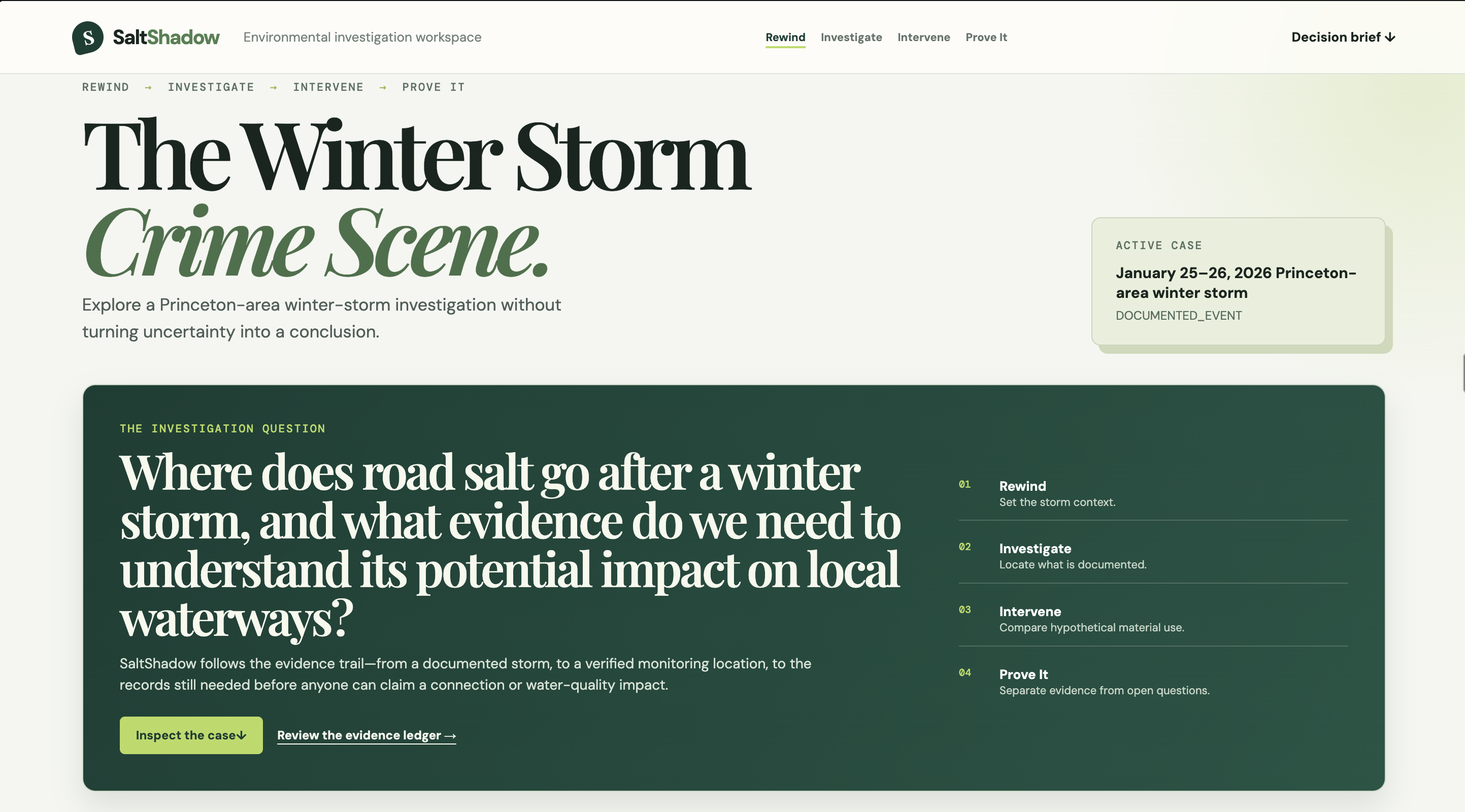
A winter storm leaves an evidence trail. But a plausible pollution story is not the same as a proven one.
Inspiration
When roads are treated with salt during winter storms, the environmental consequences can extend beyond the pavement. Yet investigating possible impacts on nearby waterways is difficult: weather records, monitoring stations, maintenance decisions, and water-quality measurements are often separate pieces of evidence.
A map can show a stream near a road. It cannot, by itself, prove that salt from that road reached the stream or caused a particular chloride reading.
We built SaltShadow to make that distinction visible and understandable.
What it does
SaltShadow is an interactive winter-storm investigation workspace built around four stages:
1. REWIND — Establish the event.
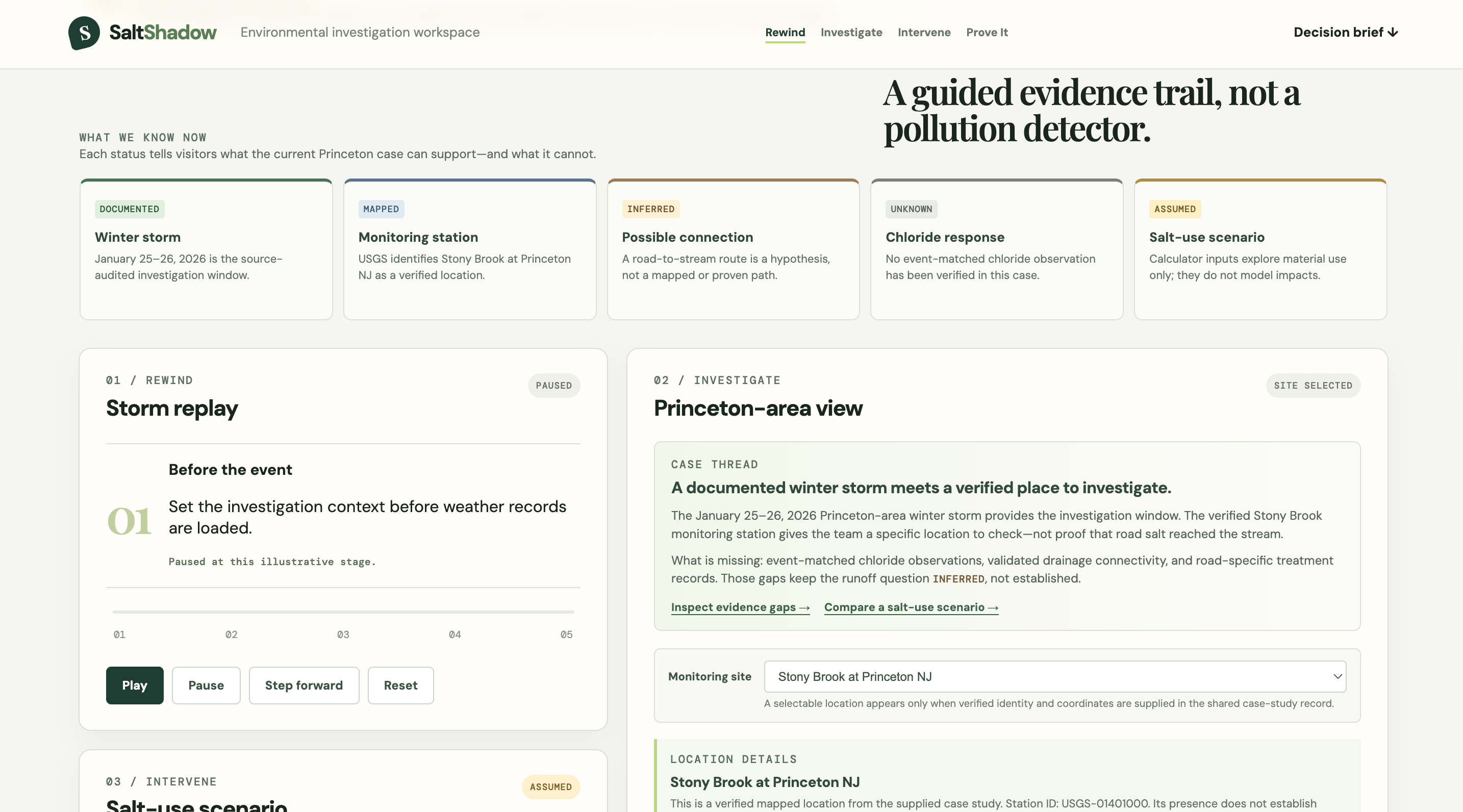
Explore a guided winter-storm timeline anchored to a documented January 25–26, 2026 Princeton-area storm. The interface separates verified historical context from illustrative replay stages rather than presenting a simulated timeline as observed weather data.
2. INVESTIGATE — Follow the evidence.
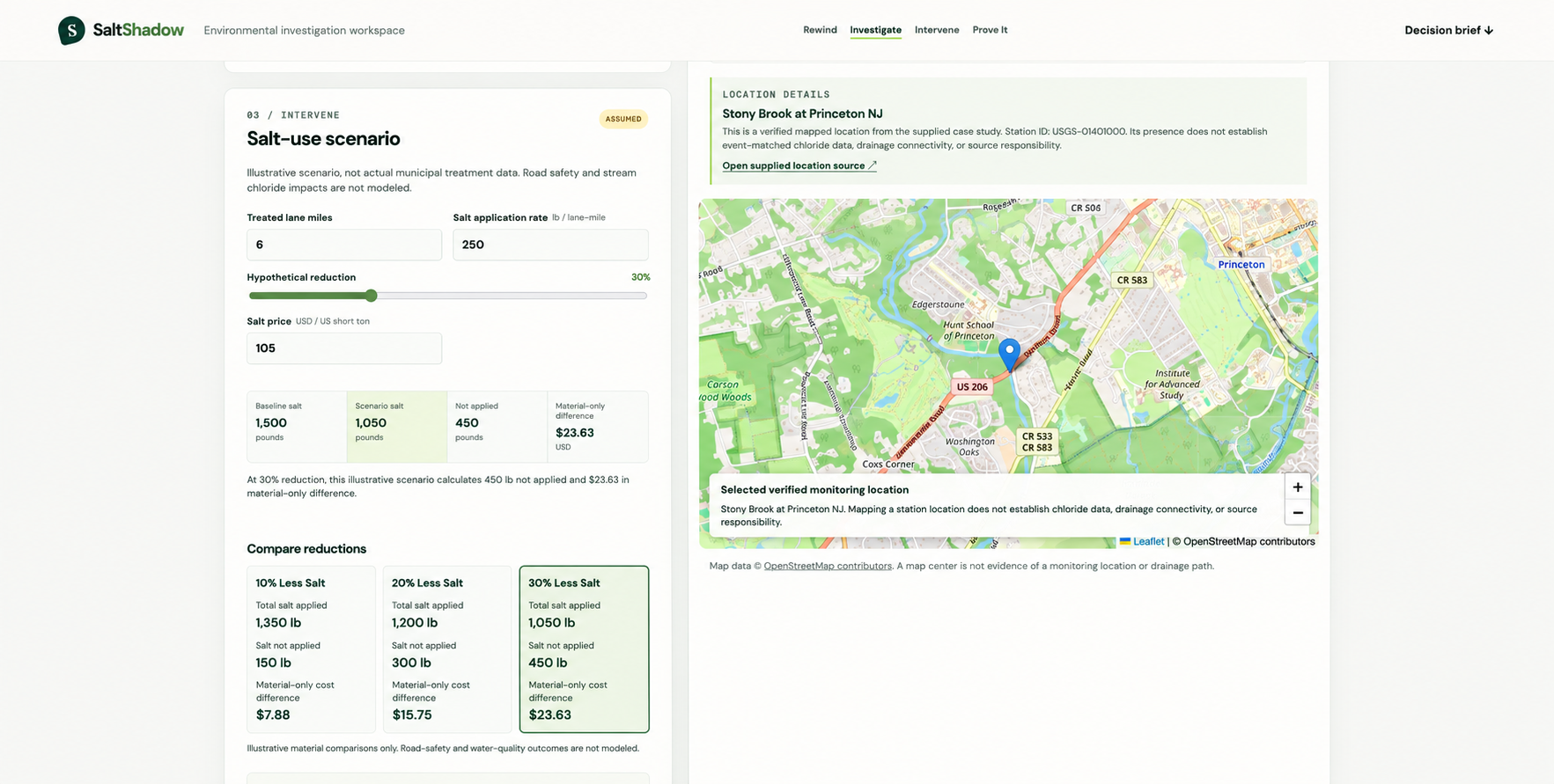
Use an interactive Princeton-area map to examine a verified monitoring location: USGS Stony Brook at Princeton NJ (station 01401000). The investigation distinguishes documented locations from possible runoff connections and identifies where event-specific chloride evidence is missing.
3. INTERVENE — Test the alternatives.
Explore hypothetical road-salt reductions with an interactive calculator and 10%, 20%, and 30% comparison scenarios. The calculations show salt mass and material-only cost differences without claiming that reduced application is automatically safe or that it produces a known water-quality improvement.
For example, an illustrative 6-lane-mile scenario using 250 lb of salt per lane-mile, a 20% reduction, and $105 per US short ton yields 300 lb of salt not applied and $15.75 in material-only cost difference. These are calculated scenario outputs, not observed municipal savings.
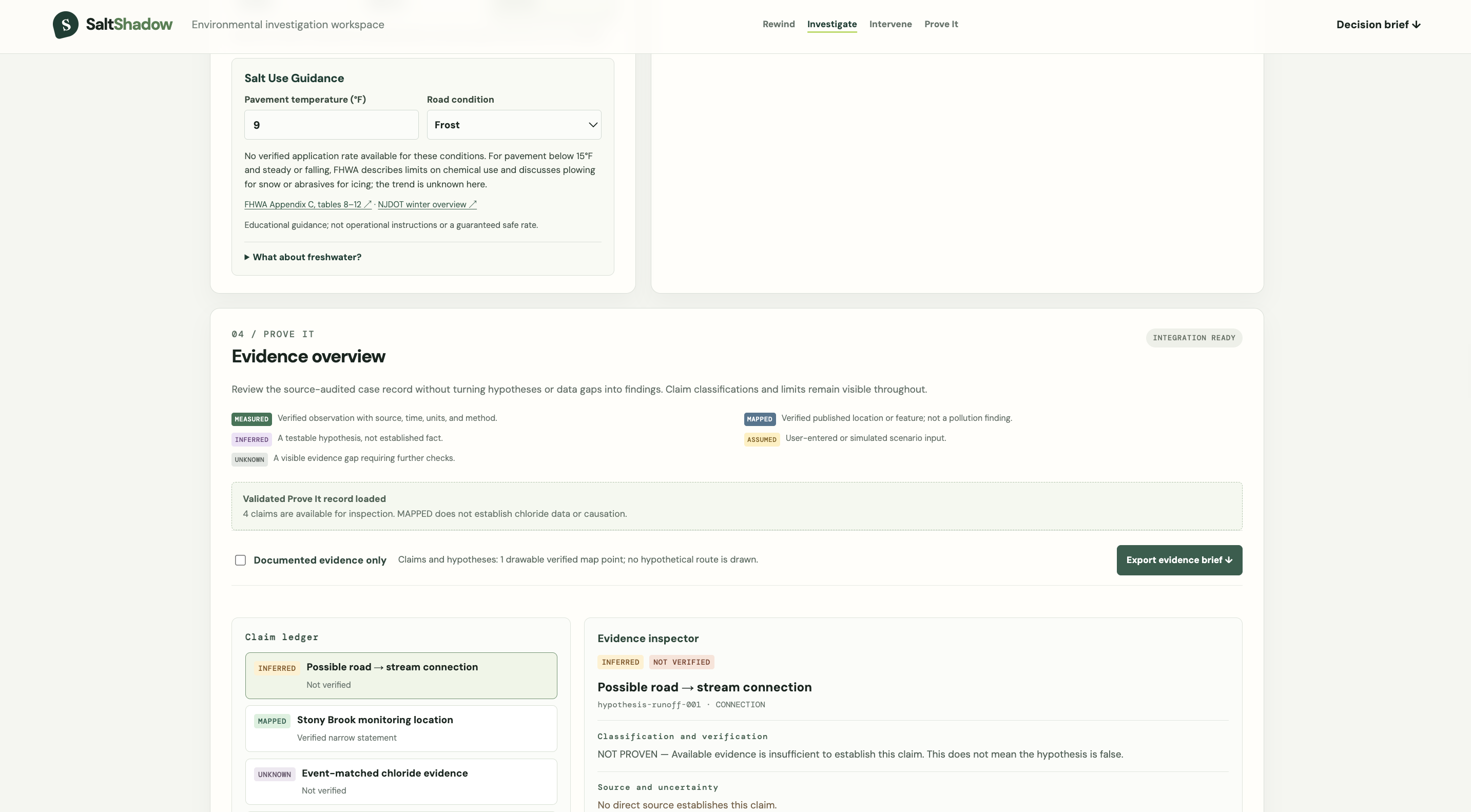
The application also offers source-linked winter-maintenance guidance based on pavement temperature and road condition, while explicitly refusing to invent a precise application rate from insufficient inputs.
4. PROVE IT — Challenge the conclusion.
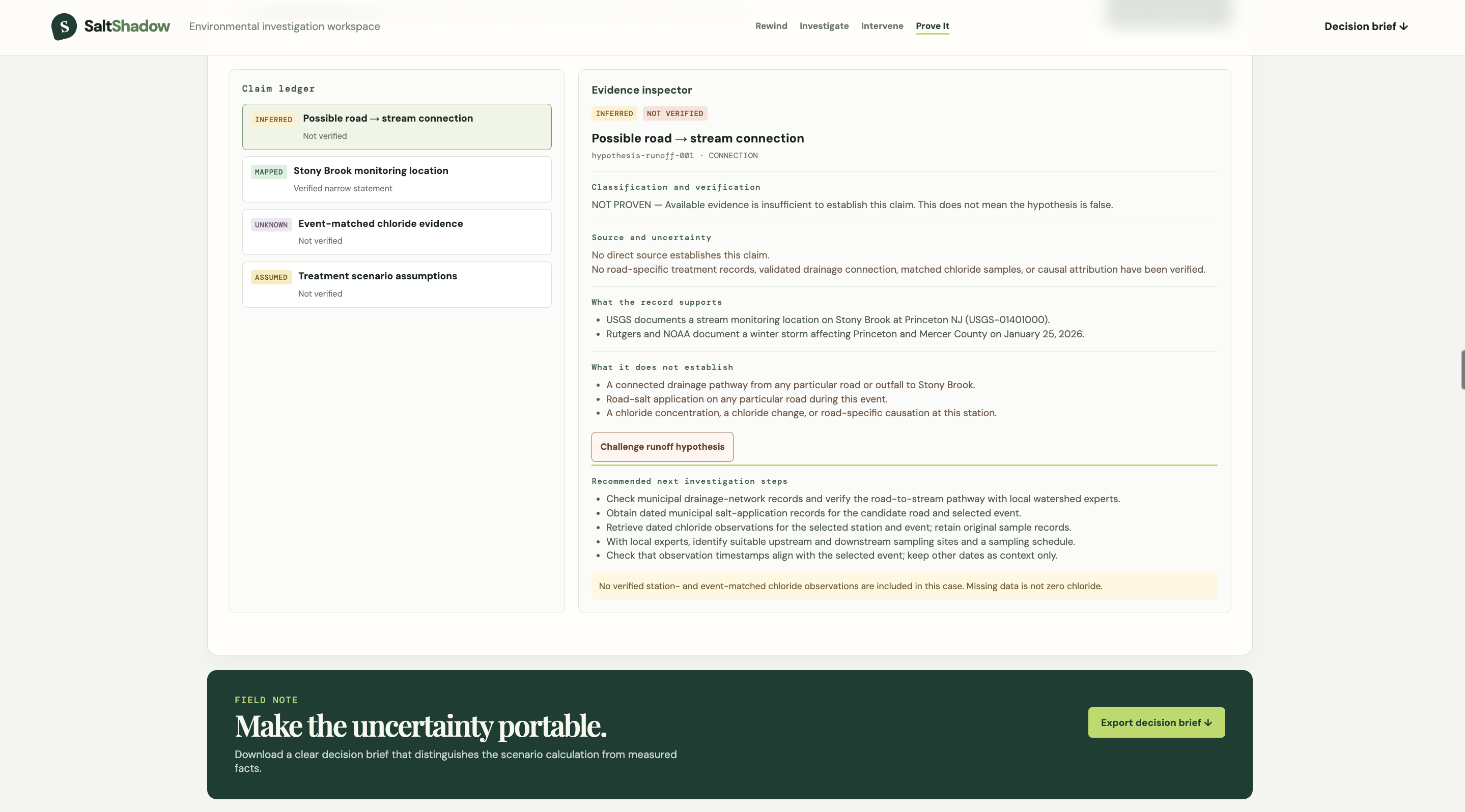
Every environmental statement is classified by its evidence status, including MAPPED, INFERRED, ASSUMED, and UNKNOWN.
A user can challenge a possible road-to-stream connection and inspect why it remains NOT PROVEN. The Documented Only filter excludes unsupported geographic connections from the verified evidence view. The interface also identifies additional records or observations needed to investigate the hypothesis.
Users can export decision and evidence briefs that preserve the calculated scenario, source context, and scientific limitations.
How we built it
SaltShadow is a modular browser application built with HTML, CSS, and JavaScript, using Leaflet and OpenStreetMap for geographic visualization.
Our implementation connects several independently developed components:
- A deterministic salt-use calculation engine with finite-input validation and consistent US short-ton conversions.
- A source-audited JSON case-study record using Rutgers, NOAA, and USGS references.
- An evidence engine that validates claim classifications, provenance, and supported map features.
- An investigation module that reports missing evidence rather than inferring unsupported conclusions.
- A frontend workflow connecting the replay, map, scenario comparisons, guidance, and downloadable reports.
- Automated Node.js unit and integration tests covering calculations, data contracts, exports, and evidence integrity.
The system deliberately separates calculated quantities from environmental observations so the former cannot silently become claims about the latter.
Challenges we faced
Integrating independent modules. Different teammates developed the frontend, environmental case study, evidence system, and calculator. We had to align their data contracts and ensure that changes did not break the shared application.
Handling incomplete evidence. A verified monitoring station is not proof of a pollution pathway. Our case study does not contain verified event-matched chloride observations, so we designed the interface to preserve that gap instead of displaying invented measurements.
Making calculations trustworthy. We tested boundary cases, fractional inputs, numerical precision, browser compatibility, and export consistency. We also fixed a bug that allowed invalid scenario inputs to produce a downloadable report.
Communicating uncertainty clearly. Our biggest design challenge was making evidence limitations understandable without making the experience feel unfinished.
Accomplishments we're proud of
- Built a connected, four-stage investigation experience rather than a standalone environmental calculator.
- Integrated a documented storm, a published monitoring location, hypothesis review, and scenario exploration.
- Created a Challenge This Connection workflow that visibly distinguishes a compelling hypothesis from supported evidence.
- Added interactive comparison scenarios without inventing environmental-impact predictions.
- Built automated regression tests that verify numerical consistency and preserve scientific limitations across exported evidence.
What we learned
We learned that technical credibility is not just about generating outputs; it is about knowing which outputs are justified by the available evidence.
We also learned to make modular JavaScript components work together, test calculations across edge cases, and design an investigation experience that explicitly communicates uncertainty.
What's next
SaltShadow could evolve into a decision-support and public-engagement tool for municipal public-works teams, watershed organizations, environmental researchers, and community groups.
Our next steps would be to incorporate verified time-matched water-quality observations, documented road-treatment records, and validated drainage information; expand beyond one case study; and develop repeatable reporting workflows.
With those data partnerships and appropriate safety validation, SaltShadow could support more rigorous comparisons of winter-maintenance practices.
Our goal is not to make pollution claims easier to generate. It is to make environmental decisions easier to investigate, explain, and challenge.
