-
-
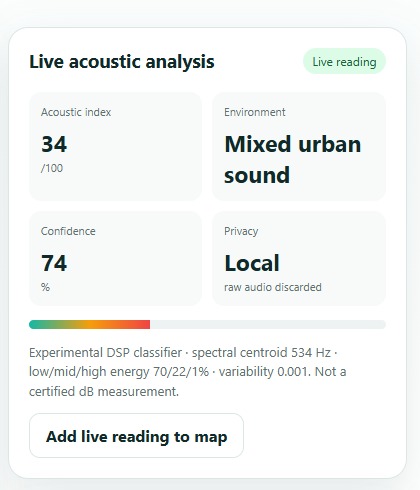
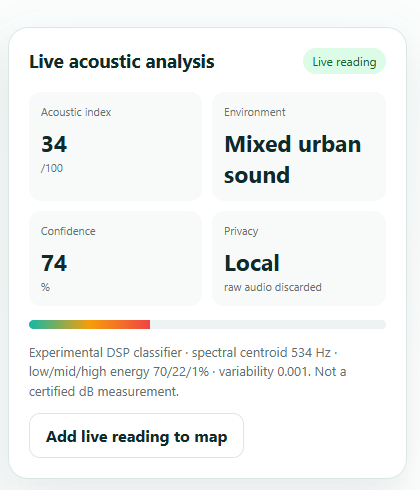
Medición real
-
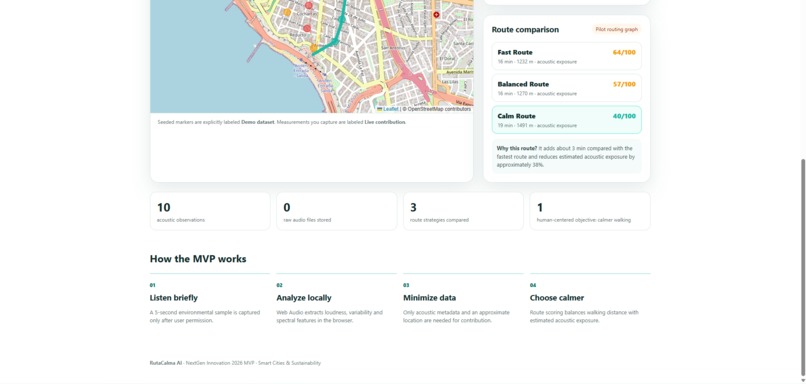
Cómo funciona
-
Portada / visión del producto
-
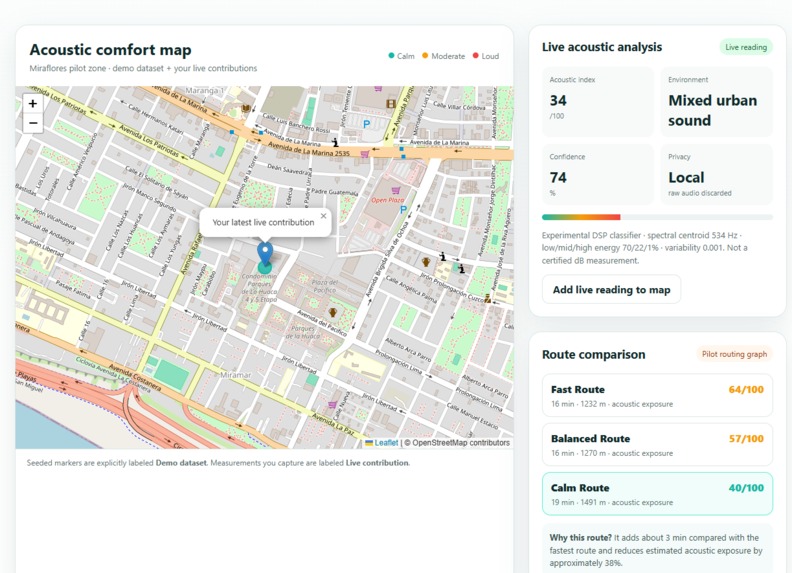
Mapa + rutas
-
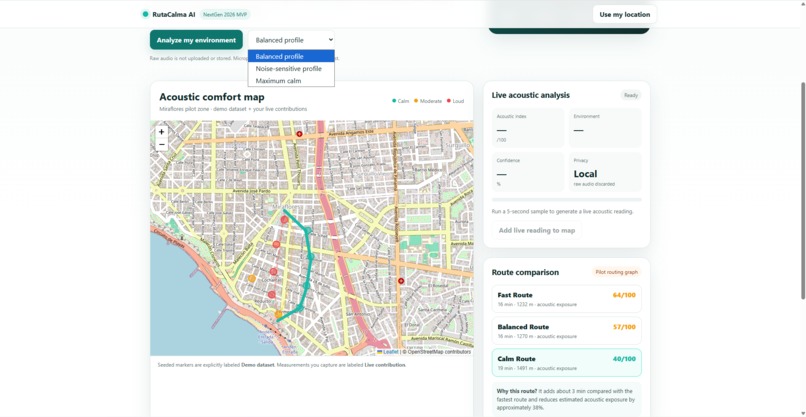
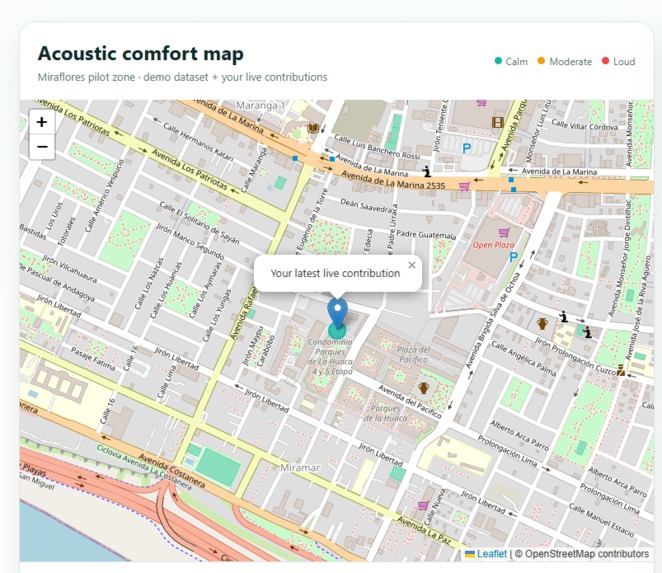
Contribución colaborativa
-
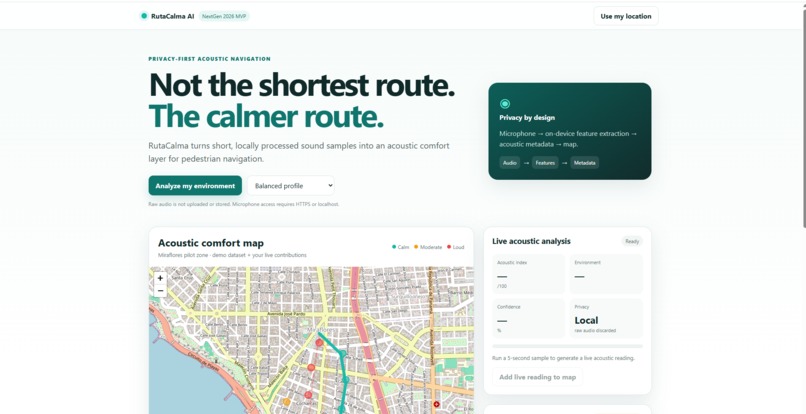
Portada / visión del producto
RutaCalma AI
Inspiration
Most navigation apps optimize for only two things: distance and travel time.
But the shortest route is not always the best route.
A pedestrian may prefer to avoid heavy traffic, constant honking, construction zones, crowded streets, or other high-noise environments. This can be especially relevant for people with high noise sensitivity, older adults, students, parents with young children, and anyone simply looking for a calmer walking experience.
That inspired us to build RutaCalma AI:
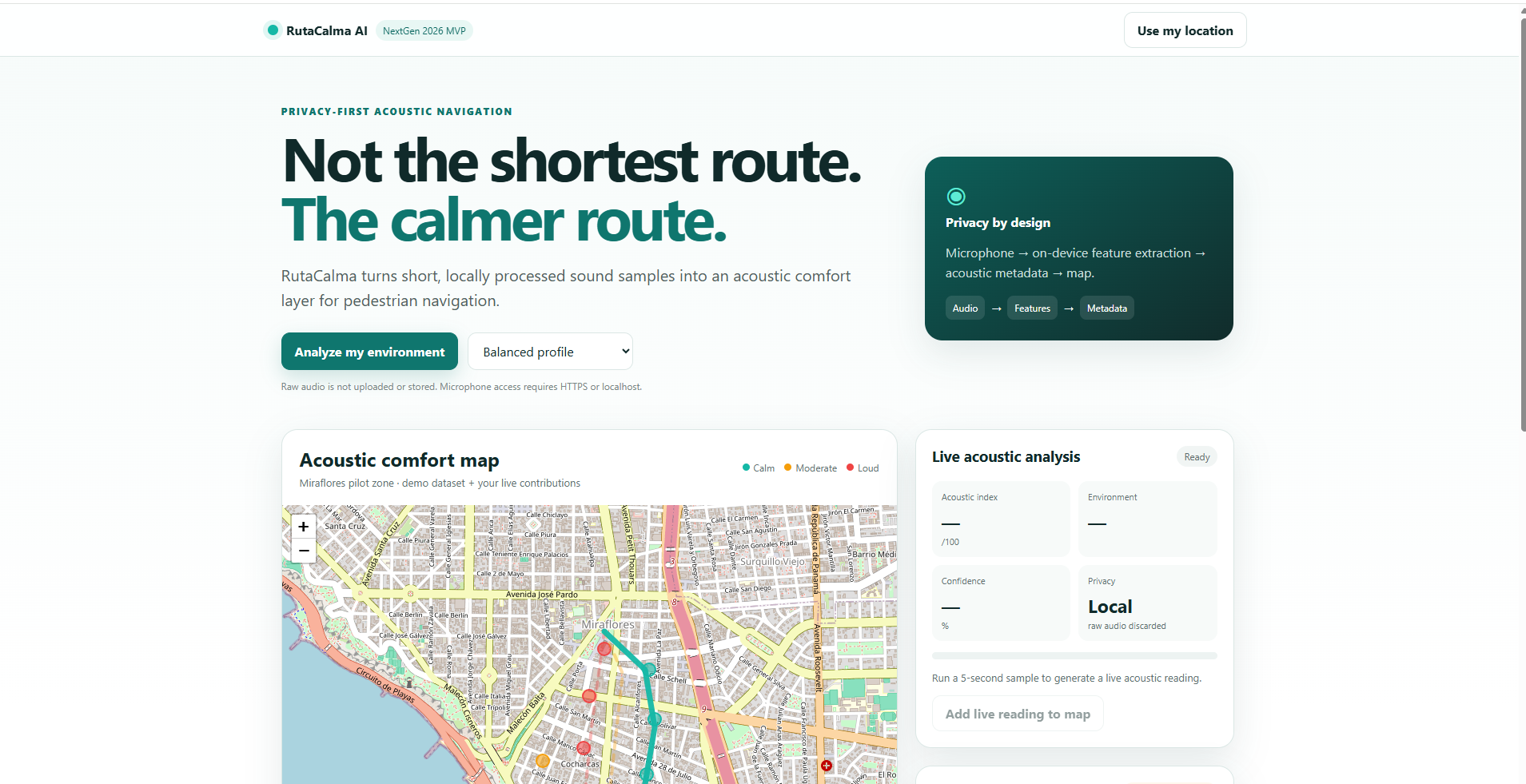
A privacy-first acoustic navigation system that recommends calmer walking routes, not just the shortest ones.
What it does
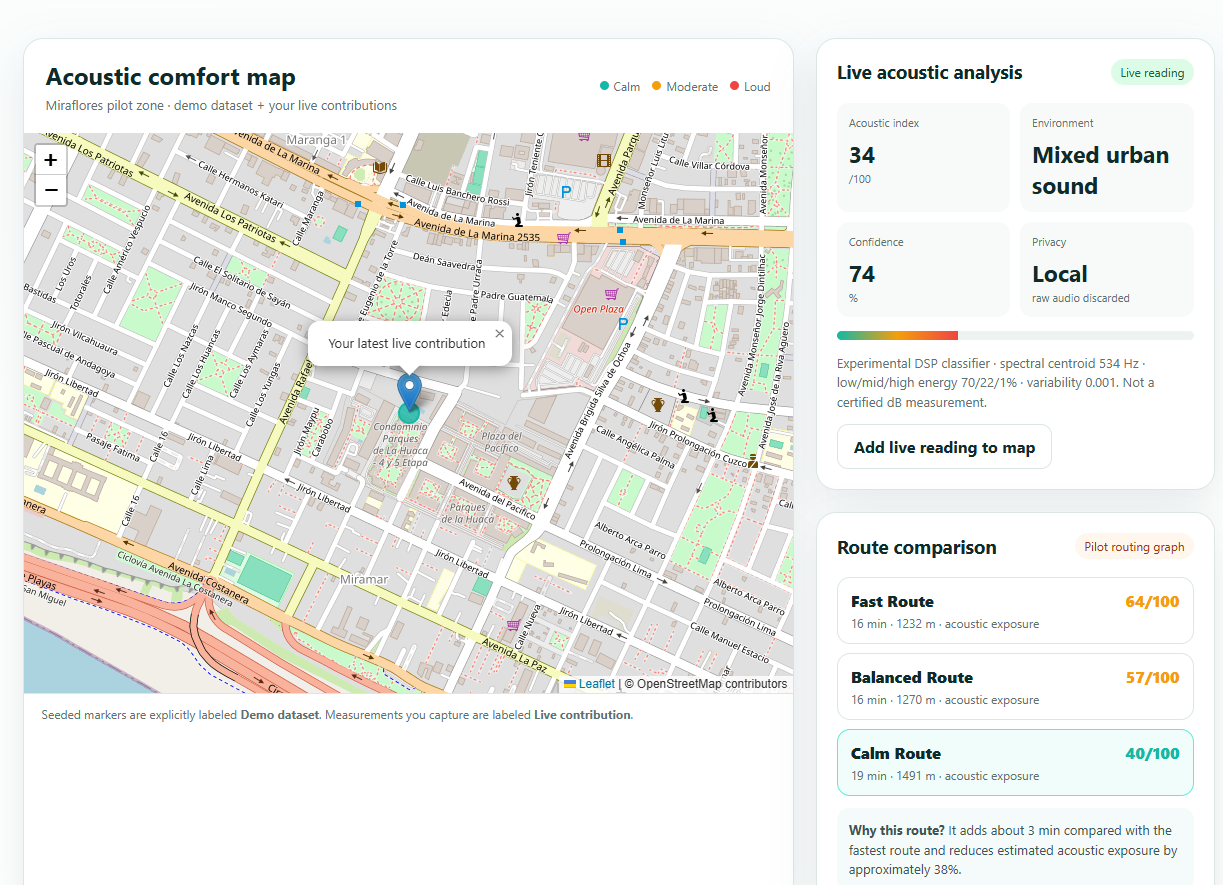
RutaCalma AI combines environmental sound analysis, collaborative acoustic data and route optimization.
A user can:
- Capture a short sample of the surrounding environment using a smartphone.
- Analyze the sound locally.
- Estimate an acoustic comfort score.
- Classify the environment into categories such as traffic, construction, crowd activity or quieter surroundings.
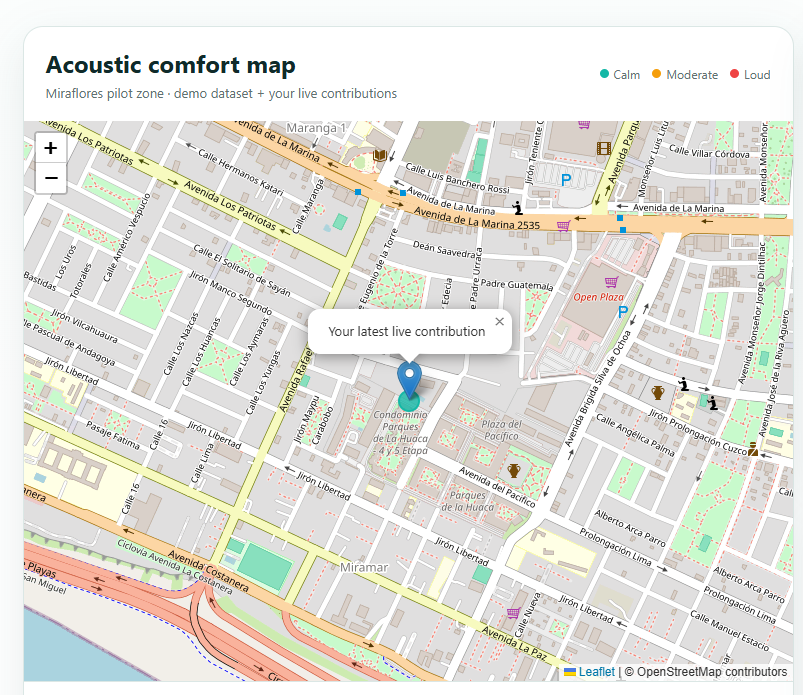
- Contribute the measurement to an acoustic map.
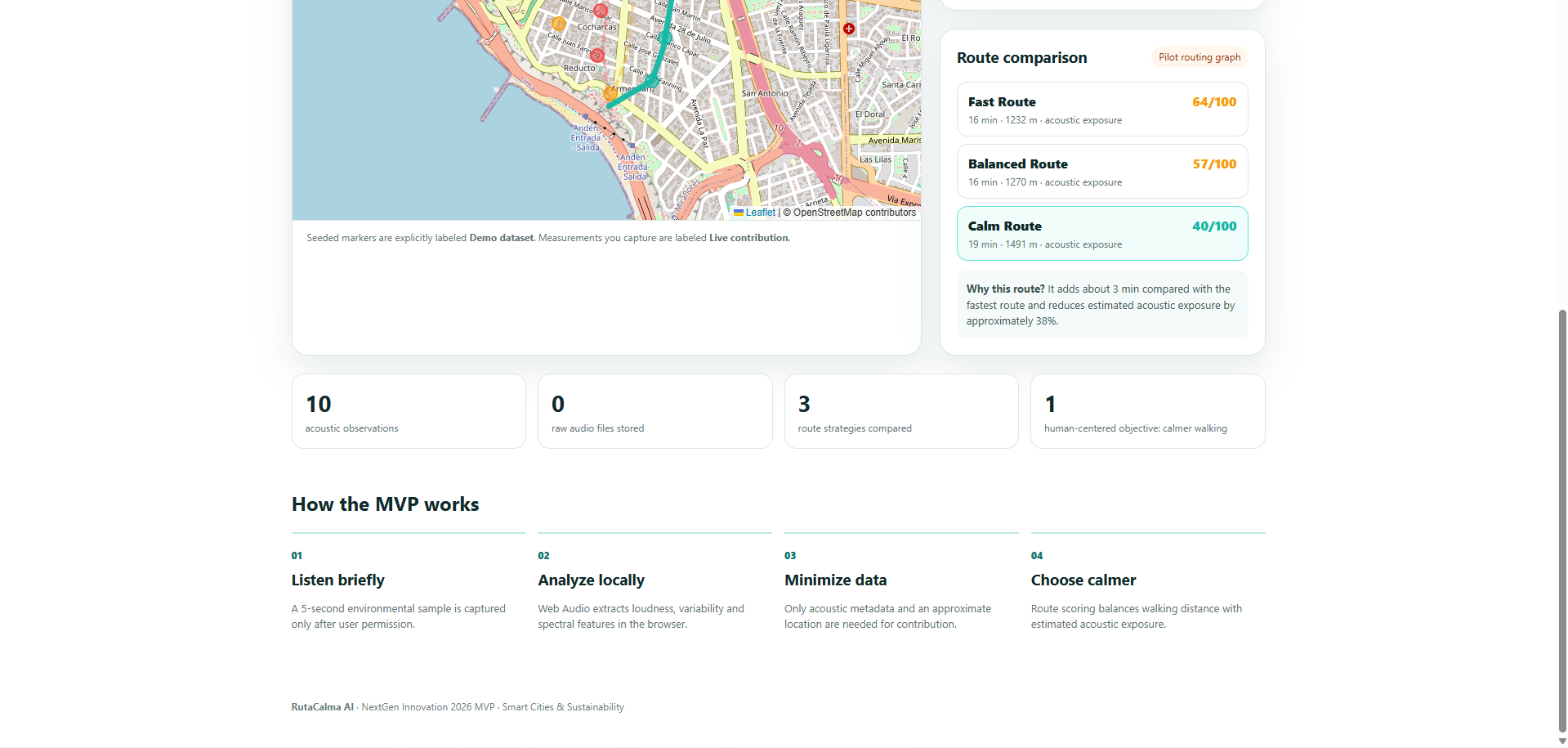
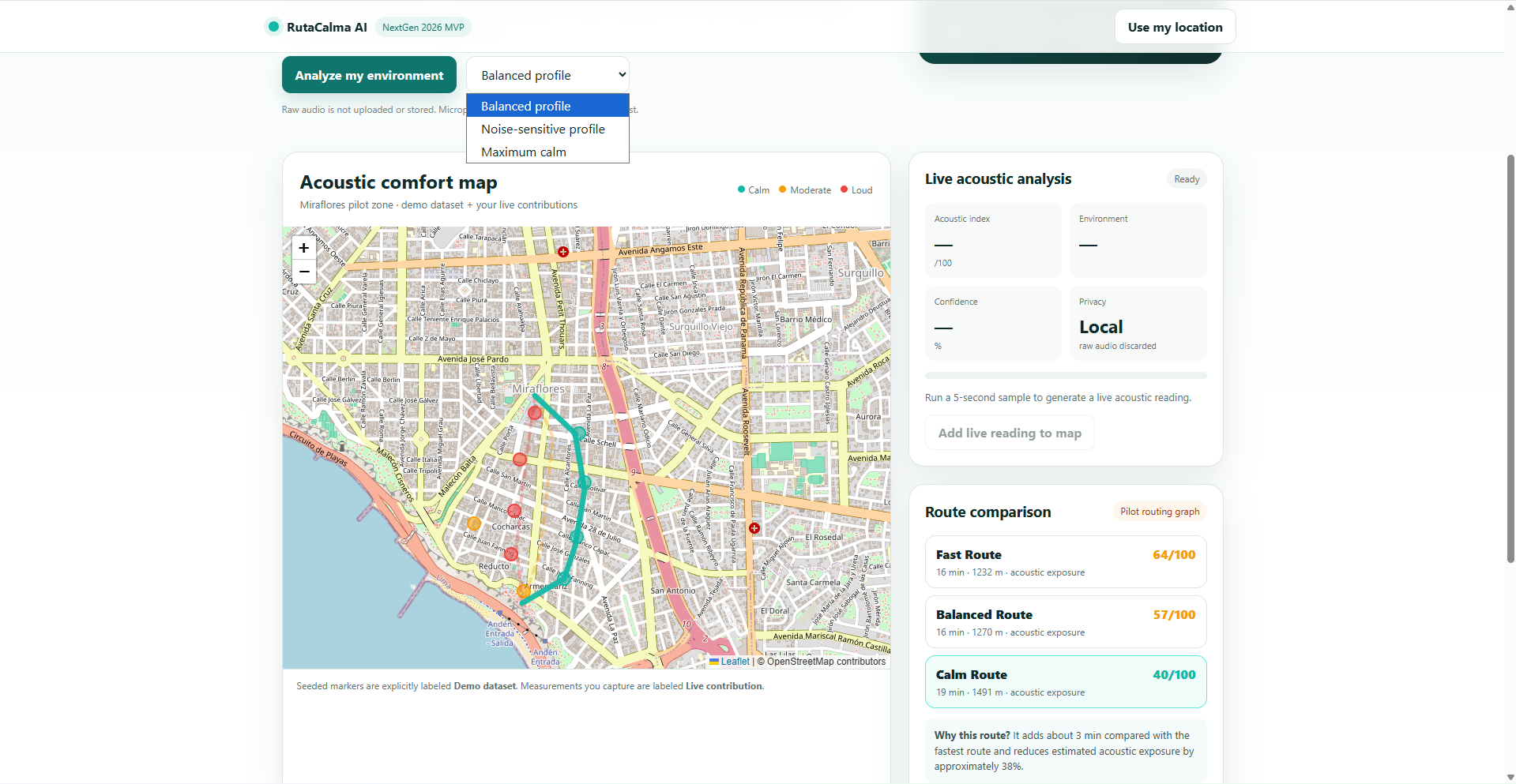
- Compare a standard route with a calmer alternative.
Instead of saying:
“This street is exactly 82 dB.”
RutaCalma uses a relative acoustic stress index.
This is intentional because smartphone microphones have different characteristics and are not professional calibrated sound-level meters.
The objective is to compare urban environments and routes rather than replace certified acoustic measurements.
Privacy by design
Environmental audio can accidentally contain conversations and other sensitive information.
RutaCalma therefore follows a privacy-first architecture.
The intended processing flow is:
Microphone → local acoustic analysis → environmental classification → acoustic metadata → map
The original audio does not need to be permanently stored.
Only information such as:
- approximate location
- acoustic index
- environmental category
- confidence score
- timestamp
is required to build the collaborative acoustic map.
This allows users to contribute urban intelligence without creating a database of private conversations.
How we built it
RutaCalma AI was designed as a mobile-first web application.
The MVP combines:
- browser microphone access
- Web Audio API
- acoustic feature extraction
- environmental sound classification
- geolocation
- collaborative acoustic measurements
- route scoring
- acoustic-aware route comparison
- privacy-preserving local processing
Each street segment can receive an acoustic cost.
Traditional navigation might optimize:
Route Cost = Distance
RutaCalma extends the idea to:
Route Cost = Distance + Acoustic Penalty
The acoustic penalty can be adjusted depending on the user's sensitivity profile.
This makes it possible for two users to receive different route recommendations even when they share the same destination.
Crowd-powered acoustic intelligence
One smartphone measurement is not enough to characterize an entire street.
RutaCalma is designed around collaborative measurements.
As more users contribute, the platform can aggregate observations according to:
- location
- time of day
- sound category
- acoustic intensity
- measurement confidence
- measurement recency
Over time, this could create a dynamic acoustic layer for cities.
Instead of mapping only roads and traffic, cities could begin mapping acoustic comfort.
Challenges
One of the biggest technical challenges is that smartphone microphones are not standardized.
Different devices may produce different values in the same environment.
For that reason, we deliberately avoided presenting the system as a professional decibel meter.
Our approach focuses on:
- relative measurements
- device normalization
- environmental classification
- aggregation of multiple observations
Another challenge was privacy.
Uploading raw environmental recordings to a central server would create unnecessary privacy risks, so the architecture prioritizes local processing and data minimization.
A third challenge was route optimization.
The shortest path and the acoustically preferable path may be completely different, so the routing model needs to balance distance against acoustic exposure.
What we learned
Building RutaCalma demonstrated that AI-powered urban systems do not always require collecting more personal data.
In many cases, better architecture means collecting less.
We also learned that acoustic data becomes significantly more useful when it is combined with context.
A single sound measurement has limited meaning.
But when combined with location, time, classification and multiple community observations, it can become useful urban intelligence.
What's next
RutaCalma AI can evolve far beyond the current MVP.
Future versions could include:
- federated learning between smartphones
- automatic device calibration
- real-time acoustic heatmaps
- historical noise prediction
- alerts for temporary noisy areas
- personalized acoustic sensitivity profiles
- integration with accessibility services
- municipal environmental dashboards
- acoustic datasets for urban planning
- integration with public transportation and pedestrian routing
Ultimately, RutaCalma could become an additional layer of urban navigation:
not only where to go, but how the city will feel along the way.
Our vision
Cities are usually optimized for vehicles, distance and speed.
RutaCalma explores another possibility:
What if navigation could also optimize human comfort?
Not the shortest route. The calmer route.
Built With
- api
- audio
- by
- css3
- design
- digital
- gps
- html5
- javascript
- leaflet.js
- openstreetmap
- optimization
- privacy
- processing
- route
- signal
- smart
- web

Log in or sign up for Devpost to join the conversation.