-
-
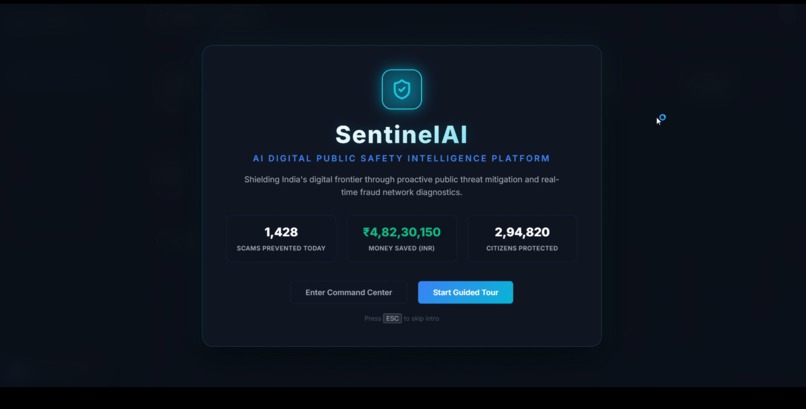
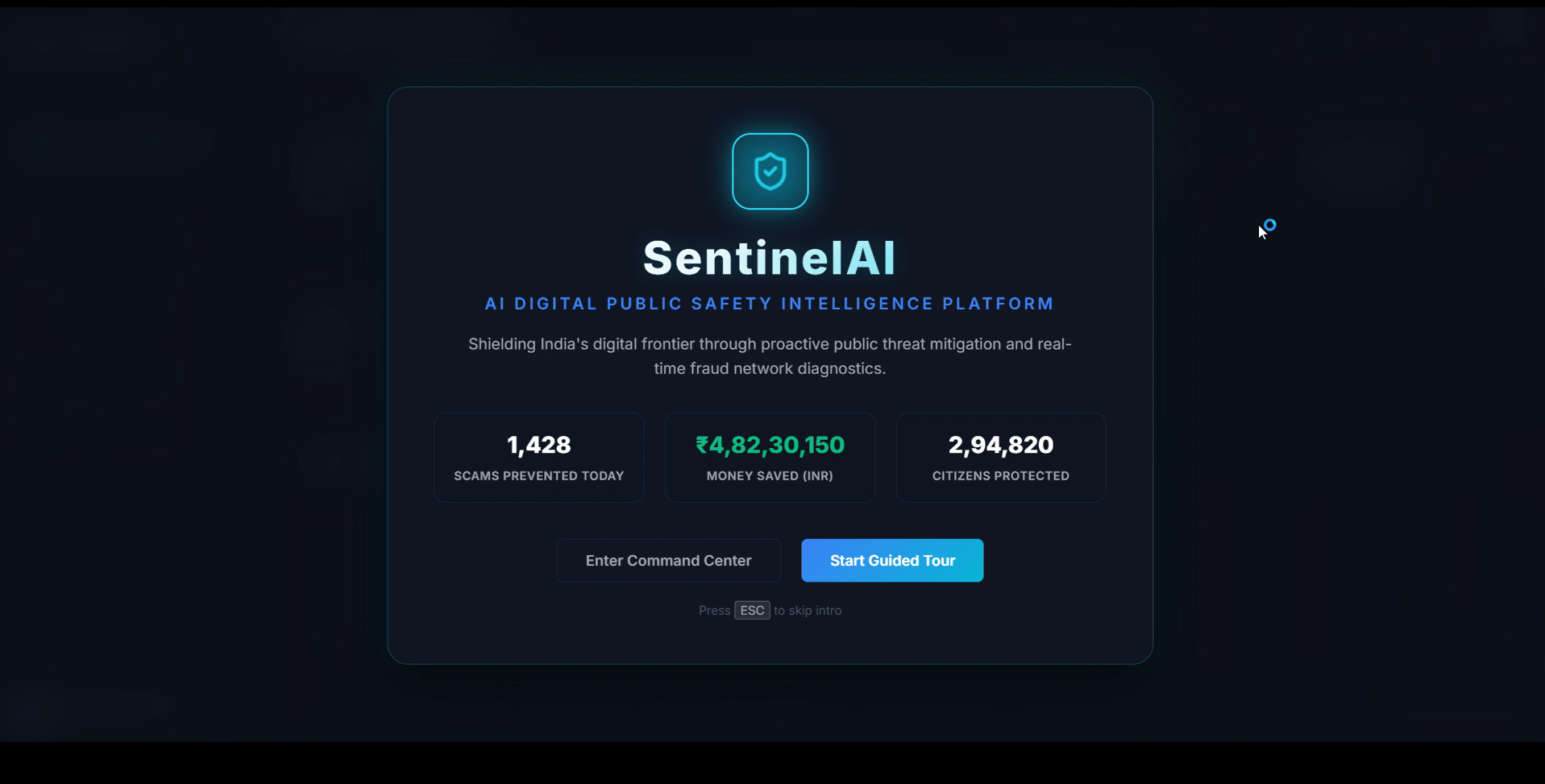
Login
-
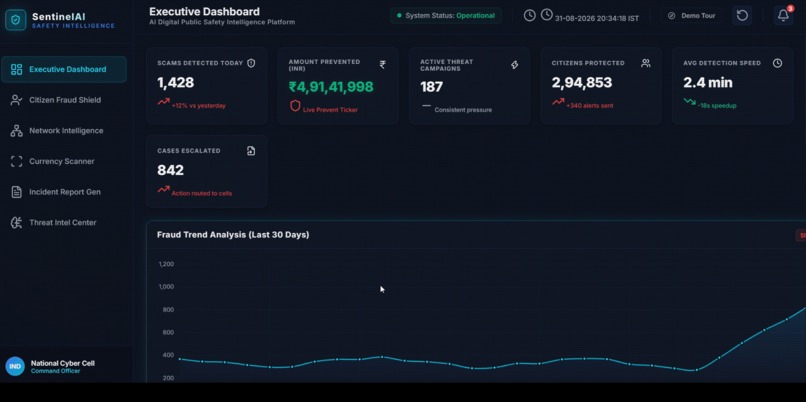
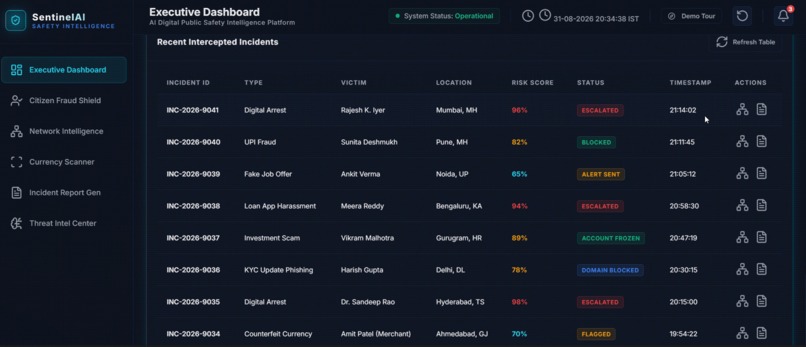
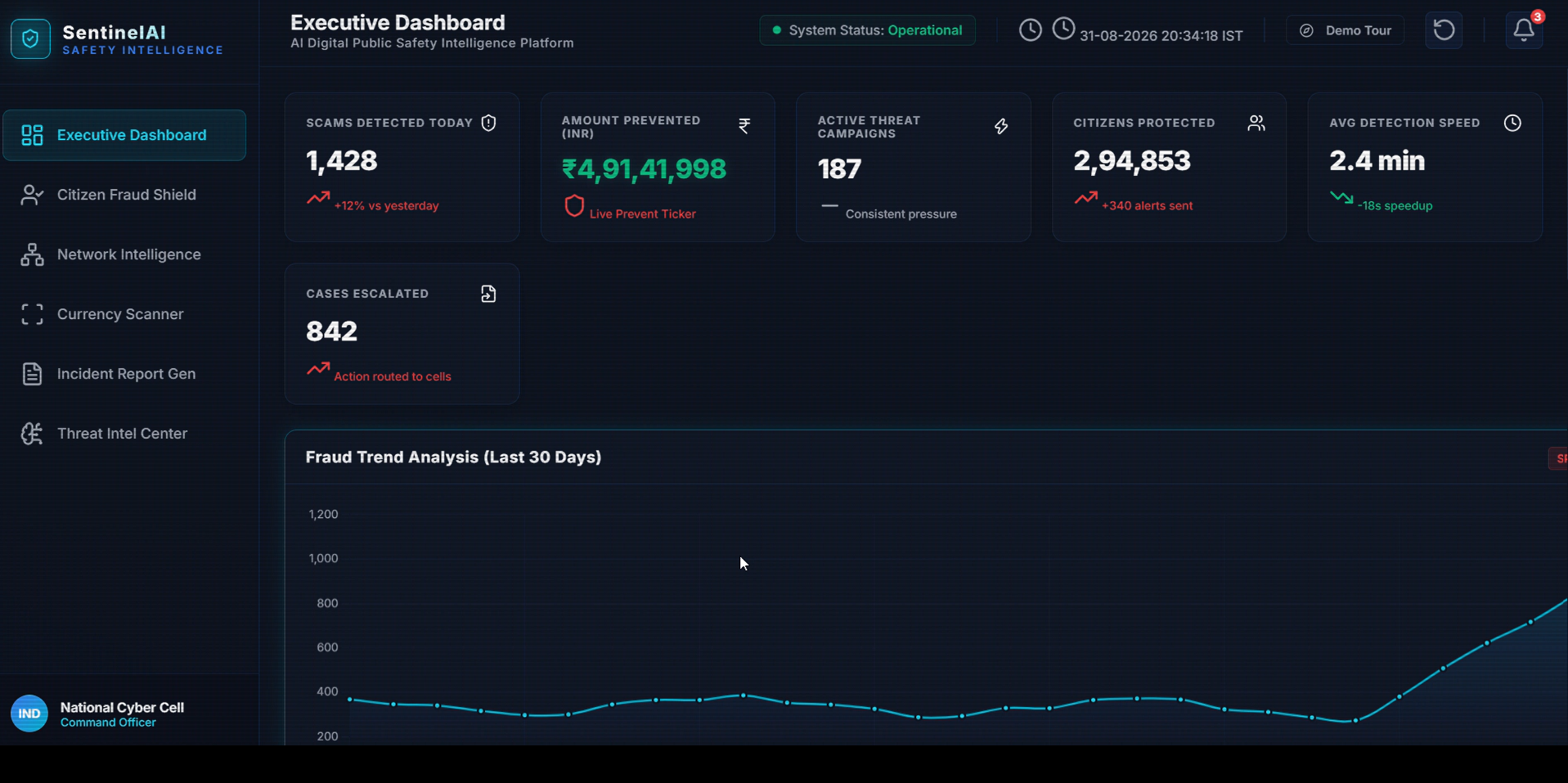
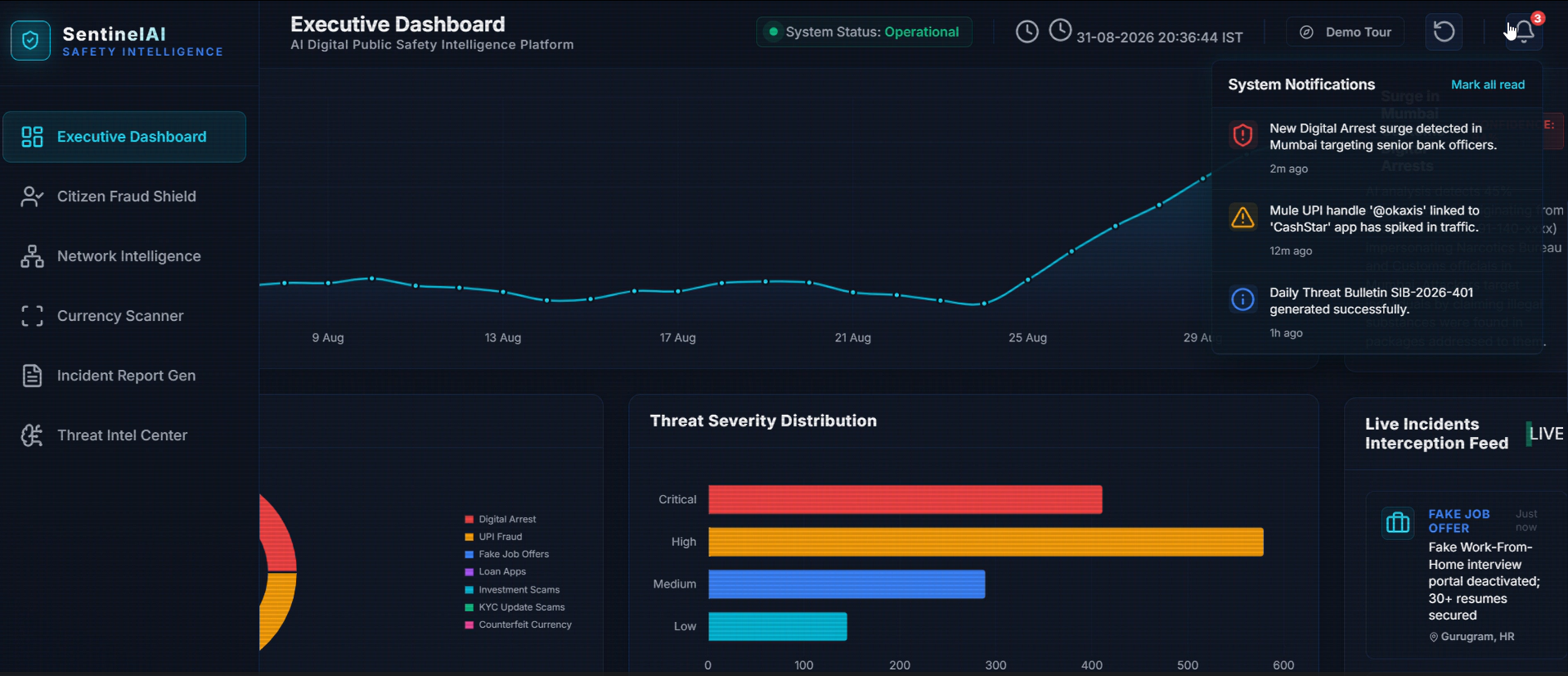
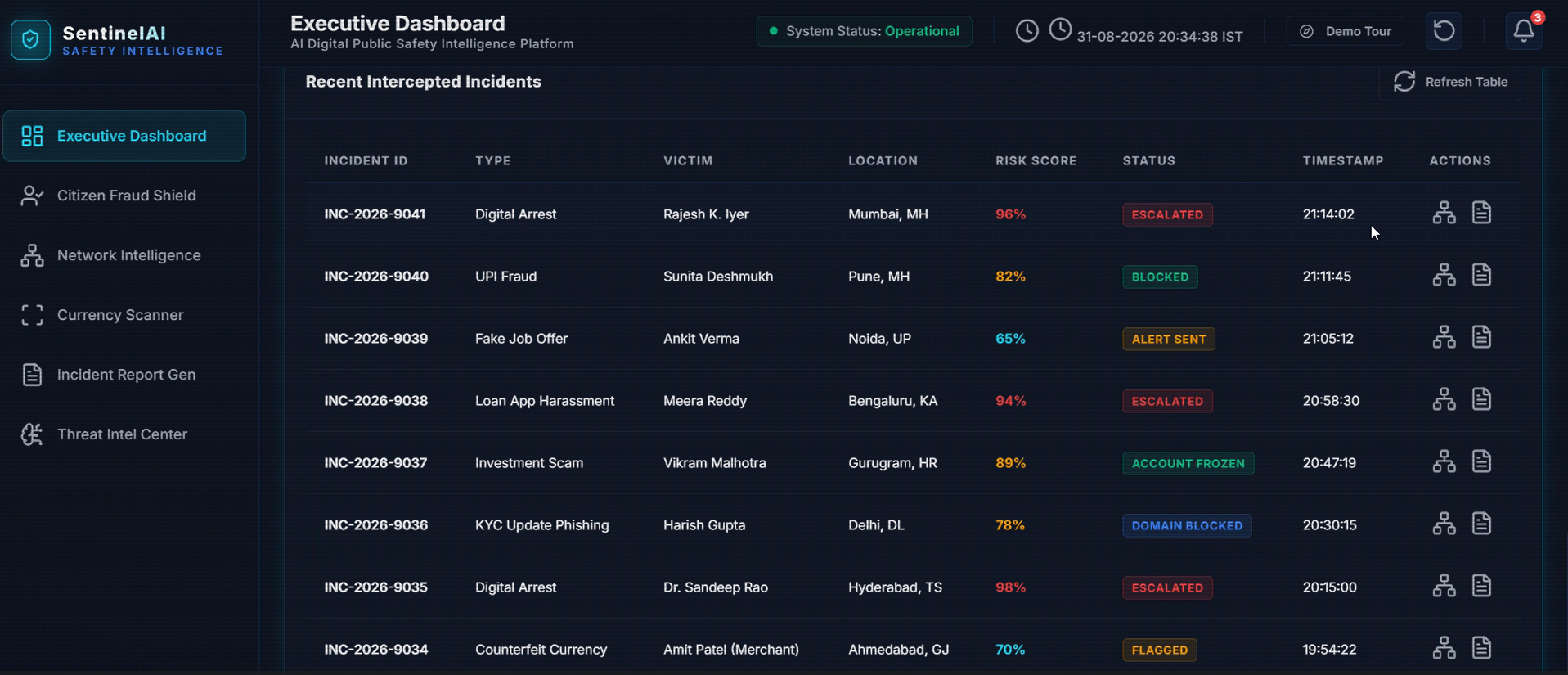
Dashboard
-
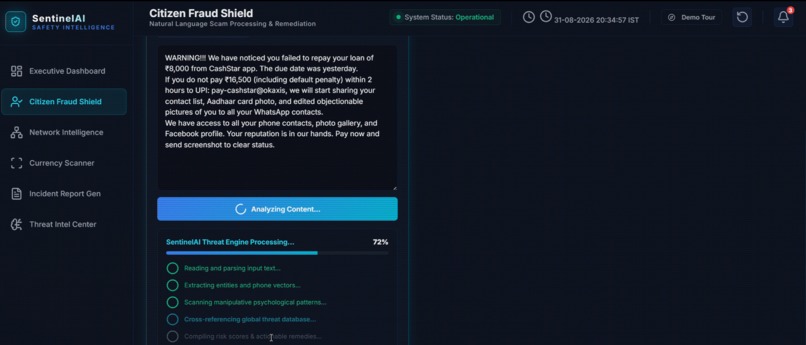
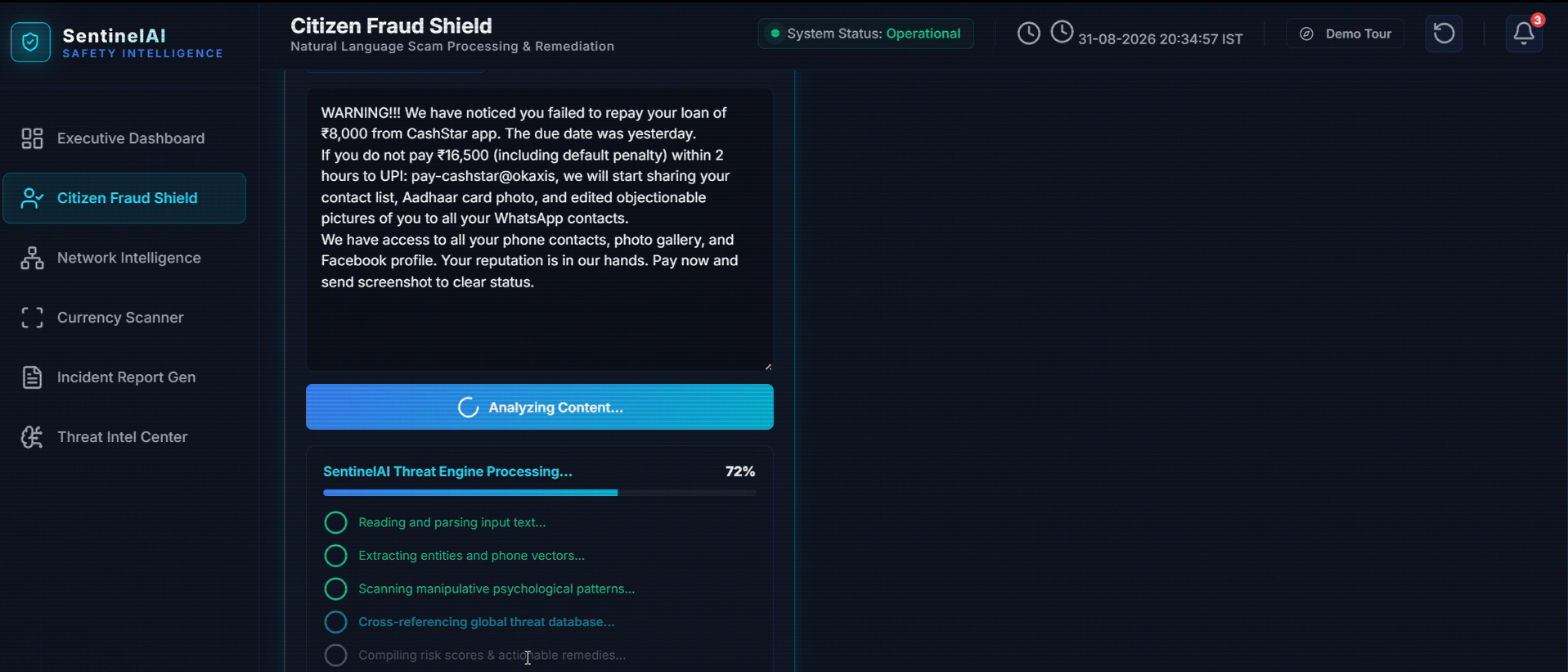
Scam Analysis and Detection
-
-
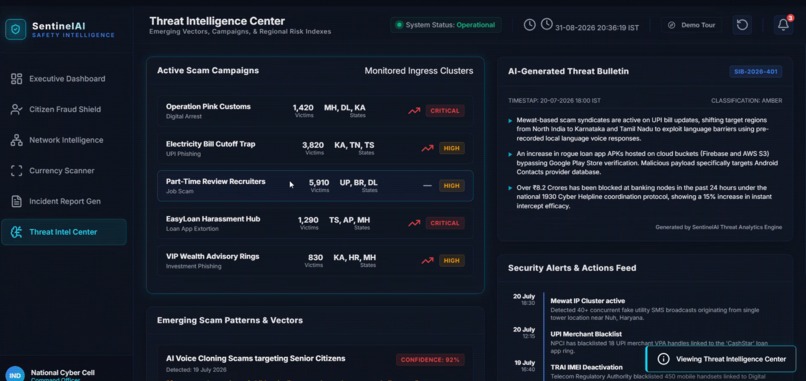
-
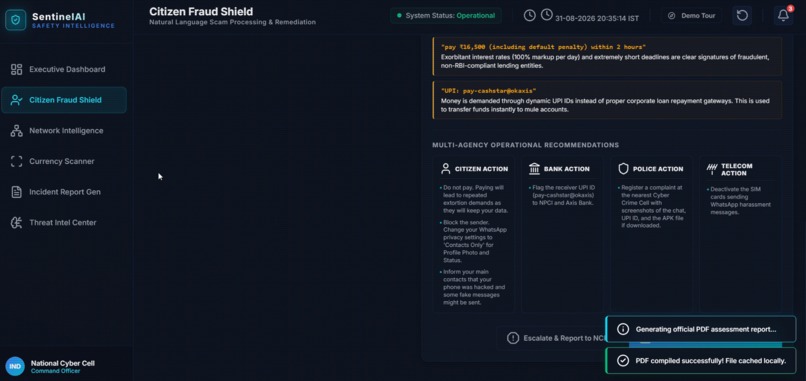
AI report Generation
-
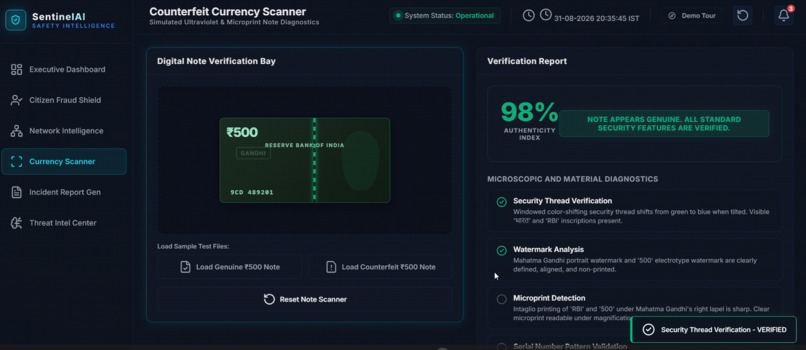
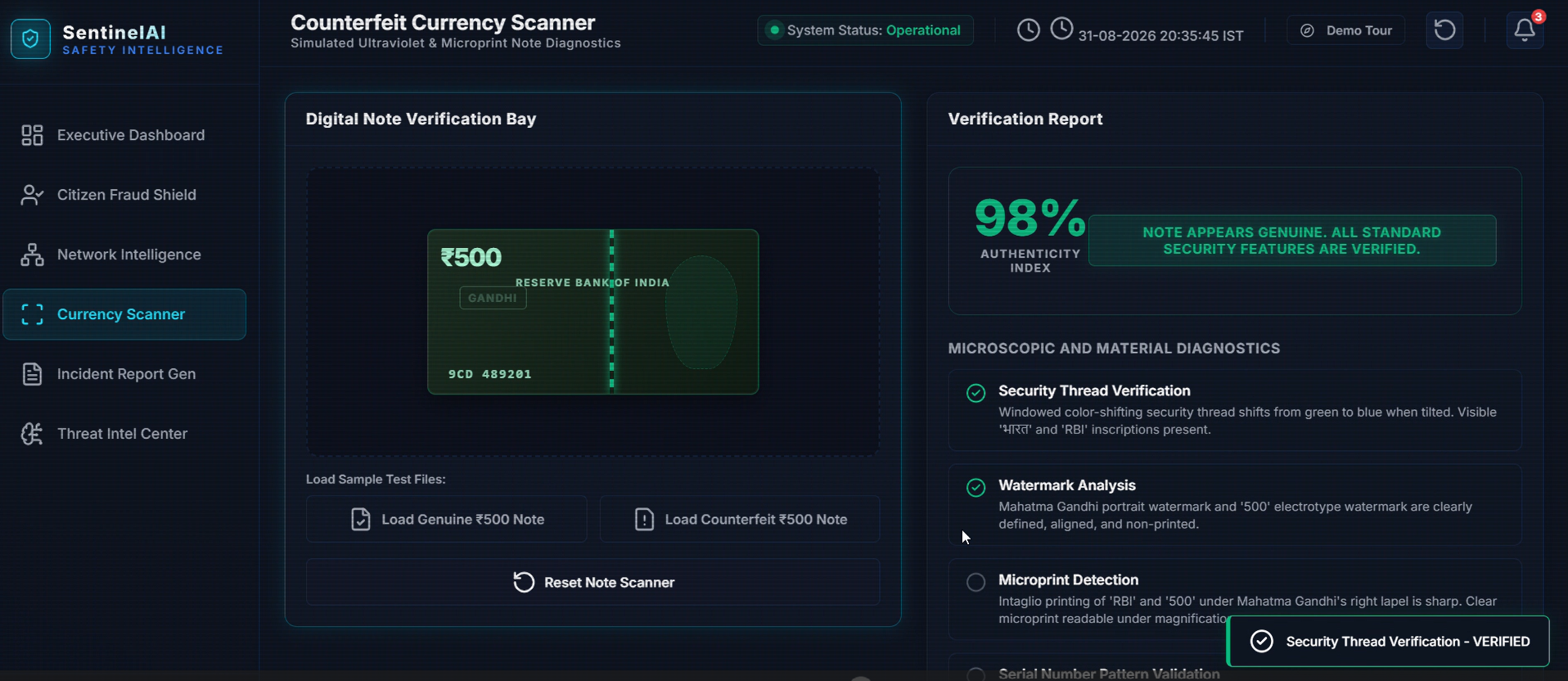
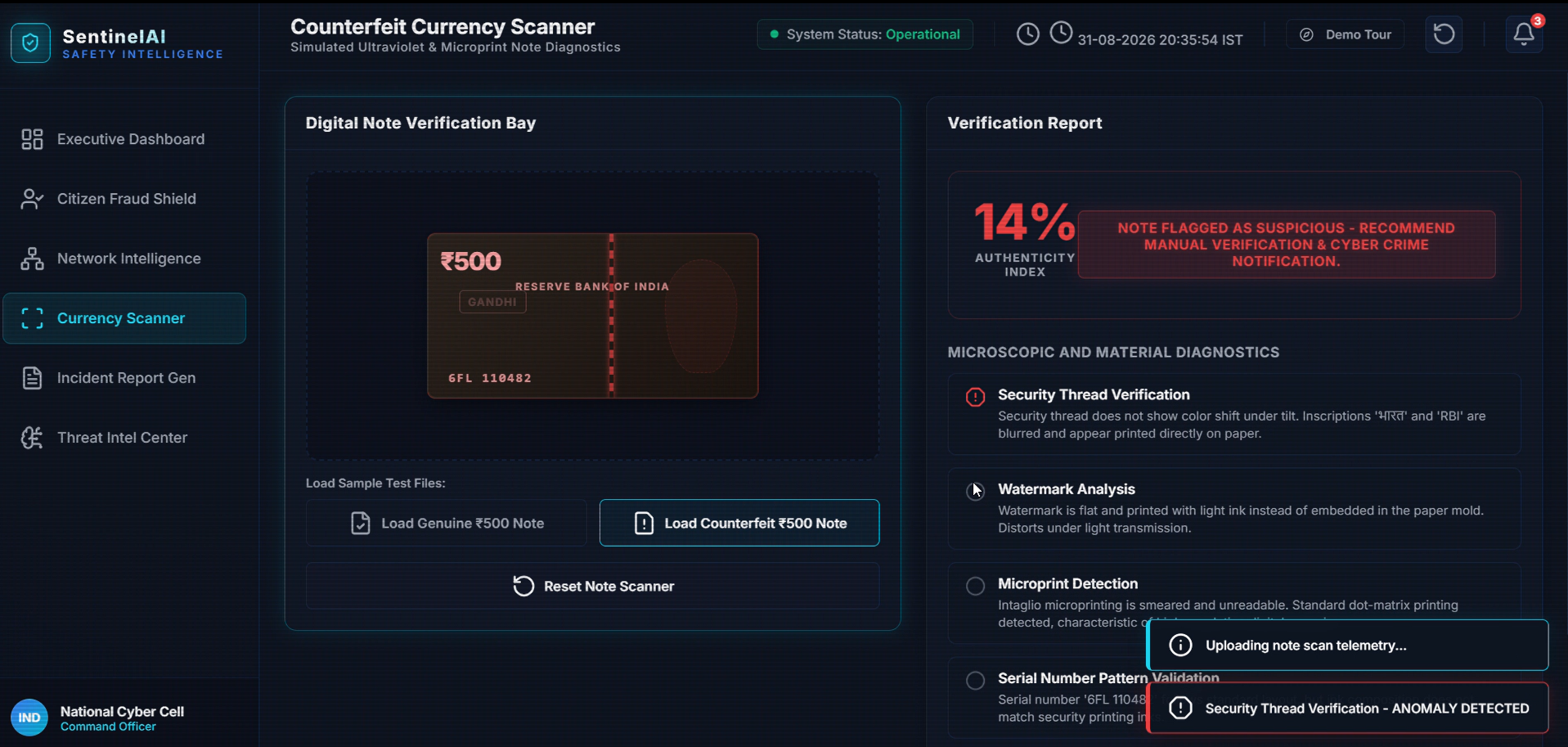
AI-Modeled Currency Scanner
-
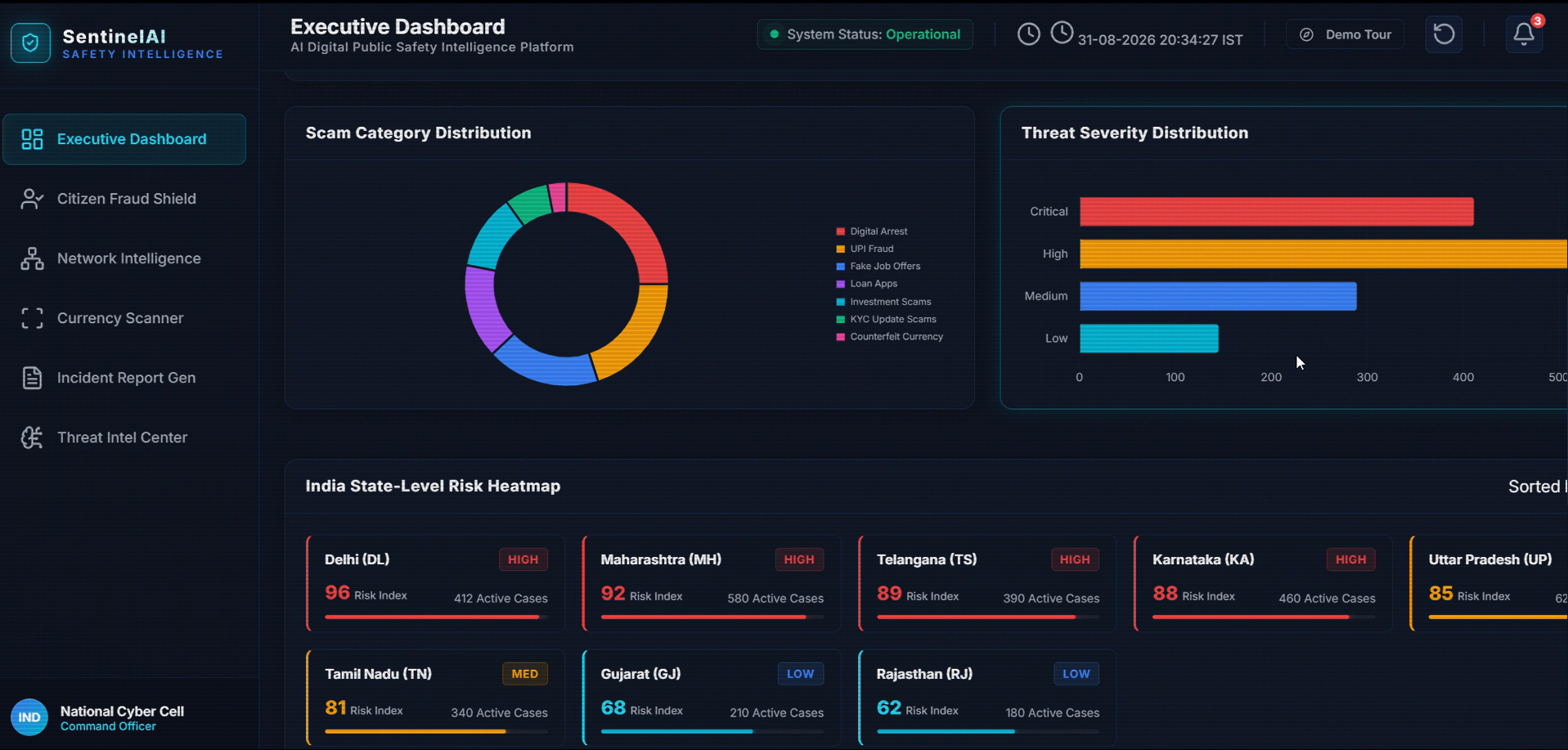
Area-wise Scam distribution
-
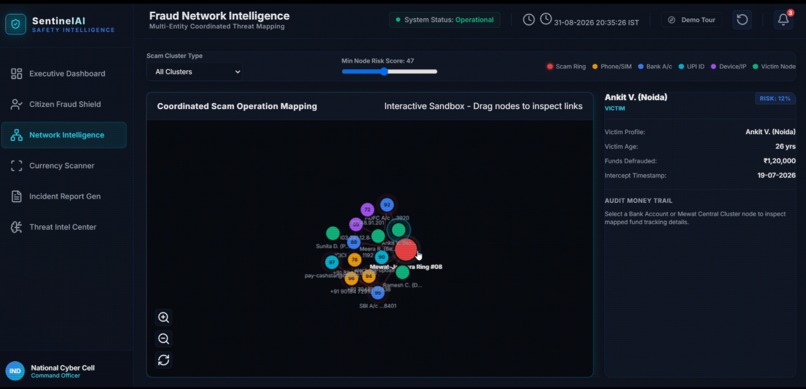
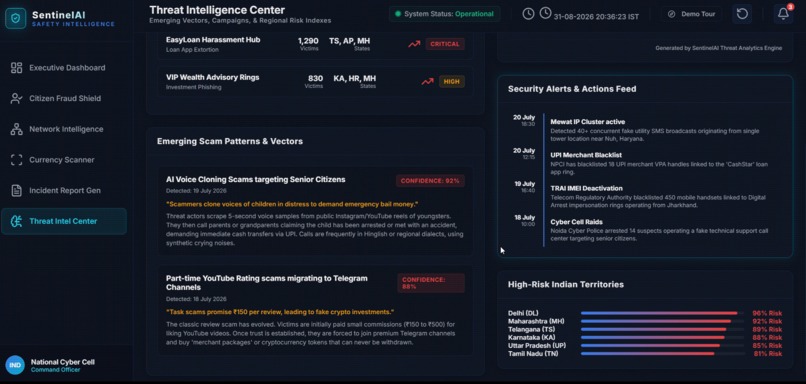
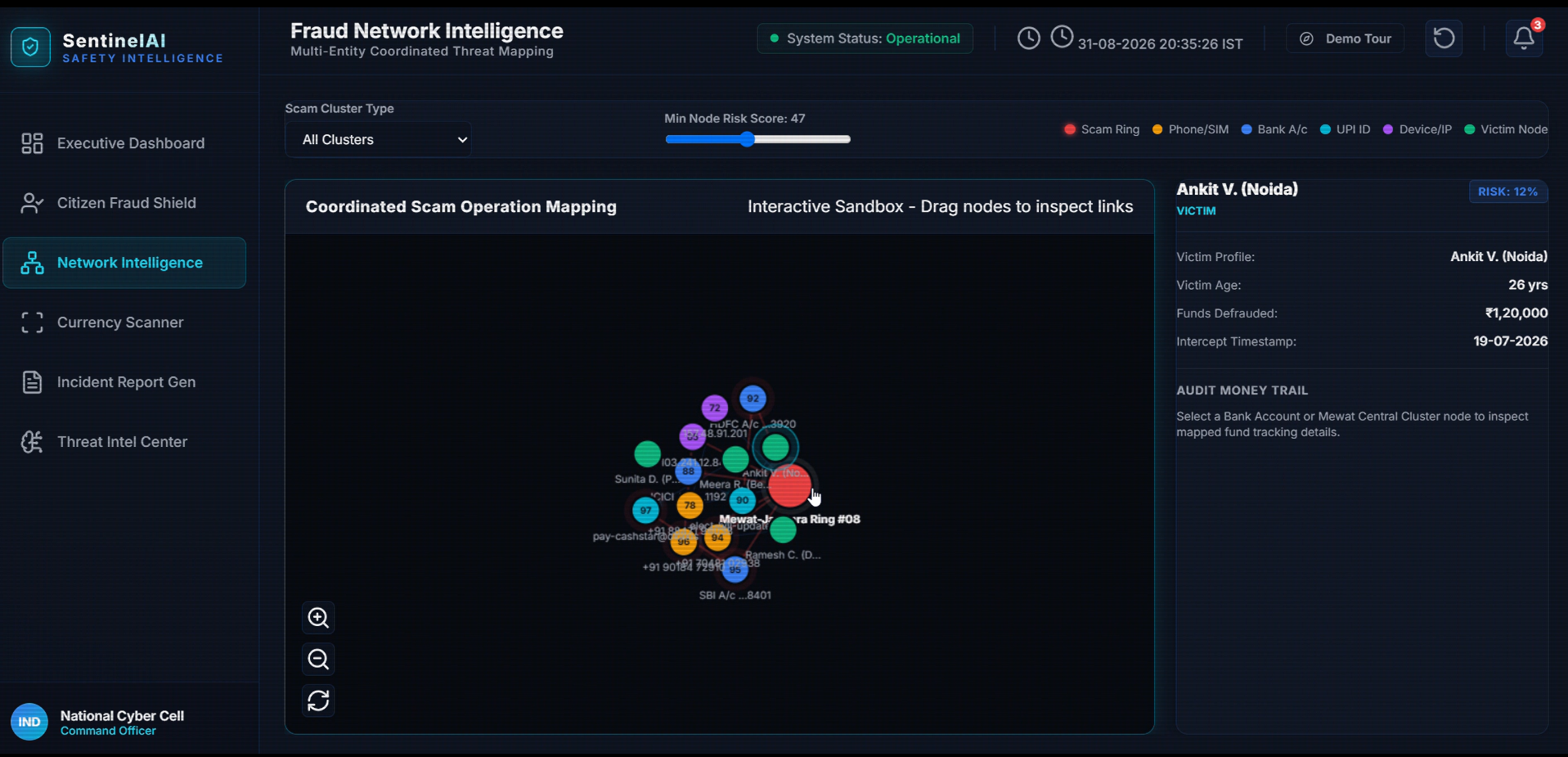
AI Fraud Intelligence Graphics
-
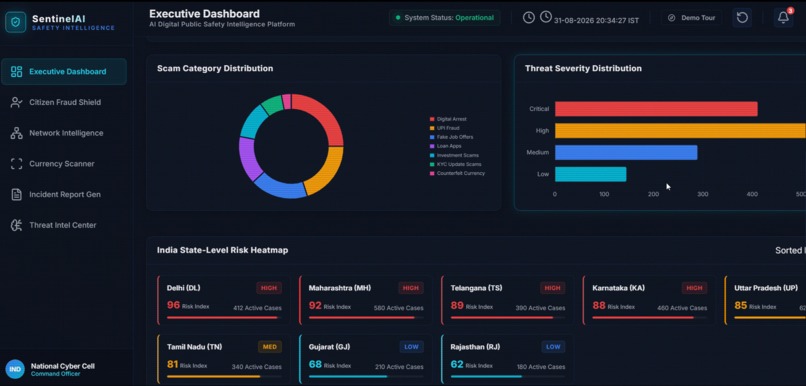
AI based Scam distribution graphics
-
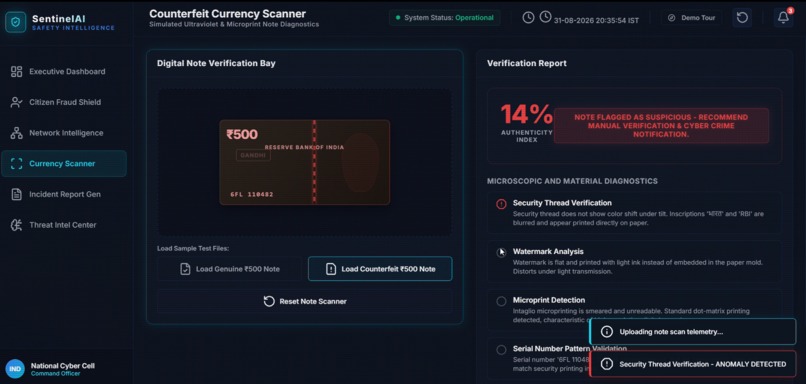
-
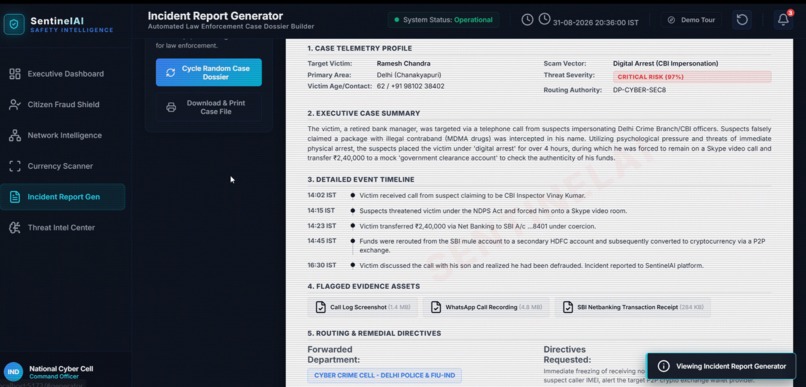
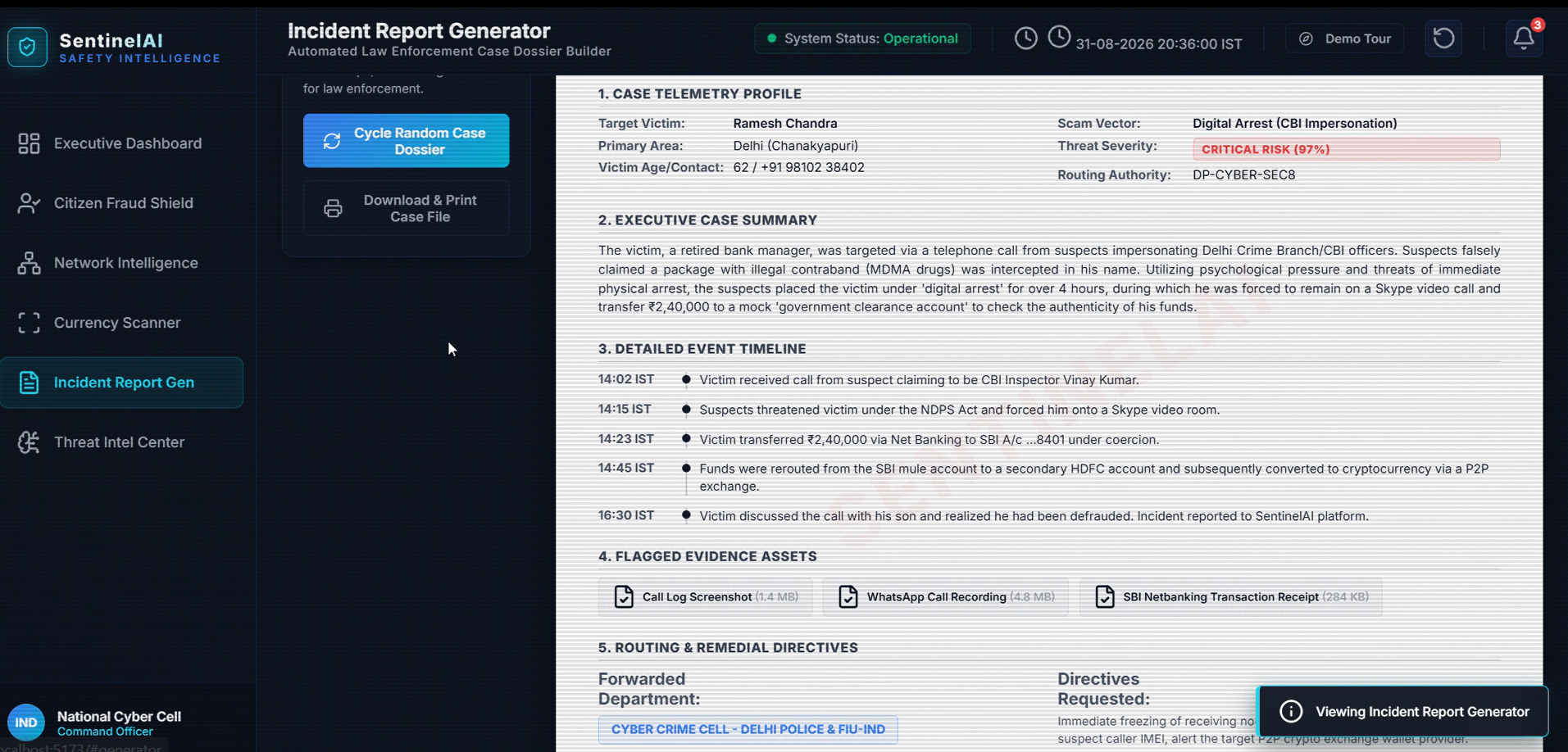
Incident Report Generation
-
#SentinelAI
Inspiration
Cybercrime is growing rapidly, with scams such as impersonation calls, digital arrest fraud, suspicious payment requests, and other forms of financial deception affecting thousands of people. What inspired us was a simple problem: most digital safety systems are reactive. Action usually begins only after a person has already become a victim and reported the incident. Citizens, financial institutions, telecom providers, and law enforcement often operate separately, making it difficult to identify patterns and respond before a threat grows. We wanted to explore a different approach: What if digital threats could be detected, analyzed, and acted upon before they cause larger harm? This idea led to SentinelAI.
What it does
SentinelAI is an AI-powered Digital Public Safety Intelligence Platform designed to transform cybercrime response from reactive investigation to proactive prevention. The platform acts as a centralized intelligence layer that helps analyze suspicious activities, assess risk, identify emerging patterns, and generate actionable information for different stakeholders.
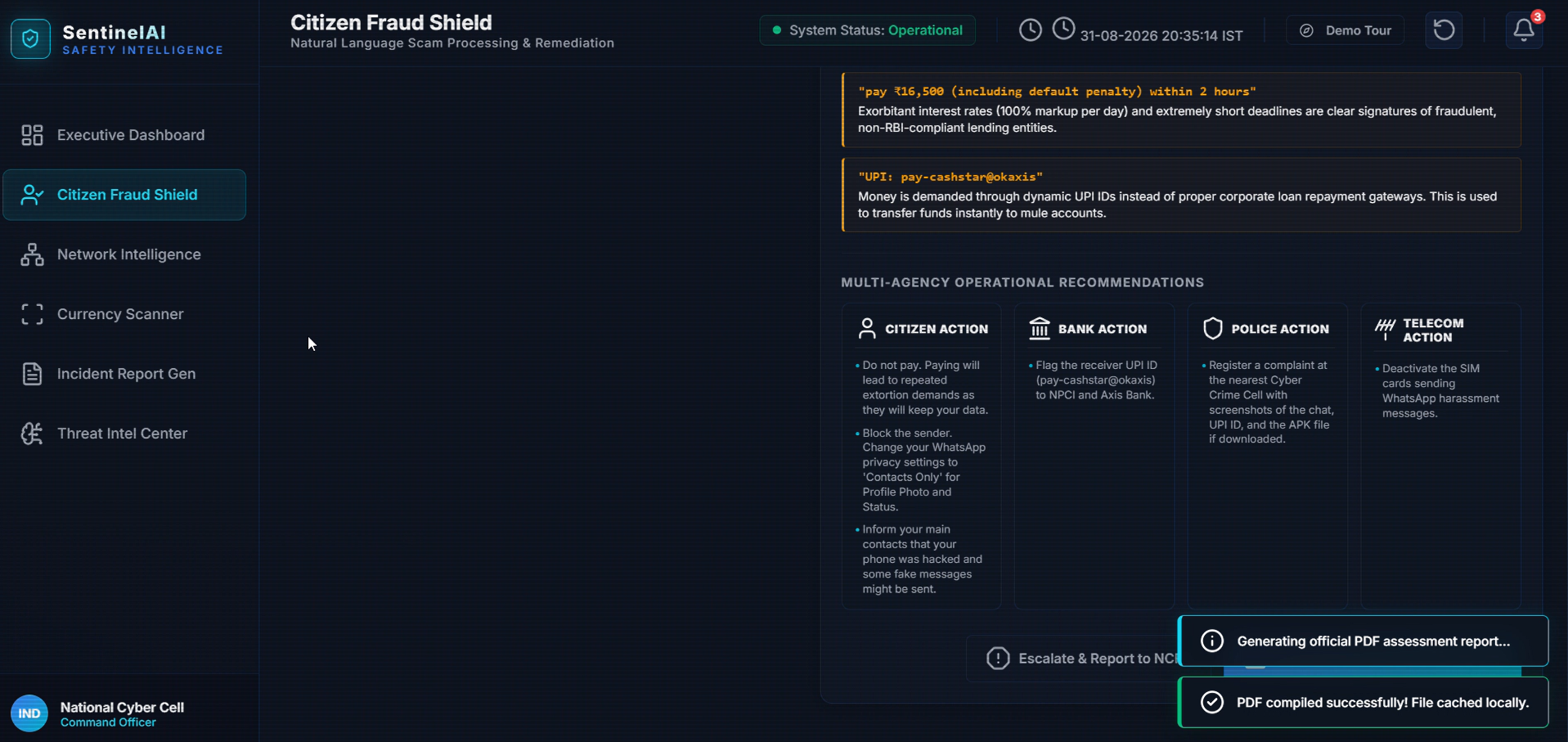
A citizen can submit suspicious calls, messages, or payment requests. SentinelAI analyzes the input, identifies potential scam patterns, classifies the threat severity, and provides instant risk feedback. The intelligence generated through these interactions can also be used to identify regional threat patterns, visualize crime hotspots, and generate structured incident reports.
SentinelAI brings multiple capabilities together in one platform: Report → Analyze → Classify → Score Risk → Identify Patterns → Generate Intelligence → Act
The Problem
Cybercrime is increasing rapidly, but existing systems are largely reactive. In many cases, a victim first experiences a scam or financial loss and only then reports it to the relevant authorities. By that time, the fraud may already have affected multiple people.
Another challenge is the lack of connected intelligence between different stakeholders. Citizens may report suspicious activity, banks may detect unusual transactions, telecom providers may observe suspicious communication patterns, and law enforcement may investigate cases independently.
Without a unified intelligence layer, valuable information remains fragmented. The core problem is not just detecting individual fraud incidents. It is understanding patterns, prioritizing threats, and helping stakeholders act faster. We wanted to build a platform that could move from: Incident → Report → Investigation
towards: Detection → Intelligence → Prevention
Our Solution
SentinelAI is an AI-driven Digital Public Safety Intelligence Platform that connects threat detection, citizen assistance, geospatial intelligence, and automated reporting. The platform continuously analyzes suspicious activity and transforms raw information into actionable intelligence. SentinelAI focuses on four major capabilities:
- Fraud Detection: Identifying and classifying suspicious activities
- Citizen Fraud Shield: Allowing individuals to submit suspicious calls, messages, or payment requests and receive instant risk feedback
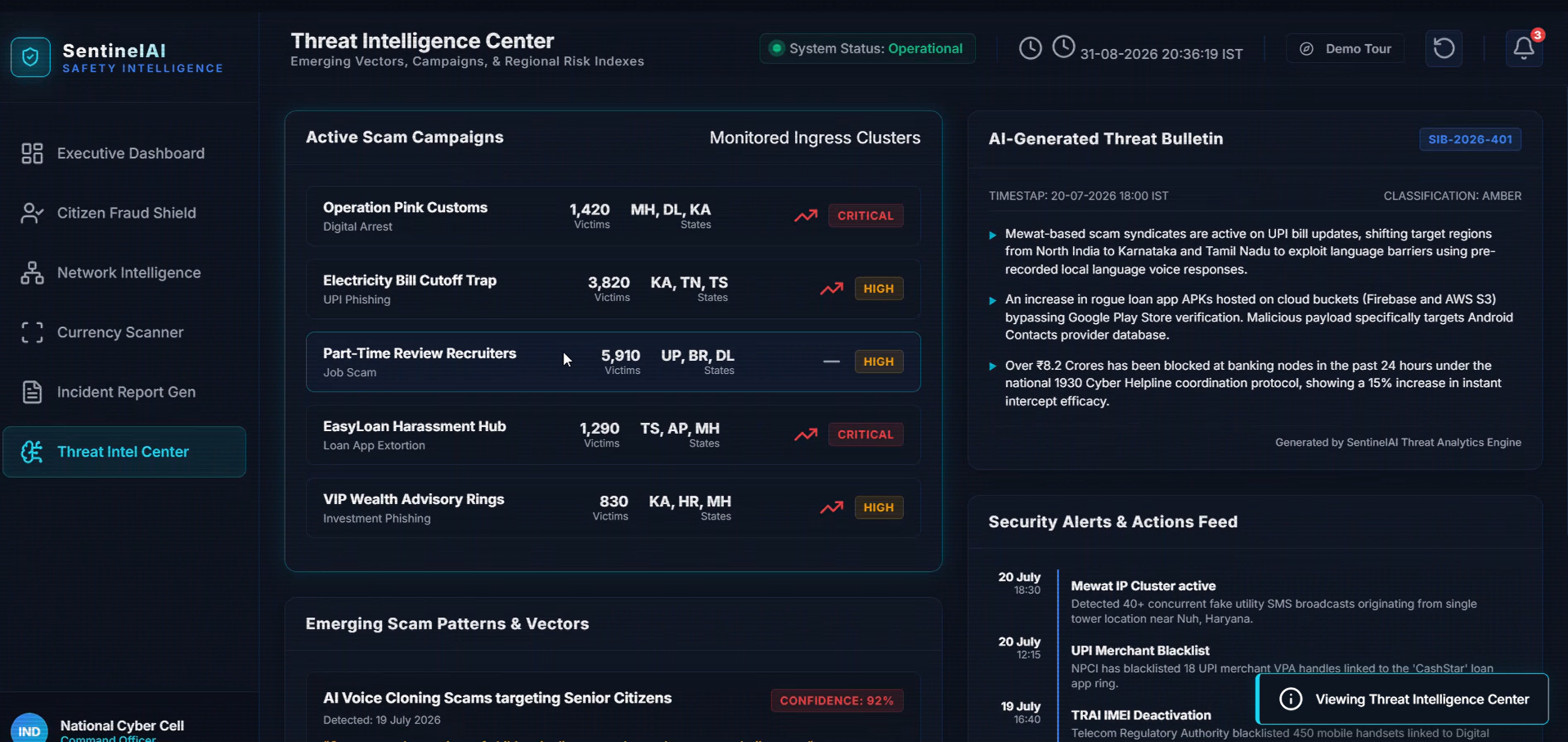
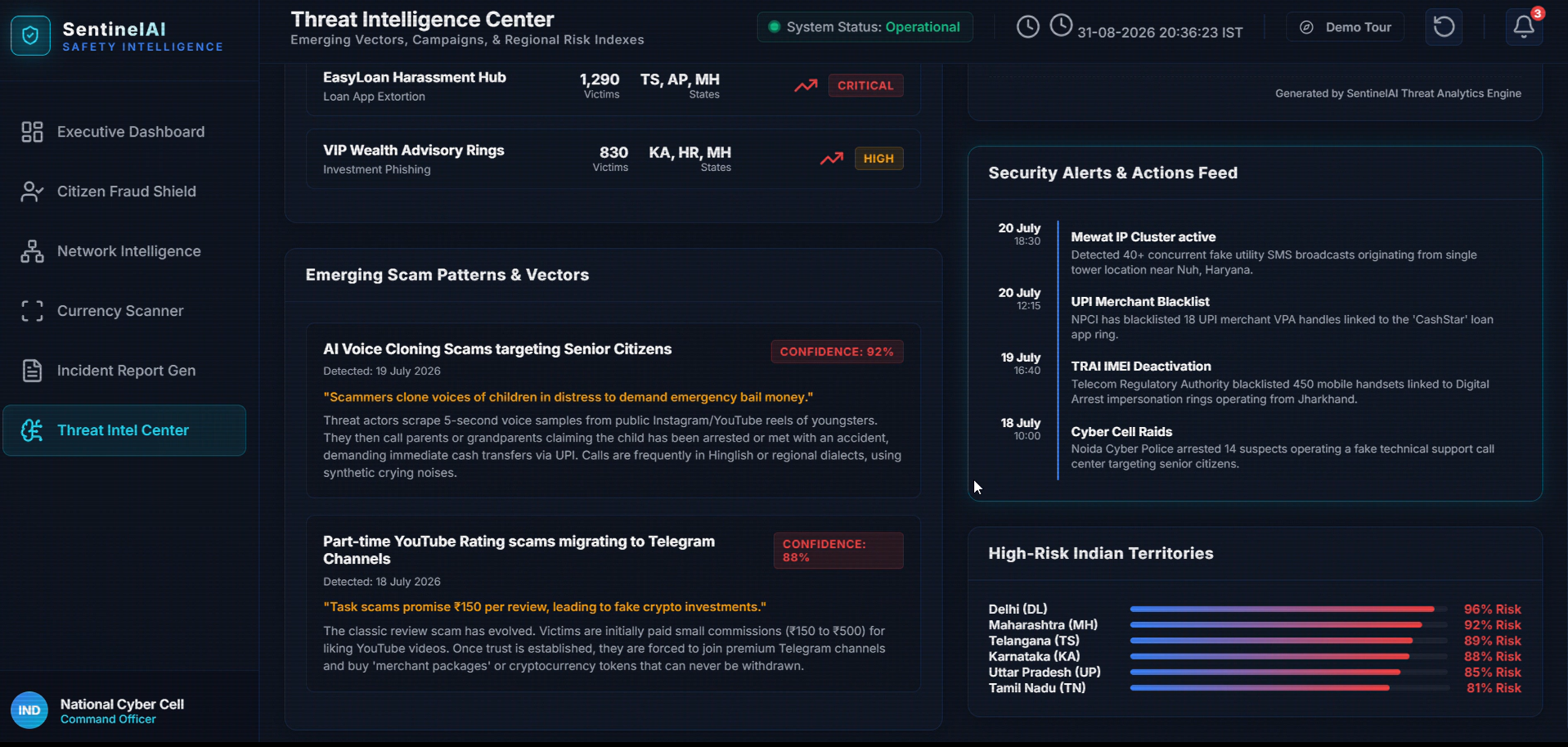
- Geospatial Crime Intelligence: Visualizing regional threat concentrations and crime hotspots
- Automated Incident Reporting: Generating structured intelligence reports that can support authorities and stakeholders
Instead of treating every report as an isolated incident, SentinelAI aims to identify patterns and provide a broader understanding of emerging digital threats.
Where AI Comes In
The core idea behind SentinelAI is not simply adding a chatbot to a public safety platform. AI is used as an intelligence layer for analyzing suspicious information and helping prioritize potential threats. The system can assist in understanding:
- Whether a submitted activity appears suspicious
- What type of scam or threat pattern may be involved
- How severe the potential risk is
- Which incidents should receive higher priority
- Whether similar patterns are emerging across multiple reports
- Where threats appear to be geographically concentrated
- What information should be included in a structured incident report
This transforms SentinelAI from a simple reporting platform into a system focused on threat intelligence and proactive digital safety.
How we built it
SentinelAI was designed as a unified Digital Public Safety Intelligence Platform with multiple connected capabilities.
The platform includes:
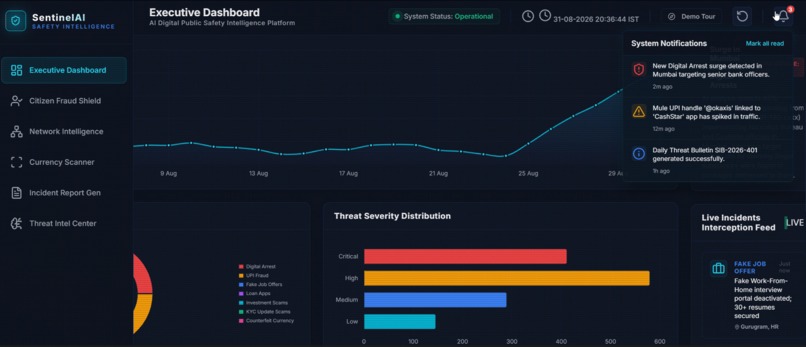
- Public Safety Intelligence Dashboard: Provides a real-time view of incidents, threat severity, risk indicators, and emerging trends
- Citizen Fraud Shield: Allows citizens to submit suspicious activities and receive instant risk assessment
- AI-Based Threat Analysis Engine: Analyzes inputs, identifies patterns, classifies threats, and assigns risk levels
- Geospatial Crime Intelligence: Visualizes threat hotspots and regional patterns
- Automated Incident Dossier Generation: Converts incident information into structured reports
- Multi-Stakeholder Recommendation System: Provides relevant guidance based on the type of user or stakeholder
Our technology stack includes:
- Frontend: React.js and Tailwind CSS
- Backend: Node.js and Express.js
- AI & Analytics: AI-based classification, Natural Language Processing, risk scoring, and data analytics
- Visualization: Interactive dashboards, geospatial mapping, and automated incident reporting
The architecture was designed to remain modular and scalable, allowing additional data sources such as financial institutions, telecom systems, and law-enforcement databases to be integrated in the future.
Challenges we ran into
One of the biggest challenges was designing SentinelAI as more than just a fraud detection system. Detecting suspicious activity is only one part of the problem. The system also needs to communicate risk clearly, prioritize incidents, identify patterns, and convert raw information into useful intelligence.
Another challenge was bringing different types of intelligence together. Individual reports, threat classifications, severity levels, geographical information, and stakeholder recommendations all need to work together as part of one connected system. We also had to think about how different users would interact with the platform. A citizen needs a simple way to report suspicious activity and understand the risk, while authorities and decision-makers need dashboards, trends, structured reports, and broader intelligence. Designing the platform around these different requirements was an important part of the project.
Accomplishments that we're proud of
We are proud that SentinelAI successfully brings multiple public safety capabilities into a single prototype. Some of our key accomplishments include:
- Building a functional AI-powered Public Safety Intelligence Dashboard
- Creating a Citizen Fraud Shield for reporting suspicious activity
- Developing an Intelligent Threat Analysis Engine for pattern and severity classification
- Implementing geospatial visualization for identifying threat hotspots
- Generating structured incident dossiers automatically
- Designing recommendations for different stakeholder types
- Validating an end-to-end pipeline from raw input to AI classification to stakeholder-ready intelligence
Most importantly, we were able to demonstrate the idea of moving beyond reactive reporting toward a more proactive digital safety ecosystem.
What we learned
Building SentinelAI taught us that AI systems are most useful when they are part of a well-designed decision workflow. The challenge was not only classifying suspicious activity. We also needed to think about what happens after the classification.
How should risk be communicated? How should incidents be prioritized? How can individual reports contribute to larger intelligence patterns? How can information be presented differently to citizens and authorities?
Through this project, we learned about AI-based classification, Natural Language Processing, risk scoring, geospatial intelligence, dashboard design, automated reporting, and designing systems for multiple stakeholders. We also learned that public safety technology requires more than intelligence. It requires clarity, accessibility, scalability, and the ability to turn information into meaningful action.
What's next for SentinelAI
SentinelAI is currently designed as a scalable prototype, and there is significant potential for future expansion. Our next steps include integrating additional real-world data sources such as:
- Bank and financial fraud intelligence
- Telecom-based suspicious activity signals
- Law-enforcement databases
- Real-time cybercrime reporting feeds
We also aim to improve the AI threat analysis engine with more advanced models and larger datasets to identify emerging scam patterns. Future versions could support real-time threat alerts, cross-platform intelligence sharing, predictive crime analysis, and stronger collaboration between citizens, financial institutions, telecom providers, and law enforcement. Our long-term vision is to build a connected digital public safety ecosystem where every stakeholder can act on trusted, real-time intelligence.
Why SentinelAI?
SentinelAI is built around a simple idea:
Don't wait for a digital crime to become a larger threat. Detect the signals early and act intelligently. By combining AI-powered threat analysis + citizen safety + geospatial intelligence + automated reporting, SentinelAI aims to transform the way digital threats are understood and addressed. SentinelAI: From Reactive Investigation to Proactive Digital Safety.
Built With
- agentic
- ai
- api
- artificial
- css
- erp
- fastapi
- generative
- gps
- intelligence
- leaflet.js
- llm
- openrouteservice
- openstreetmap
- postgresql
- pwa
- python
- razorpay
- react
- rest
- tailwind
- vite
- websockets

Log in or sign up for Devpost to join the conversation.