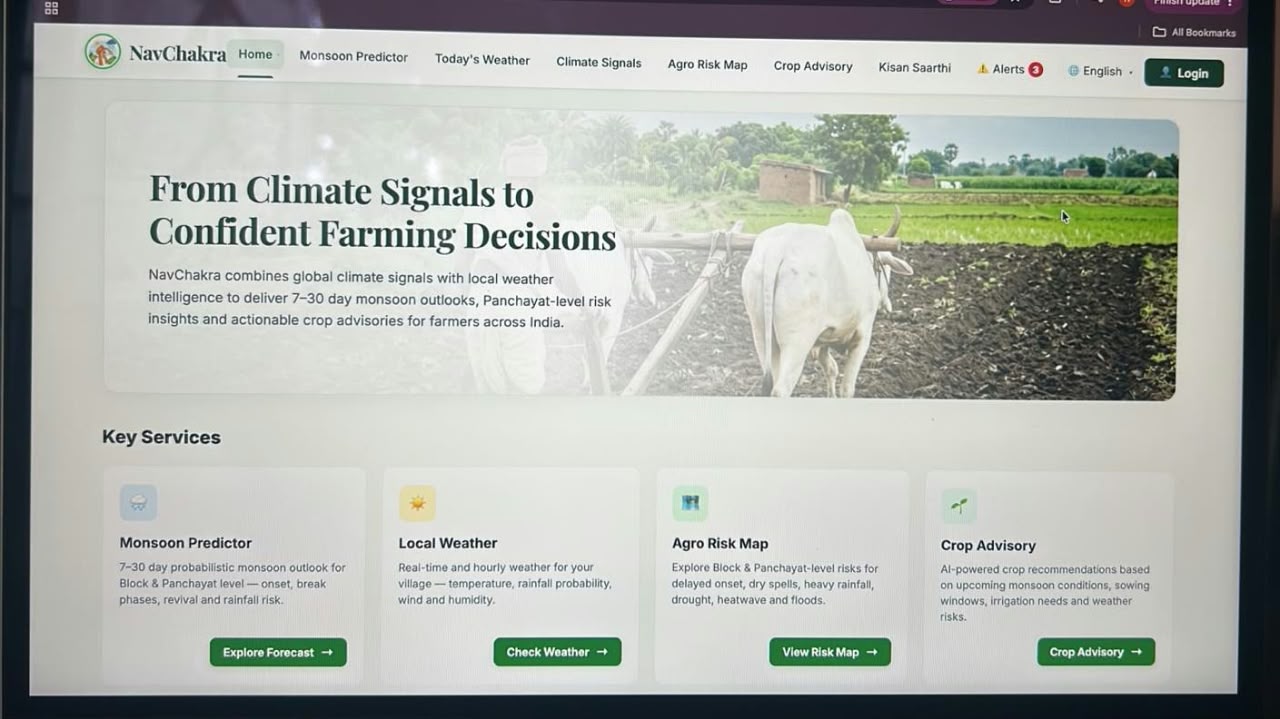
What Inspired Us NavChakra was inspired by a simple question: Can better information about upcoming monsoon conditions help farmers make better decisions? Farmers depend heavily on the monsoon for sowing, irrigation, crop protection, and harvesting. However, rainfall can vary significantly between nearby locations, and events such as false monsoon onset, prolonged dry spells, or unexpected heavy rainfall can seriously affect crops. We wanted to build a platform that goes beyond simply displaying weather data and helps farmers understand what the forecast means for their crops and what action they should take. What We Built NavChakra is a hyperlocal monsoon intelligence platform that combines ENSO, IOD, and MJO climate signals, regional weather data, and historical rainfall patterns to generate 7–30 day probabilistic monsoon insights. The platform provides:
- Monsoon onset and break prediction
- 7–30 day rainfall outlook
- Local rainfall anomaly and risk analysis
- Dynamic hyperlocal risk maps
- Crop-specific recommendations
- Early weather and crop-risk alerts
- AI-powered farmer assistance
- Explainable forecasts Our core approach is: Climate Signals → AI Prediction → Hyperlocal Risk → Crop Decision → Farmer Action How We Built It We developed a farmer-focused web platform with a modern frontend and a Python-based AI/ML backend. The system processes climate and weather data, applies forecasting and risk-analysis techniques, and presents the results through an easy-to-understand dashboard. A major focus during development was making complex climate information accessible to non-technical users. Instead of overwhelming farmers with raw data, we designed the platform around clear risks, recommendations, and actionable insights. What We Learned Through this project, we learned that prediction alone is not enough. The real value comes from converting predictions into practical decisions. We gained experience in climate-data analysis, probabilistic forecasting, geospatial visualization, AI/ML workflows, and designing technology for real-world users. Challenges We Faced One of the biggest challenges was connecting large-scale climate signals with highly localized weather outcomes. Weather conditions can vary considerably across nearby regions, making hyperlocal prediction difficult. We also faced challenges related to data availability, forecast uncertainty, model reliability, and presenting predictions without creating false confidence. NavChakra aims to bridge the gap between climate intelligence and practical farming decisions, helping farmers become better prepared for an increasingly uncertain monsoon.
Built With
- bhashini-api
- css3
- docker
- fastapi
- geojson
- html5
- hugging-face
- javascript
- leaflet.js
- lightgbm
- lstm
- maplibre-gl-js
- mistral-7b
- nasa-power-api
- onnx-runtime
- open-meteo-api
- openstreetmap
- pwa
- python
- pytorch
- scikit-learn
- shap
- sqlite
- three.js

Log in or sign up for Devpost to join the conversation.