
Inspiration
Launching a product is a bet on people you have never met. Small teams guess where to start. They guess who to talk to. Then they guess what the ad should say.
I asked an LLM where to launch a portable speaker. It gave a confident answer, but it could not tell me why. It had no real data about what people in those cities actually like. Qloo has that data. So I built an agent around it.
What it does
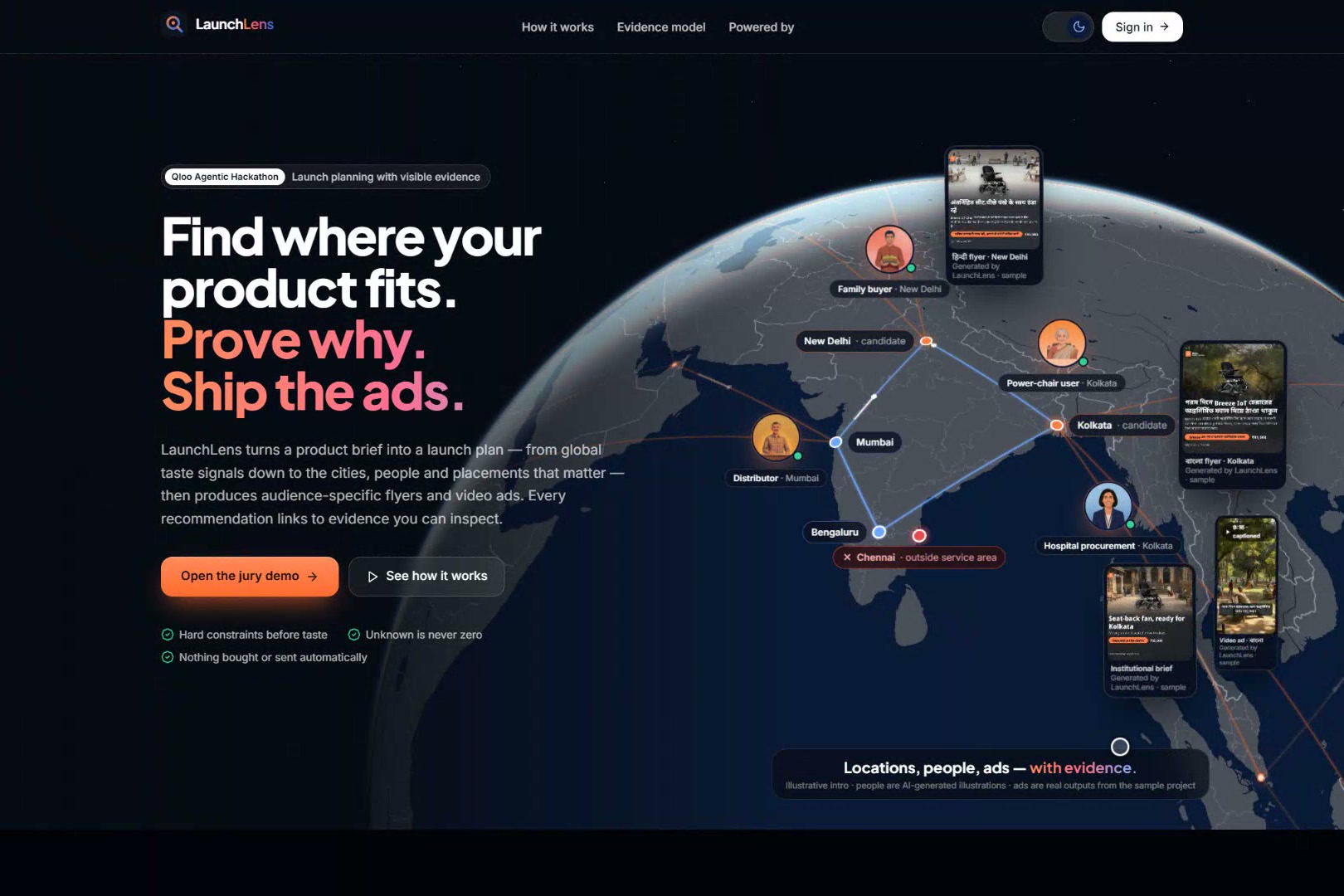
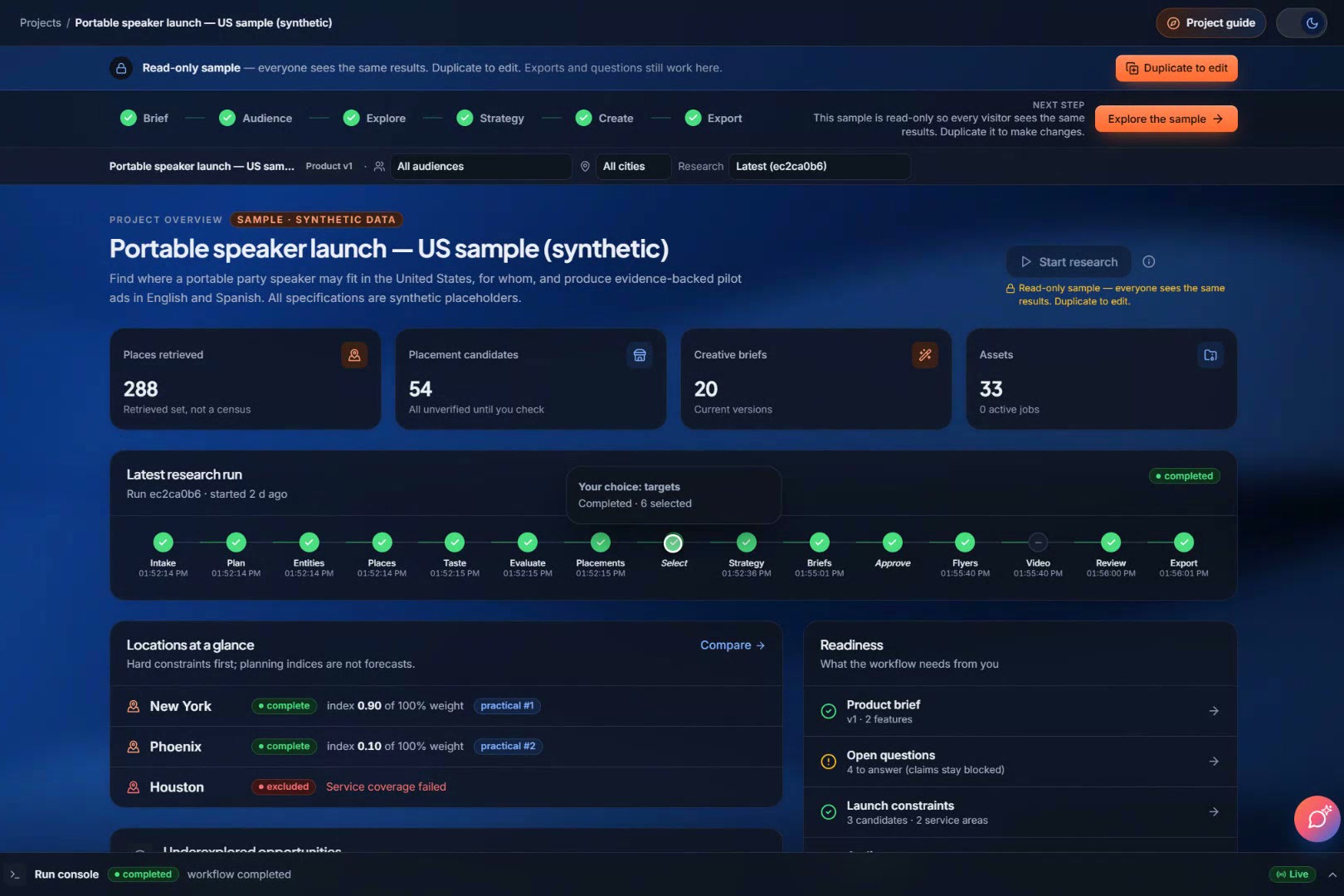
LaunchLens turns a product brief into a launch plan you can check.
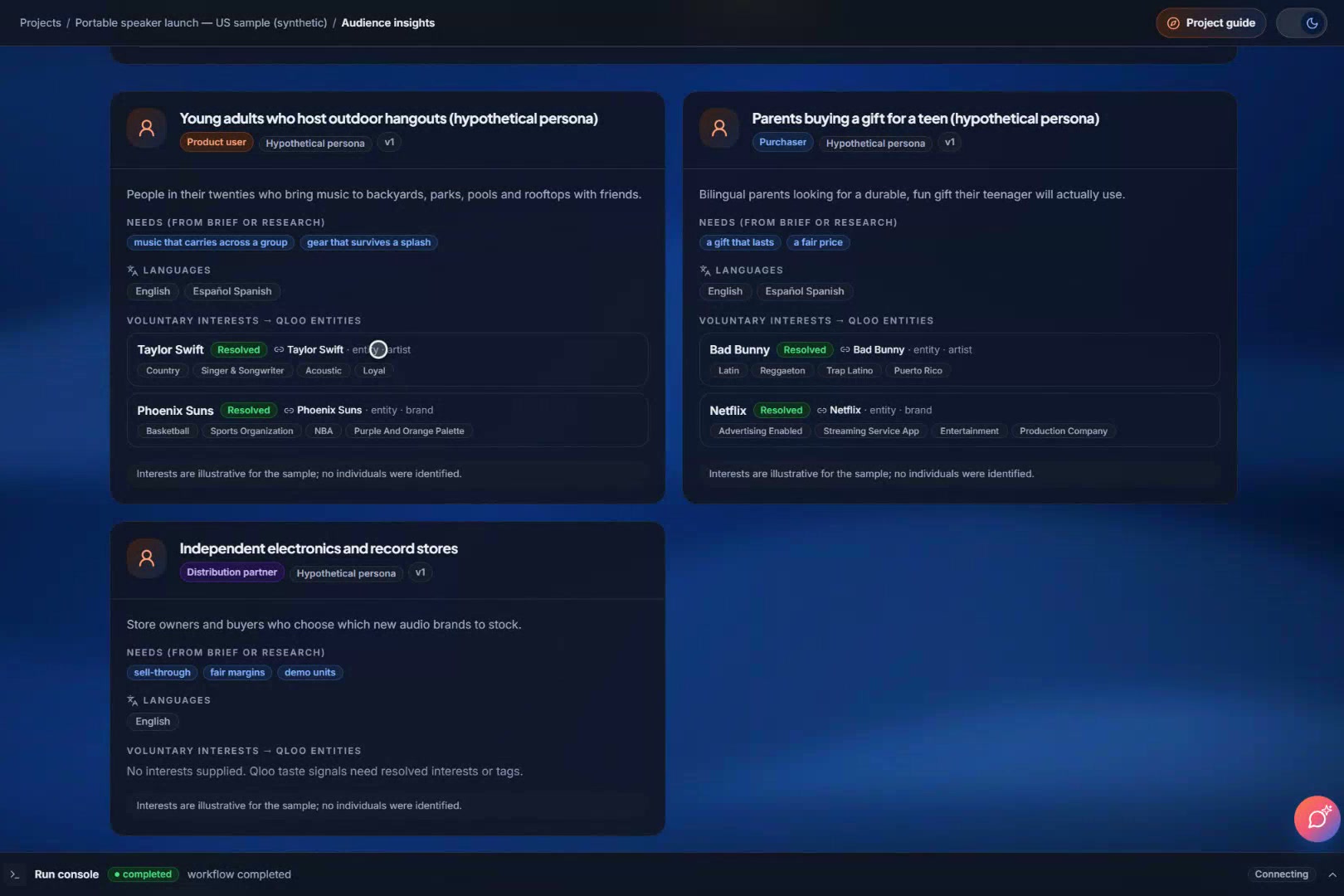
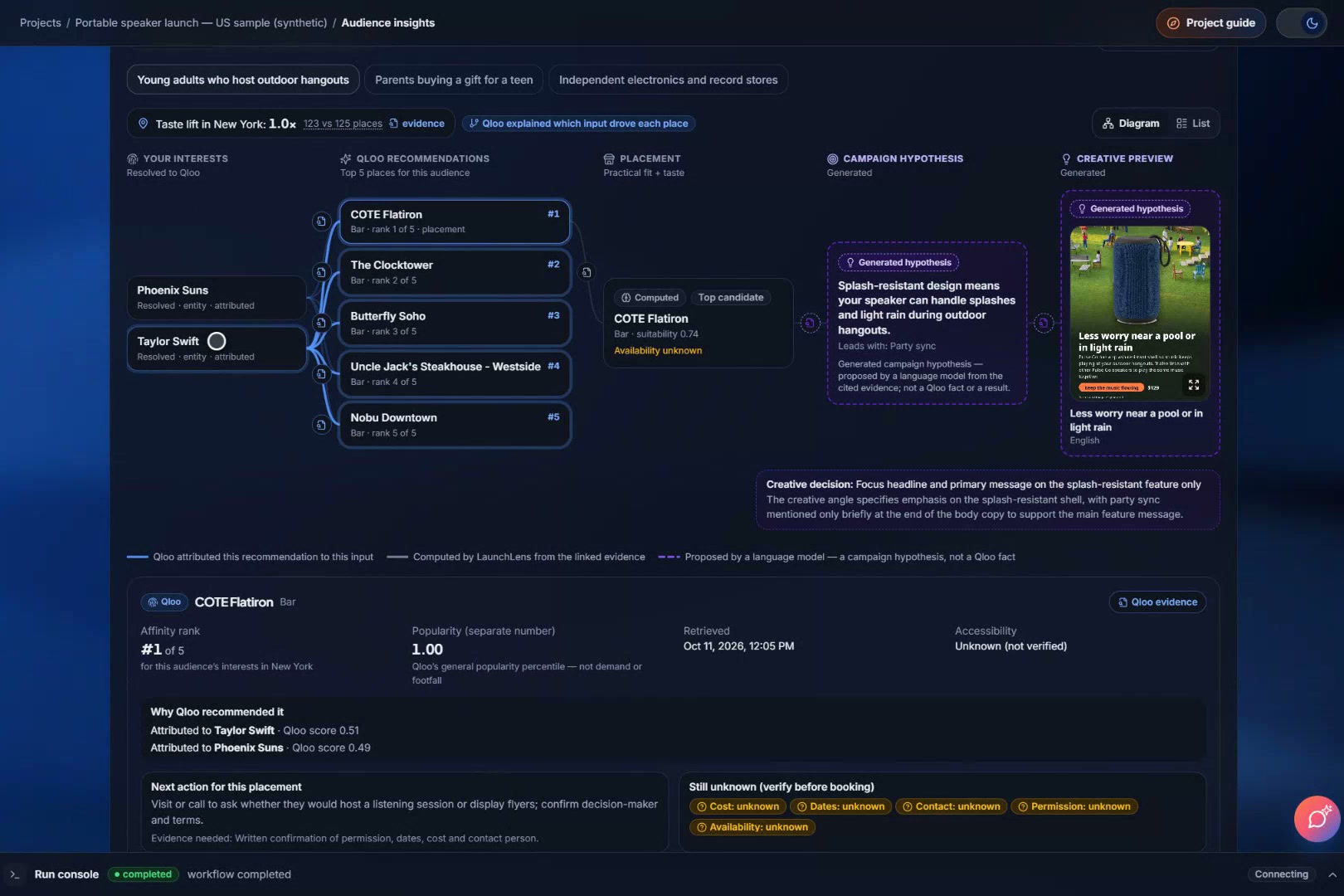
- Real interests, not guesses. Each audience interest, like Taylor Swift or Bad Bunny, is resolved to a real Qloo entity. If a match is unclear, the agent pauses and asks a person.
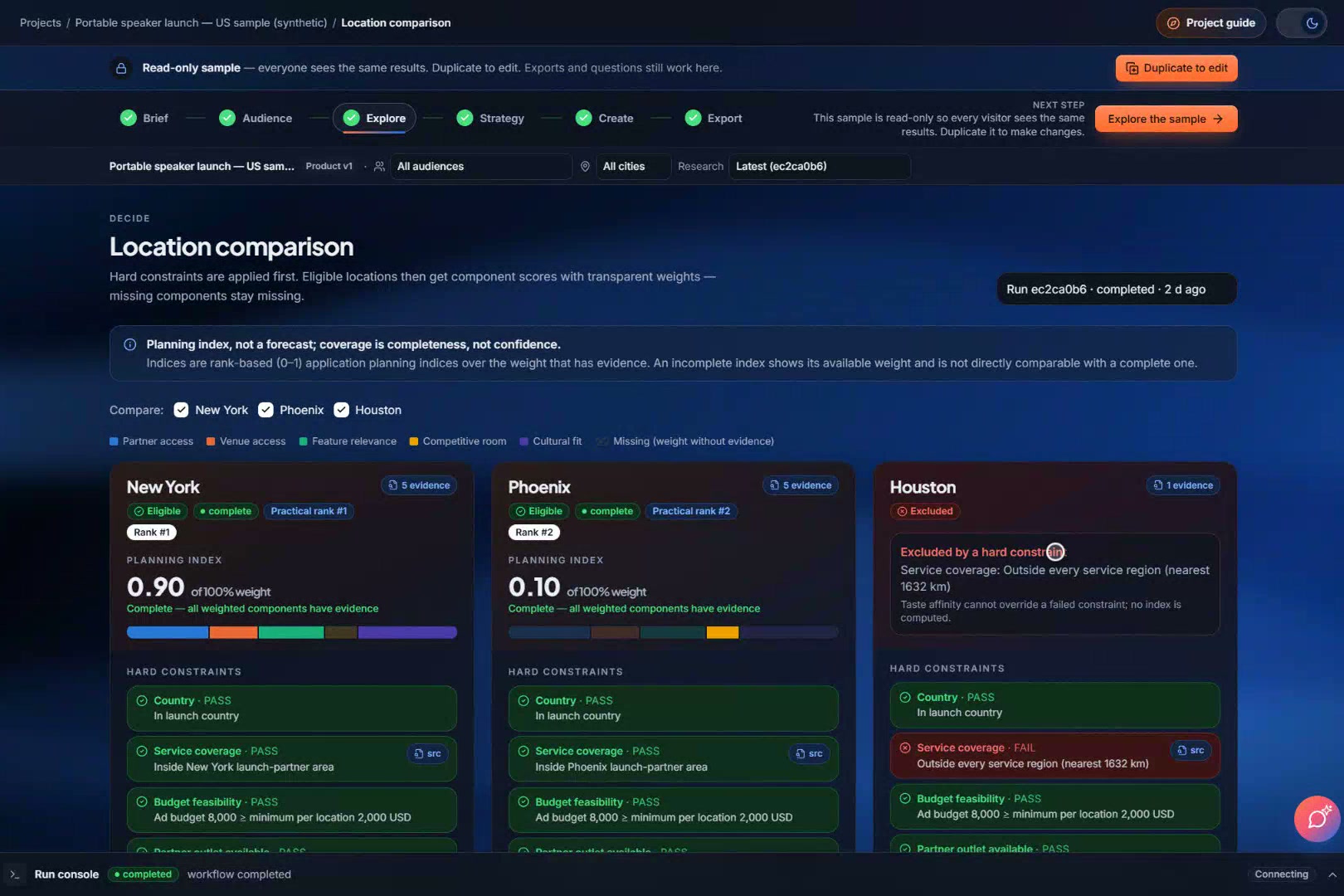
- Hard rules first. A city outside your partner area is excluded. Taste cannot override that.
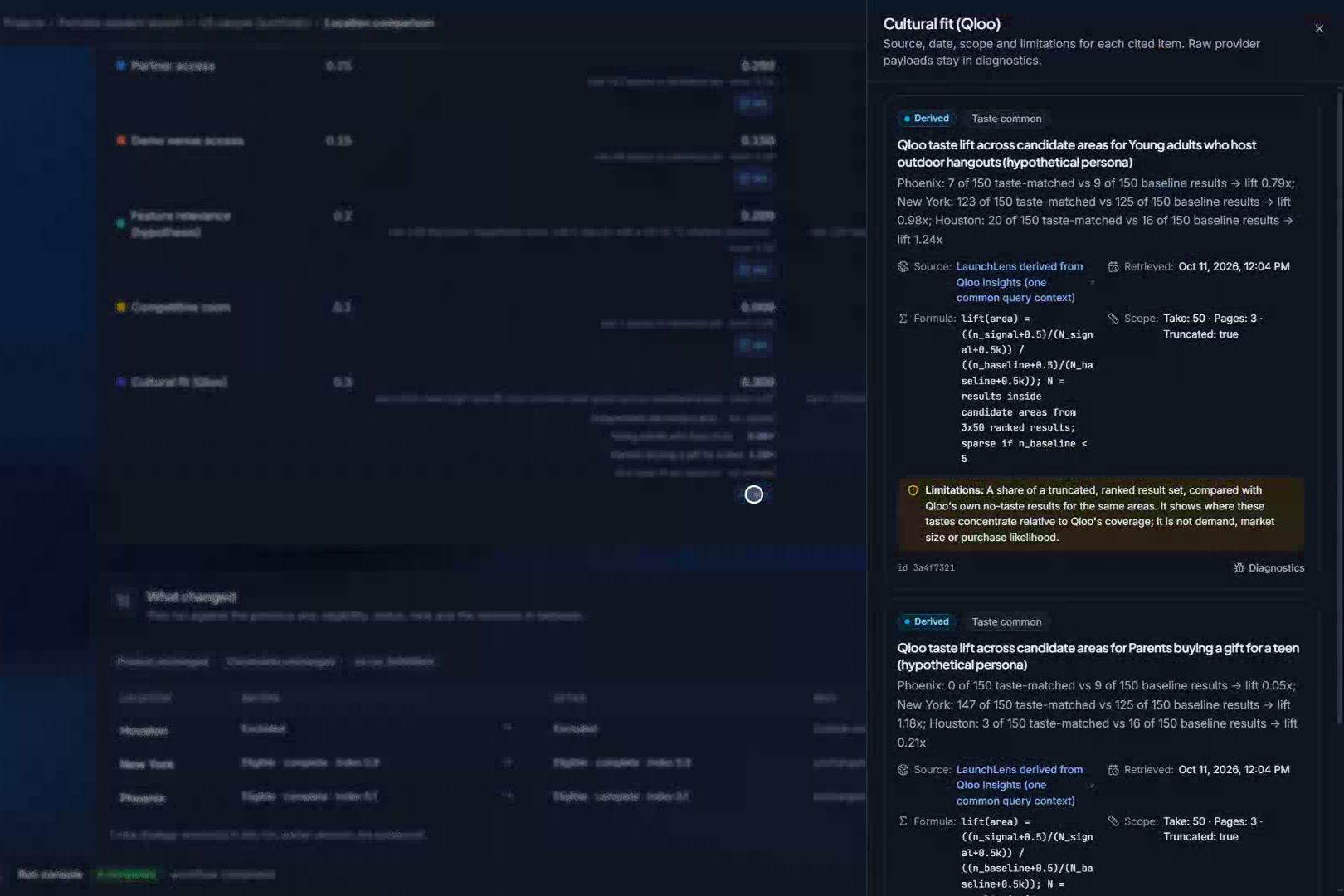
- Taste you can compare. One shared Qloo query covers every candidate city. Each city's share of results is compared with a no-taste baseline.
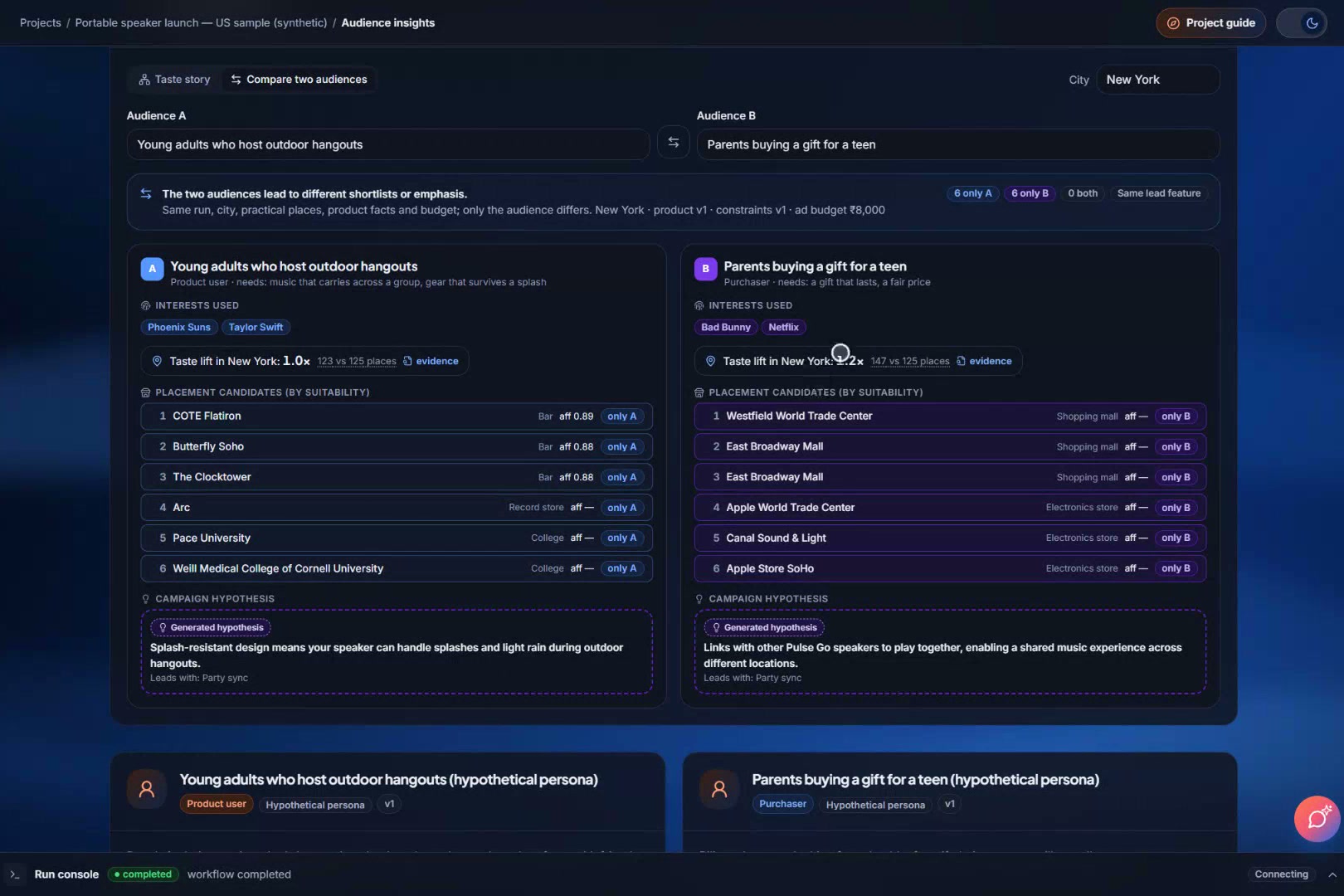
- Why these places? Qloo recommends venues for each audience. Its explainability shows which interest drove each venue.
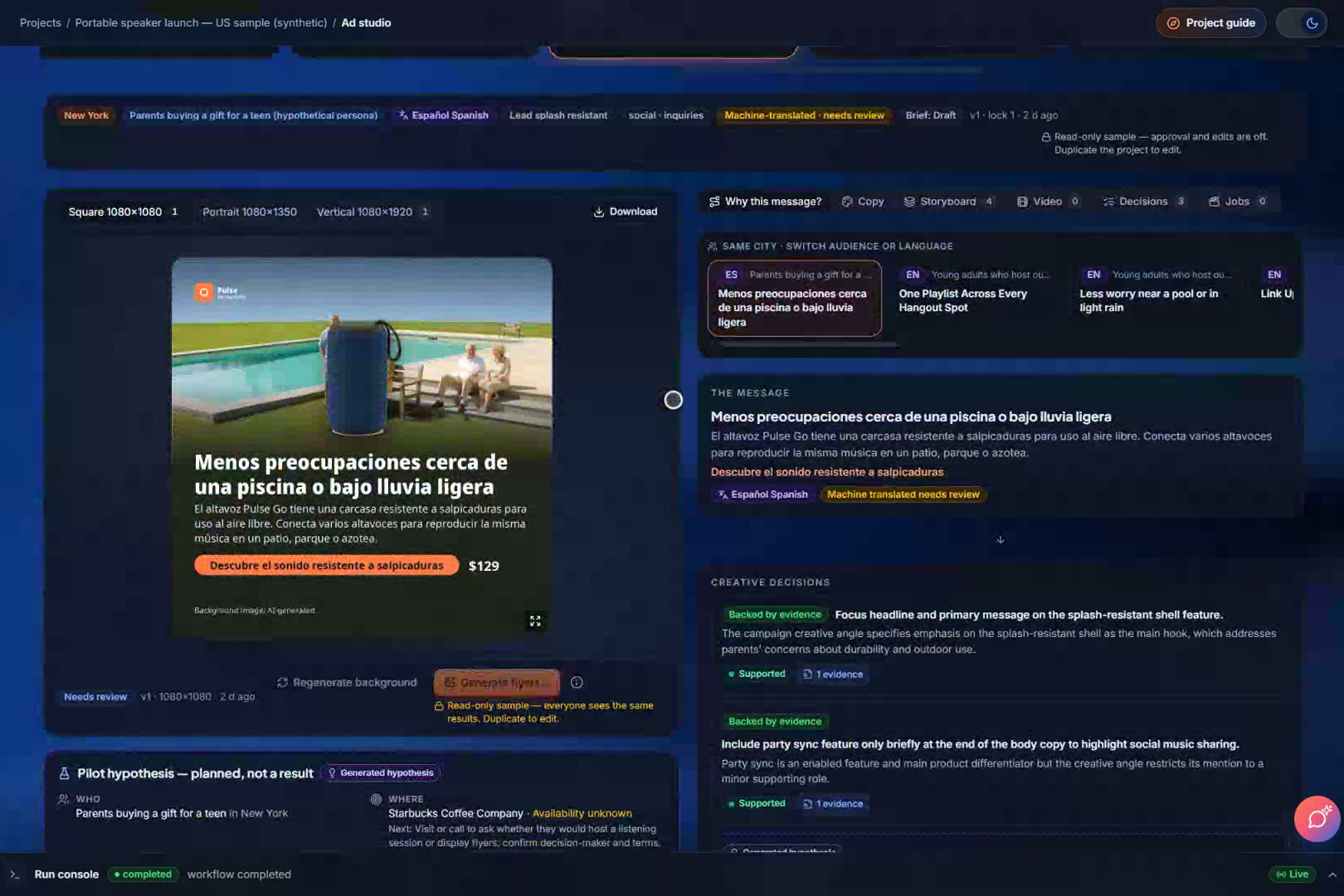
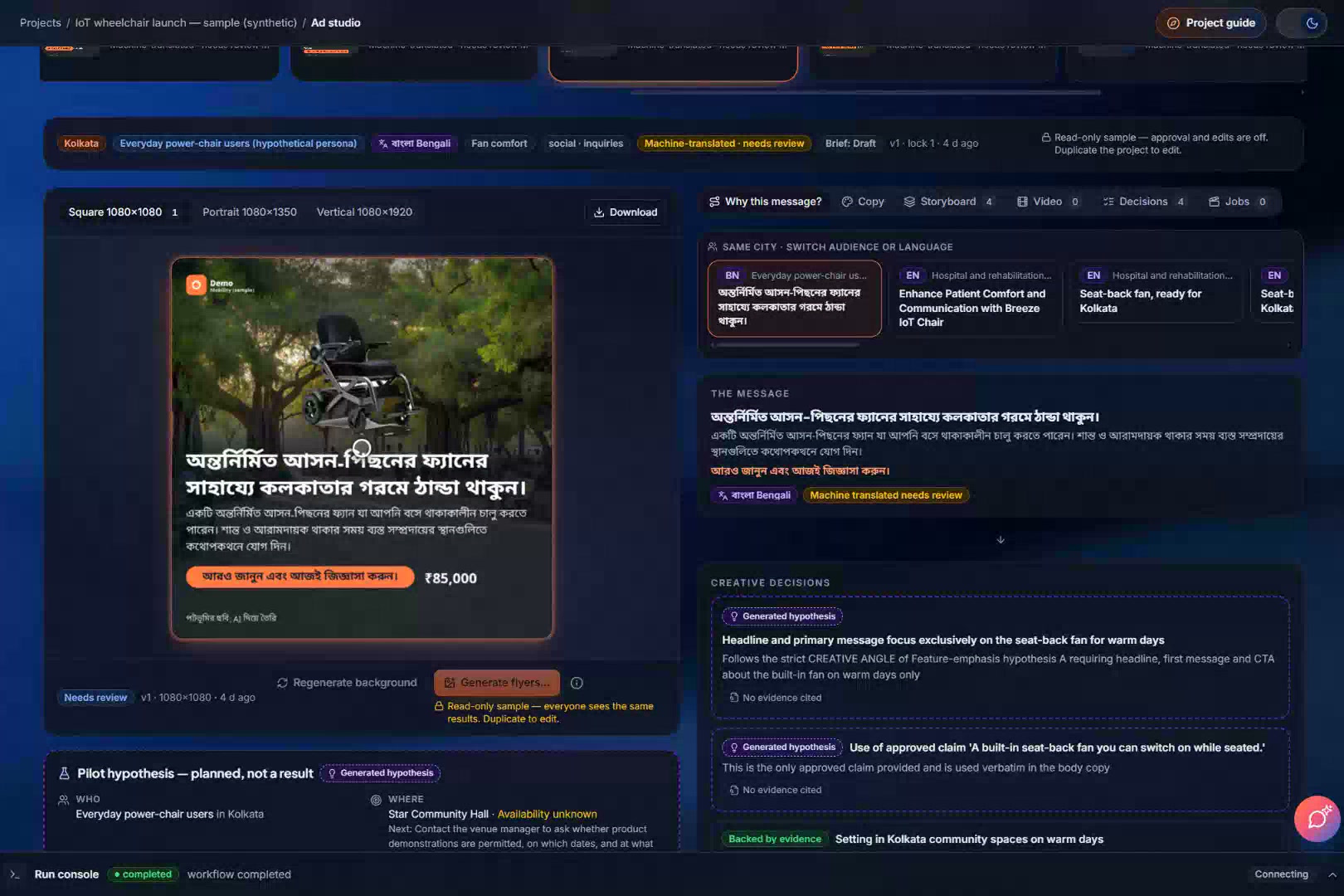
- Ads with receipts. The agent writes a strategy, then English and Spanish flyers and a short video. Every line traces back to product facts. Unsupported claims are blocked.
- Clear labels. Anything a language model writes is marked as a hypothesis. It is never shown as data.
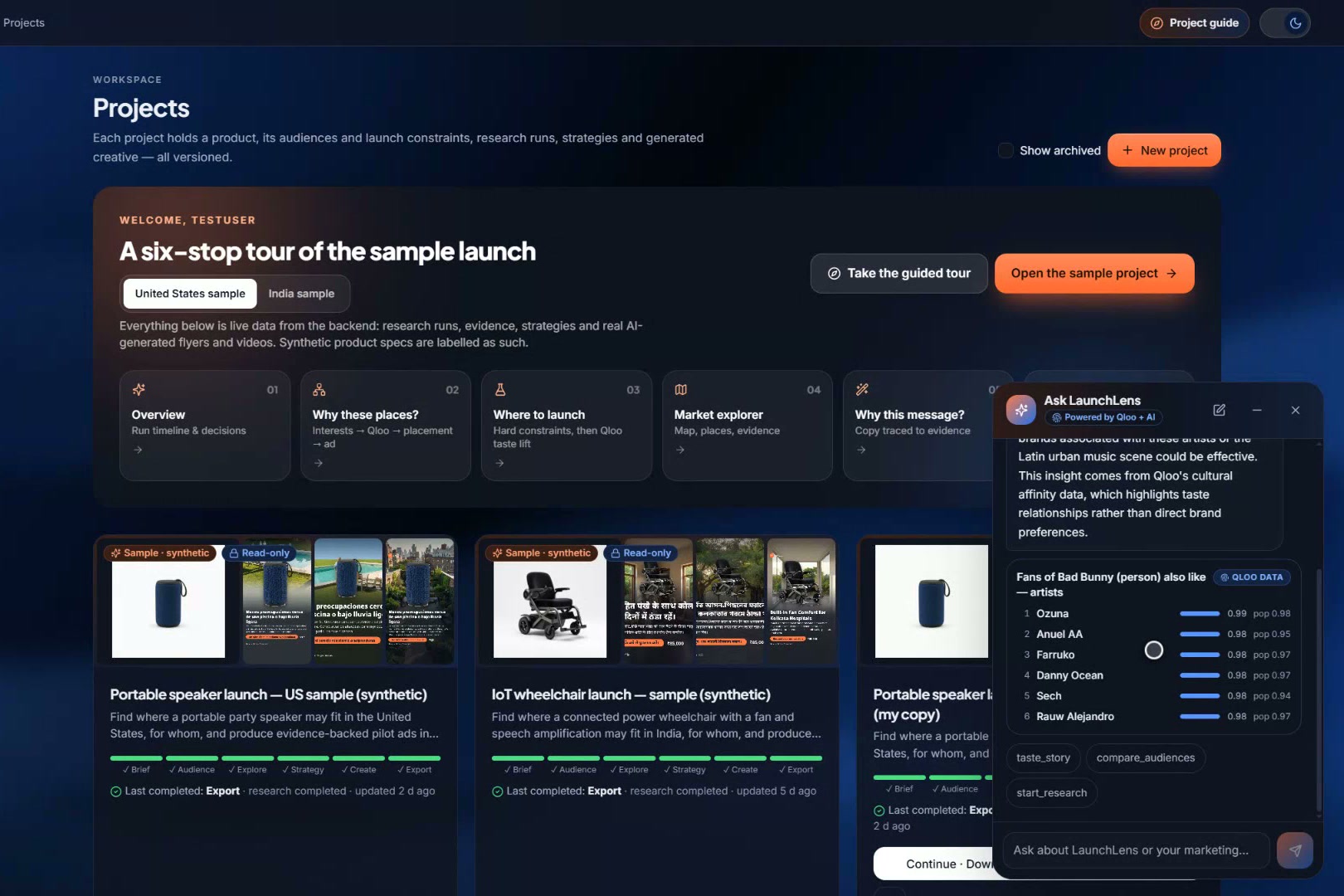
- Ask LaunchLens. A chat assistant answers questions using live Qloo data.
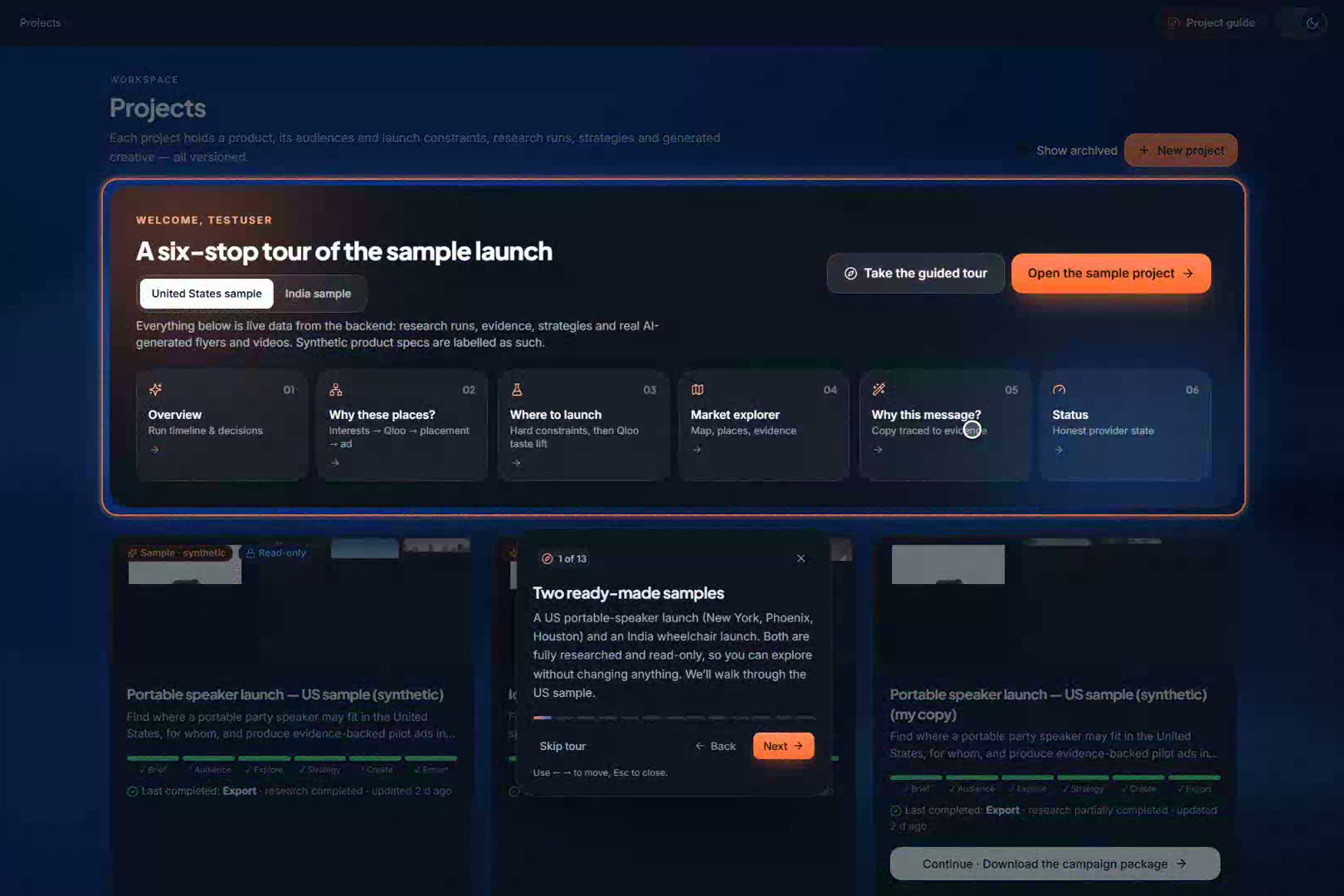
There are two samples. One is a US speaker launch in New York, Phoenix and Houston. The other is a power wheelchair launch in India, with Hindi and Bengali ads.
How I built it
- Agent: LangGraph runs the workflow. It goes through intake, entities, places, taste, evaluation, placements, strategy, creative and export. Checkpoints live in PostgreSQL, so a crashed run resumes where it stopped.
- Qloo:
/searchand/v2/tagsresolve interests./v2/insightsreturns places near each city, with explainability for each recommendation. - Taste lift: for each area, I compare its share of taste results with its share of baseline results. I use light smoothing:
$$\text{lift}(a) = \frac{(n_{\text{taste}} + 0.5)\,/\,(N_{\text{taste}} + 0.5k)}{(n_{\text{base}} + 0.5)\,/\,(N_{\text{base}} + 0.5k)}$$
Each audience gets a $\log_2$ lift, and the mean across audiences becomes the cultural-fit score.
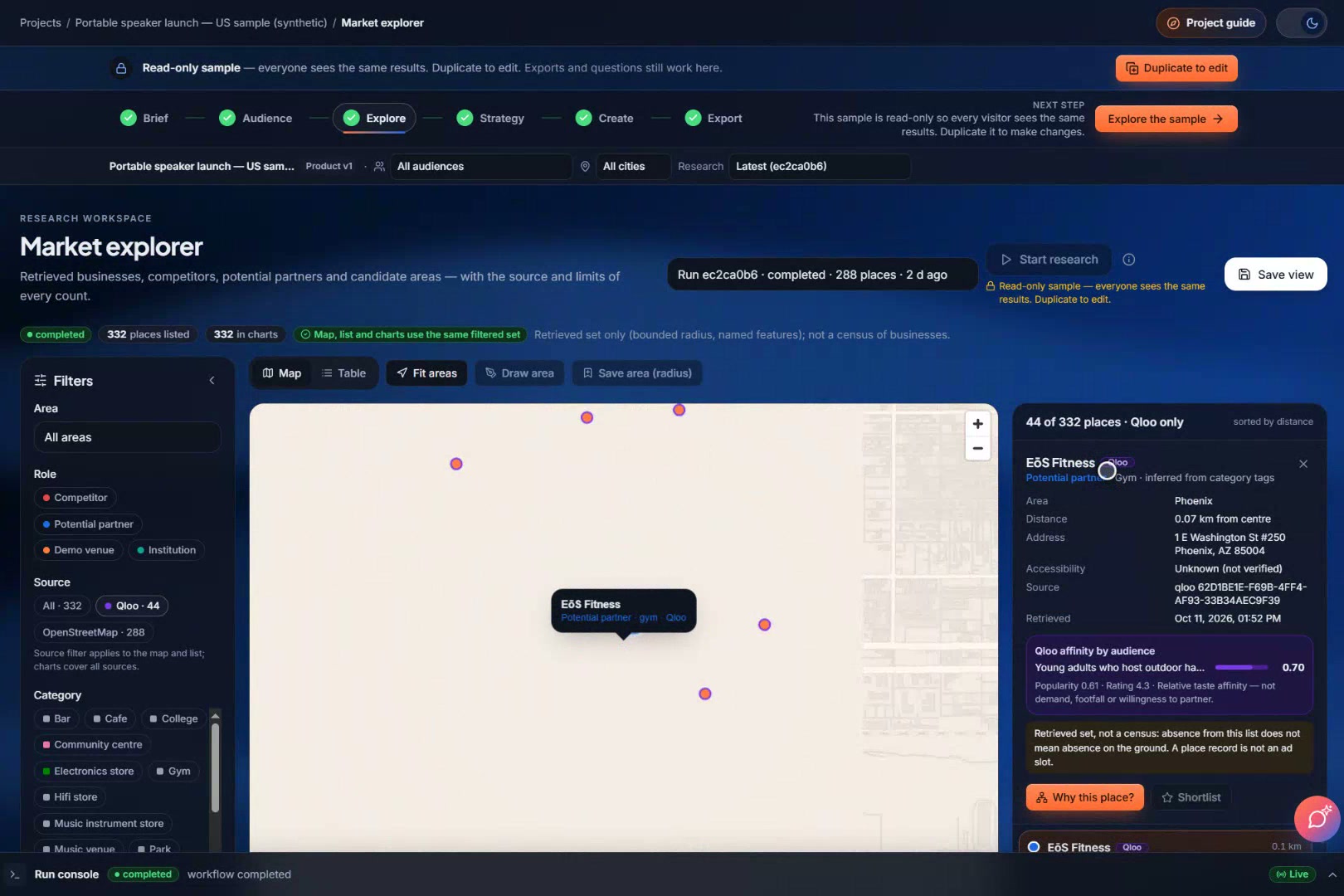
- Practical evidence: OpenStreetMap for places, Nominatim for geocoding, and Open-Meteo for climate.
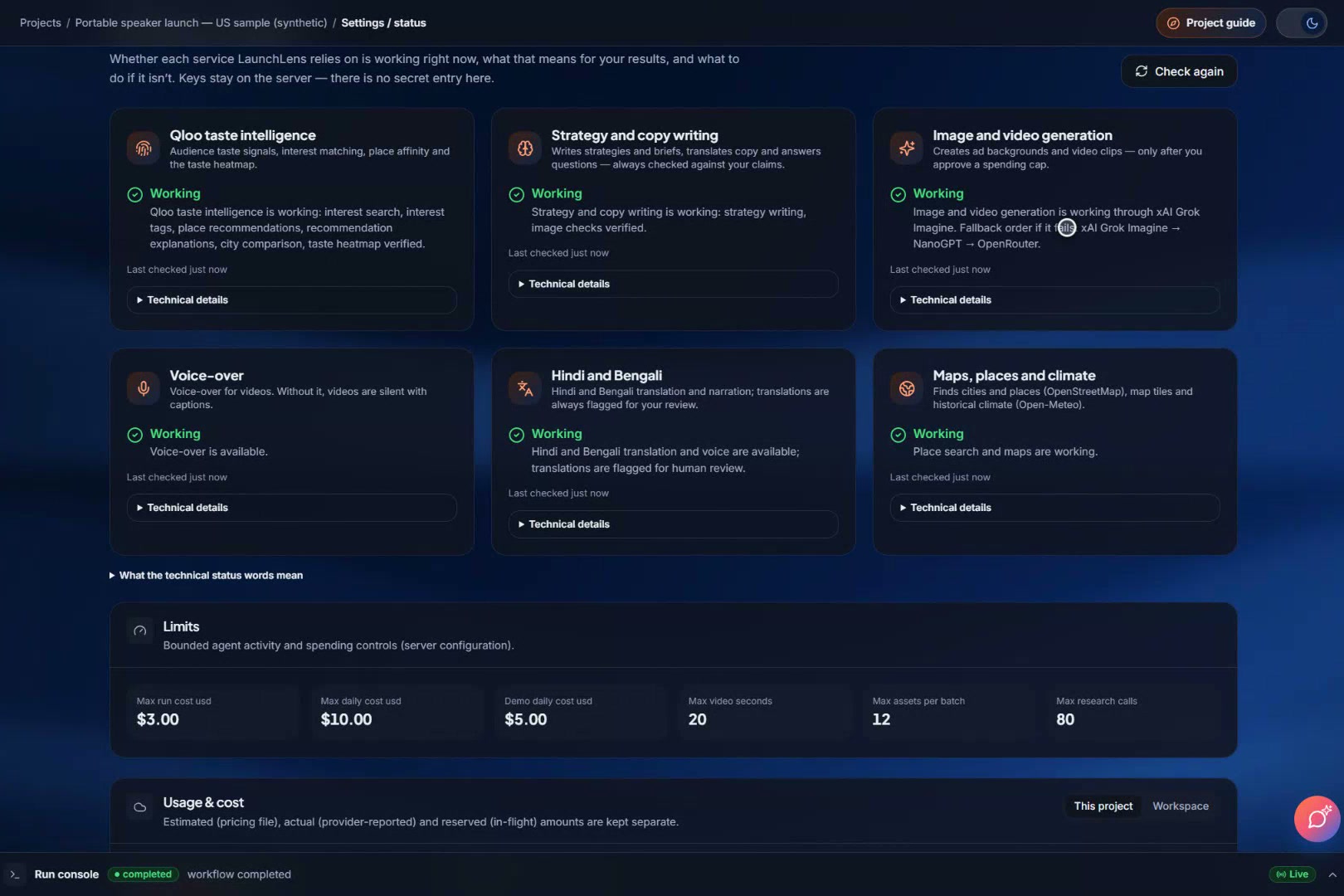
- Creative: xAI Grok Imagine makes the images and video clips. Sarvam AI handles Hindi and Bengali translation and voice.
- App: FastAPI, PostgreSQL with PostGIS, and a React + TypeScript frontend with MapLibre maps.
- Safety: every paid call is reserved against a cost cap before it runs. Nothing is spent without approval.
Challenges I ran into
- Qloo silently ignores invalid parameters and returns an empty result. I had to treat "empty" as "unknown", not as zero.
- Raw affinity scores from different queries are not comparable. The shared query plus baseline fixed that.
- Public map APIs rate-limit hard. I serialized calls and added backoff and caching.
- My primary LLM ran out of credits mid-build. Automatic fallbacks kept the agent working.
Accomplishments that I'm proud of
- Every recommendation links to its evidence, including which Qloo interest drove it.
- The agent stops before spending money and waits for a person.
- The same workflow runs end to end in two countries and four languages.
- Judges can explore everything with one click, read-only, without breaking anything.
What I learned
Taste data changes the answer, not just the wording. Different audiences in the same city get different venues. I also learned that being honest about unknowns builds more trust than a confident guess.
What's next for LaunchLens
- Connect real pilot results back into the plan, so it learns what worked.
- Add more markets and languages.
- Let teams bring their own audience data alongside Qloo.
Built With
- fastapi
- ffmpeg
- langgraph
- maplibre
- open-meteo
- openstreetmap
- postgis
- postgresql
- python
- qloo
- react
- sarvam-ai
- tailwindcss
- typescript
- vite
- xai-grok

Log in or sign up for Devpost to join the conversation.