-
-
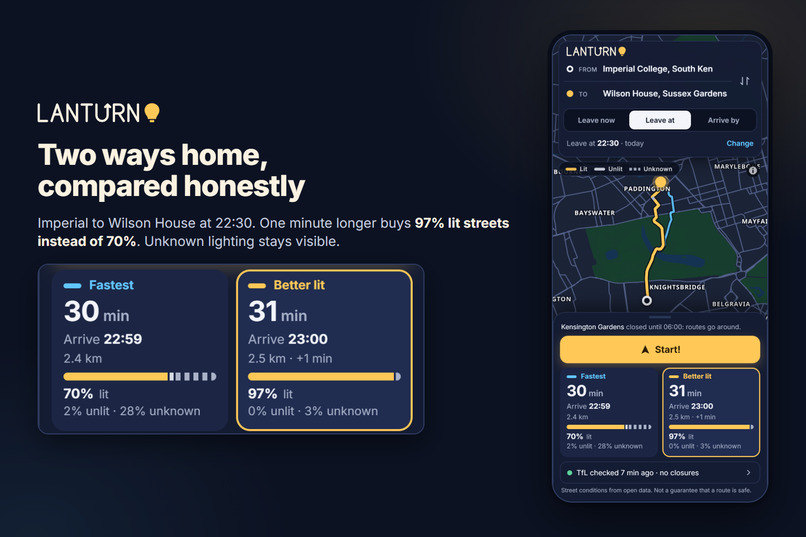
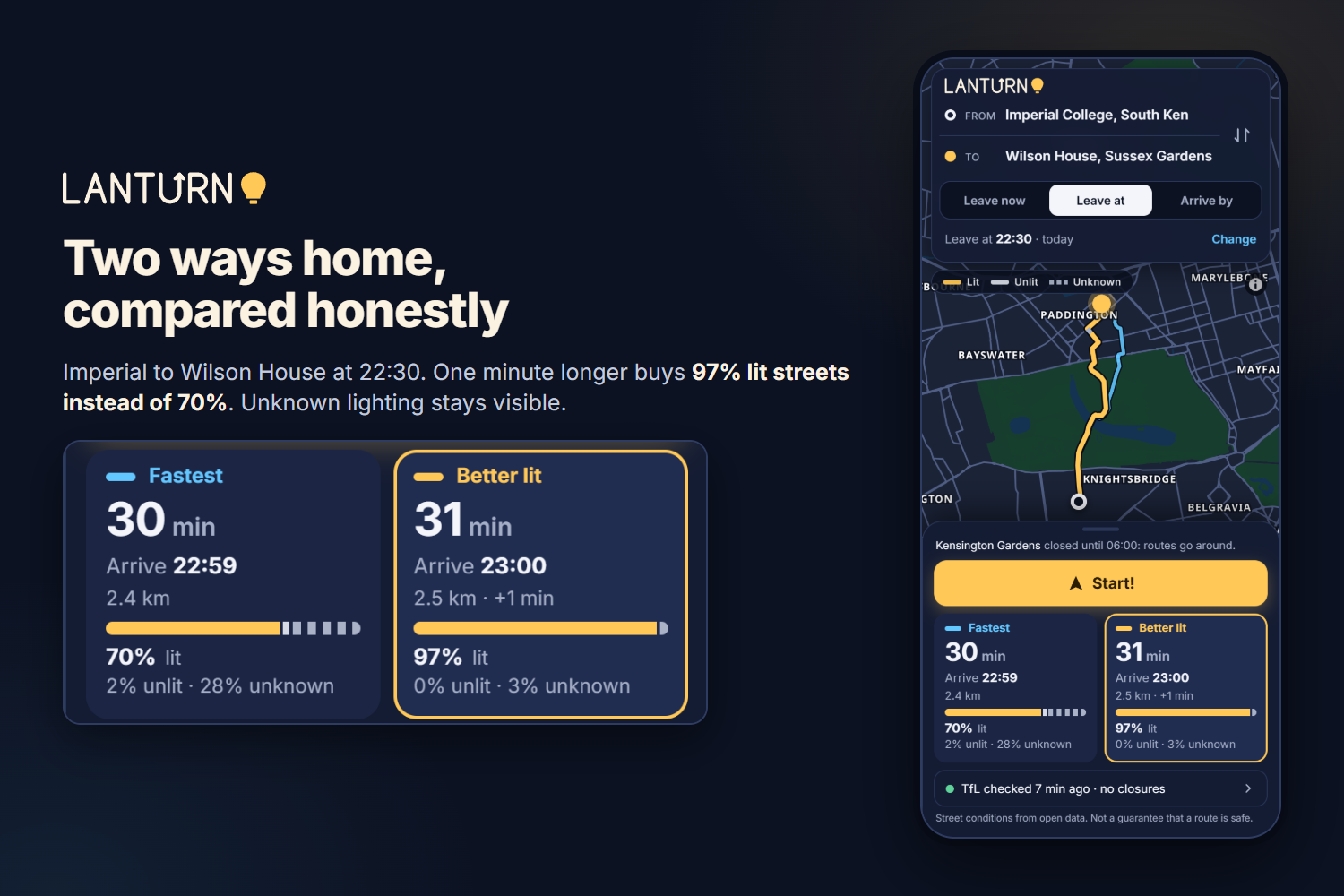
Main page, Route comparison - One extra minute, a better-lit walk
-
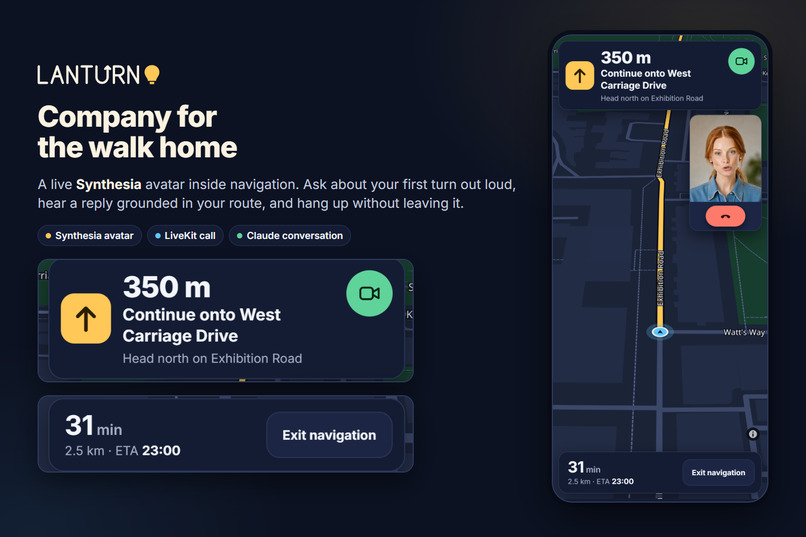
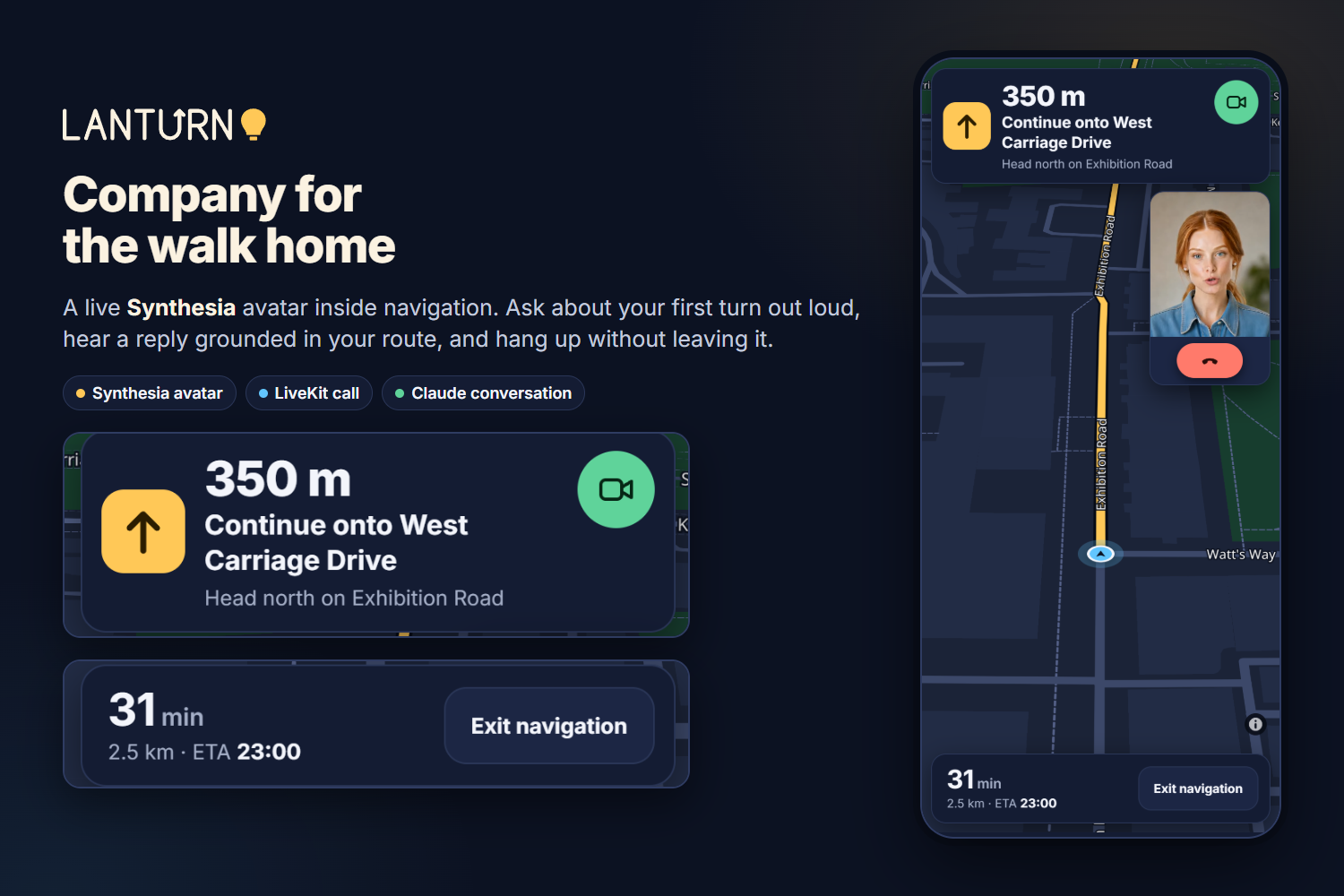
Live companion - Company on the way home, powered by Synthesia
-
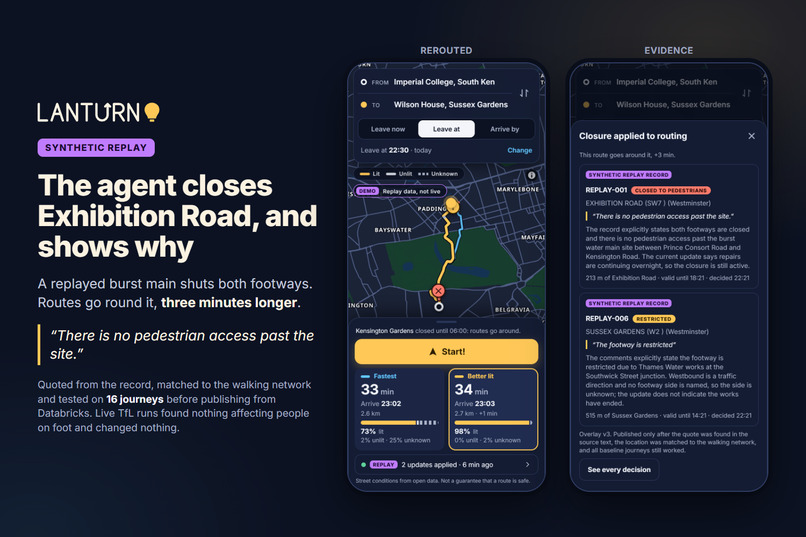
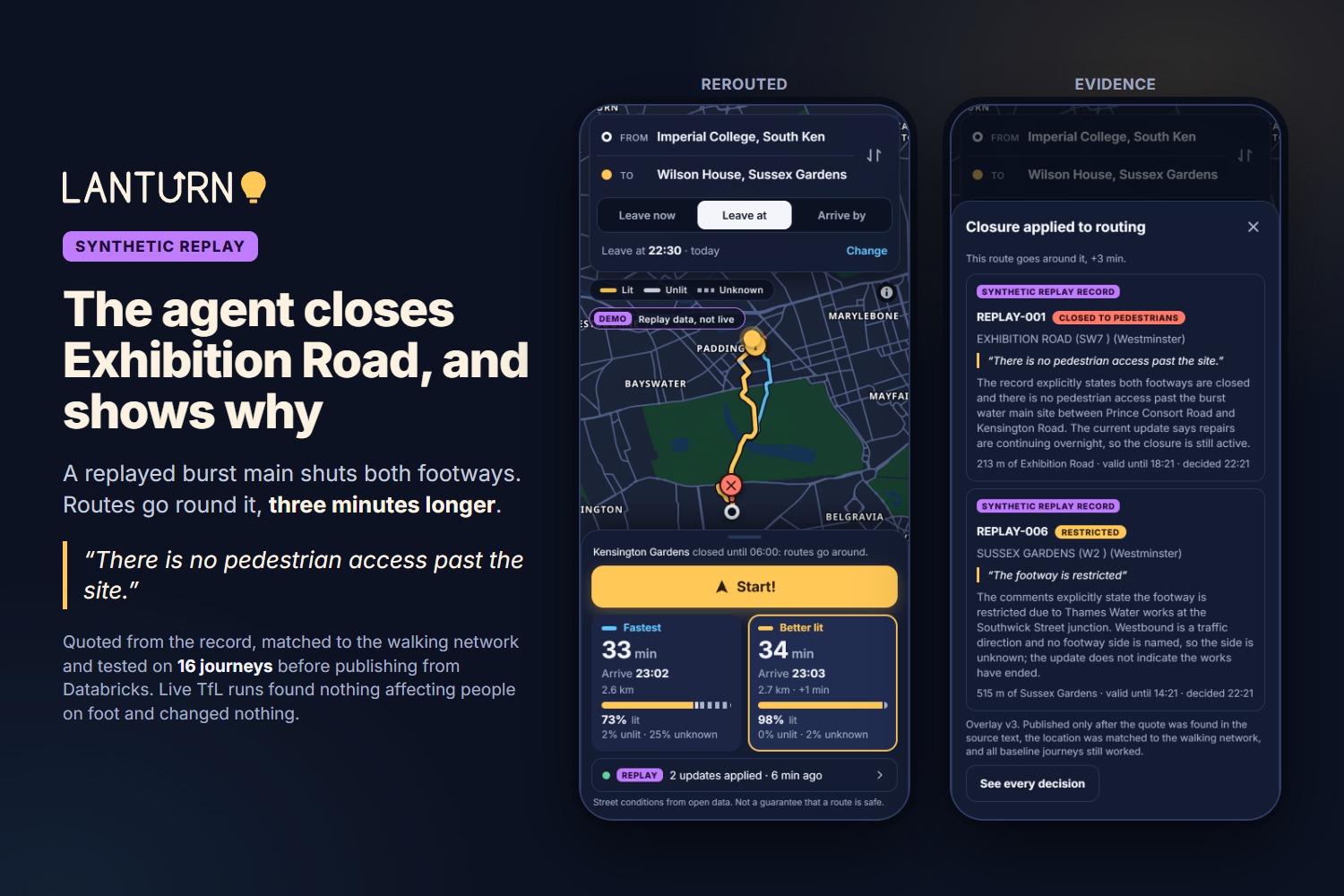
Agent reroute - Databricks reroutes around a closure
-
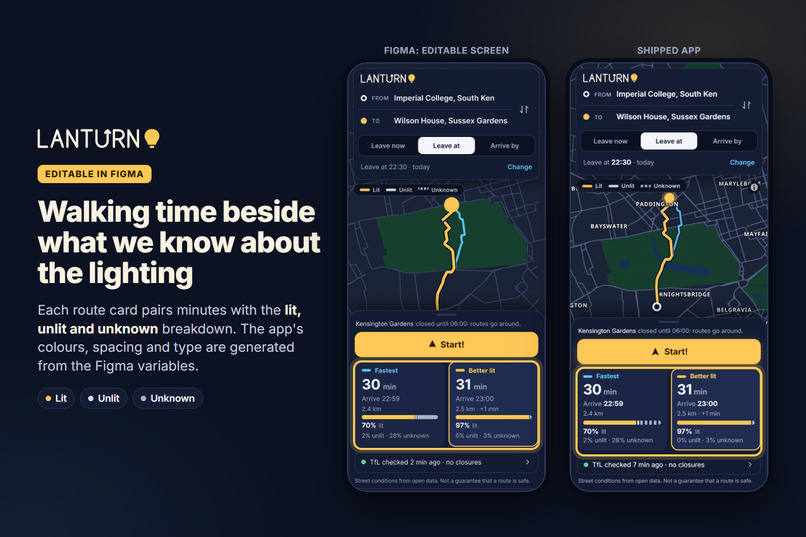
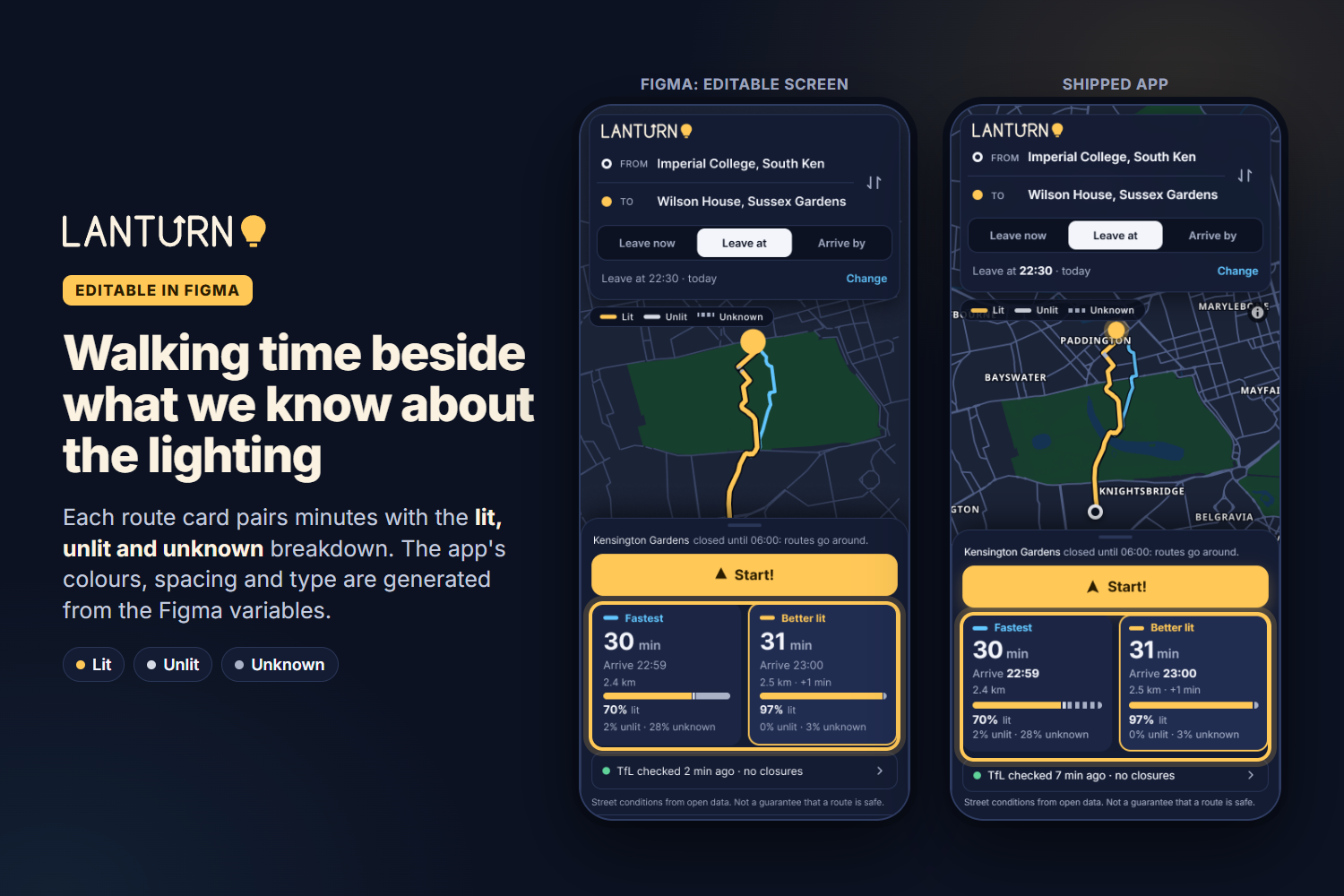
Figma design - From Figma to the app: making lighting visible
Inspiration
It’s 22:30. You’ve stayed late at Imperial, and you’re about to walk from South Kensington to your accomodation - Wilson House in Paddington. Your map can tell you which route is quickest. What we wanted to know was how much more of the walk could be on streets recorded as lit if we gave ourselves another minute. And on the stretches where you’d rather have someone to talk to, could the app offer a little company?
What it does
Lanturn compares the fastest walk with an alternative that weighs walking time against lighting and other mapped conditions. On our Imperial-to-Wilson House demo journey, that meant 30 minutes with 70% of the route recorded as lit, or 31 minutes with 97%. We show unrecorded lighting in dashed grey so you can see where the map has gaps.
Pick a route and start navigation. You can open a live video call with an AI walking companion, ask about your first turn, or simply talk while you walk.
How we built it
Databricks runs the autonomous agent that keeps Lanturn’s routes current. Every 30 minutes, a Serverless job checks live TfL reports. Claude identifies reports that may affect pedestrians. Our code checks the quoted evidence and location against the walking network, then reruns 16 test journeys before publishing a versioned update the app can use.
Synthesia powers the live video companion inside navigation. We used LiveKit to carry the call and Claude Haiku to respond. The companion can use directions from the selected route, so you can ask which way to head without leaving the map.
Figma helped us make the trade-off visible at a glance. We designed editable route comparison and disruption screens and used exported tokens for the app’s colours, spacing and typography. Each route card puts walking time beside the breakdown of lit, unlit and unknown stretches.
Challenges we ran into
The hardest part of using TfL data was deciding what a report actually meant for someone on foot. A lane closure can sound dramatic and still leave the pavement fully open. We made the agent quote the source and locate the affected stretch before it could propose a route change.
We also hit a bug that made a successful cloud job look broken. Databricks had published a newer update, but the app was still showing an old replay closure because its cached login token had expired. Fixing the credential refresh taught us to check what the student actually sees, all the way through from the scheduled job to the map.
Accomplishments that we're proud of
In our live runs, the agent found vehicle-only restrictions and left the walking routes alone. To show what happens when there is evidence of a pedestrian closure, we ran a clearly labelled synthetic Exhibition Road report through the same Databricks workflow. The agent checked it, published the update, and the app routed around it, adding about three minutes.
We also tested the Synthesia call ourselves in Chrome. Being able to ask a question out loud and hear the avatar answer about the actual route was the moment the companion felt like part of the walk.
What we learned
About 39% of our walking network had no lighting tag. Changing how we scored those stretches moved routes more often than changing individual weights did. That made uncertainty a design decision as much as a mathematical one. Showing a grey stretch on the map gives the student information they can use, even when the data can’t tell them what the street will look like.
What's next for Lanturn
We’d start by checking lighting on more routes students actually walk, working with university communities and using borough lamp data where it’s available. Then we’d test whether students understand what an extra minute buys them and whether the companion makes the walk feel less lonely.
We want more London students to leave the library after dark with a route they understand and the option of company. A little more light, a little less alone - Lanturn.
Built With
- claude
- claudeapi
- databricks
- deltalake
- fastapi
- figma
- javascript
- livekit
- maplibre
- openfreemap
- openstreetmap
- overpass-openstreetmap
- overpassapi
- python
- synthesia
- tfl
- tflunifiedapi
- unitycatalog

