-
-
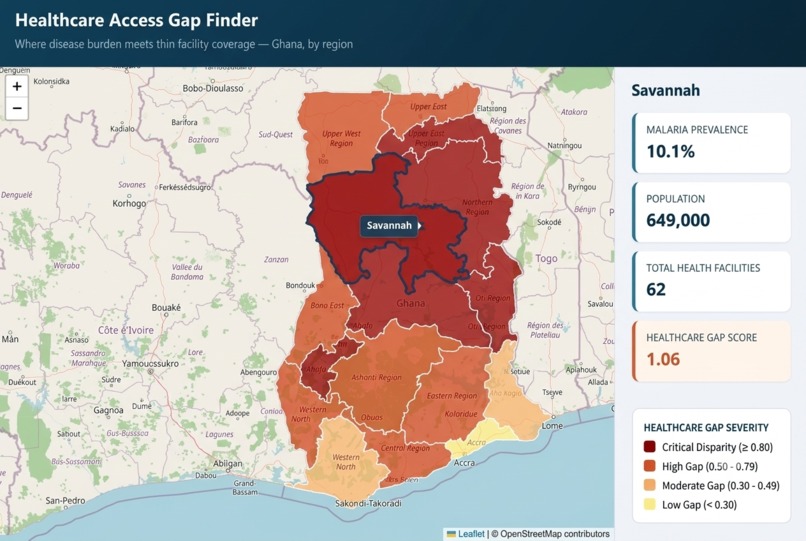
Dashboard view of the platform highlighting the malaria prevalence and healthcare gap score for the Savannah region
Inspiration
I've been building toward accessible health technology for West Africa for a while now — it's personal for me. I lost my brother because his illness wasn't caught early enough, and that's shaped everything I've built since, from an SMS health-alert platform to this project. A few weeks before this hackathon, I worked on a project quantifying flood early-warning targeting in Accra, and it got me thinking about a related but different gap: it's not just that warnings arrive late, it's that healthcare access itself isn't evenly distributed against where the need is greatest. I wanted to make that gap visible on a map, not buried in two separate government datasets that never get compared side by side.
What it does
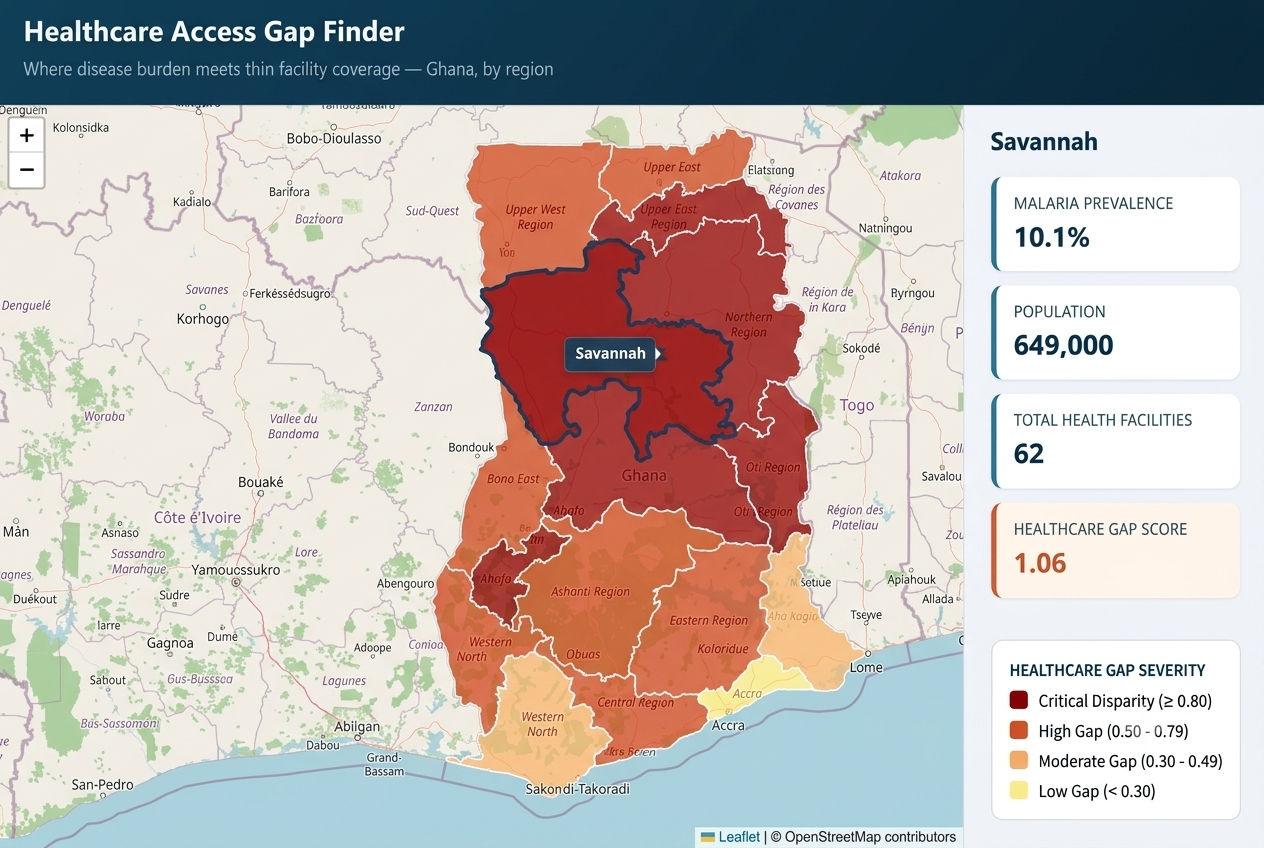
Healthcare Access Gap Finder is an interactive map of Ghana's 16 regions that combines regional malaria prevalence with health facility density to calculate a Healthcare Gap Score for each region. Click any region and a panel shows its malaria burden, population, total health facilities, and resulting gap score, color-coded on the map from Low Gap to Critical Disparity. The goal is simple: let anyone, in seconds, see where disease burden and thin healthcare coverage overlap, since that overlap is where intervention matters most.
How we built it
The frontend is plain HTML, CSS, and vanilla JavaScript, no framework, using Leaflet.js for the map and OpenStreetMap tiles as the base layer. Region boundaries come from a GeoJSON file, and the underlying data — malaria prevalence by region and population figures — comes from Ghana Health Service/GDHS data and Ghana Statistical Service figures. Health facility counts per region came from a public Ghana health facilities dataset, which I counted and matched against each region manually. I started with a basic scaffold and real regional stats, then built out the actual Gap Score formula, the color-severity legend, and the click-to-detail panel myself, and deployed it as a static site on GitHub Pages.
Challenges we ran into
Sourcing usable geographic data was harder than expected. My first GeoJSON source only covered 4 of 16 regions, and a second, more "official" source was stored via Git LFS and wouldn't load reliably in a browser at all, so I had to find and validate a third source before the map would even render properly. Once the map was working, I noticed the color scale didn't visually match the severity legend, most regions rendered the same shade despite having very different gap scores, which would have undercut the entire point of the tool. I recalibrated the color-to-score mapping so the map actually shows the contrast the underlying numbers describe.
Accomplishments that we're proud of
Getting real, sourced public health and demographic data to drive an actual working choropleth map, not placeholder numbers, in a short build window. I'm also proud of catching the color-calibration issue myself before submission, since a map that visually contradicts its own legend would have undermined the whole idea even with correct underlying data.
What we learned
I learned a lot about handling real-world geospatial data (GeoJSON structure, coordinate matching, and why "official" data sources aren't always the easiest to actually use), and about how much visual design choices matter in data storytelling, correct data means nothing if the visual encoding doesn't communicate it clearly.
What's next for Healthcare Access Gap Finder
Breaking the analysis down to the district level instead of just regional, since real access gaps vary a lot within a single region. I'd also like to add other disease burdens beyond malaria (cholera, maternal health outcomes), a search/filter bar, and potentially connect it to Nkwa Alert, my SMS health-alert platform, so underserved regions identified by the gap score could be prioritized for outreach.
Team Registration & Verification Details
• Full Name: [Shadrack Owusu Ansah • Contact Email: [email protected] • Discord Username: shadrackowusuansah_17176_19790 • GitHub Username: alpharianosei2005-maker • Age: 21 • Current School or Institution: University of the People • Country: Ghana

Log in or sign up for Devpost to join the conversation.