-
-
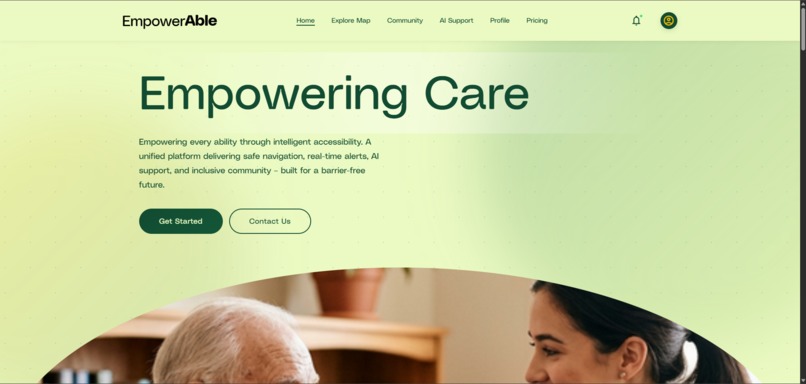
This is the Home page of the website.
-
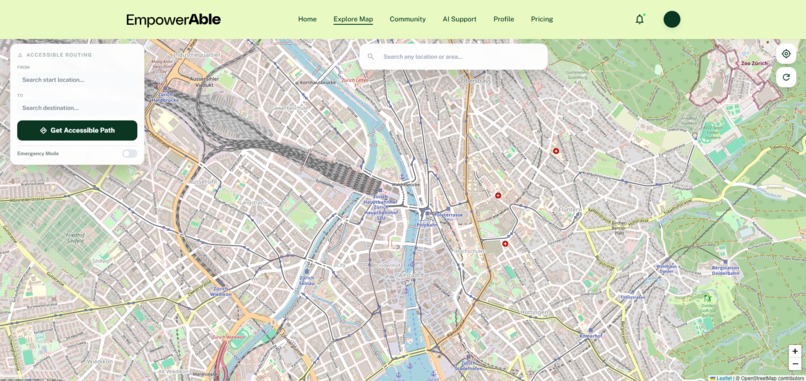
This is the map area.. I could upload more images but the limit is 5mb onlyy..
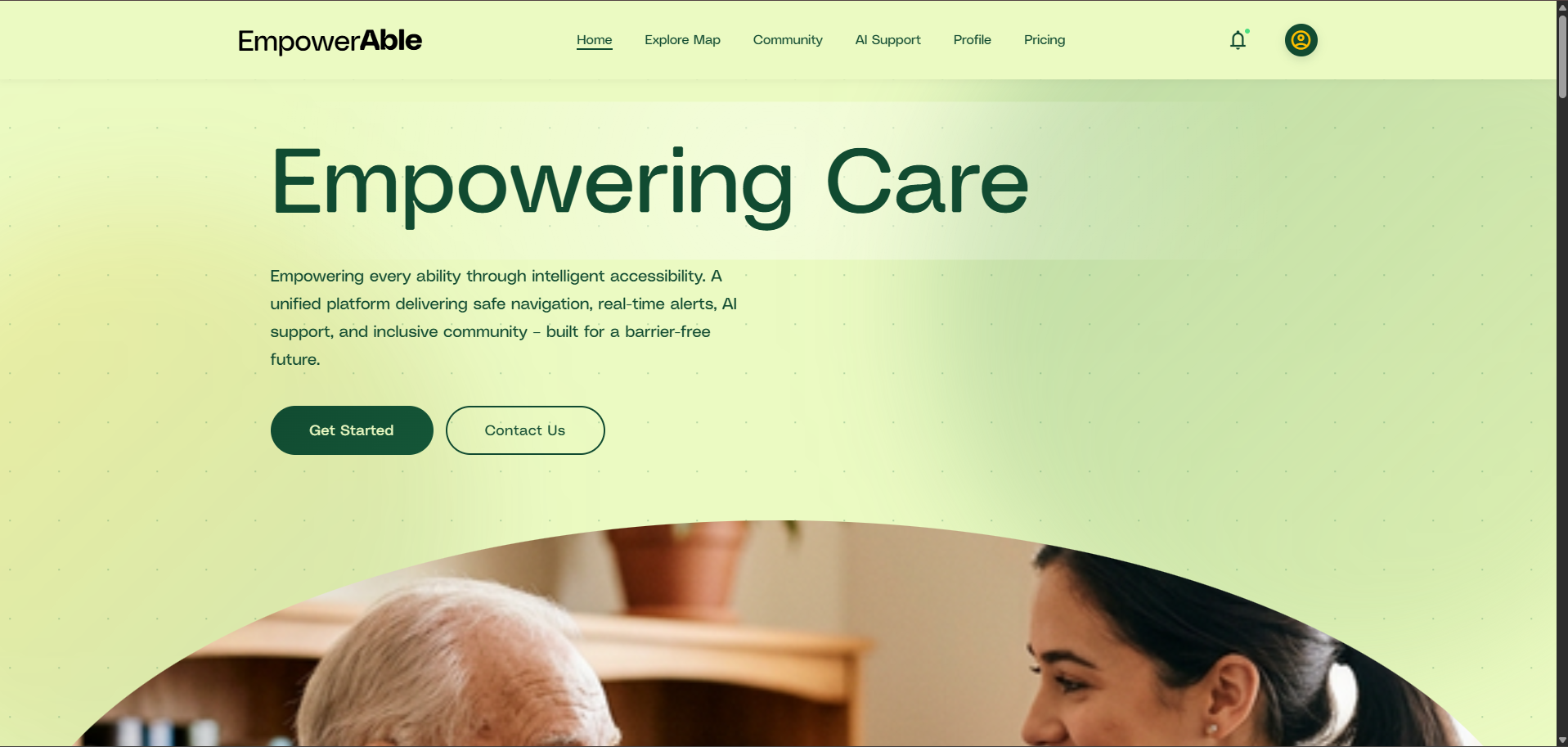
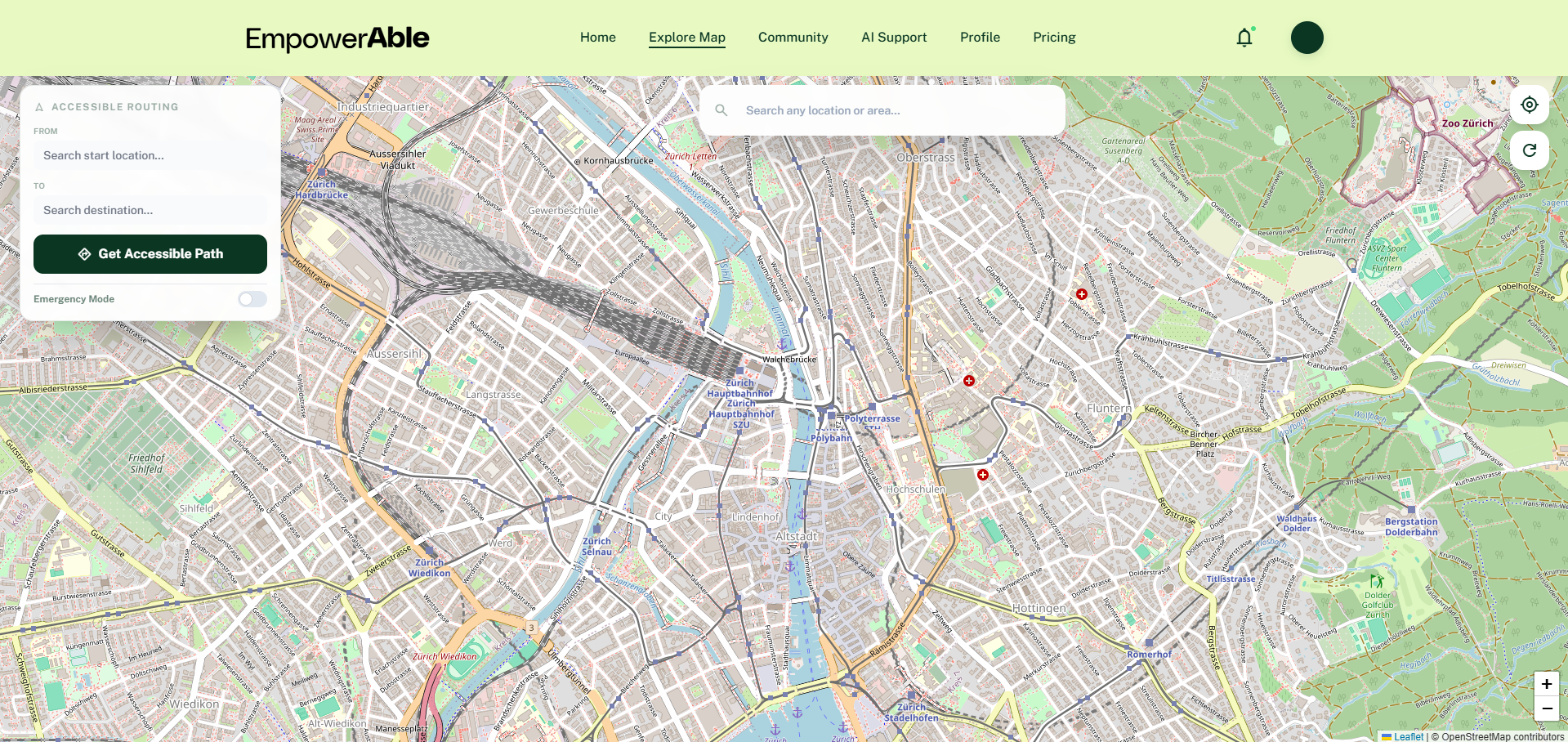
Inspiration - The inspiration behind EmpowerAble came from a fundamental observation:
While digital maps can calculate the shortest path between two locations, they rarely consider the accessible path.
For many individuals with mobility challenges, the “shortest route” is not the “usable route.” Similarly, infrastructure accessibility data is often fragmented, outdated, or completely invisible to those who need it most. Elevators, wheelchair ramps, tactile paving, and accessible restrooms are critical facilities — yet there is no widely accessible system that evaluates and rates these in real time.
We asked:
"What if accessibility was measurable, transparent, and intelligently routed?" EmpowerAble was built to answer that question.
What it does -- What EmpowerAble Does
EmpowerAble is a complete accessibility ecosystem designed to empower individuals with disabilities through safety, navigation, community, and intelligent support.
- Smart Accessibility Mapping
Detects whether locations have elevators, ramps, wheelchair access, and accessible restrooms. Displays infrastructure accessibility using a clear Green / Yellow / Red rating system. Allows users to click buildings and instantly view detailed facility information.
- Accessible Route Planning
Provides From–To route mapping optimized for accessibility. Highlights the shortest and safest wheelchair-friendly route. Includes Emergency Route Mode for urgent, priority navigation.
- Emergency Support System
One-tap access to saved emergency contacts. Fast route generation during crises. Designed for quick decision-making in high-risk situations.
- AI-Powered Support Assistant
Provides emotional and motivational support. Assists users in finding locations and understanding accessibility information. Offers guidance in a simple, human-friendly interface.
- Community & Social Support
Interactive communities for encouragement, fitness, motivation, and well-being. Real-time notifications for messages and community updates. Safe digital spaces for people with different disabilities to connect and support each other.
- Secure & Simple Authentication
Google Authentication for fast, secure login. Personalized user profiles. Privacy and data control settings for user safety.
Community Reporting & Contribution
Users can report inaccessible infrastructure. Helps build a continuously improving accessibility database. Encourages collective contribution toward inclusive cities.
How we built it -- EmpowerAble was built using a modern full-stack architecture focused on scalability, accessibility, and real-world usability.
- Frontend Development
Designed a premium, accessibility-focused UI using modern web technologies. Built responsive interfaces for Home, Map, Community, Profile, Emergency, Notifications, and AI Support pages. Used a warm, inclusive design theme to reflect comfort and human connection. Implemented intuitive navigation with interlinked components via a structured navbar system.
- Accessibility Mapping Integration
Integrated OpenStreetMap-based infrastructure data to analyze accessibility features such as ramps, elevators, and restrooms. Built a color-coded accessibility rating engine (Green / Yellow / Red) to simplify infrastructure evaluation. Developed interactive map features including: Click-based infrastructure insights From–To accessible routing Emergency shortest-path highlighting
- Emergency System
Engineered an emergency mode that prioritizes shortest and safest accessible routes. Designed quick-access emergency contacts functionality for rapid response situations.
- AI Support System
Integrated an AI-powered conversational assistant for emotional and navigational support. Designed the AI interface to be calm, friendly, and distraction-free. Structured prompts and response handling to ensure supportive and context-aware interaction.
- Authentication & User Management
Implemented secure Google Authentication for fast login. Created dynamic profile management (name, profile image, emergency settings, privacy controls). Designed a backend structure for storing user preferences and contributions.
- Community & Reporting System
Built interactive community spaces for motivation and support. Developed a reporting mechanism for inaccessible infrastructure. Designed notification handling for community updates and alerts.
- Development Approach
Rapid prototyping and UI structuring using AI-assisted design tools. Iterative feature implementation within a 24-hour hackathon timeframe. Focused on balancing technical complexity with real-world impact.
Challenges we ran into --
Challenges We Ran Into
Building EmpowerAble within a limited hackathon timeframe presented several technical and design challenges that required rapid problem-solving and adaptability.
- Real-World Accessibility Data Limitations
One of the biggest challenges was working with incomplete or inconsistent accessibility data. Public map sources do not always provide structured or verified information about elevators, ramps, or accessible restrooms. We had to design a flexible rating system that could work even with partial infrastructure data.
- Accessible Routing Complexity
Traditional routing systems optimize for shortest distance, not accessibility. Designing a route logic that prioritizes usability for wheelchair users — including emergency routing — required careful planning of how path data should be interpreted and displayed.
- Frontend–Backend Integration
Converting static UI prototypes into a fully functional system required significant debugging. Maintaining consistent design while connecting authentication, maps, community modules, and profile management introduced structural complexity.
- Balancing Simplicity with Feature Depth
EmpowerAble includes mapping, AI support, emergency systems, community interaction, and reporting features. Ensuring the platform remained intuitive and not overwhelming — especially for users with different disabilities — required thoughtful UX decisions.
- Designing Ethical AI Support
Creating an AI assistant for emotional support required careful prompt structuring to ensure responses were helpful, safe, and encouraging — without replacing professional medical advice.
- Time Constraints
Developing a multi-feature, impact-driven platform within a hackathon timeframe demanded prioritization, fast iteration, and decisive leadership. We focused on building a strong core system first, then layering advanced features.
Accomplishments that we're proud of --
Built a Complete Accessibility Ecosystem
Within a hackathon timeframe, we developed not just a prototype, but a multi-feature platform integrating mapping, emergency support, AI assistance, authentication, and community engagement into one unified system.
- Designed an Accessibility Rating Engine
We successfully transformed complex infrastructure data into a simple and intuitive Green / Yellow / Red rating system, making accessibility information understandable at a glance.
- Implemented Emergency Route Functionality
We developed an emergency navigation mode that prioritizes the shortest and safest accessible path — focusing on real-world usability rather than just theoretical routing.
- Integrated Human-Centered AI Support
We created an AI assistant designed not just for information, but for emotional encouragement and guidance — promoting both independence and confidence.
- Built a Supportive Community Framework
Beyond navigation, we built digital spaces for connection, motivation, and peer support — addressing the emotional and social dimensions of accessibility.
- Prioritized Security & Accessibility Together
We implemented secure authentication while maintaining a clean, minimal, disability-friendly interface.
- Delivered a Premium, Inclusive UI Design
We designed a modern, visually polished interface with warm tones and accessible layouts, ensuring comfort, readability, and inclusivity.
- Turned a Social Problem into a Scalable Tech Solution
Most importantly, we translated a real-world accessibility challenge into a structured, scalable digital platform that has the potential to expand across cities and countries.
What we learned --
- Accessibility Is More Than Infrastructure
We learned that accessibility is not just about ramps and elevators — it’s about dignity, independence, safety, and confidence. Technology must consider emotional and social inclusion alongside physical accessibility.
- Simplicity Is Powerful
Complex systems must feel simple to users. Designing an intuitive interface while managing multiple advanced features taught us the importance of clarity, minimalism, and user-first thinking.
- Real-World Data Is Imperfect
Working with open infrastructure data revealed that real-world datasets are often incomplete or inconsistent. We learned how to design flexible systems that can adapt to partial information while still delivering value.
- Rapid Problem-Solving Under Pressure
Building a multi-feature platform within a hackathon timeframe strengthened our ability to prioritize core functionality, iterate quickly, and make strategic technical decisions.
- Human-Centered AI Design
We understood that AI systems designed for emotional support require responsibility. Tone, safety, and clarity matter as much as technical accuracy.
- Security and Trust Matter
Handling user authentication and emergency features reinforced the importance of privacy, data protection, and building trust into the platform architecture.
- Innovation Comes from Empathy
Most importantly, we learned that impactful innovation begins with empathy. Understanding the daily challenges faced by people with disabilities shaped every design and technical decision we made.
What's next for EmpowerAble --
What’s Next for EmpowerAble
EmpowerAble is not just a hackathon project — it is the foundation of a scalable accessibility ecosystem. Our next steps focus on expansion, validation, and real-world deployment.
- Native Mobile Applications
Launching dedicated iOS and Android applications for seamless, on-the-go accessibility support. Offline accessibility maps for low-connectivity environments. Real-time push notifications for emergency alerts and infrastructure updates. Voice-controlled navigation for visually impaired users.
- Advanced Accessibility Intelligence
AI-powered accessibility prediction for buildings with limited data. Integration with smart city datasets and government infrastructure APIs. Real-time crowd-sourced verification of elevators, ramps, and restrooms. Accessibility heatmaps to identify underserved areas.
- Smart Emergency Expansion
Integration with local emergency services. Live location sharing with emergency contacts. One-tap SOS mode with automated accessible route calculation. Disaster-aware routing during floods, earthquakes, or public hazards.
- AI 2.0 — Personalized Support
Emotion-aware AI responses for improved emotional well-being support. Personalized accessibility recommendations based on user preferences. Multi-language support for global reach. Voice-enabled AI companion mode.
- Stronger Community Ecosystem
Verified local volunteer networks. Accessibility ambassadors program. Community-driven accessibility rating validation. Gamified contribution system to encourage reporting and improvements.
- Real-World Partnerships
Collaborations with hospitals, NGOs, urban planners, and accessibility advocates. Partnerships with malls, universities, transport authorities, and public institutions. Corporate accessibility certification system powered by EmpowerAble ratings.
- From Hackathon to Startup
Our long-term goal is to transform EmpowerAble into a full-scale social impact startup focused on inclusive mobility and accessibility intelligence. Establishing a legal entity and structured development roadmap. Applying for grants and social innovation funding. Building a cross-functional team (engineering, accessibility experts, legal advisors). Expanding city-by-city, then internationally.
- Global Vision
We envision EmpowerAble becoming: A global accessibility data standard. A trusted mobility companion for millions. A platform that influences infrastructure design through transparent ratings. A step toward cities designed for everyone.
--------------------------------------------- Our Ultimate Goal-----------------------------------------------
To ensure that no individual feels limited by inaccessible infrastructure — and that technology becomes a bridge between independence and inclusion.
Built With
- ai
- antigravity
- api
- chat
- claude
- css3
- firebase
- geojson
- git
- github
- html
- html5
- javascript
- leaflet.js
- mongodb
- openstreetmap
- osrm
- stitch
- vercel
- vscode

Log in or sign up for Devpost to join the conversation.