Inspiration
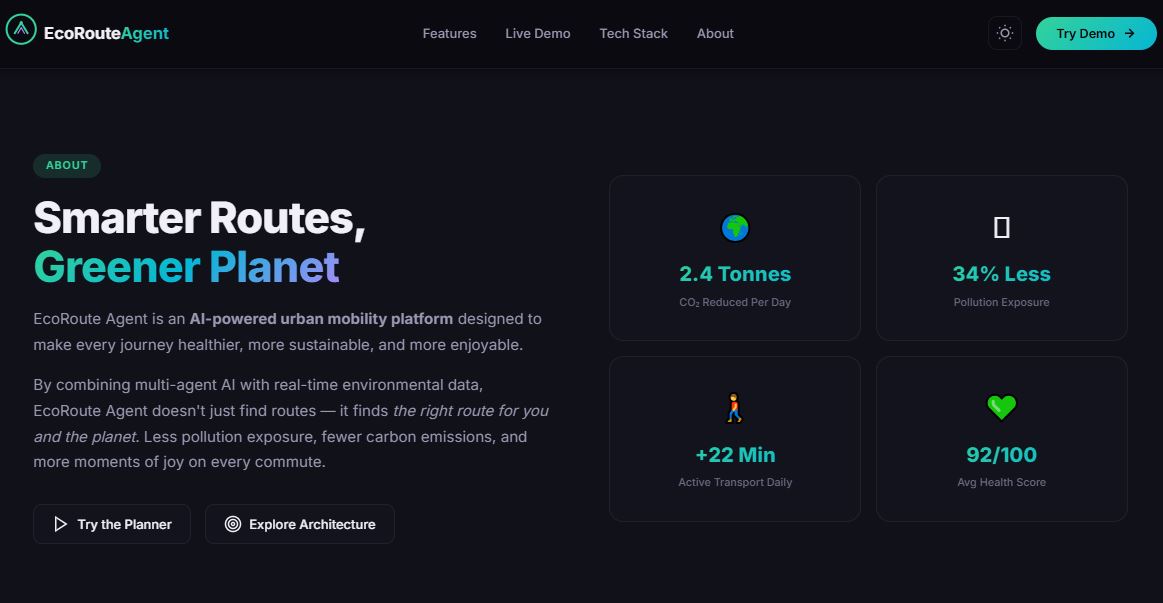
Urban transportation accounts for roughly 29% of global greenhouse gas emissions. Millions of commuters rely on navigation apps every day, but these systems share a fundamental flaw: they optimize almost exclusively for speed. I realized that if I could change how people move by factoring in environmental impact, personal health, and air quality, I could make a massive dent in urban carbon footprints. EcoRoute Agent was born out of the desire to make the sustainable choice the default choice.
What it does
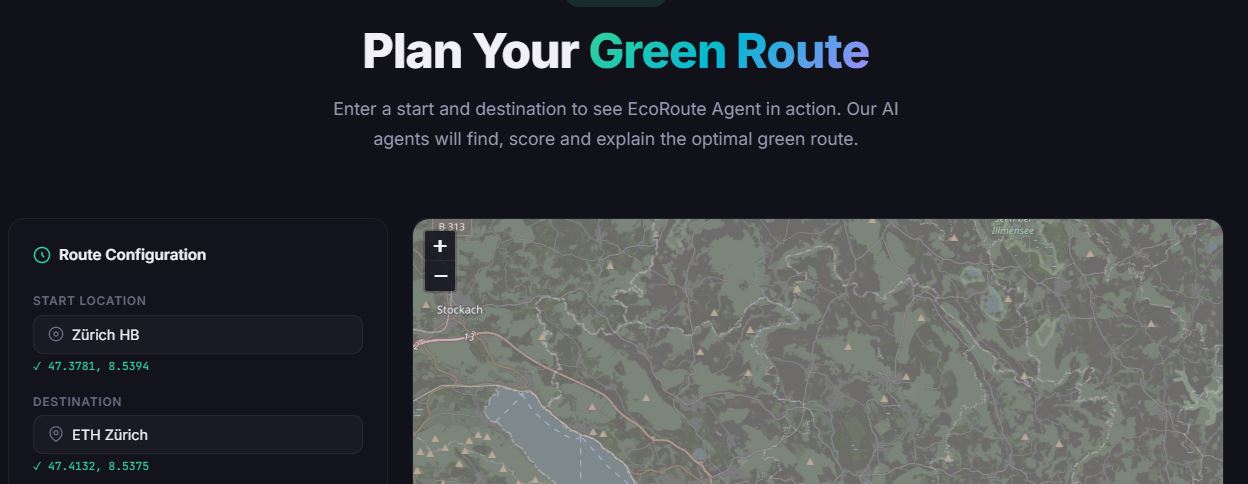
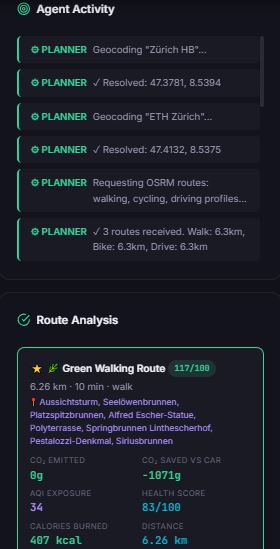
EcoRoute Agent is a multi-agent AI mobility platform that dynamically calculates and compares travel paths. When a user inputs their origin and destination, our orchestration pipeline instantly generates routes optimized for:
- Low Carbon Emissions (CO₂)
- Minimal Air Quality Index (AQI) Exposure
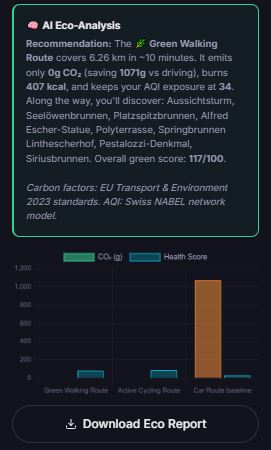
- High Personal Health Scores (calories burned & scenic points of interest) Users are presented with beautifully visualized data cards comparing active transport (walking/cycling) against a traditional car baseline, paired with an AI-generated Eco-Analysis summarizing the best choice.
How I built it
I architected EcoRoute Agent using a highly scalable front-end paired with a simulated intelligent agent back-end orchestration. The Tech Stack:
- Frontend: Vanilla JavaScript, HTML5, and CSS3 with custom CSS Variables for a dynamic Dark/Light Theme toggle.
- Mapping Engine: Leaflet.js with customized tile rendering and dynamic path drawing.
- Routing APIs: Open Source Routing Machine (OSRM) for precise geocoding and pathfinding.
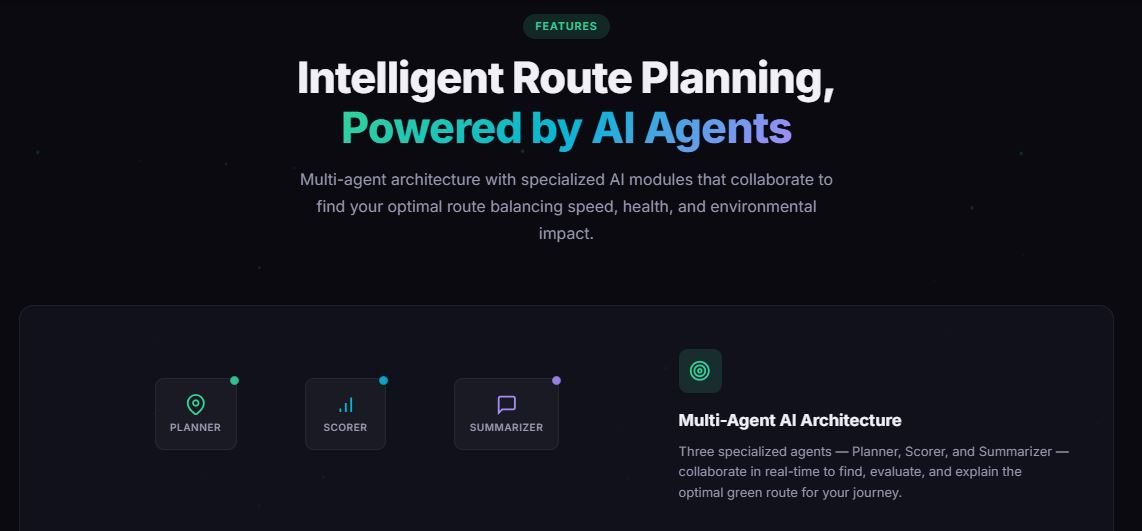
- Data Sources: OpenStreetMap Nominatim for geocoding and Overpass API to query scenic Points of Interest (POIs). Following the principles of Multi-Agent Systems (MAS), I designed three distinct logical agents: ```javascript // The Orchestrator Logic const orchestrator = new AgentPipeline([ new RoutePlannerAgent(OSRM_API), new EnvironmentalScorerAgent(AQI_Model, Carbon_Model), new NLPSummarizerAgent() ]);
Challenges I ran into
Building a highly responsive, multi-layered mapping interface that simultaneously handles multiple asynchronous API calls was my biggest technical hurdle. Coordinating requests between Nominatim (for geocoding), OSRM (for routing geometries), and the Overpass API (for geographic POIs) initially caused noticeable lag and race conditions in the UI. I also struggled with translating raw environmental data into meaningful metrics for the user. Calculating precise CO₂ emissions dynamically required building an intelligent scoring model that could accurately contrast a standard combustion engine baseline against the zero-emission reality of active transport, all while maintaining a smooth user experience.
Accomplishments that I am proud of
- The Agent Orchestrator: I successfully engineered a front-end "Agent Pipeline" in pure Vanilla JavaScript. It effectively simulates complex LLM agent workflows (Planner → Scorer → Summarizer) without requiring heavy backend infrastructure.
- Flawless UI/UX: Designing a modern, glassmorphism-inspired interface with a fully custom, dynamic Dark/Light mode theme toggle that even inverts map tile rendering.
- Real-world Integration: Successfully pulling live geographic and routing data, processing it through an environmental lens, and generating data-backed, actionable climate advice instantly.
What I learned
This project taught me that data presentation is just as important as the data itself. I learned that users will make the healthier, greener choice if the environmental impact (like carbon saved or pollution avoided) is presented clearly and beautifully. On the technical side, I gained extensive, hands-on experience working with Leaflet.js, handling complex spatial bounding boxes, and orchestrating asynchronous simulated agent behaviors entirely within the browser.
What's next for EcoRouteAgent - AI-powered green mobility planner
- Live API Integrations: Hooking the Scorer Agent directly to live city-wide sensor networks (like the Swiss NABEL air quality network) for real-time AQI routing.
- True LLM Backend: Implementing an open-weights model like Llama on a dedicated backend server to generate hyper-personalized route summaries based on live weather patterns and user health history.
- Mobile Ecosystem: Porting the core routing and agent logic into a React Native environment to create a ubiquitous, on-the-go green mobility app for daily commuters.


Log in or sign up for Devpost to join the conversation.