-
-
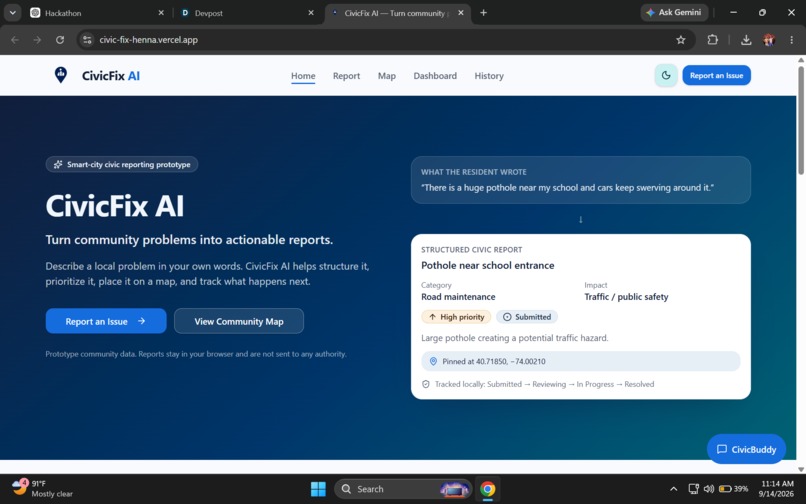
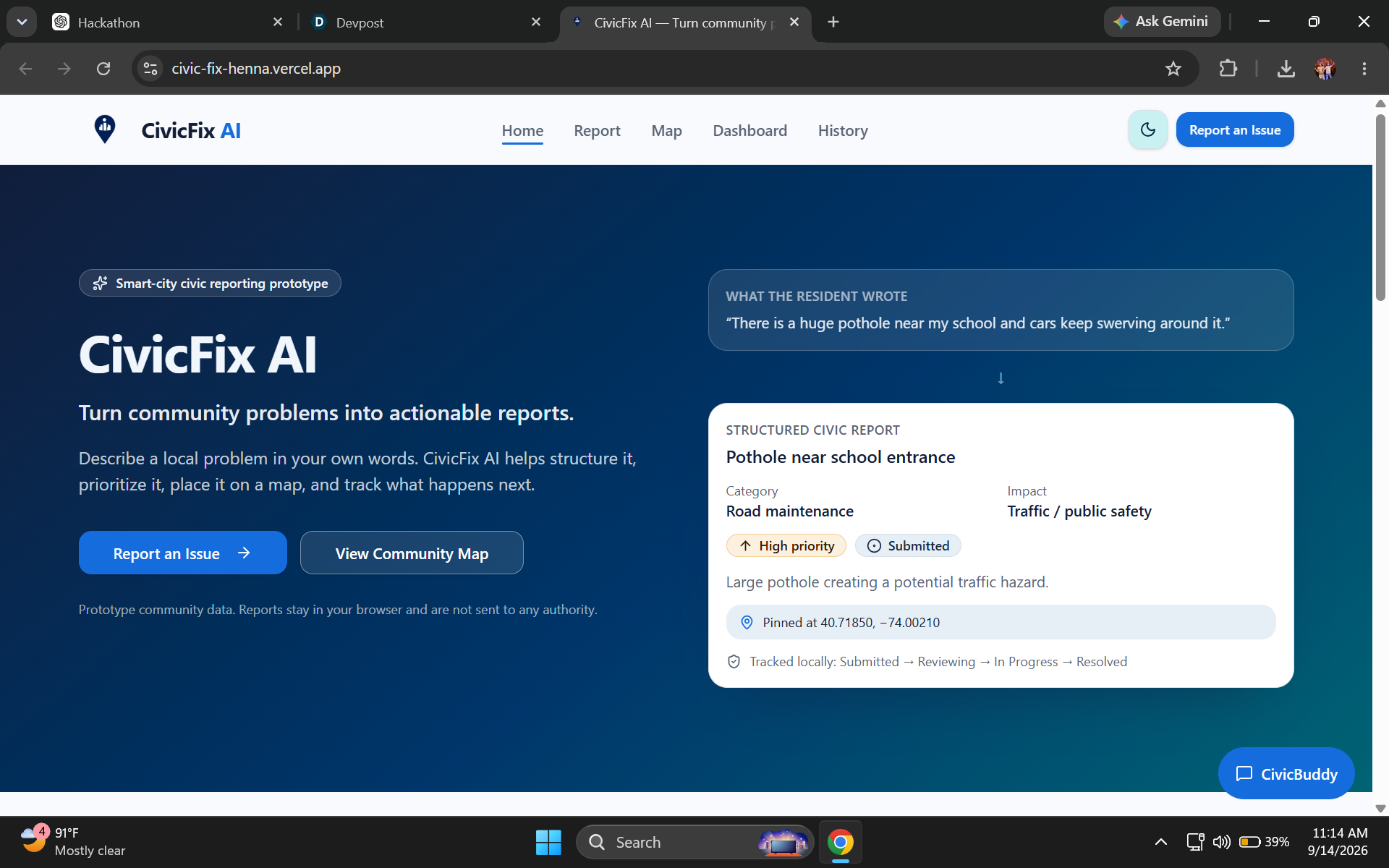
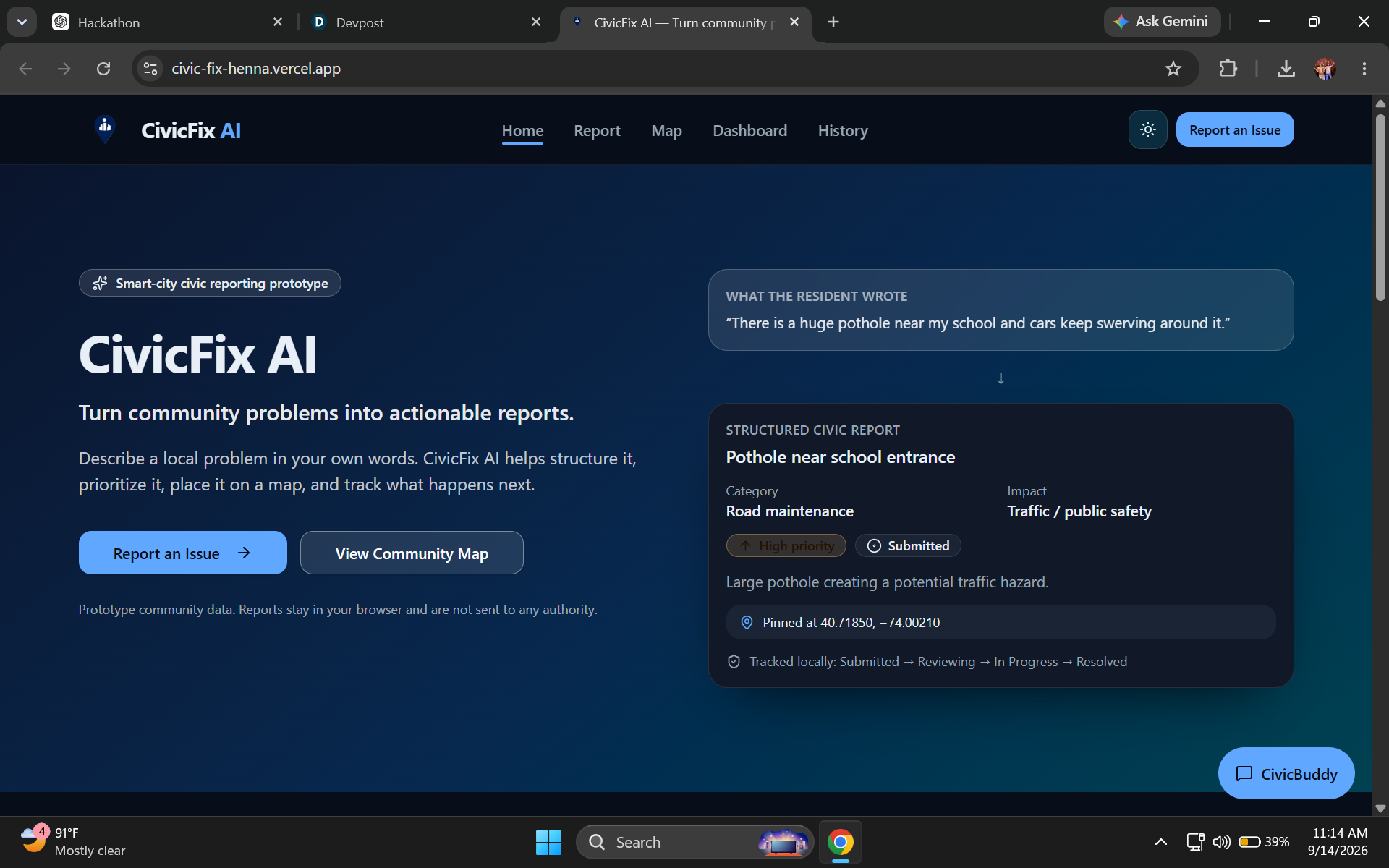
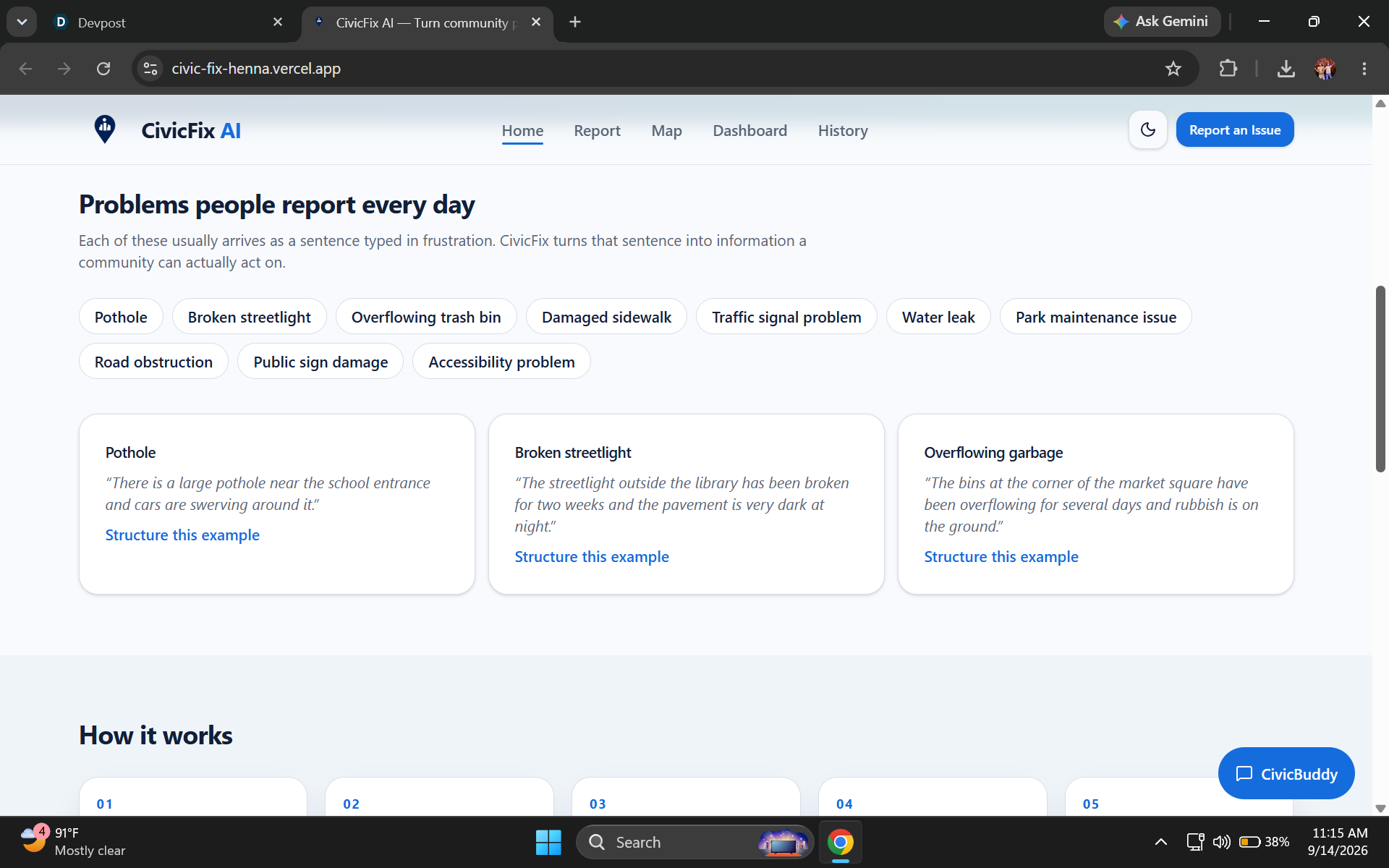
Homepage[Light Mode]
-
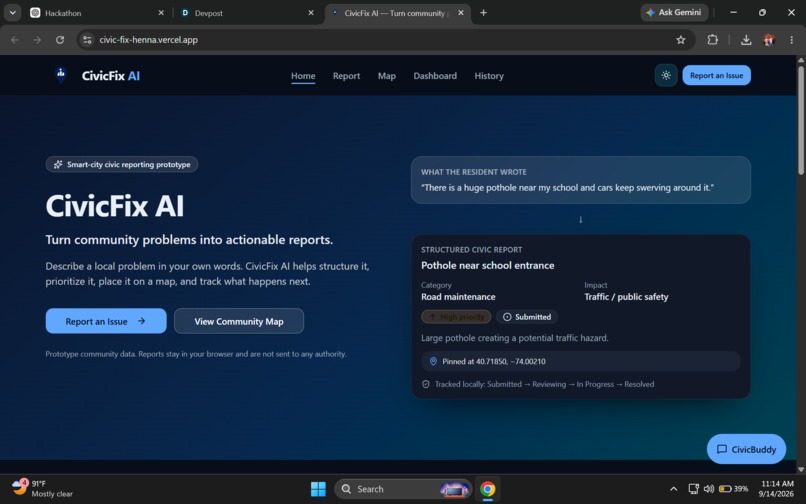
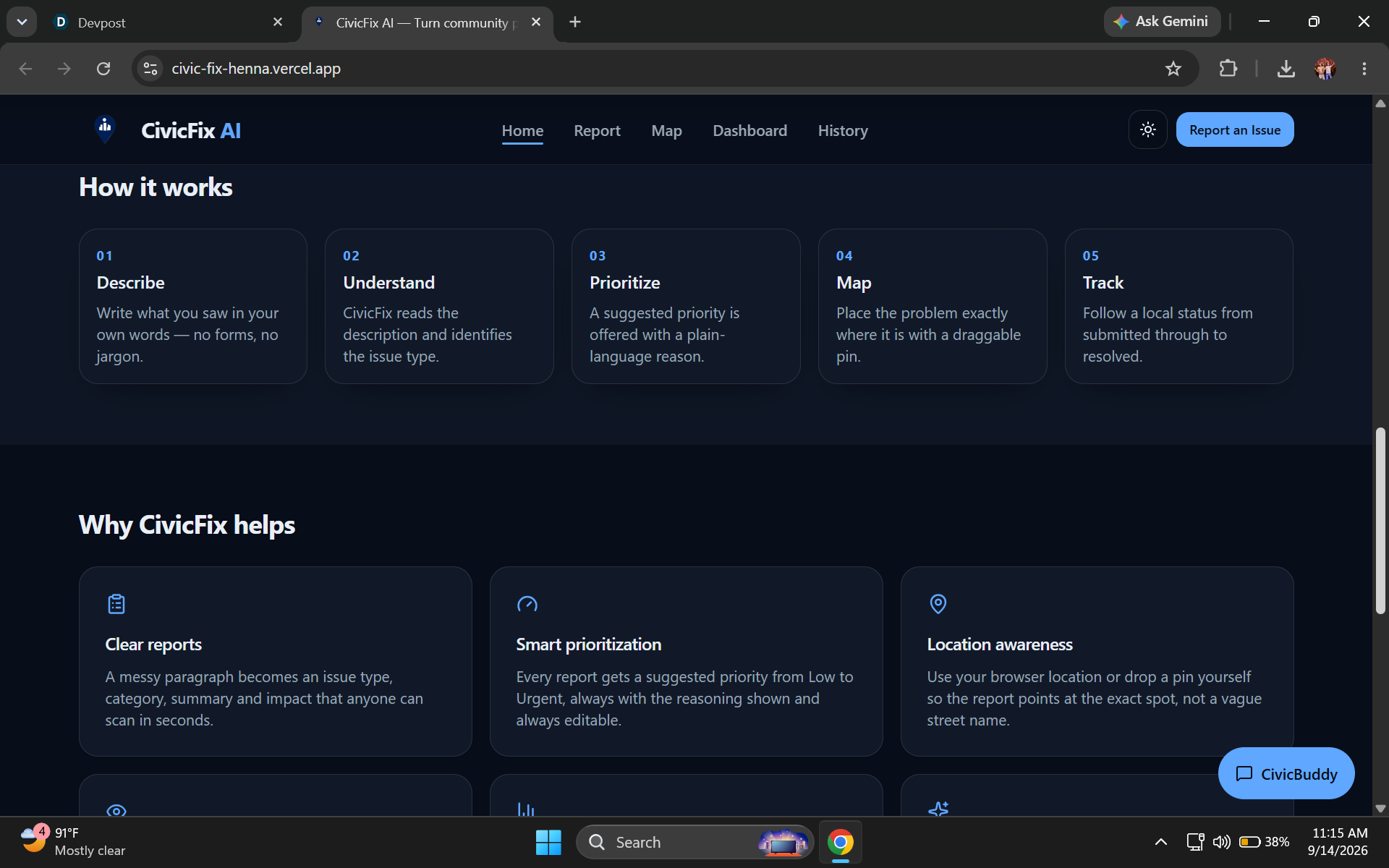
Homepage[Dark Mode]
-
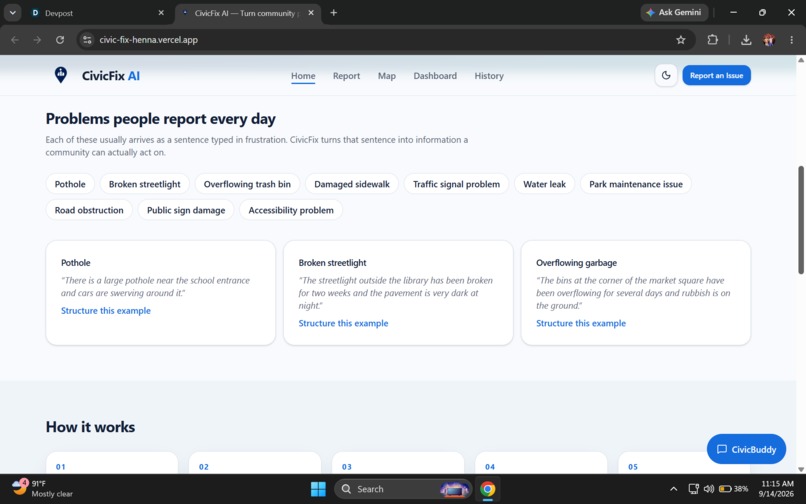
Overview
-
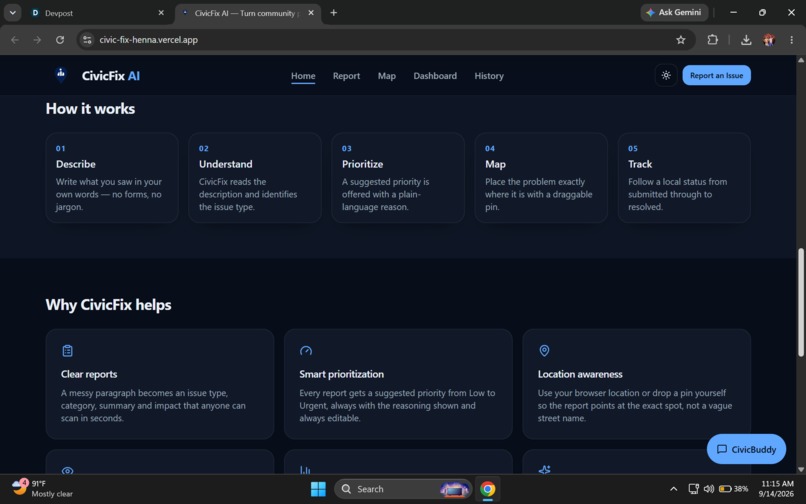
General Info
-
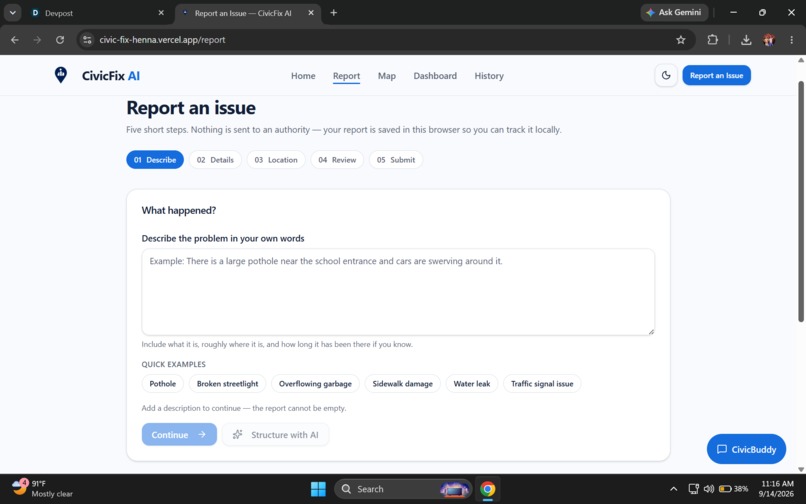
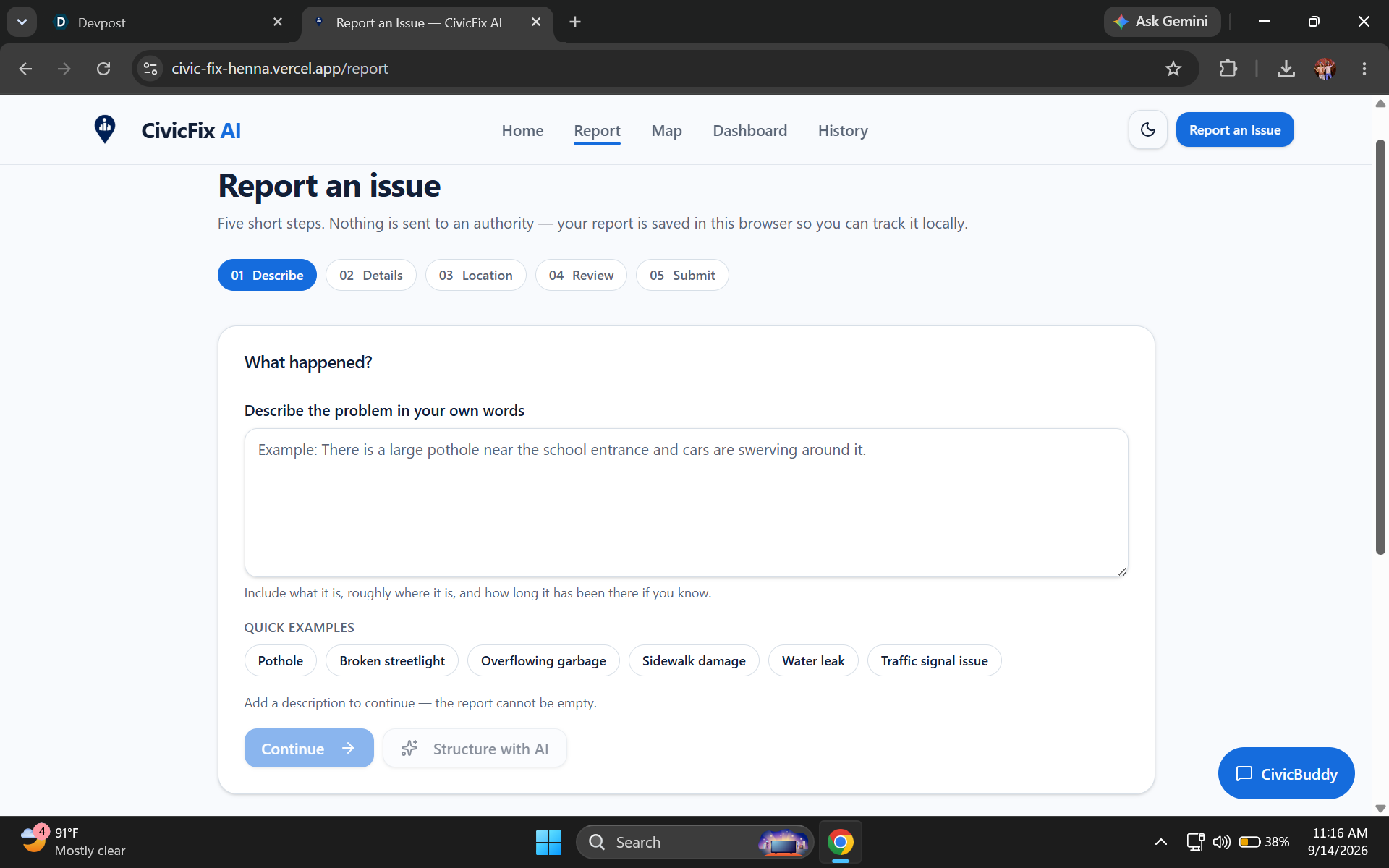
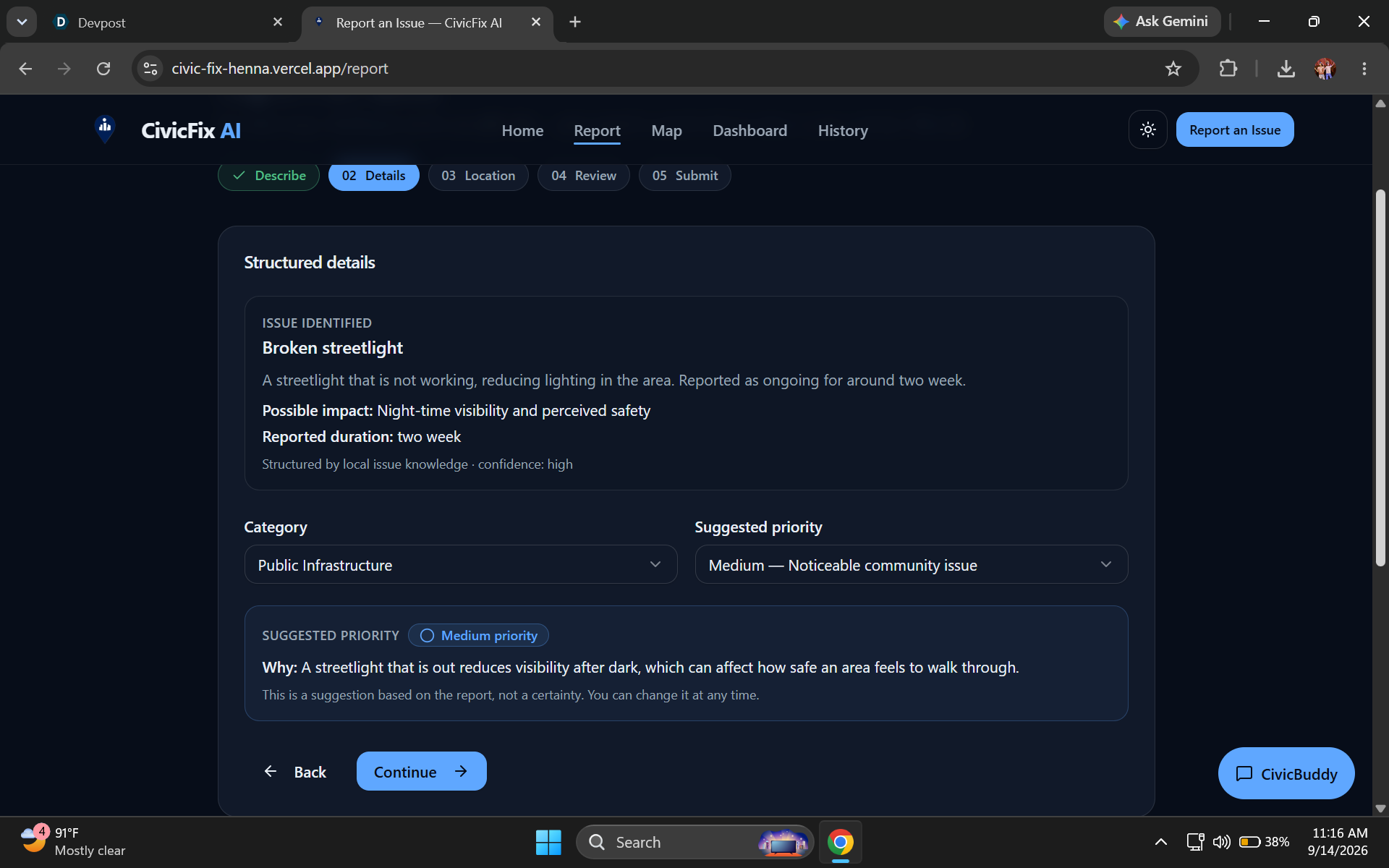
Report Page --Step_1
-
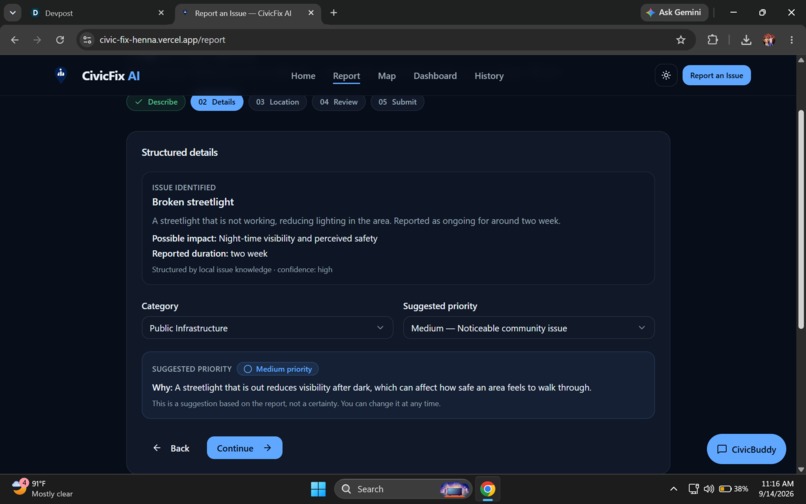
Report Page--step_2
-
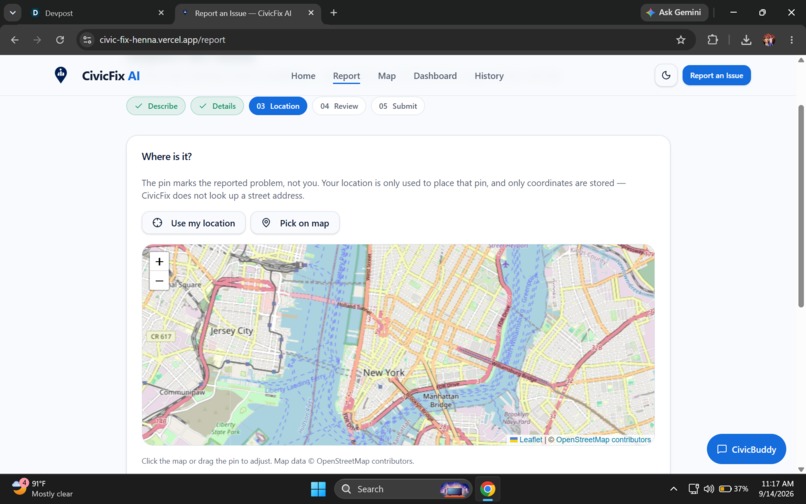
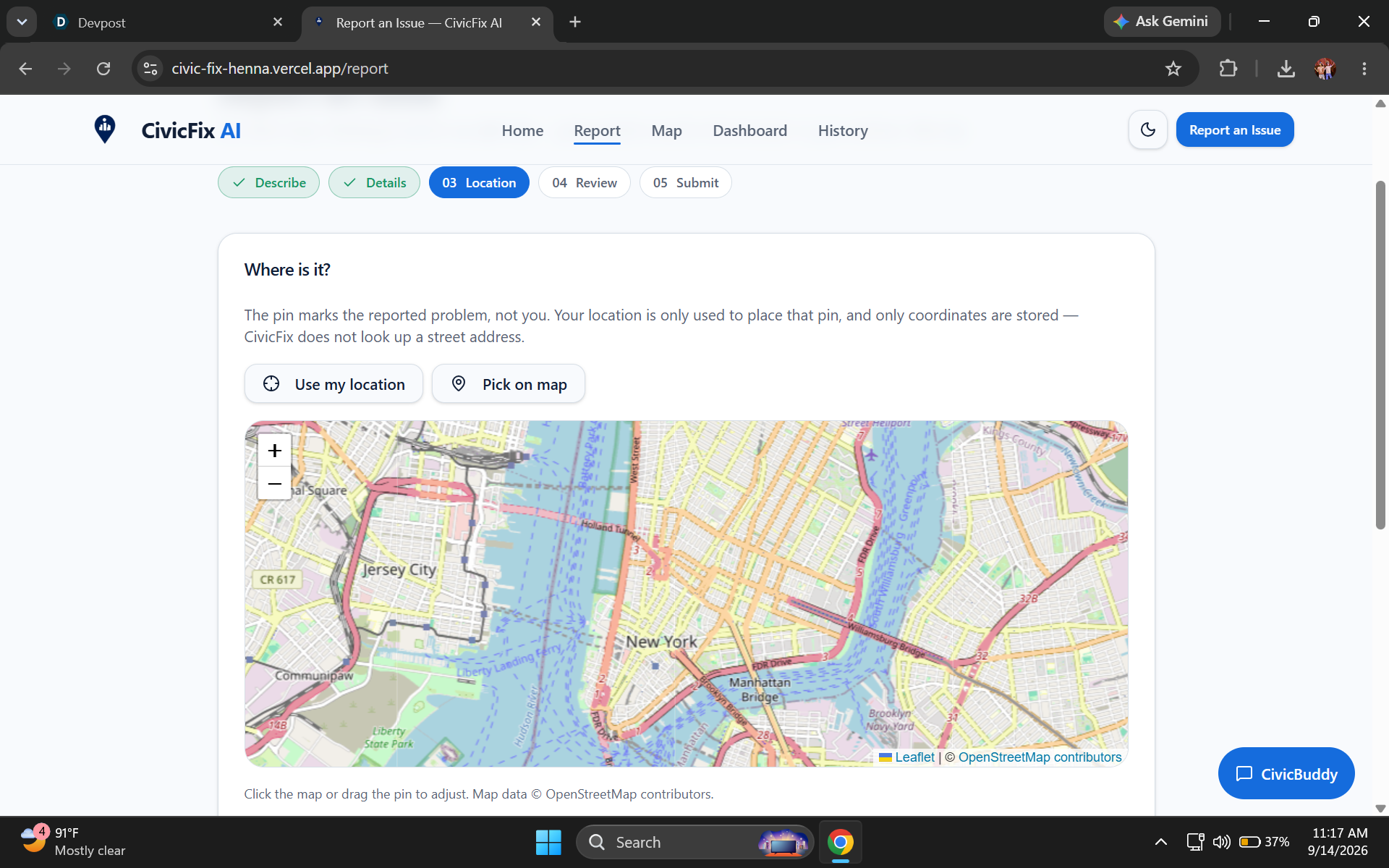
Report Page--step_3[Choose Location]
-
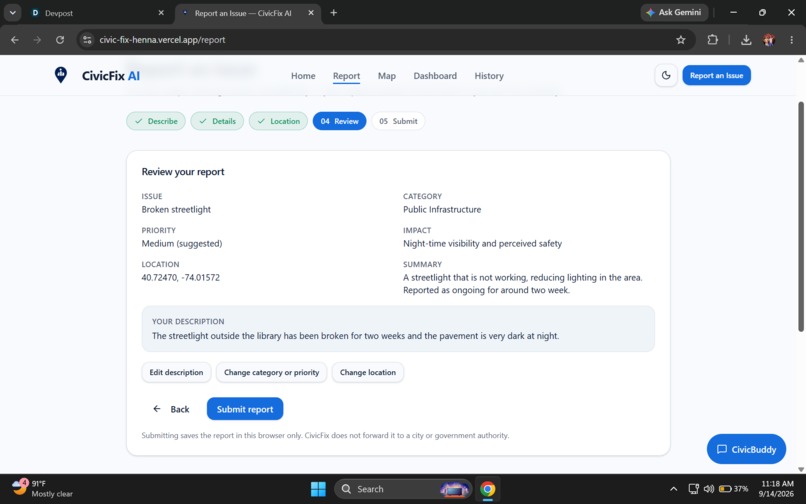
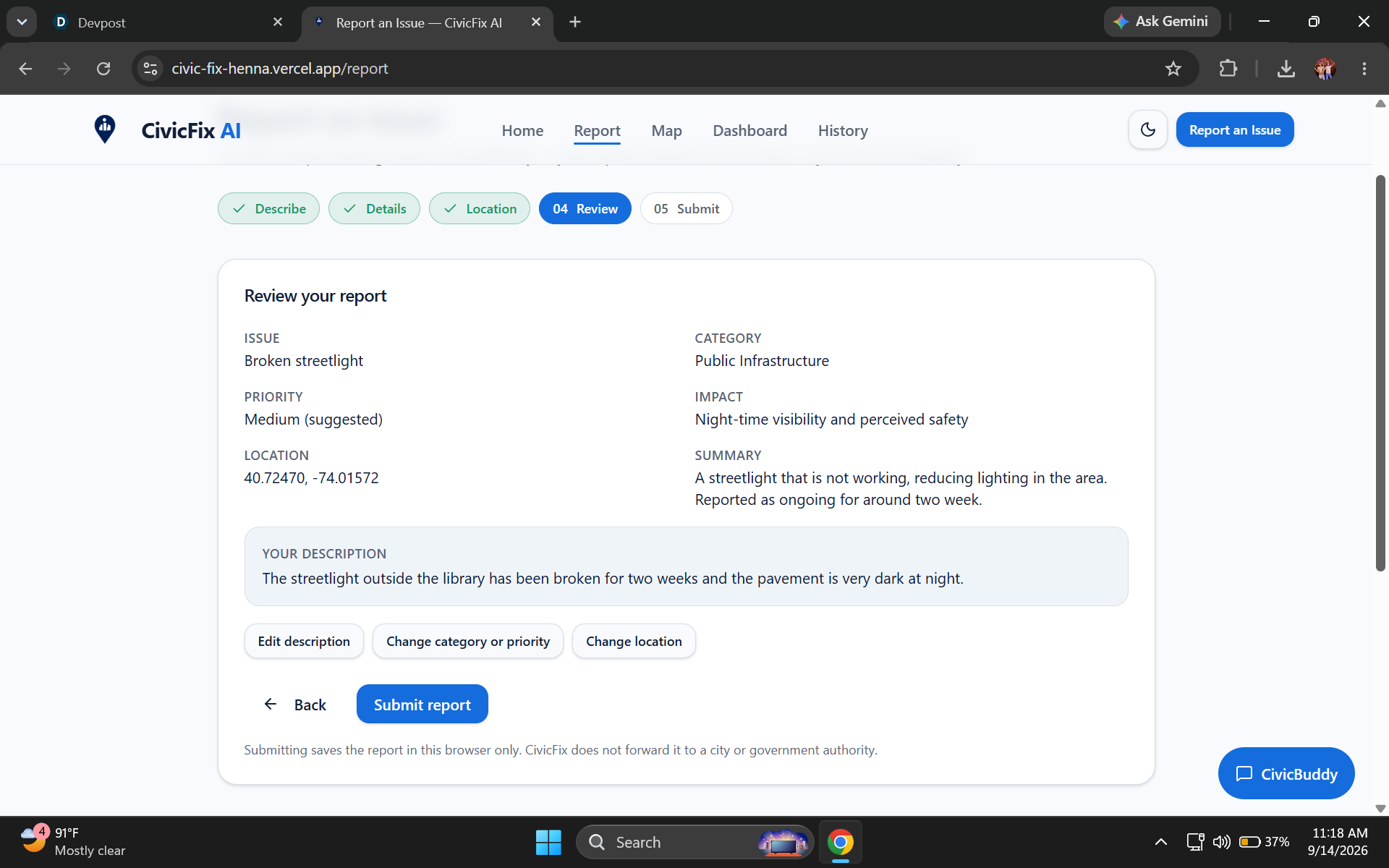
Report Page--step_4[Preview]
-
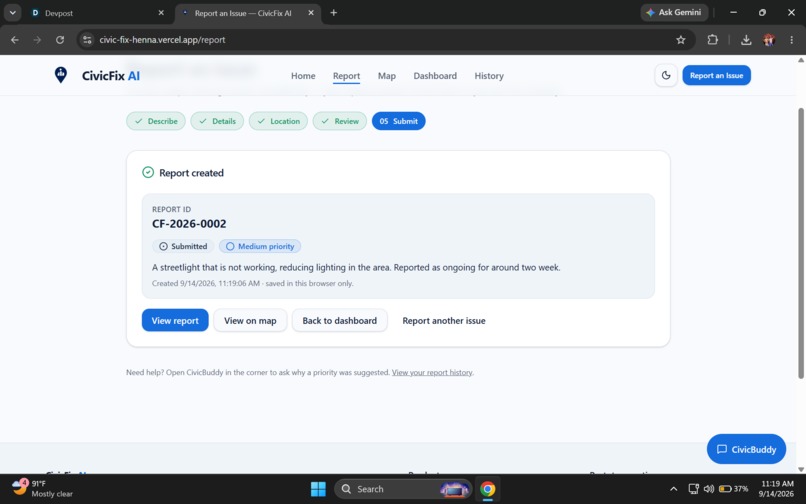
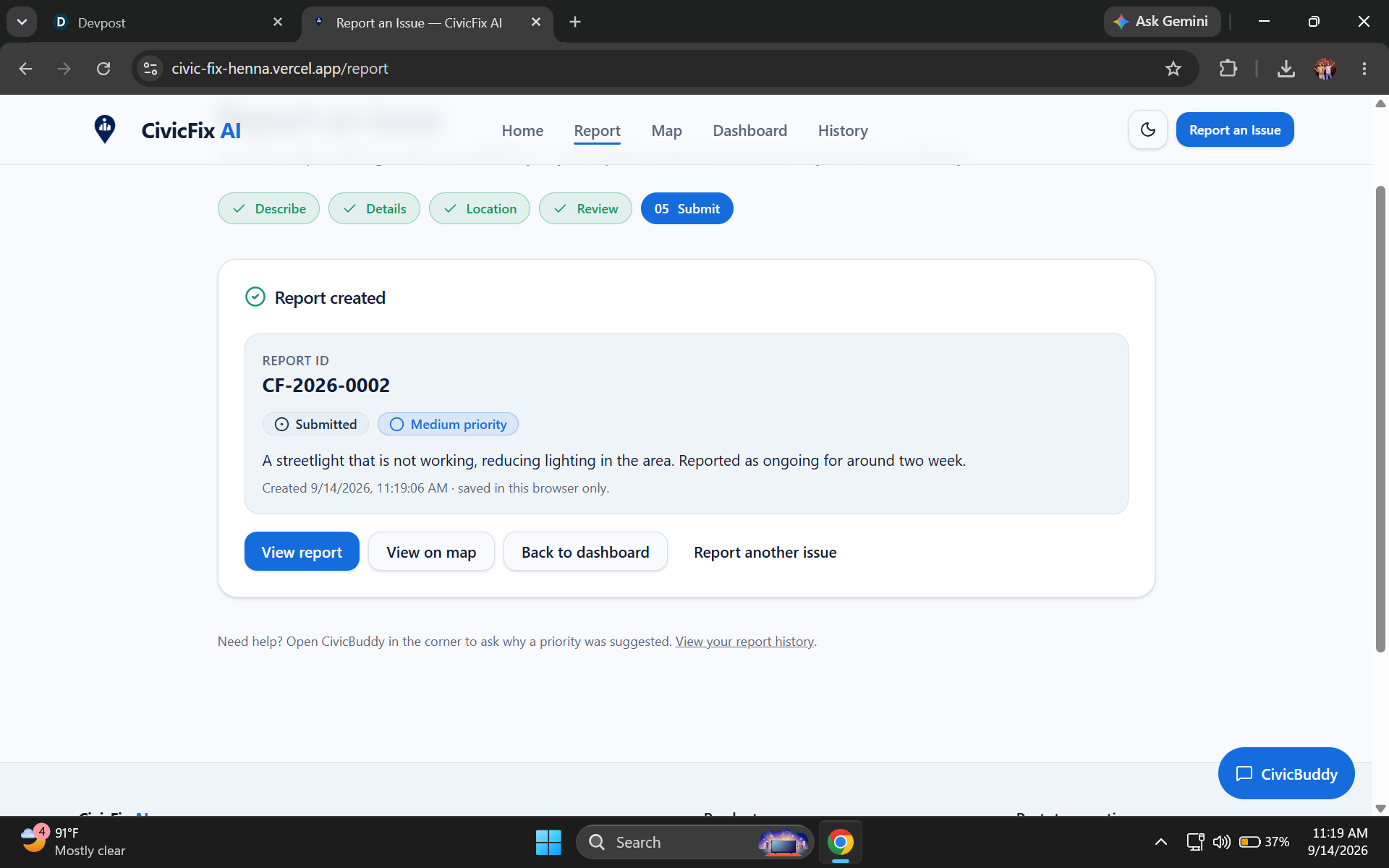
Report Page--step_5[Submit]
-
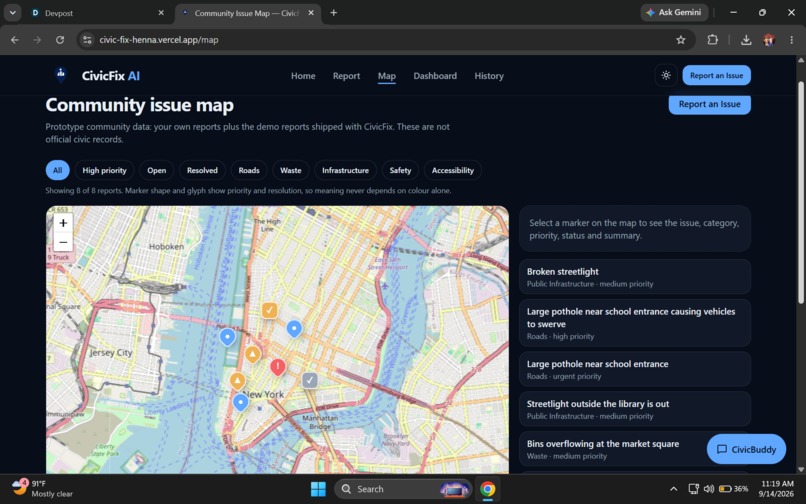
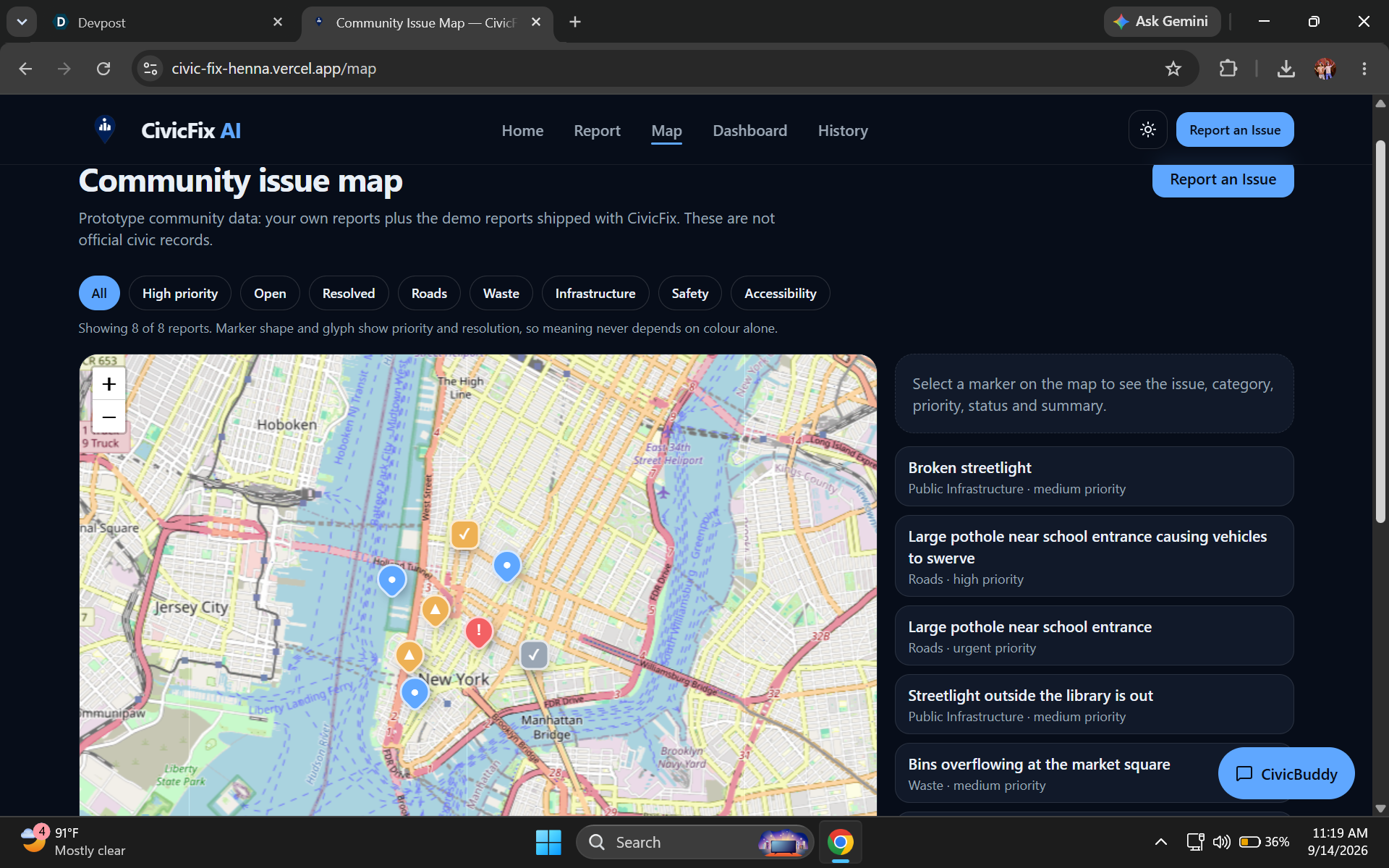
Map Page
-
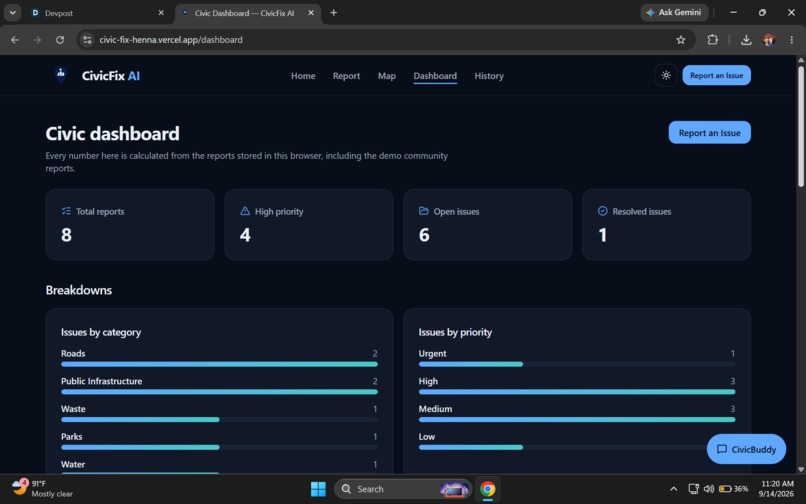
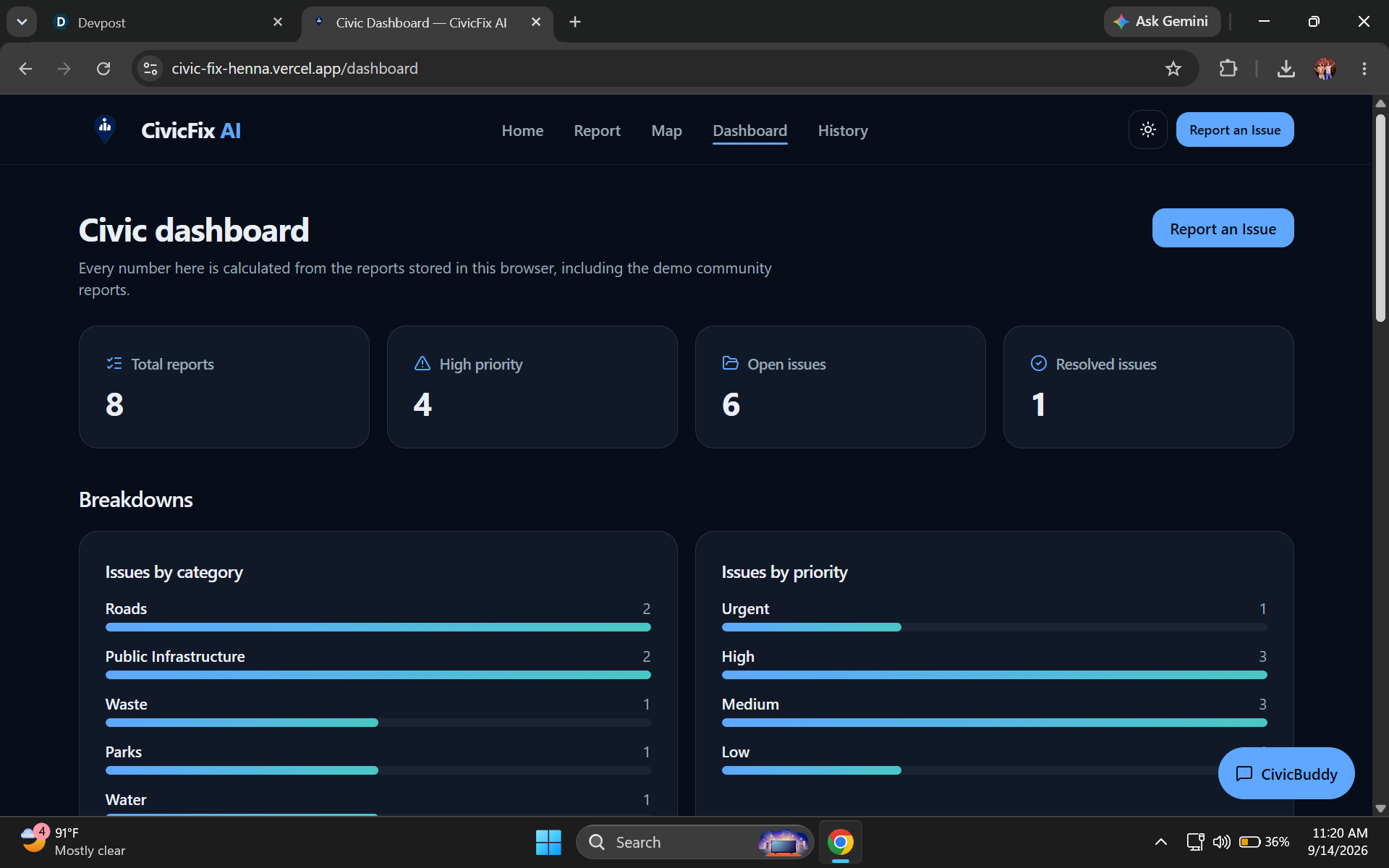
Dashboard
-
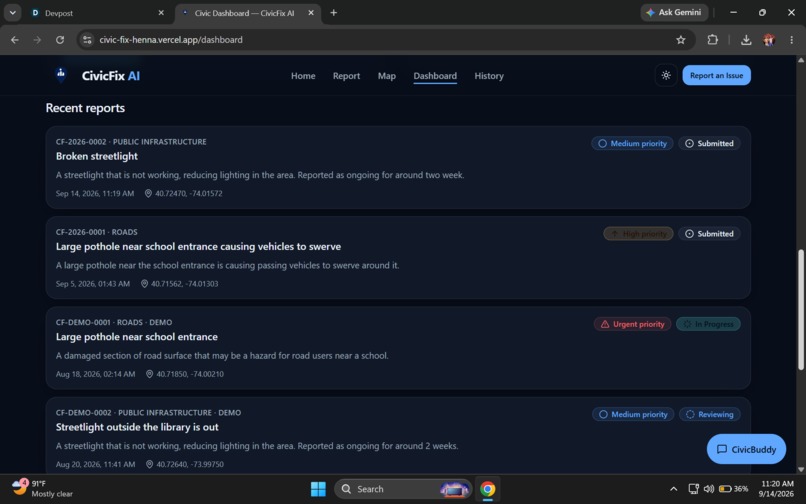
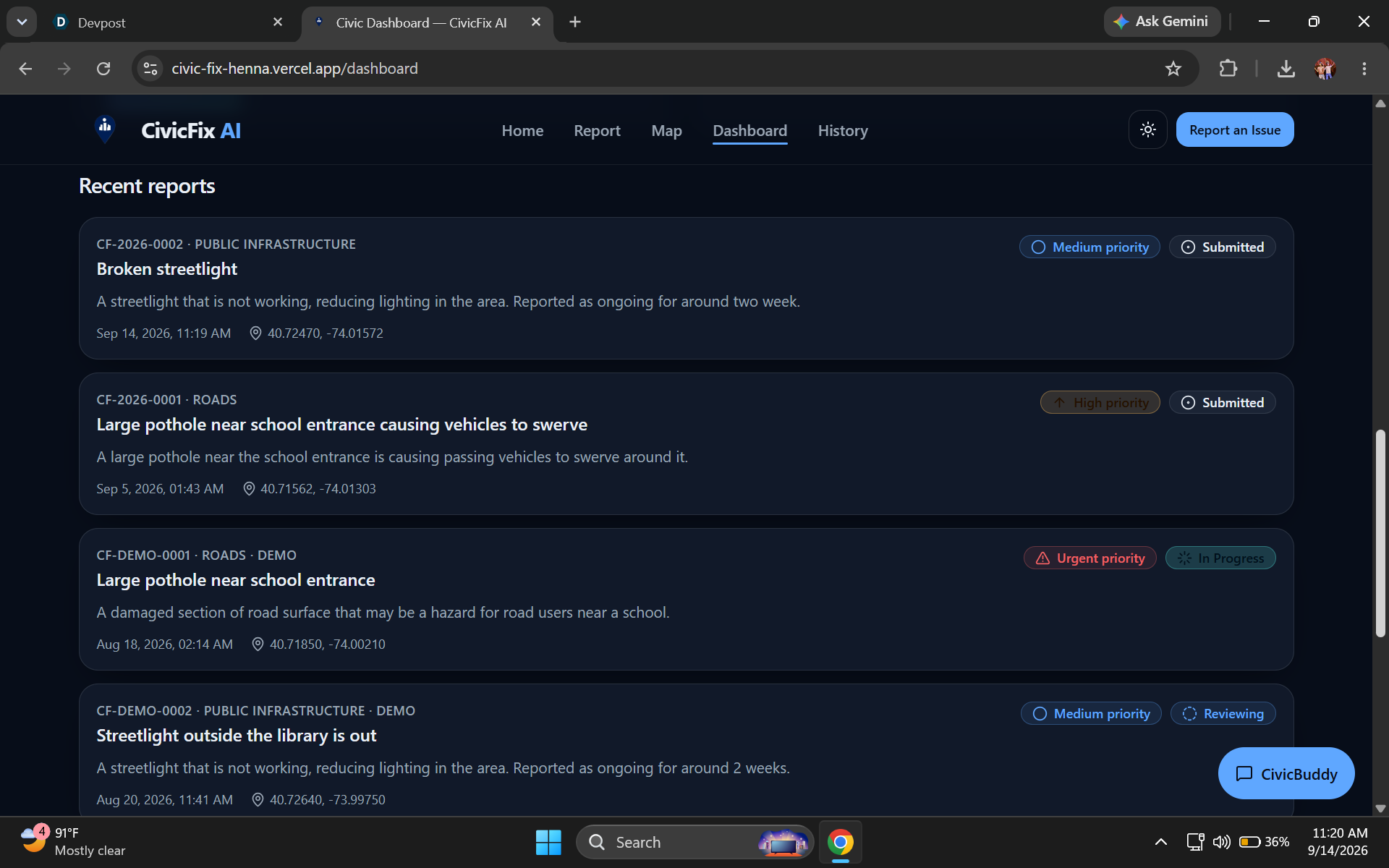
Recent Reports
-
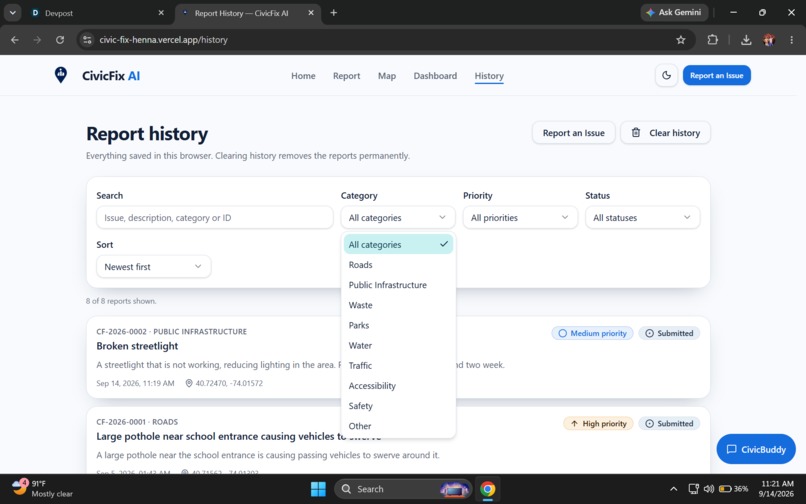
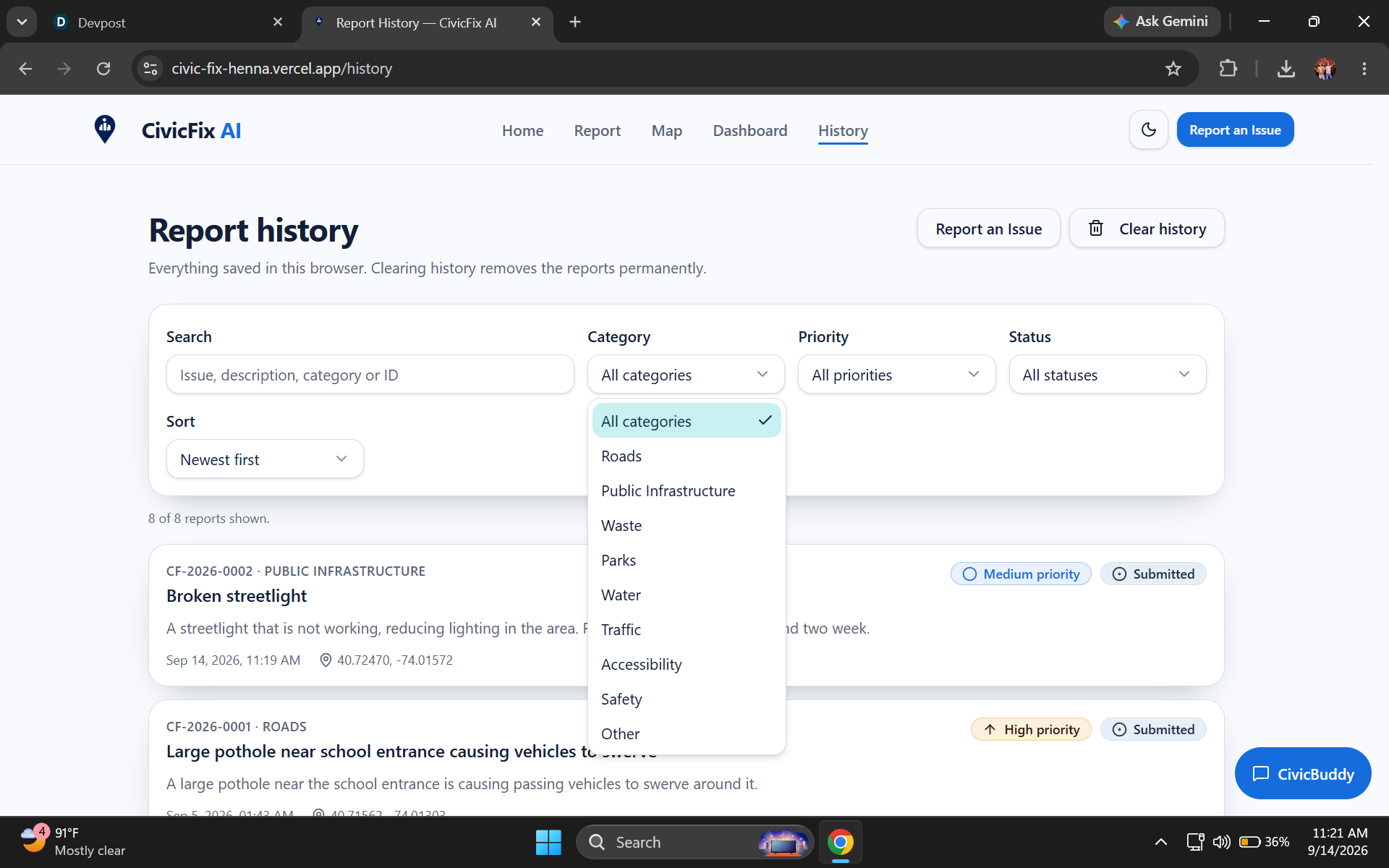
History Page
-
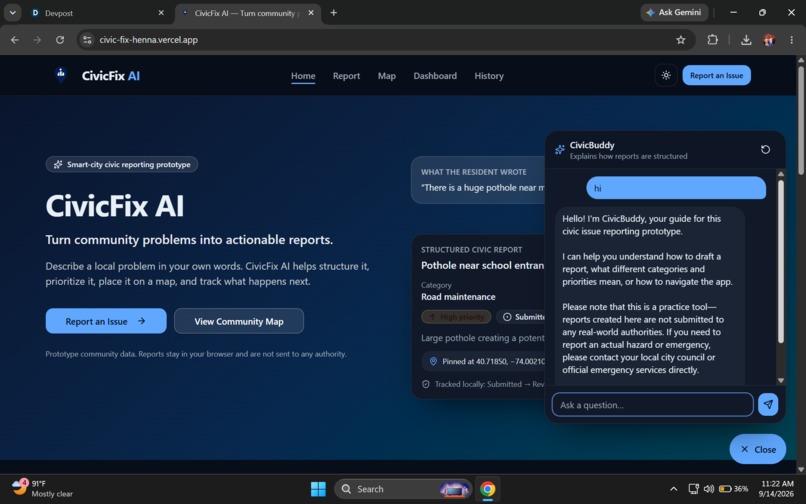
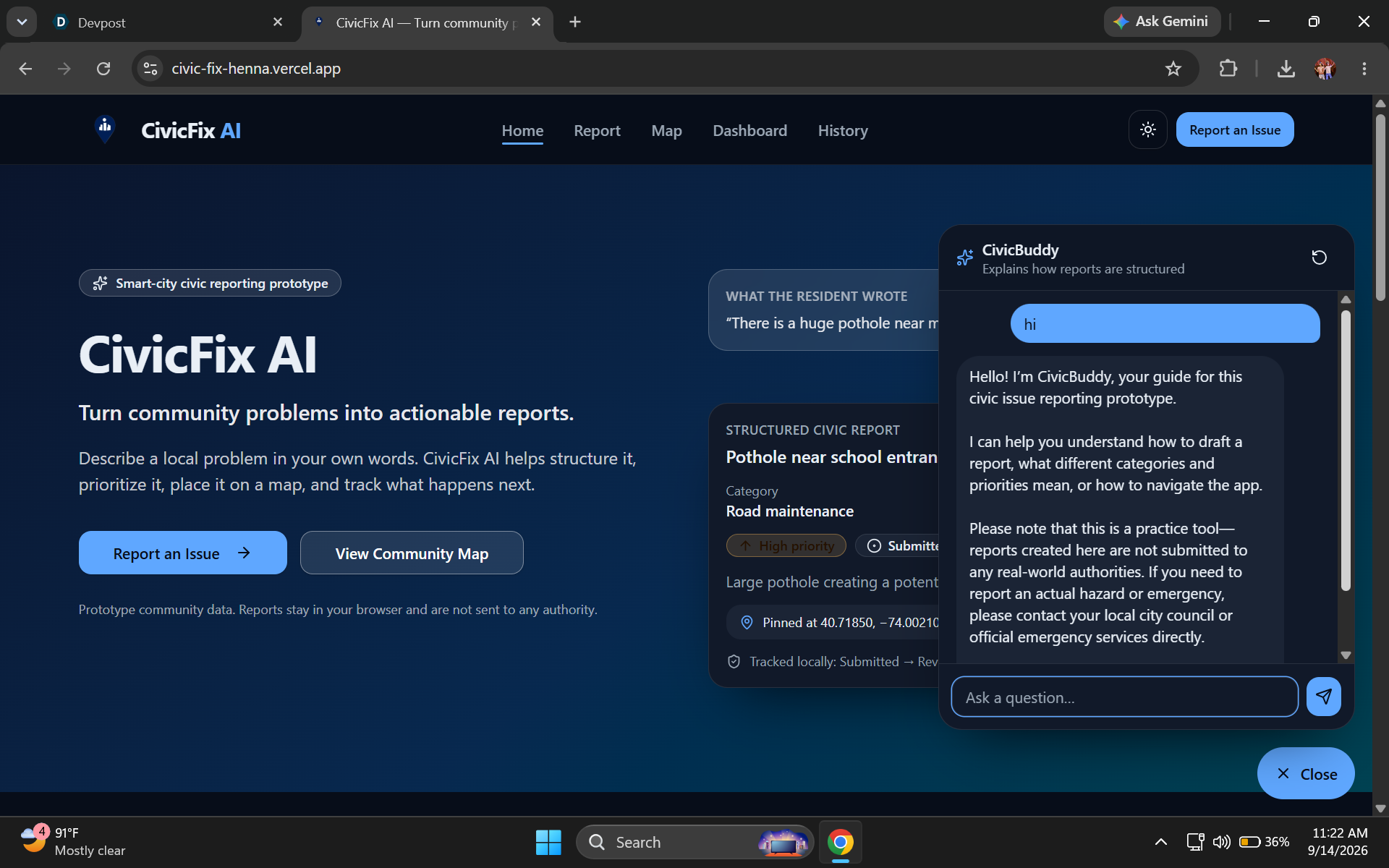
CivicBuddy - CivicFix AI
-
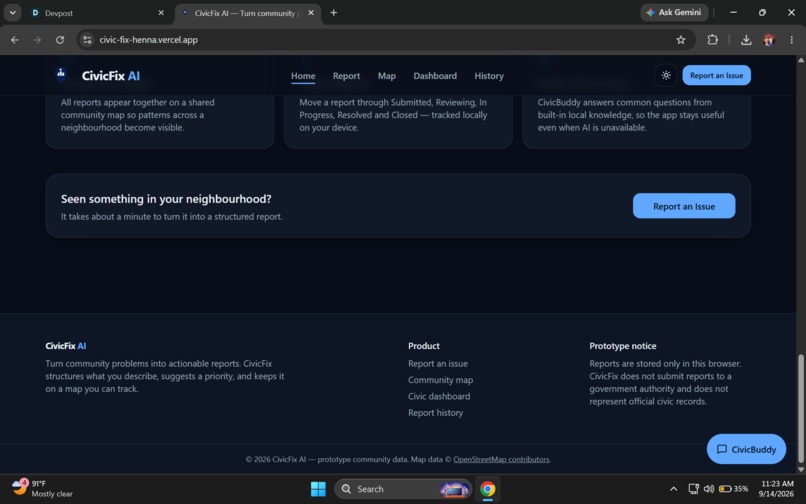
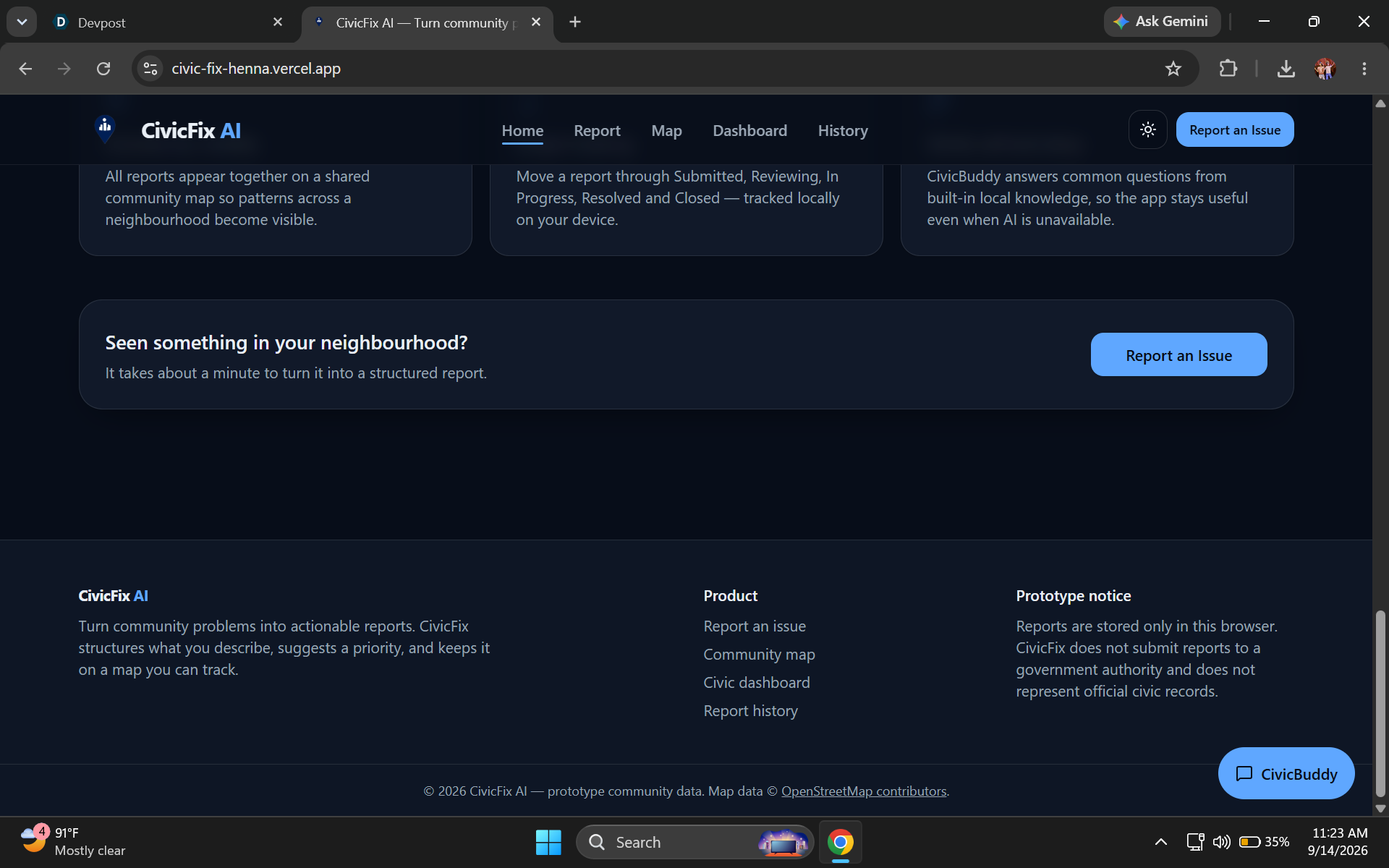
Footer
Inspiration
CivicFix AI was inspired by a simple problem: people notice problems in their communities every day, but turning those observations into clear, structured, trackable civic reports can be difficult. We wanted to create a practical technology solution that makes the process simpler for everyday users.
What It Does
CivicFix AI allows users to report community issues such as potholes, broken streetlights, overflowing garbage, water leaks, damaged sidewalks, traffic signal problems, obstructions, signage issues, and accessibility concerns.
The platform guides users through:
Describe → Add Details → Add Location → Review → Submit → Track
Users can provide their location through browser geolocation or manually place it on an interactive map. Reports are structured with useful information such as category, priority, duration, confidence, and status.
CivicFix AI also provides:
- Guided civic issue reporting
- AI-assisted report structuring
- Interactive location-based mapping
- Priority and category classification
- Civic analytics and charts
- Search, filtering, and sorting
- Report history and tracking
- Local browser persistence
- A built-in civic assistant
The result is a complete workflow that turns an everyday observation into a structured, location-aware civic report.
How We Built It
CivicFix AI is a responsive web application built with React, TypeScript, Vite, Tailwind CSS, Leaflet, OpenStreetMap, Recharts, Zod, Browser Geolocation, LocalStorage, and the Gemini API.
The application uses a local-first architecture so the core reporting workflow remains functional without depending entirely on an external AI service. Common issues can be handled using local civic knowledge and deterministic logic, while AI assistance can be explicitly used for ambiguous or custom reports.
The system separates the reporting interface, civic knowledge, AI functionality, mapping, persistence, analytics, and history into clear application components.
Challenges We Ran Into
One of our biggest challenges was designing a reporting workflow that was detailed enough to create useful civic information without overwhelming users. We solved this by dividing the process into simple guided steps.
Another challenge was handling natural-language descriptions. Users may describe the same problem in many different ways, so the platform combines local civic knowledge with optional AI-assisted structuring.
Location was another important challenge because a report is much more useful when its position is clear. CivicFix AI supports both browser geolocation and manual map placement to provide a practical fallback.
We also designed the application so that an unavailable AI service does not prevent users from using the core reporting workflow.
Accomplishments We're Proud Of
We are proud that CivicFix AI goes beyond being a simple complaint form.
It combines:
Guided Reporting + AI Assistance + Location + Mapping + Prioritization + Analytics + History + Tracking
into one connected civic experience.
We built the complete journey from describing a problem to submitting and reviewing a structured report. The dashboard and interactive map then turn individual reports into information that is easier to understand at a community level.
We are also proud of the application's emphasis on usability, accessibility, clear information hierarchy, and graceful handling of AI and storage failures.
What We Learned
CivicFix AI taught us that solving a real-world problem is not simply about adding technology. The technology has to remain understandable and useful to people who may not have technical knowledge.
We learned the importance of:
- Designing around the user's actual task
- Breaking complex workflows into simple steps
- Separating deterministic logic from AI assistance
- Providing fallbacks when external services are unavailable
- Turning collected data into meaningful visual information
- Keeping privacy and security in mind from the beginning
We also learned that AI is most valuable when it solves a specific problem rather than being added simply for the sake of using AI.
What's Next for CivicFix AI
Future versions could connect CivicFix AI with municipal service systems, community verification, real-time status updates, notifications, multilingual reporting, duplicate issue detection, richer analytics, and expanded accessibility.
The long-term goal is to make civic participation easier while helping communities organize information about local problems in a clearer and more actionable way.
Overall
CivicFix AI is designed to turn:
“I noticed a problem.”
into:
“Here is a structured, location-aware report that can be understood, prioritized, and tracked.”
The project combines modern web technologies, mapping, analytics, local knowledge, and AI assistance into a practical civic platform focused on making community reporting simpler, clearer, and more actionable.
Built With
- api
- artificial
- browser
- civic
- css
- data
- design
- gemini
- gps
- html
- intelligence
- javascript
- leaflet.js
- localstorage
- openstreetmap
- react
- recharts
- responsive
- tailwind
- typescript
- visualization
- vite
- web
- zod


Log in or sign up for Devpost to join the conversation.