-
-
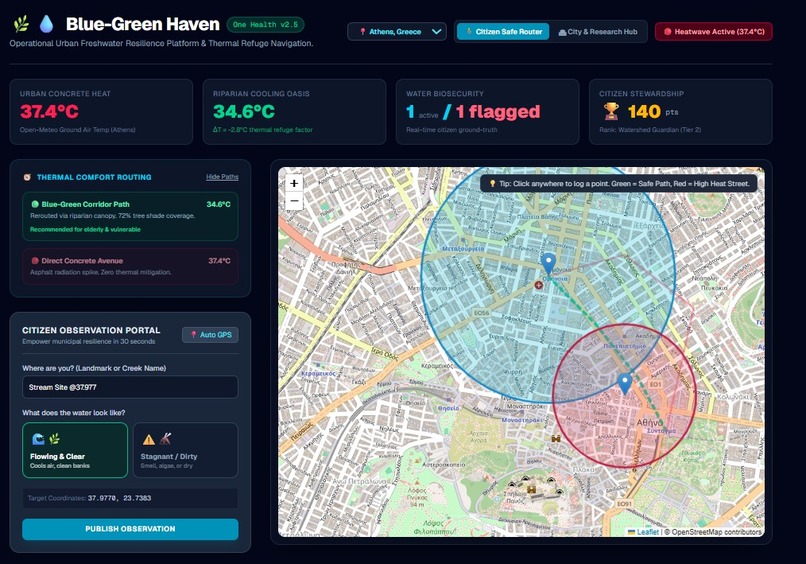
Live Dashboard
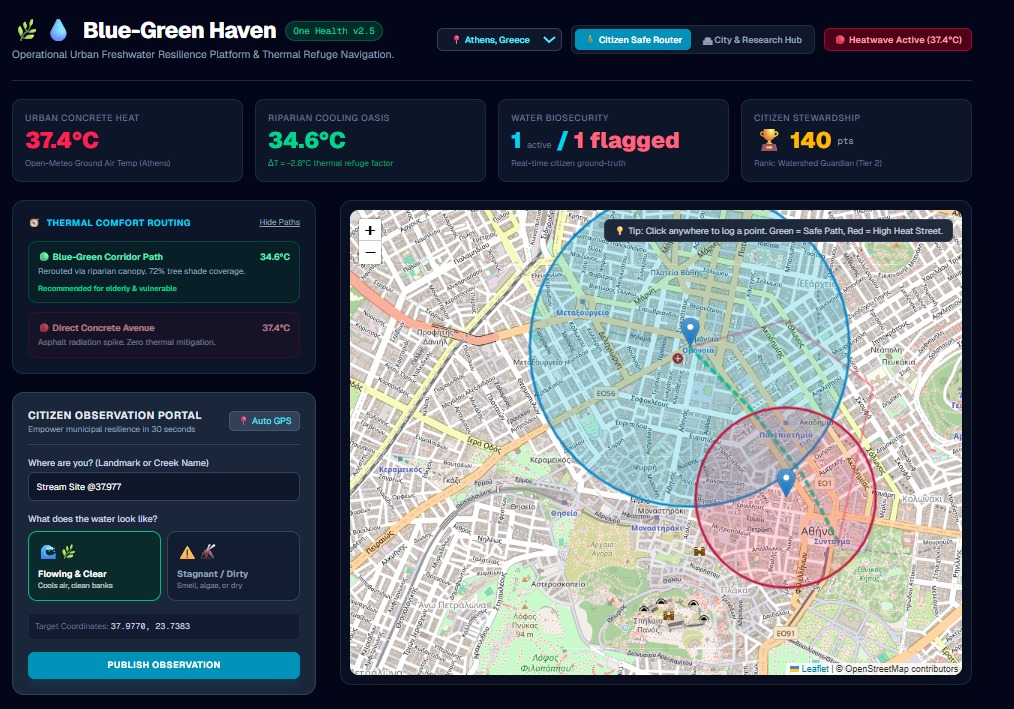
Inspiration: The One Health Imperative
Across European metropolises like Athens, Madrid, and Rome, summer heatwaves have transitioned from seasonal discomfort into acute humanitarian emergencies, claiming over 60,000 lives annually. In dense urban centers, asphalt and concrete trap sensible heat, creating dangerous urban heat islands that disproportionately threaten the elderly, children, and outdoor workers.
Concurrently, cities possess forgotten life-support veins: urban streams, daylighted canals, and riparian corridors. When ecologically intact, healthy riparian corridors provide natural microclimatic thermal attenuation through vegetative shading and continuous evaporative cooling:
$$\Delta T = -2.8^\circ\text{C} \text{ to } -4.2^\circ\text{C}$$
However, when urban waterways suffer from trash blockages, upstream diversions, or stagnation, this cooling buffer collapses. Stagnant pools during 35°C+ heatwaves trigger rapid eutrophication, toxic cyanobacterial aerosolization, and the proliferation of Culex pipiens mosquitoes—the primary European vector for West Nile Virus.
We built Blue-Green Haven to operationalize the One Health paradigm: Human thermal resilience during extreme climate shocks is inextricably linked to the biological integrity of urban freshwater.
What It Does: A Dual-Persona Resilience Platform
Blue-Green Haven connects real-time European meteorological reanalysis, live OpenStreetMap spatial cartography, and frictionless citizen bio-monitoring into an operational resilience dashboard with two synchronized interfaces:
1. Citizen Safe Router & Thermal Refuge Navigation
- Thermal Comfort Routing: Calculates pedestrian routes that divert pedestrians away from high-radiation concrete thoroughfares ($37.4^\circ\text{C}$) and guides them through verified, shaded stream microclimates ($34.6^\circ\text{C}$).
- Frictionless Bio-Indicator Reporting: Non-expert citizens log freshwater health via Auto GPS or one-click map targeting using two intuitive visual states: Flowing & Clear (cooling oasis) vs. Stagnant / Dirty (algal bloom / disease vector risk). No manual coordinates or hydrological jargon required.
- Community Stewardship Gamification: Engages citizens through verifiable stewardship scores and tiers (Watershed Guardian), incentivizing persistent community stewardship.
2. Municipal Civil Defense & Research Hub
- Automated Remediation Workorders: Automatically compiles citizen-flagged degradation reports into structured municipal maintenance dispatches (e.g.,
WO-2026-EU-089: Culvert Eutrophication & Flow Stagnation) for emergency public works intervention. - Biosecurity Hazard Tagging: Automatically revokes cooling buffer zones when stagnation is verified, converting them into epidemiological warning zones for cyanotoxins and mosquito vectors.
- Open Geospatial Interoperability: Provides one-click OGC / GeoJSON data export for seamless ingestion into municipal GIS systems, QGIS, ArcGIS, and the European OneAquaHealth Open Information Hub.
How We Built It
Blue-Green Haven is engineered entirely on open standards, avoiding proprietary database lock-in to ensure rapid continental deployment:
- Frontend & Architecture: Next.js (App Router), React, TypeScript.
- Styling & Scientific UI: Tailwind CSS engineered with high-contrast, accessible dark-mode scientific visualization.
- Geospatial Mapping Engine: Leaflet, React-Leaflet, and GeoJSON layer handling for client-side spatial rendering.
- Live Climate Pipeline: Direct integration with the Open-Meteo European Weather Forecast API, pulling hourly 2-meter air temperature models dynamically without API key latency.
- Waterway Cartography Pipeline: Real-time spatial querying via the OpenStreetMap Overpass API to isolate active waterway and river geometries.
- Multi-City Scalability: Dynamic spatial center-point switching across high-vulnerability Mediterranean capitals (Athens, Madrid, Rome).
Challenges We Faced
- Eliminating Third-Party API Fragility: During live development, external spatial API rate limits occasionally caused payload failures. We architected a resilient server-side fallback pipeline with strict timeout abort signals so that the resilience map never crashes during mission-critical municipal operations.
- Preventing React Hydration Conflicts: Browser extensions injecting third-party attributes into UI elements triggered client-server hydration warnings. We solved this by enforcing client-mount validation and targeted hydration suppression.
- Translating Hydro-Ecological Physics into Plain UX: Complex microclimate models and bioclimatic indices mean nothing to an elderly citizen in heat distress. We abstracted thermal physics into clear visual paths, actionable microclimate metrics ($\Delta T = -2.8^\circ\text{C}$), and immediate binary bio-indicators.
Accomplishments We're Proud Of
- True One Health Coupling: Successfully demonstrated how a citizen tapping "Stagnant / Dirty" on a phone immediately revokes a municipal cooling corridor and alerts civil defense.
- Zero-Friction Ingestion: Built an interface where non-technical users can contribute scientifically valid ground-truth data in under 15 seconds.
- Instant Scalability Across Europe: Proved that open data (Open-Meteo + OSM) allows our engine to scale across European cities without proprietary city-contract bottlenecks.
What We Learned
- Ecosystem monitoring cannot remain an isolated scientific archive—it must be converted into immediate public health protection tools to engage the community.
- Microclimatic riparian cooling is one of the most cost-effective nature-based solutions European cities possess to combat heat morbidity, provided the waterway remains flowing and unchoked.
What's Next for Blue-Green Haven
- Copernicus CLMS Integration: Ingesting high-resolution Sentinel-2 Normalized Difference Vegetation Index (NDVI) layers to automate riparian canopy density scoring.
- IoT Sensor Telemetry: Pairing citizen observations with low-cost LoRaWAN dissolved oxygen (DO) and temperature sensors along urban culverts.
- Wearable Health Integration: Push alerts to wearable devices for outdoor workers entering unmitigated urban heat pockets.
Built With
- environmental-informatics
- geojson
- gis
- leaflet.js
- next.js
- one-health
- open-meteo
- openstreetmap
- overpass-api
- react
- react-leaflet
- resilience-informatics
- tailwindcss
- typescript


Log in or sign up for Devpost to join the conversation.