-
-

Thumbnail
-
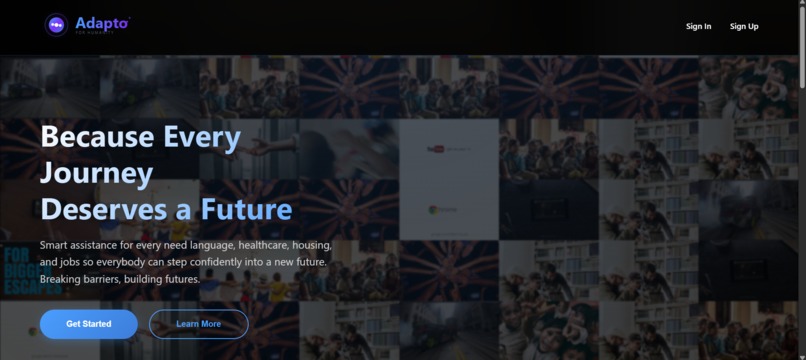
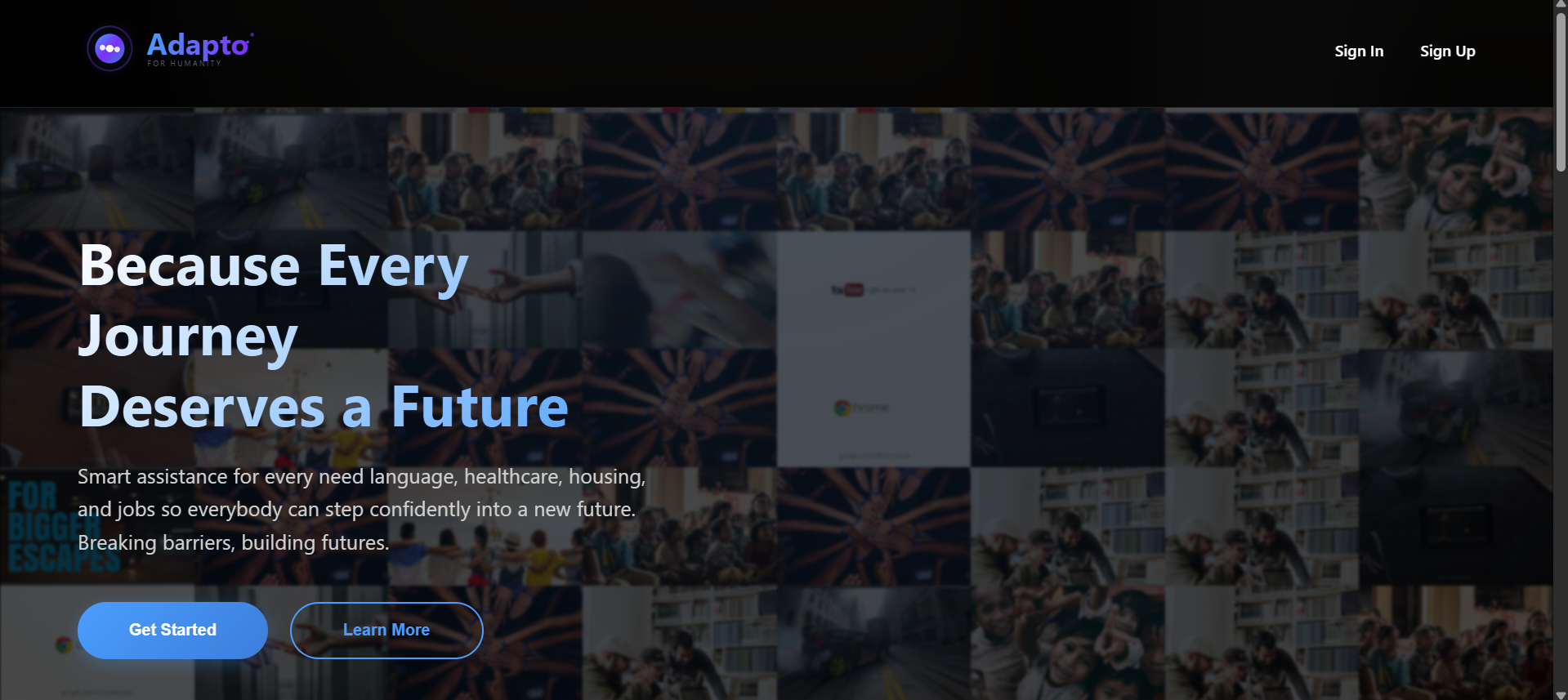
Landing Page
-
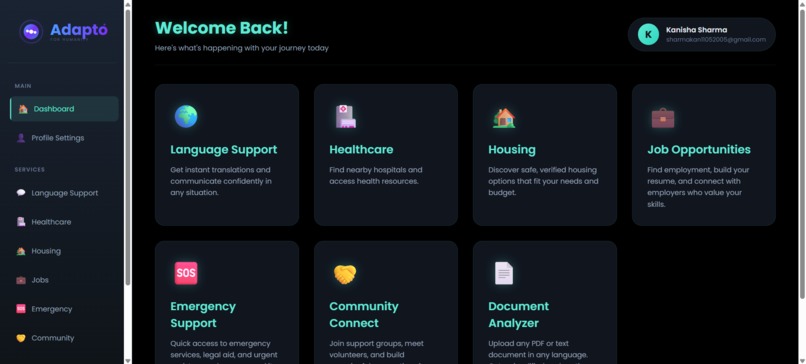
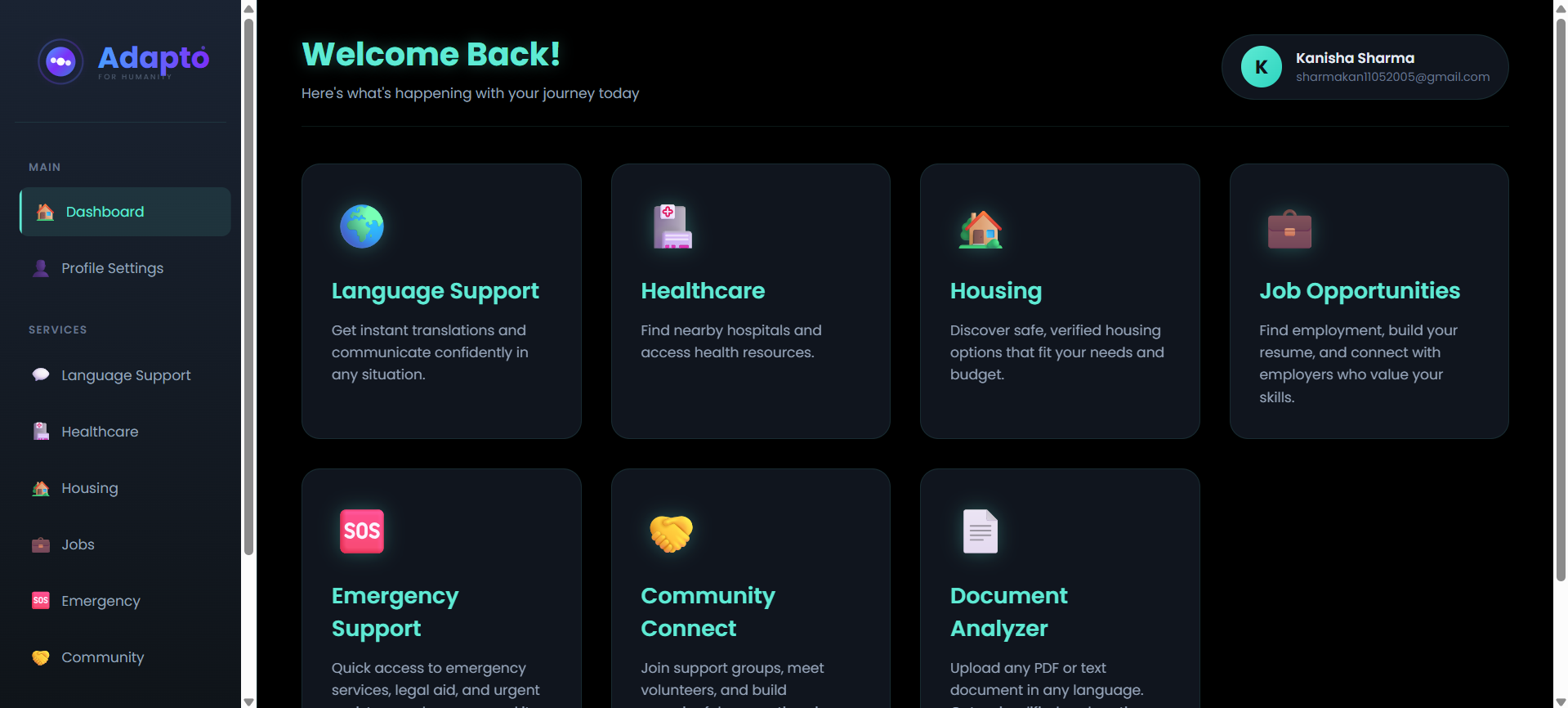
HomePage

Inspiration
Every day, millions of people are displaced, traveling in unfamiliar places, or facing emergencies without immediate access to help. Migrants struggle with language barriers, disaster survivors cannot quickly find shelter, and travelers often lack access to local healthcare information when they need it most.
While technology is advanced, essential support remains fragmented across multiple applications. In critical moments, people don't have time to search through different platforms — they need one intelligent system that adapts instantly to their situation.
Adapto was inspired by the belief that technology should prioritize humanity, accessibility, and real-world survival needs. Our goal was to build a single platform that empowers people to stay safe, understand their surroundings, and access help instantly — regardless of language, literacy level, or location.
What it does
Adapto is a human-first humanitarian platform designed to help individuals navigate emergencies, disasters, migration, and unfamiliar environments using intelligent and accessible tools in one unified ecosystem.
The platform provides real-time language and voice support to remove communication barriers and help users interact in new environments. It includes a healthcare finder that allows users to locate nearby hospitals, clinics, and pharmacies through interactive maps.
Adapto also offers a community-driven housing and shelter system where individuals can post or find temporary accommodation during crises or relocation. A peer-to-peer community support network connects people who need help with volunteers and nearby support providers.
For critical situations, the emergency SOS system allows users to send live location alerts to trusted contacts with a single tap. Additionally, the AI-powered document analyzer simplifies complex legal, medical, or immigration documents into understandable explanations in the user's language.
Together, these features create a unified platform that helps users find help, understand their environment, and stay safe in real time.
How we built it
Adapto was built using a modern and accessible technology stack focused on real-world usability and scalability.
The frontend was developed using:
// HTML5, CSS3, and JavaScript
// Mobile-first responsive design
Leaflet.js and OpenStreetMap were integrated to provide interactive maps and location-based services, while OpenRouteService enabled navigation and routing features.
Firebase was used for backend infrastructure, including:
- Authentication for secure user access
- Firestore for real-time database management
- Cloud storage for document and media handling
Google Generative AI was integrated to power the intelligent document analyzer, allowing users to upload complex documents and receive simplified explanations.
The platform was designed as a Progressive Web App (PWA) to ensure lightweight performance, cross-platform accessibility, and future offline capabilities.
Challenges we ran into
One of the biggest challenges was designing a unified platform that integrates multiple critical services without overwhelming users during stressful situations. Creating a clean, accessible interface for multilingual and low-literacy users required extensive design consideration.
Integrating real-time location tracking with privacy-first principles was another major challenge, as emergency features must be fast while also protecting sensitive user data.
We also had to balance advanced AI capabilities with affordability and accessibility, ensuring that the platform remained open-source and usable without expensive dependencies.
Coordinating multiple APIs, ensuring reliable performance, and maintaining a seamless user experience across features required careful system architecture and testing.
Accomplishments that we're proud of
We successfully built a comprehensive humanitarian platform that combines:
- Emergency response
- Language translation
- Healthcare discovery
- Housing support
- AI-powered assistance
- Community-driven help
All in a single ecosystem.
We created an accessible design that supports users across different languages and literacy levels, ensuring inclusivity. The platform emphasizes privacy-first data handling while still enabling powerful real-time features such as live location alerts.
Adapto demonstrates how open-source technology and affordable tools can be used to create scalable humanitarian solutions with real-world impact.
Most importantly, we built a system designed to genuinely help people in vulnerable situations rather than focusing solely on technical complexity.
What we learned
We learned that designing for real-world crises requires empathy, simplicity, and reliability more than just advanced features. Accessibility is not optional — it is essential when building technology for diverse communities.
We also discovered the importance of human-centered design, especially when addressing multilingual environments and emergency use cases. Integrating AI responsibly showed us that technology becomes meaningful when it helps users understand complex situations clearly and quickly.
Finally, we learned how powerful community-driven systems can be in creating resilience and collective support networks.
What's next for Adapto - For Humanity
The next phase of Adapto focuses on expanding accessibility, intelligence, and real-world deployment.
We plan to develop:
✓ Native Android and iOS applications
✓ AI chatbot assistant for real-time guidance
✓ Voice command functionality for hands-free use
✓ Enhanced accessibility features
We aim to introduce full offline capabilities so the platform remains usable in disaster zones and low-connectivity environments. Partnerships with humanitarian organizations and local governments will help integrate official emergency services and expand global reach.
Long term, we envision Adapto becoming a global humanitarian technology ecosystem that ensures anyone, anywhere can access critical support instantly when it matters most.
Built With
- ai
- apis
- app
- authentication
- cloud
- css3
- design
- es6+)
- fetch
- firebase
- firestore
- gemini
- generative
- git
- github
- gps
- html5
- javascript
- leaflet.js
- openrouteservice
- openstreetmap
- output)
- overpass
- progressive
- responsive
- rest
- rules
- security
- speech
- storage
- text-to-speech
- voice
- vscode
- web


Log in or sign up for Devpost to join the conversation.