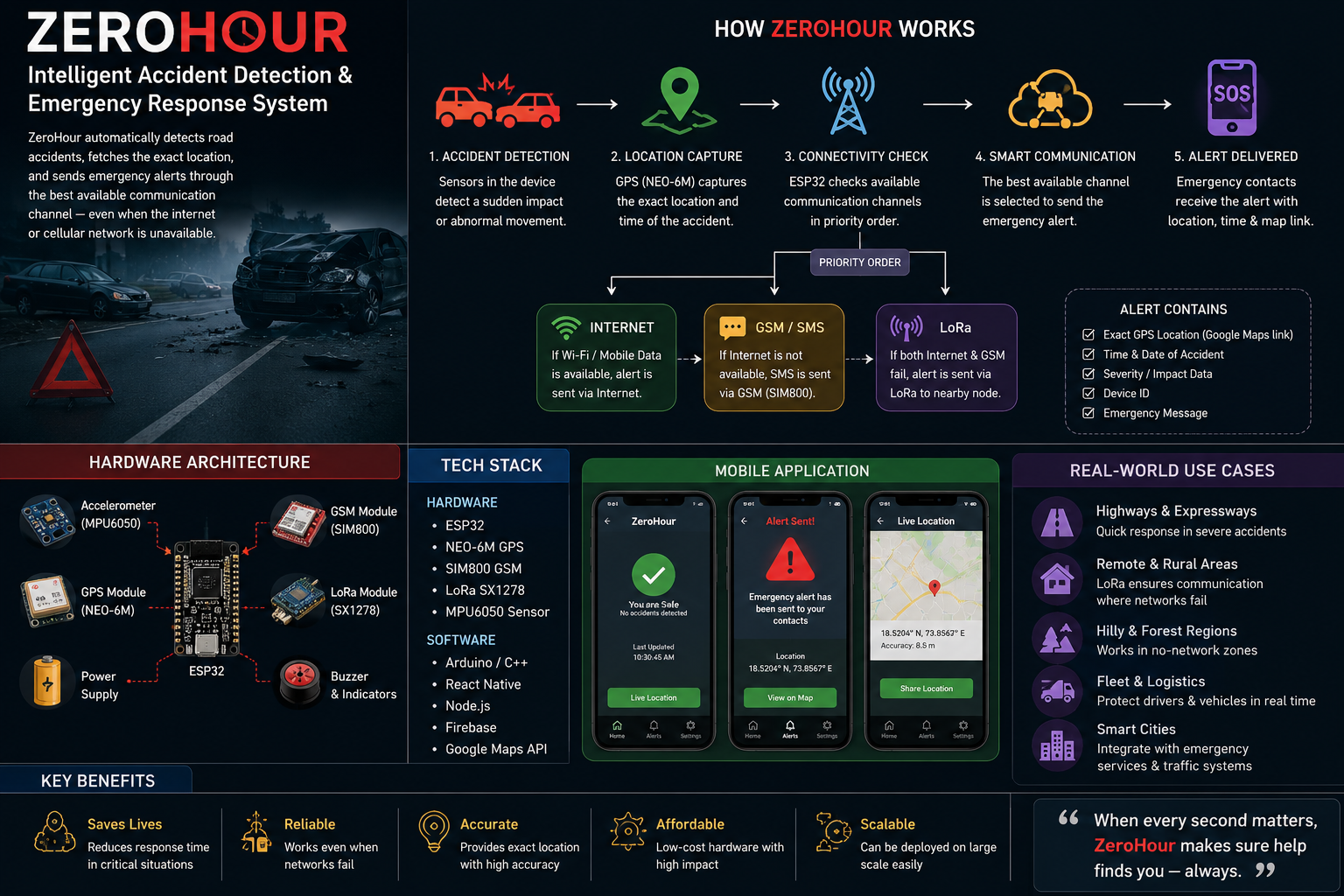
ZeroHour — Intelligent Accident Detection & Emergency Response System Inspiration
In an accident, every second matters—but what happens when the network fails?
Most emergency-response systems depend on internet or cellular connectivity. On highways, rural roads, and remote areas, this can become a critical limitation.
We wanted to solve this gap by creating a system that can detect an accident, locate the victim, and deliver an emergency alert even when conventional connectivity is unavailable.
This idea became ZeroHour—a connectivity-resilient emergency response system designed to reduce the time between accident detection and emergency response.
What it does
ZeroHour automatically detects a potential accident and initiates an emergency-response workflow.
It:
Detects a potential accident using an IoT-based system. Captures the victim's real-time GPS location. Automatically evaluates available communication channels. Sends emergency alerts through the best available channel. Uses Internet, GSM/SMS, and LoRa as complementary communication paths. Shares critical location information with emergency contacts through a mobile application. Our USP: Adaptive Emergency Communication
Instead of relying on a single network, ZeroHour follows a fallback approach:
Internet → GSM/SMS → LoRa
If one communication path becomes unavailable, the system can use another available path.
The emergency message doesn't stop just because the network does.
How we built it
ZeroHour combines IoT, embedded systems, GPS, wireless communication, cloud infrastructure, and mobile technology.
Hardware ESP32 — central controller NEO-6M GPS — real-time location tracking SIM800 — GSM/SMS communication LoRa — long-range communication Software React Native — mobile application Node.js — backend Firebase — real-time cloud infrastructure REST APIs — system communication System Flow Accident Detection ↓ ESP32 Processing ↓ GPS Location ↓ Check Connectivity ↓ ┌──────┼───────┐ ↓ ↓ ↓ Internet GSM LoRa ↓ ↓ ↓ └──────┼───────┘ ↓ Emergency Alert ↓ Emergency Contacts ↓ Faster Response Challenges we ran into
Our biggest challenge was not simply detecting an accident—it was ensuring that the emergency message could still be delivered when the preferred network failed.
We faced challenges with:
GPS signal acquisition and accuracy GSM configuration and SMS delivery LoRa communication and range Switching between communication channels Asynchronous hardware and network events Hardware-software integration Testing different connectivity-failure scenarios
These challenges pushed us to design ZeroHour around redundancy and fault tolerance rather than assuming ideal conditions.
Accomplishments we're proud of
We are proud of transforming a simple accident-detection concept into a complete detect → locate → communicate → respond ecosystem.
Our biggest achievement is the multi-channel communication architecture, bringing together Internet, GSM, and LoRa to create a more resilient emergency-alert mechanism.
We also successfully integrated:
Embedded Hardware + GPS + Wireless Communication + Cloud Backend + Mobile Application
into a single working system.
What we learned
ZeroHour taught us that real-world technology must be designed for failure, uncertainty, and imperfect conditions.
We gained hands-on experience in:
ESP32 and embedded systems GPS-based tracking GSM and LoRa communication IoT architecture React Native development Node.js backend development Firebase integration Hardware-software debugging Fault-tolerant system design
Our biggest takeaway:
Don't build technology assuming everything will work. Build it knowing something eventually won't.
What's next for ZeroHour?
We want to evolve ZeroHour from an accident-alert system into a connected emergency-response ecosystem.
Next Steps AI-powered accident severity detection Automatic classification of minor vs. critical incidents Integration with ambulances, hospitals, and emergency services Real-time emergency dashboards for responders Accident-risk prediction using traffic, road, and weather data LoRa mesh networks for wider coverage in remote areas Integration with connected vehicles and smart-city infrastructure Our Vision
We envision a future where an accident doesn't have to wait for a stable network before help is notified.
A crash is detected. The location is known. The alert finds a route. Help starts moving.
ZeroHour — When every second matters, the message must get through.
