Inspiration
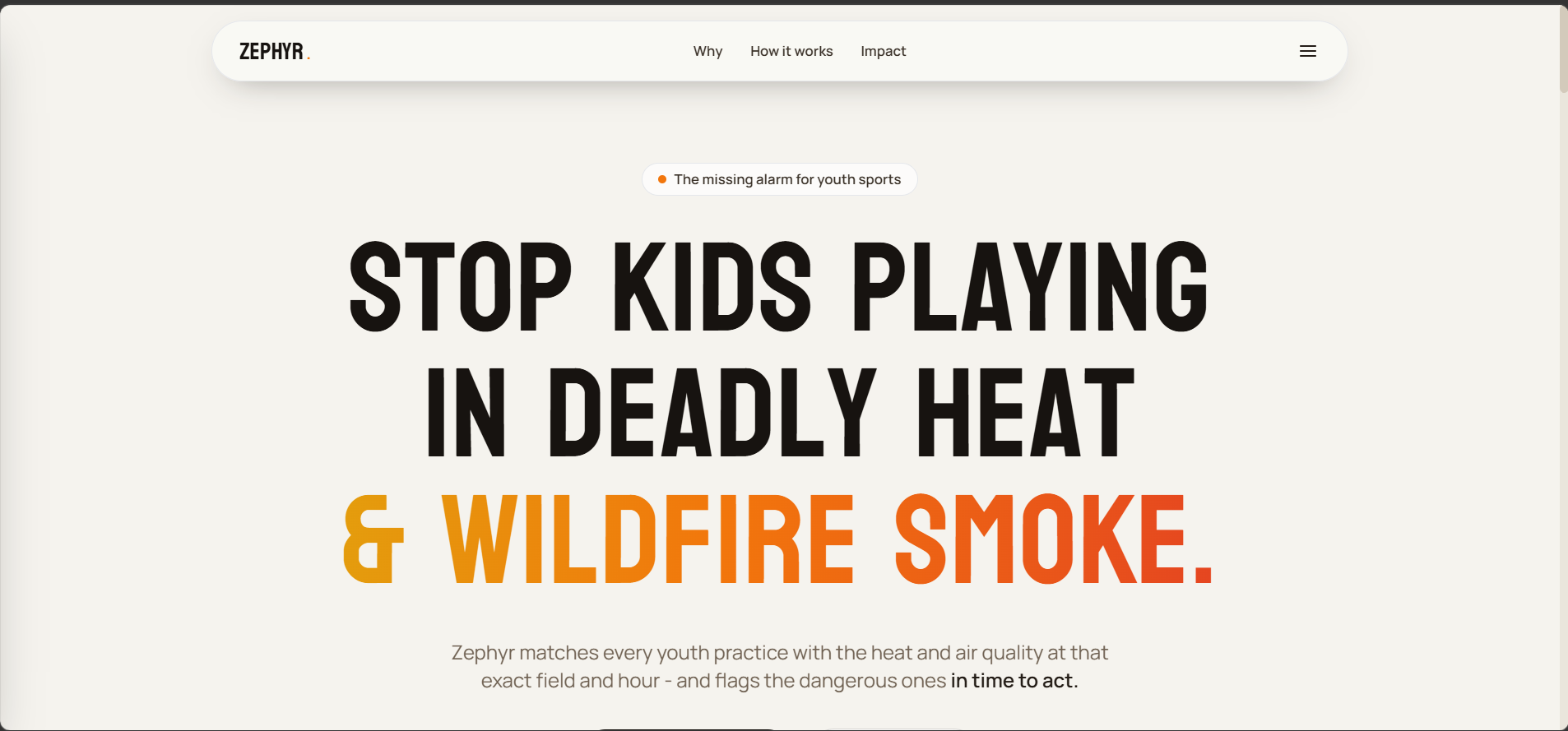
Youth sports are supposed to be safe havens, but two massive, invisible threats are pricing kids out or putting them in danger. First, the safety risk: With climate change accelerating, young athletes are increasingly practicing in dangerously high heat indices and toxic air quality (wildfire smoke), often resulting in preventable heat strokes. Second, the access crisis: Youth sports have become incredibly expensive. While millions of dollars in financial aid, scholarships, and free equipment drives exist, the data is hopelessly fragmented across thousands of messy, local Parks & Rec websites and unsearchable PDFs. We realized that parents and coaches don't have the time to manually cross-reference weather APIs or hunt down hidden grants. We built Zephyr to be the ultimate, automated command center that acts as a protective shield and an access key for youth athletes everywhere.
What it does
Zephyr is a dual-engine platform that safeguards and empowers youth sports communities:
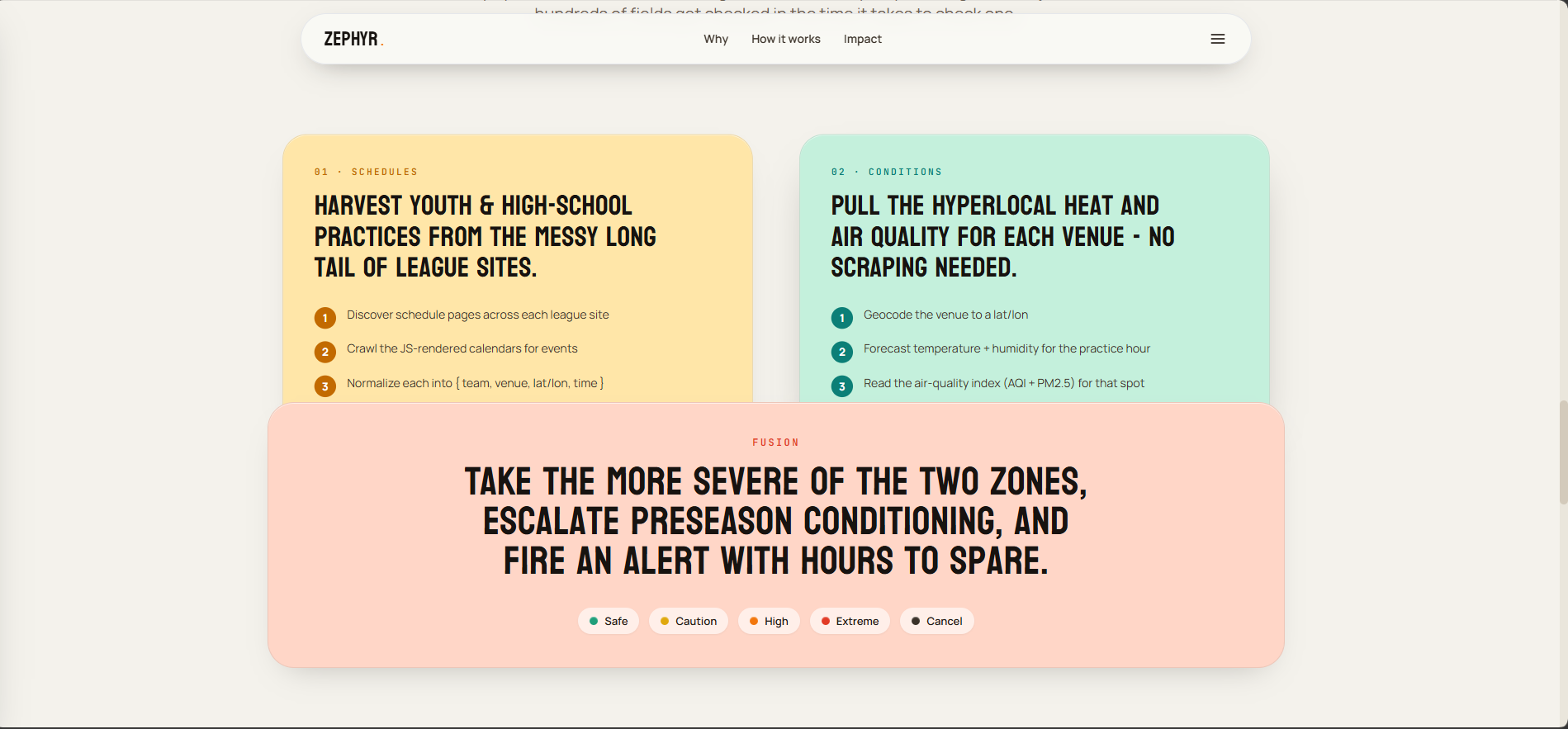
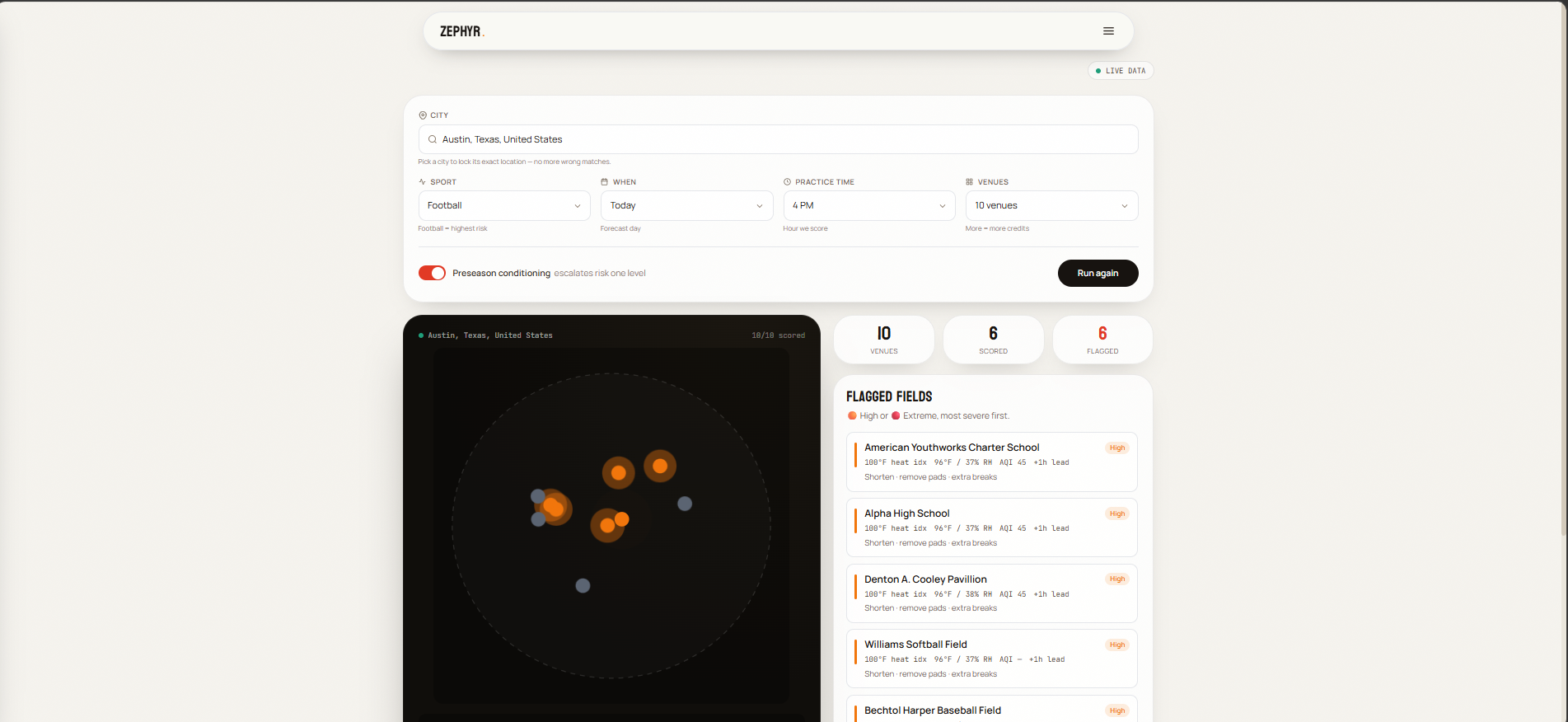
- The Heat Shield: A live danger map that takes a city, sport, and practice time, and dynamically scrapes OpenStreetMap to locate every physical field in the area. It then calculates a fused "Danger Tier" by combining hyperlocal Heat Index and Air Quality data, streaming color-coded warning flags onto a live map so coaches know exactly which fields are unsafe before kids step onto them.
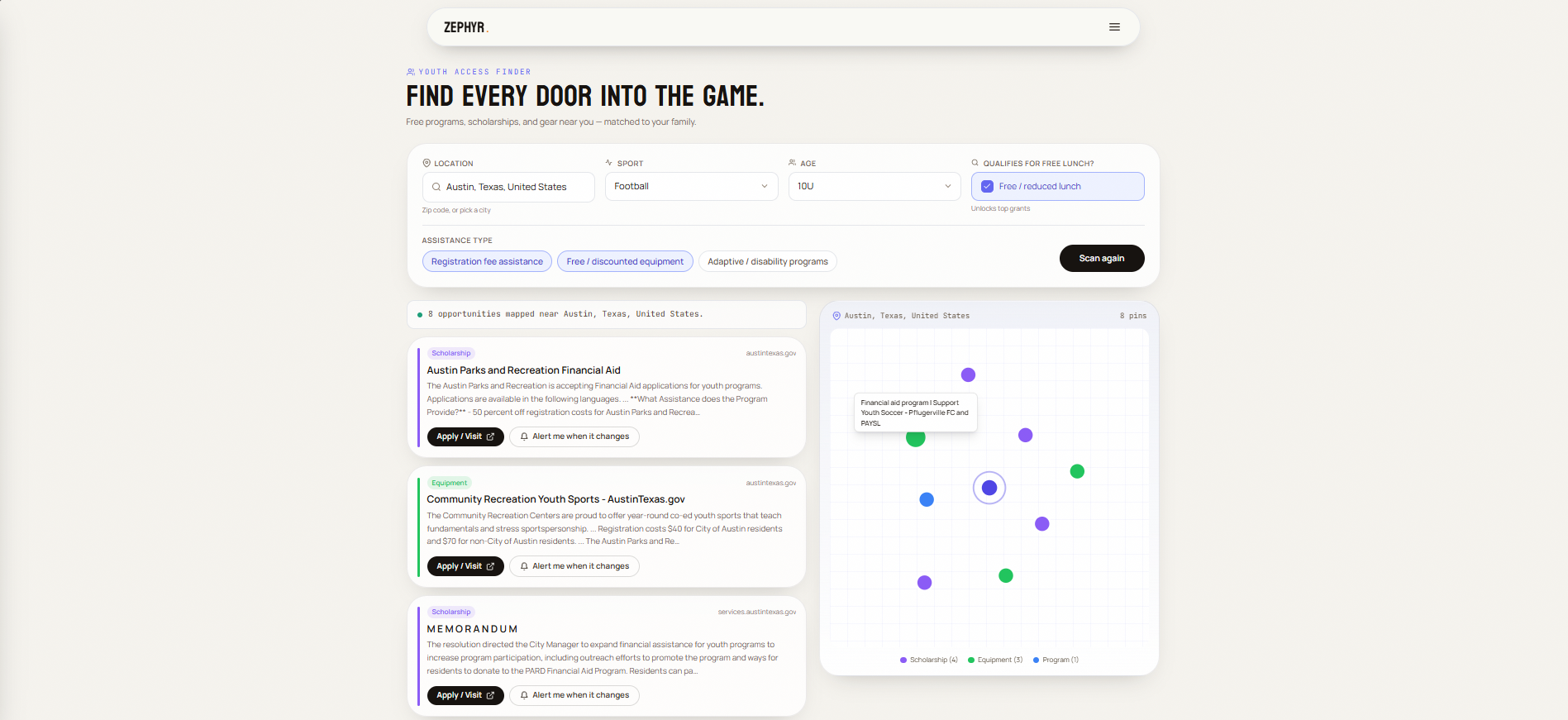
- The Youth Access Finder: An AI-powered swarm that scrapes and organizes fragmented funding opportunities. It instantly matches low-income families to hyper-local registration grants, adaptive sports leagues, and free equipment drives, alerting them the millisecond a new scholarship window opens.
How we built it
We built a lightning-fast, highly responsive frontend using Next.js 14, React, and Tailwind CSS, bringing the command center to life with smooth GSAP micro-animations and a stunning dark-mode UI.
To power the backend "Swarm," we heavily utilized the Anakin AI ecosystem:
- Anakin Search API: Dynamically discovers the thousands of hyper-local club websites and municipal pages that contain hidden financial aid programs.
- Anakin Wire / Universal Scraper: Extracts critical, unstructured data (like income requirements and deadlines) from messy websites and turns it into clean JSON.
- Anakin Wire (Open-Meteo Integration): Fires parallel asynchronous tasks (
om_forecastandom_air_quality) to fetch precise, coordinate-level environmental data for our Risk Engine. - Anakin Monitors: Silently watches closed scholarship URLs 24/7, triggering a webhook the instant the text changes to "Applications Open."
Finally, to ensure the UI feels instantaneous, we piped the Risk Engine's output through Server-Sent Events (SSE), streaming JSON chunks to the client the millisecond a field is scored.
Challenges we ran into
Speed and scale were our biggest hurdles. When a user requests a sweep of a major city like Austin or Dallas, the backend dynamically discovers 50+ individual football or soccer fields. Firing 100+ parallel weather and AQI tasks and waiting for them all to resolve before rendering the map caused massive UX bottlenecks. We solved this by implementing an SSE (Server-Sent Events) pipeline. Instead of blocking the client, we keep a persistent HTTP connection open, scoring fields individually and streaming them down the pipe chunk-by-chunk so the UI populates in real-time.
Accomplishments that we're proud of
We are incredibly proud of the Risk Engine Fusion. We didn't just pull raw temperature numbers; we built a custom algorithm that calculates the true Heat Index (what it actually feels like on the turf) and fuses it with the AQI metric. We then mapped these combined scores against official National Weather Service (NWS) safety bands and even built in an artificial risk-elevation toggle to account for "Preseason conditioning" (unacclimated athletes). It takes raw data and turns it into actionable, life-saving intelligence.
What we learned
We learned the sheer power of treating the internet as a structured database. By orchestrating Anakin's Search, Crawl, and Monitor tools, we realized that you don't need official API access to thousands of local sports clubs to aggregate their data. You can use LLMs to intelligently swarm, scrape, and organize the chaos into a centralized, accessible platform.
What's next for Zephyr
- Automated SMS Alerts for Coaches: We want to build an integration where coaches can register their team's practice schedule. If the Risk Engine detects that a scheduled Tuesday 4 PM practice is entering the "Extreme Danger" tier, Zephyr will automatically text the coach a recommendation to cancel or move indoors.
- The AED Gap Map: Expanding our scraper to map every field that is missing a working, accessible Automated External Defibrillator (AED), flagging the dangerous gaps for municipal leagues to fix.
- Direct Application Portals: Allowing parents to 1-click apply for local scholarships directly through the Zephyr interface using auto-filled profiles, rather than navigating away to the scraped PDFs.
Built With
- anakin
- gsap
- nextjs
- openstreetmap
- tailwindcss

Log in or sign up for Devpost to join the conversation.