-
-
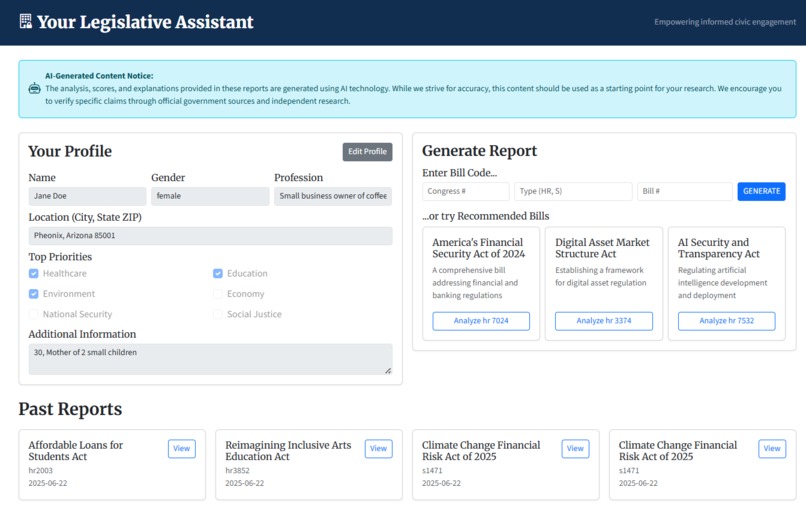
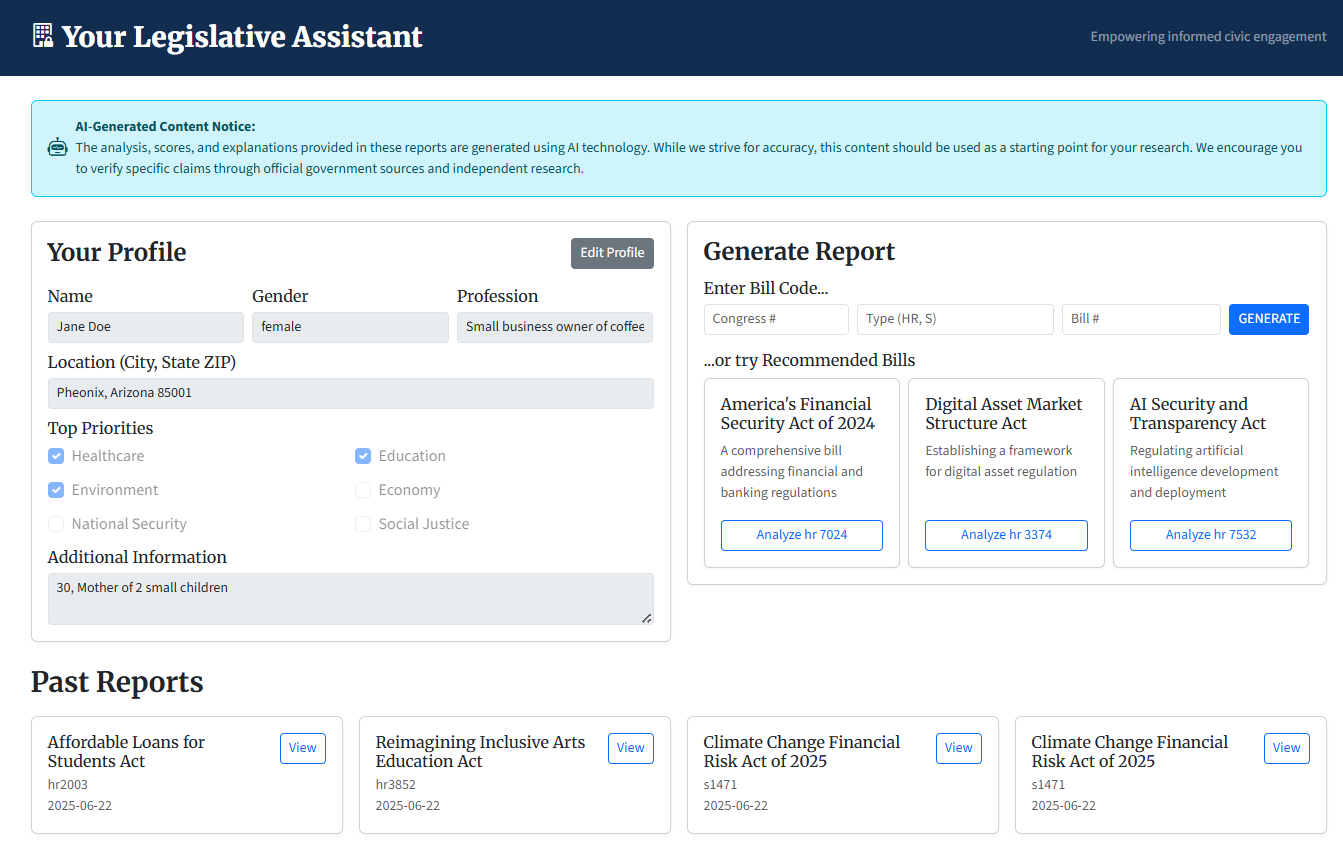
Homepage
-
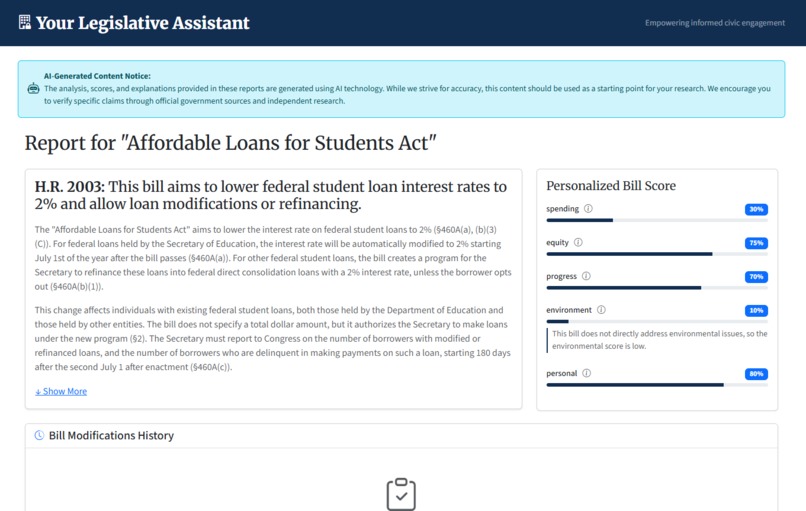
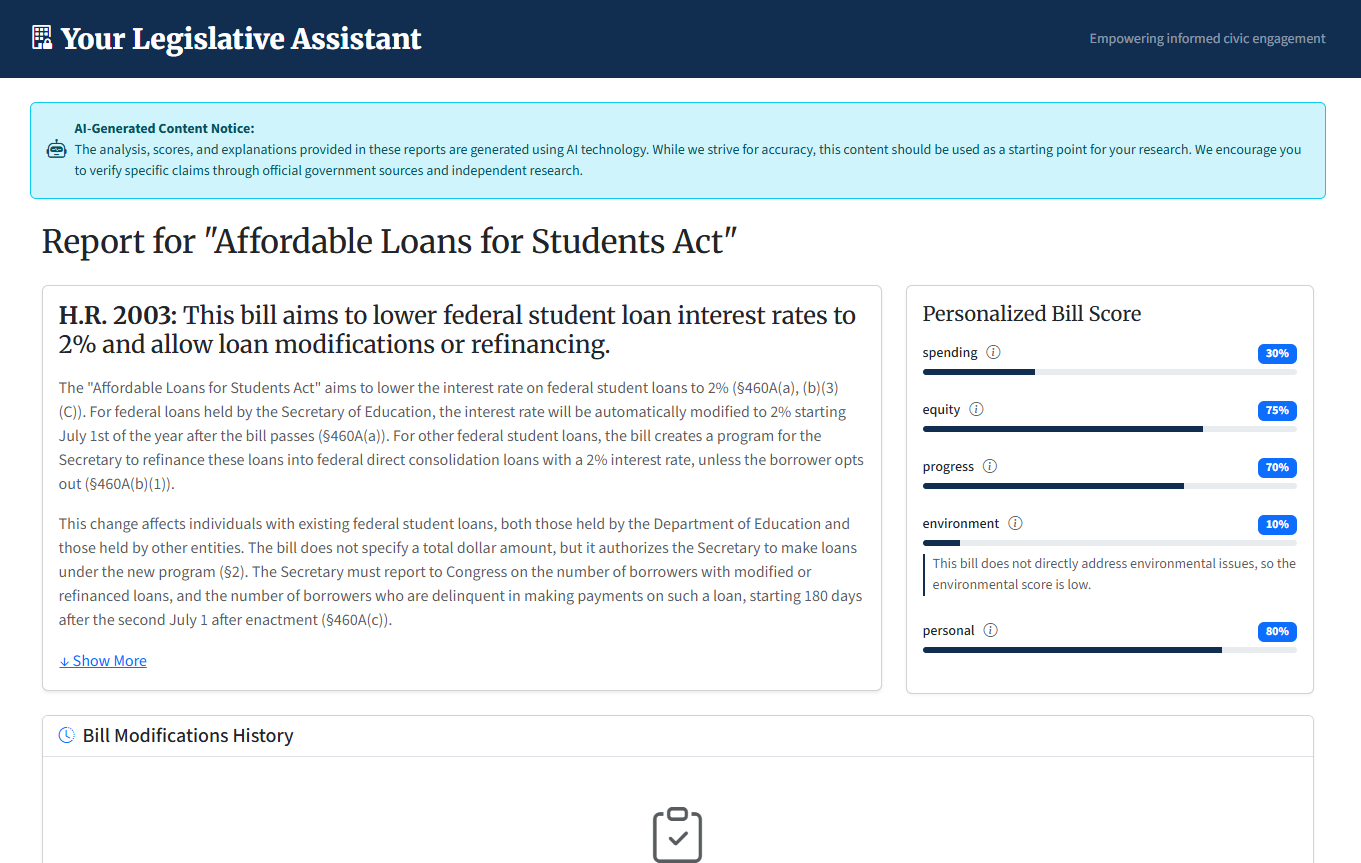
Report summary and scores
-
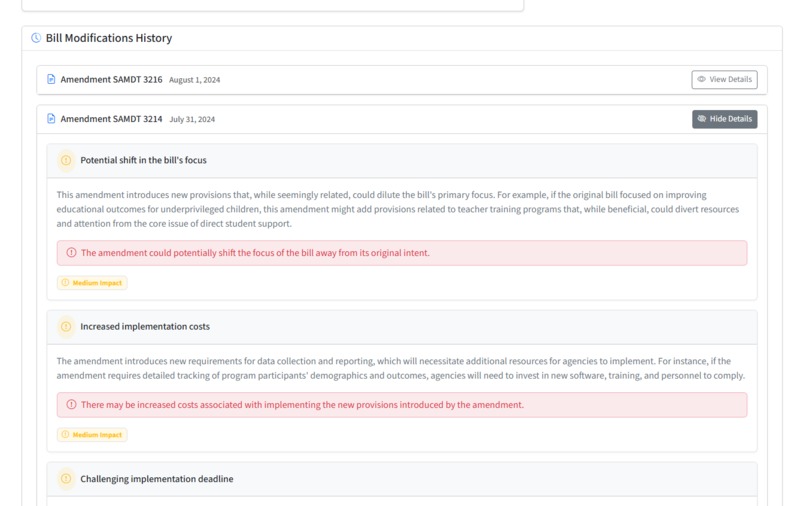
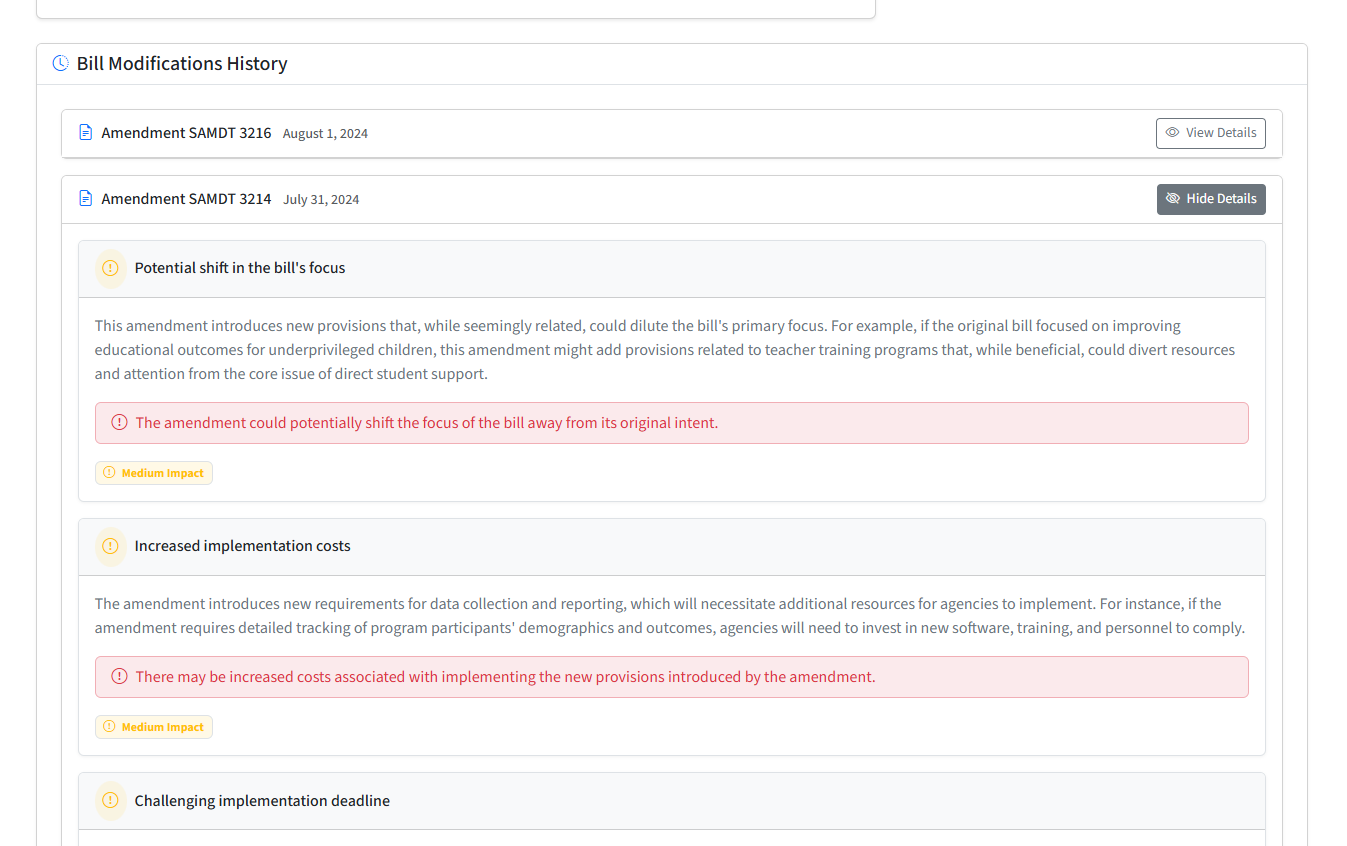
Bill history analysis and consequences of amendments
-
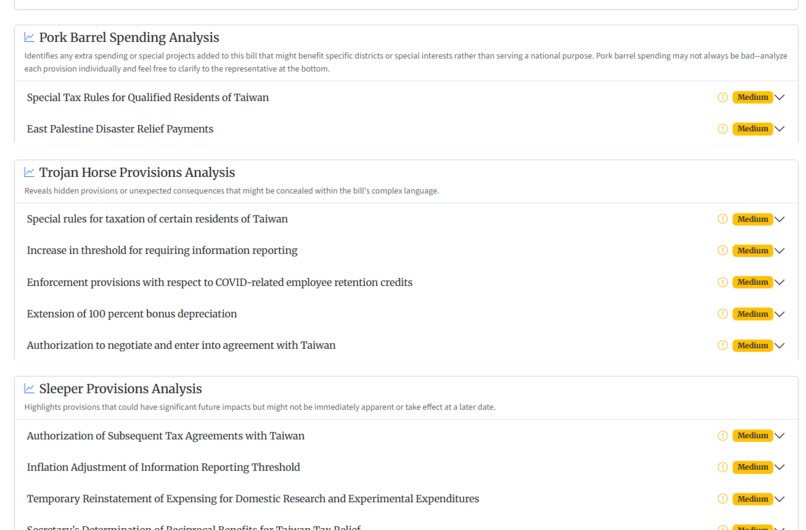
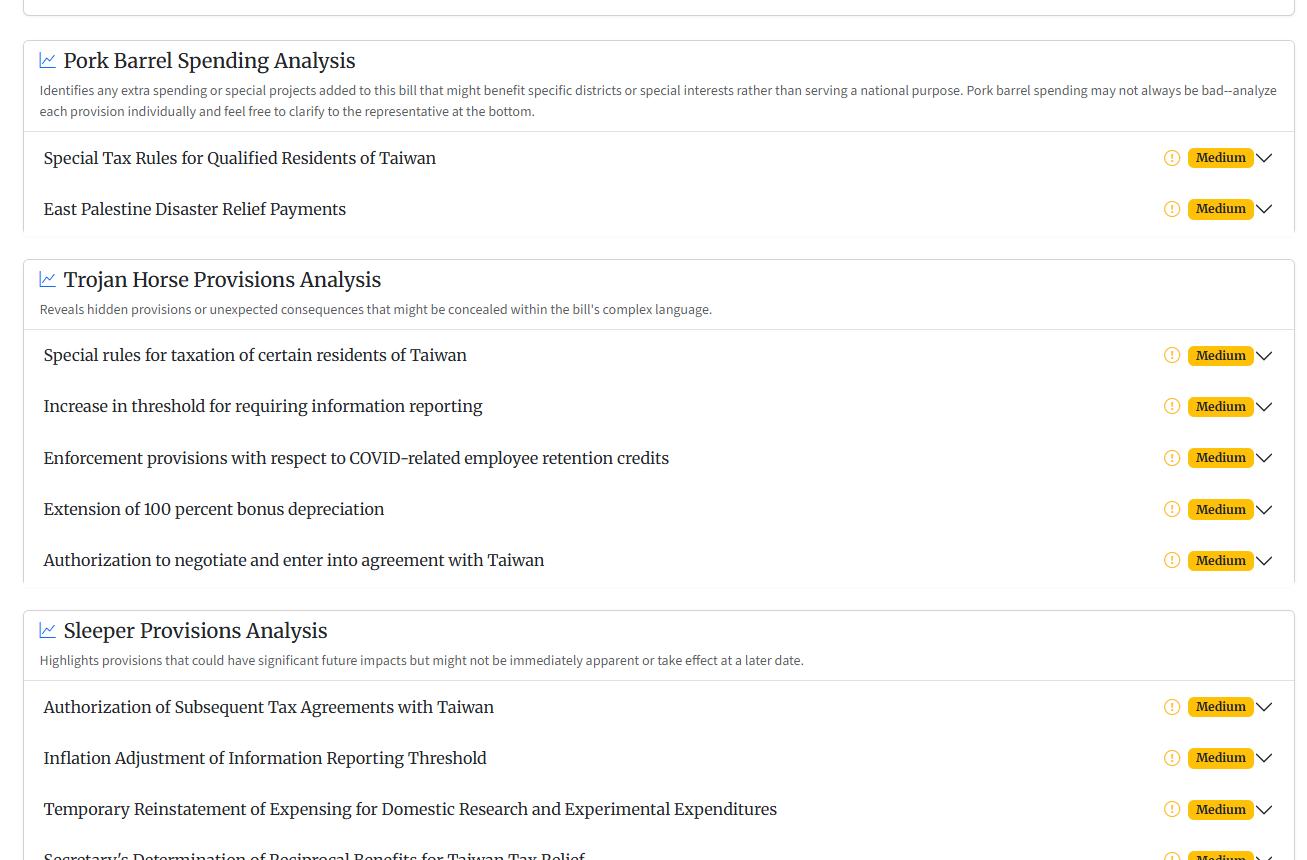
High level overview of concerns (pork barrel spending, trojan horse provisions, sleeper provision)
-
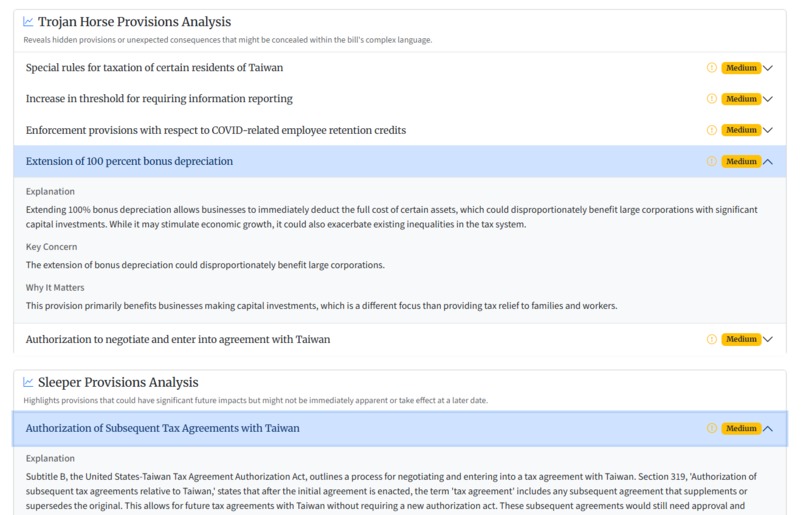
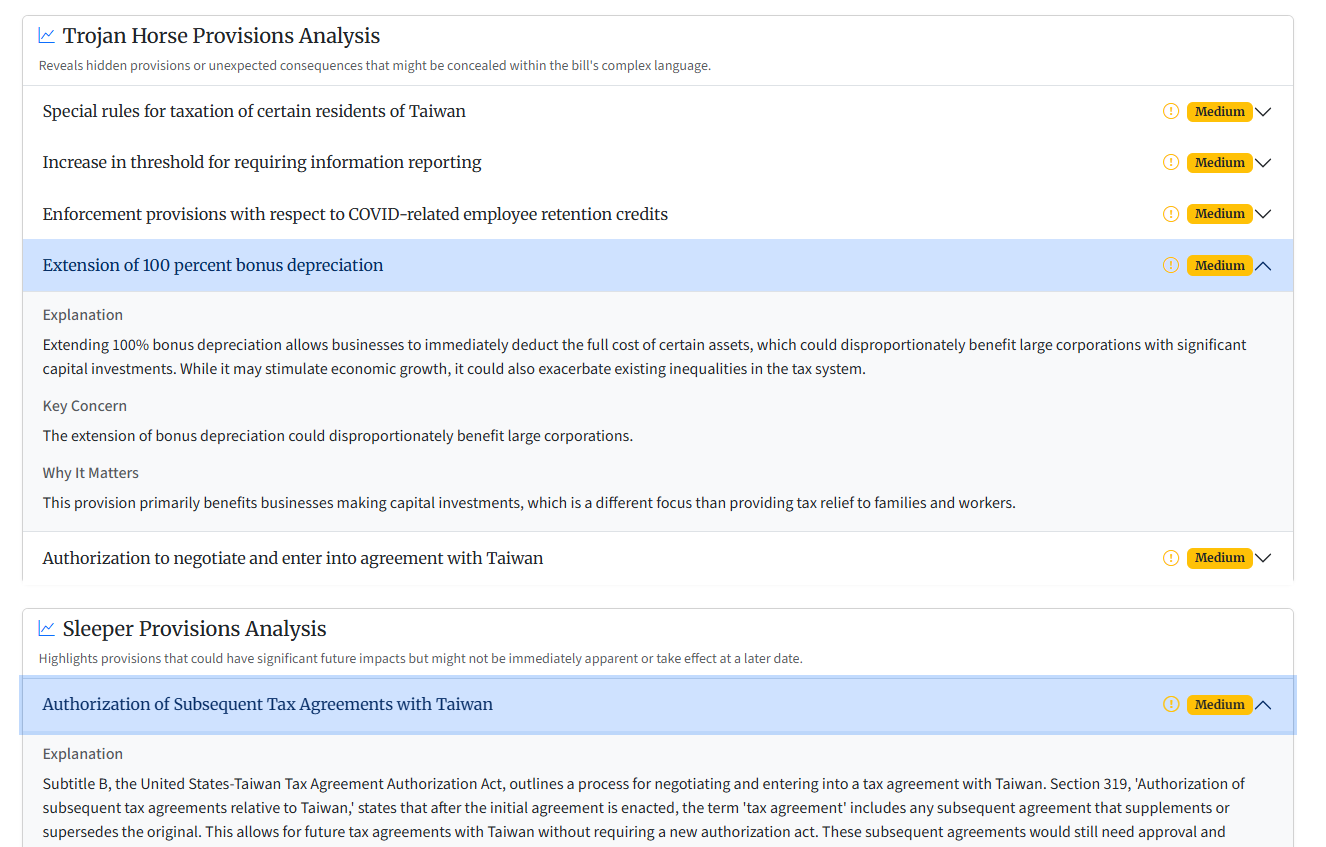
detailed view
-
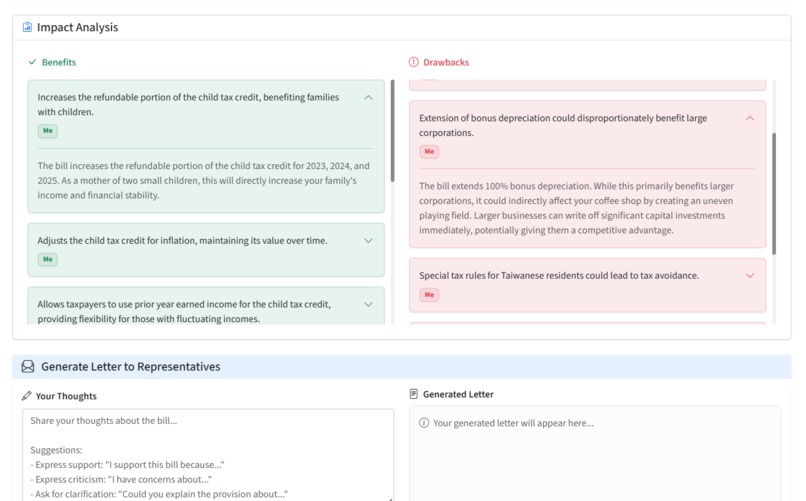
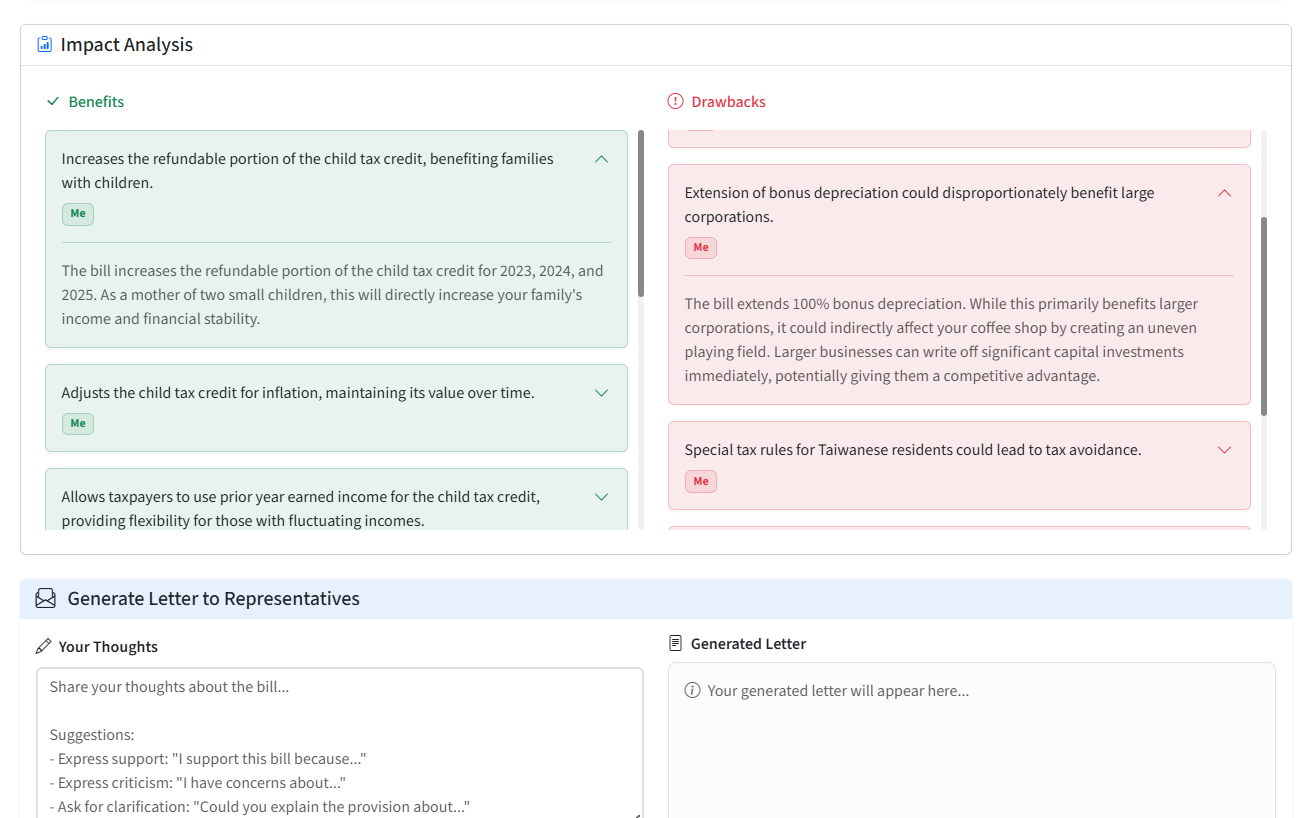
Benefits and analysis for the user based on their specific profile
-
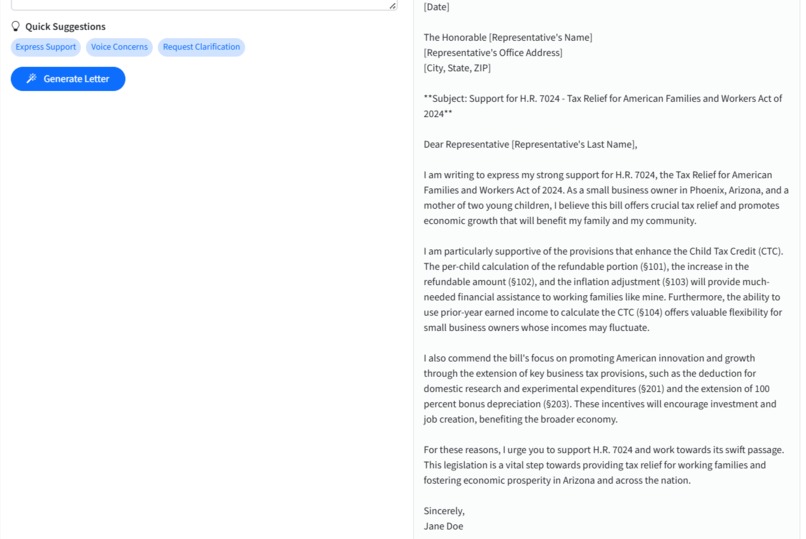
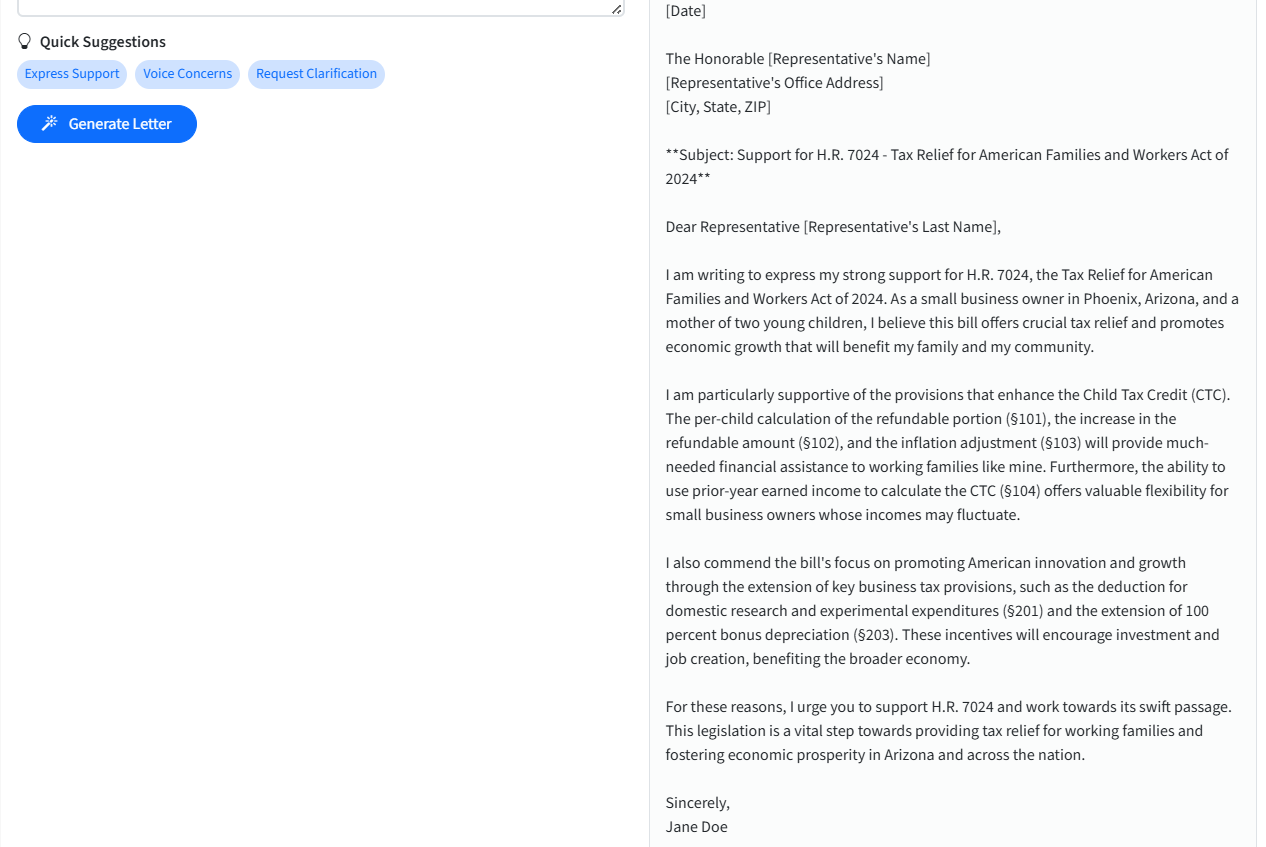
Empowerment - helps citizens write strong business letters to representatives.
-
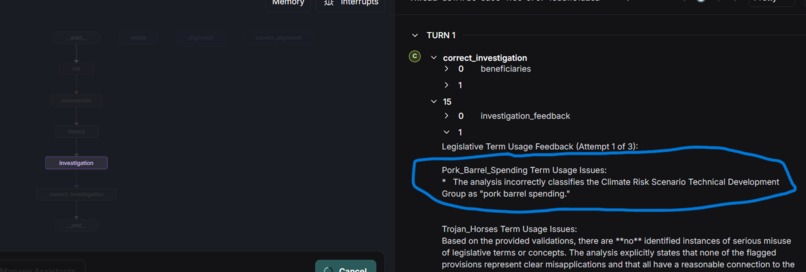
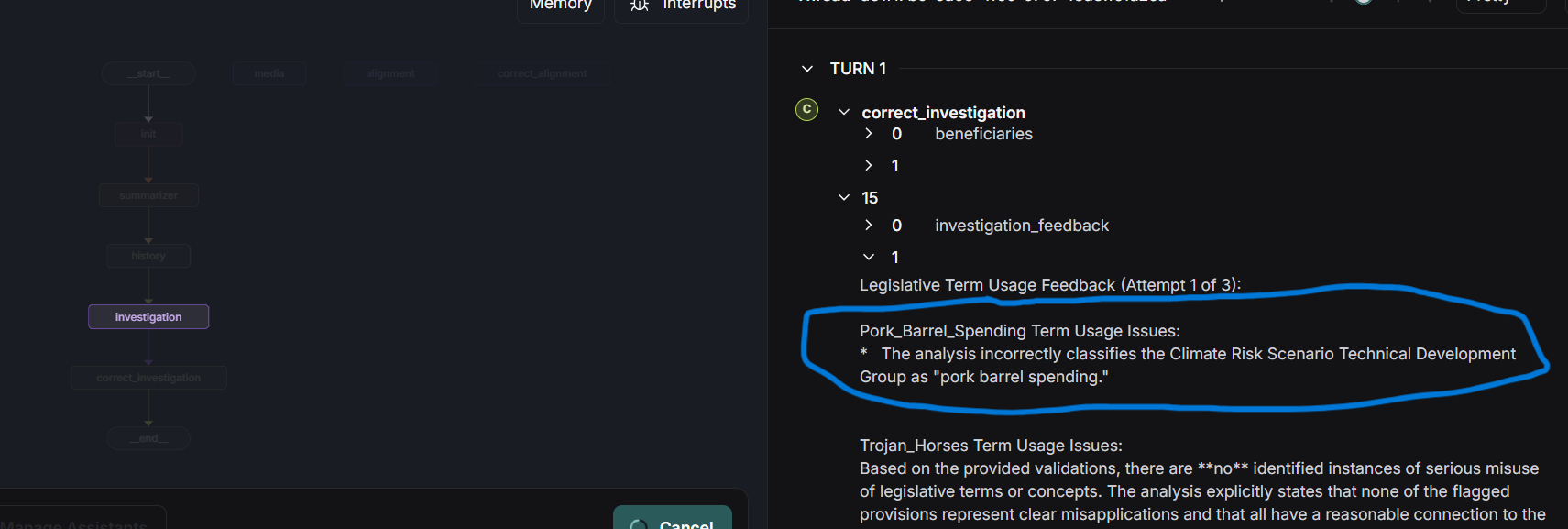
Example of the agent correction mechanism
-
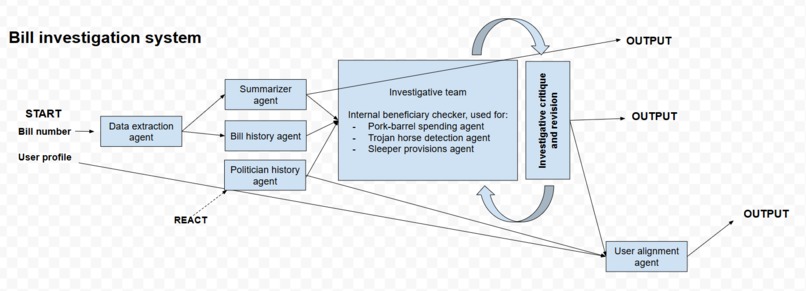
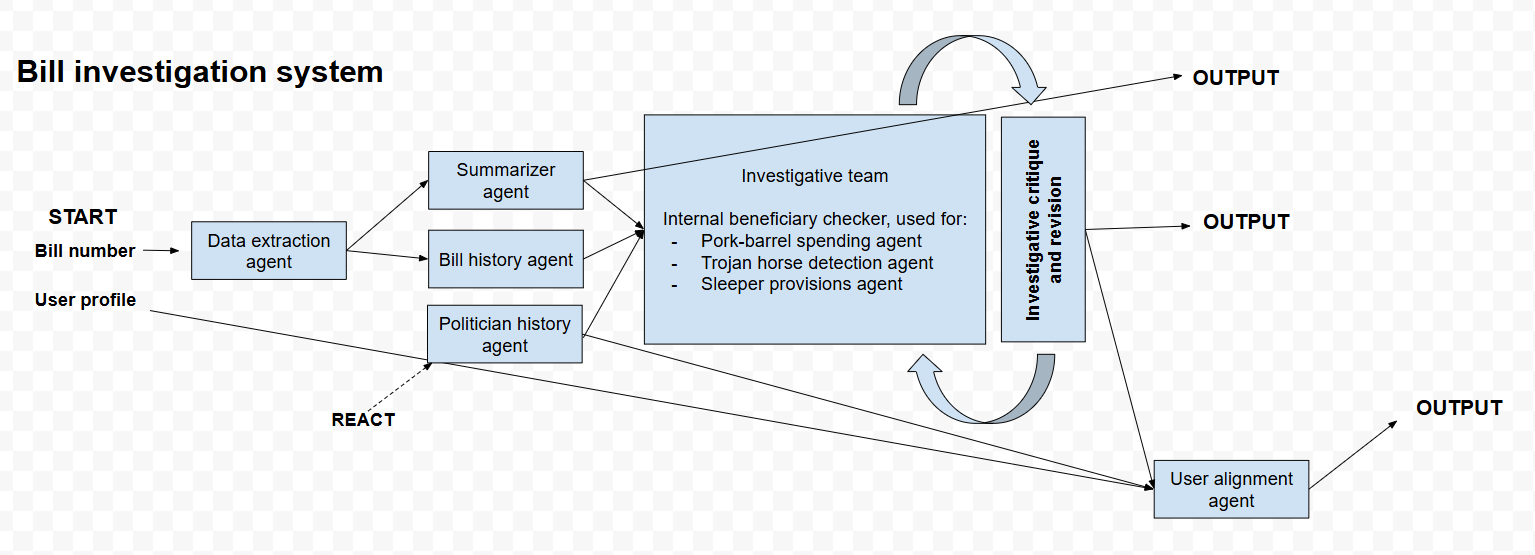
Investigative AI agent workflow
Inspiration
Through my AP US Government class, I discovered firsthand how inaccessible legislation is for ordinary Americans. While researching important bills for our senior project, I witnessed how politicians use deceptive tactics like pork-barrel spending (funds allocated to narrow interests rather than national needs) and sleeper provisions (hidden laws that activate after a delay to avoid detection). I also learned how special interests, from industry sectors to lobbying groups, can unfairly influence legislation. Because of that, it was incredibly difficult for me to truly understand how a bill benefitted and harmed me.
AI can analyze documents at a speed faster than humans. However, it is difficult to control its outputs, and individual AI models often cannot get results as detailed as a professional team of investigative journalists can.
Sophisticated multi-agent systems, in which you split a task between several AI instances and augment them with tool, search, and thinking capabilities, can identify these problematic provisions and pinpoint things which are often impossible to find manually.
What it does
"Your Legislative Assistant" transforms how citizens engage with legislation by going far beyond simple summaries to deliver detailed, personalized insights that reveal how bills will directly impact your life.
Our Multi-Agent Analysis System:
- Context Agent: A REACT-based investigator that researches bill sponsors and tracks legislative changes.
- Investigative Journalism Team: Specialized sub-agents that hunt for pork-barrel spending, trojan-horse provisions (laws with hidden consequences), and sleeper provisions that escape public notice
- Political Consultant Agent: Provides personalized impact analysis based on your unique background, preferences, and circumstances
Personalized Impact Analysis:
- Unlike generic political coverage that discusses broad demographic effects, our system analyzes how specific bill provisions will benefit or harm you personally. Simply enter your background and preferences, and the AI examines each provision through the lens of your individual situation.
From Insights to Action:
- Understanding legislation is just the first step. Our platform empowers you to act on your insights by converting your concerns into professional, business-format letters to your representatives, transforming analysis into meaningful civic engagement.
How we built it
AI Architecture: Built the core intelligence using LangGraph with Gemini 2.5-Flash, selected for its large context window and flexible rate limits--essential for processing lengthy legislative documents. The system features a multi-agent architecture with built-in correction mechanisms: when a critic agent identifies errors in analysis, the system automatically revises its output. I enhanced this with the REACT workflow, enabling semi-autonomous reasoning, and integrated Tavily/News search for real-time political context. To handle extremely large bills, I implemented document chunking that preserves context across sections.
API & Integration: Created FastAPI endpoints that allow seamless model access through standard fetch() calls, providing a clean interface between the AI system and user applications.
Frontend & User Experience: Developed the interface using SvelteKit and Bootstrap with custom theming designed to emulate professional government websites--building user trust through familiar, distinguished aesthetics. Implemented localStorage as a lightweight database solution to store past API calls, creating a serverless experience similar to platforms like Supabase.
Prompt Engineering: Leveraged Claude Sonnet's advanced reasoning capabilities to construct sophisticated prompts. I provided domain-specific knowledge about legislative analysis and asked the LLM to generate meta-prompts--essentially prompts that help other LLM instances create more effective prompts for the agentic workflow, creating a self-improving system.
Challenges we ran into
One of the main challenges we faced was dealing with the subjectivity of political classifications. There were some specific bills with laws that could be interpreted in several ways, and the AI often struggled (often flagging too many provisions of legislation or too little). We addressed this by creating a critic agent which grades the response and sends feedback for revision. This mostly fixed the problem
Additionally, another problem was debugging. When something failed, it was difficult to understand what agent caused the problem. To improve interpretability, we utilized LangGraph Studio which shows your multi-agent workflow in a visual format and shows the intermediate outputs step-by-step
Accomplishments that we're proud of
- Created complex multi-agent system combining thinking, iterative refinement, generation in ~24 hrs. I learned how to utilize LangGraph and this was my first project working with multi-agent workflows.
- Created decent UI with minimal prior design experience
- Vetted several bills and learned so many new things I hadn't even realized. The AI was able to investigate way better than I did and surprised me with its results.
What we learned
- How to work with seminal documents and government APIs
- How to construct multi-agent workflows with LangChain and Gemini
- How to build and refine prompts and code using Claude Sonnet and Opus
- How to validate AI results and how to get AI agents themselves to validate and refine their own outputs
- How to use LLMs in practical scenarios
What's next for Your Legislative Assistant
- Media support in order to understand the political climate and context the bill was created in.
- Dynamic subagent creation--that is, the LLM creates its own agents by determine what kinds of tasks are required for analysis.
- Support for State and County-Level bills.
Built With
- claude
- fastapi
- gemini
- langchain
- langgraph
- sveltekit
- tavily


Log in or sign up for Devpost to join the conversation.