WildBridge - Keep the world green
Inspiration
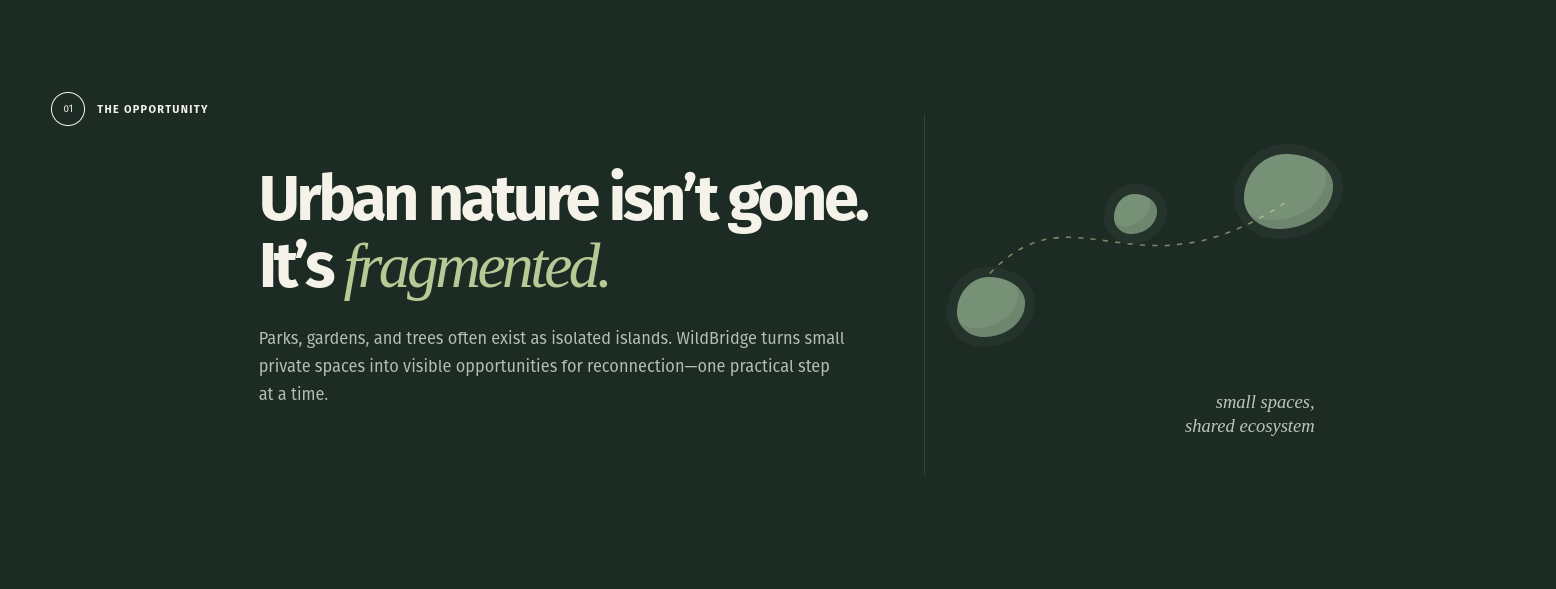
Urban nature often survives as isolated patches: parks, gardens, street trees, and private green spaces that are close together but disconnected as habitats. We created WildBridge to show that even a balcony, patio, yard, or window box can become a small stepping stone for biodiversity.
What it does
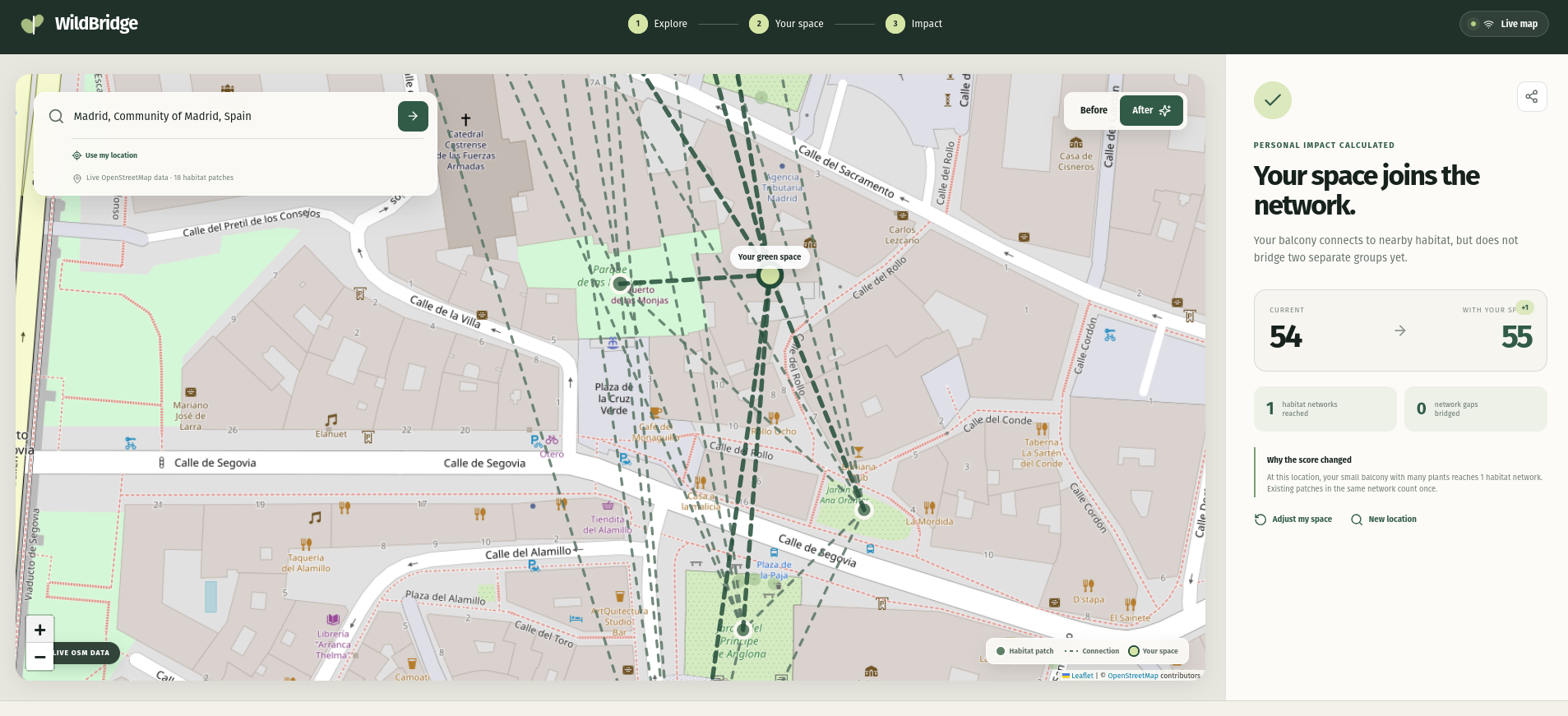
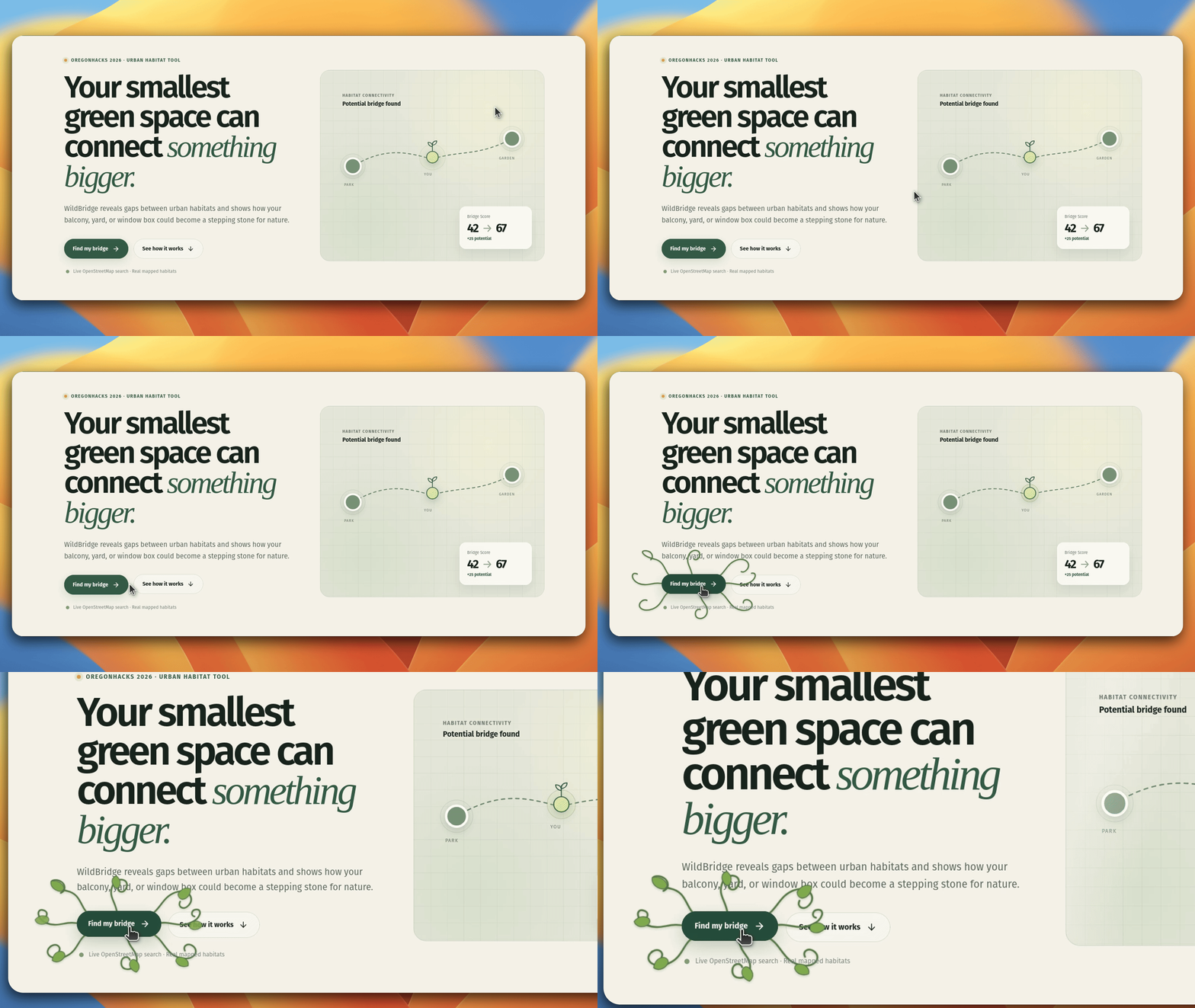
WildBridge searches real locations and maps nearby green spaces. It identifies potential gaps between habitats, lets users add their own small space, and recalculates a before-and-after Bridge Score.
Based on the space type and sunlight conditions, it also recommends native plants that could help create new ecological connections.
How we built it
We built WildBridge with Next.js, React, TypeScript, Leaflet, and OpenStreetMap data.
The application:
- Retrieves nearby parks, gardens, woods, and meadows.
- Converts them into nodes in a connectivity graph.
- Uses Haversine distance to connect nearby habitats.
- Detects gaps between disconnected habitat groups.
- Adds the user’s space as a new graph node.
- Recalculates connectivity and visualizes the potential improvement.
- Recommends native plants through deterministic matching.
Challenges we ran into
Our biggest challenge was making habitat connectivity understandable without presenting a simplified model as scientific certainty.
We also had to combine live geospatial data, distance calculations, graph analysis, map visualization, and accessibility in a flow that users could understand in under a minute.
Accomplishments that we're proud of
We are proud that WildBridge uses live mapped green spaces instead of a hard-coded demo. These OpenStreetMap features act as approximate habitat nodes. Its Bridge Score is calculated dynamically, and every user intervention changes the graph using the same connectivity algorithm.
We also built keyboard-accessible form controls, reduced-motion support, native-plant recommendations, and text summaries of the map’s main insights.
What we learned
We learned that small urban spaces can be presented as part of a larger ecological network, making an abstract environmental problem feel personal and actionable.
We also learned that responsible product design matters: WildBridge clearly communicates that its score is an educational proxy, not a formal ecological assessment.
What's next for WildBridge - Keep the world green
Next, we want to add species-specific movement models, richer municipal habitat data, locally verified plant databases, and citizen-science observations.
We also want to turn WildBridge into a mobile app, making it easier for people to explore nearby habitats, add their own spaces, and take action wherever they are.
Beyond the product itself, we want to build a community around urban biodiversity, where users can share their contributions, discover what others are doing nearby, and collectively create a growing network of small ecological connections.
We also hope to collaborate with schools, communities, and municipalities so WildBridge can help people turn overlooked urban spaces into meaningful connections for nature.
Built With
- css
- leaflet.js
- next.js
- nominatim
- openstreetmap
- overpass-api
- react
- react-leaflet
- typescript


Log in or sign up for Devpost to join the conversation.