-
-
!Forgot_banner
-

!Forgot_logo

Inspiration
The inspiration for this project began with a small problem that I often experienced myself—forgetfulness. I realized that even the smallest things I forgot could sometimes result in fatal consequences for my activities or work. Imagine forgetting something important that we should have remembered, letting brilliant ideas slip away as soon as they crossed our minds, or feeling the need for something that constantly reminds us of what we should do. All these small but recurring problems of forgetfulness are what I wanted to tackle with the iForgot app.
What it does
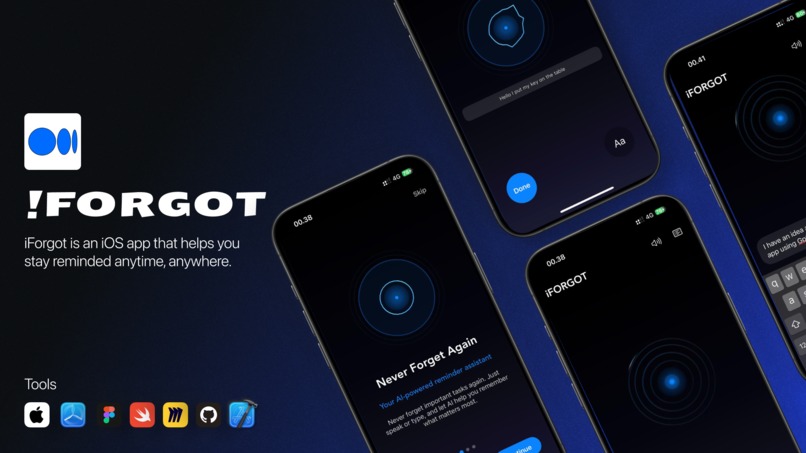
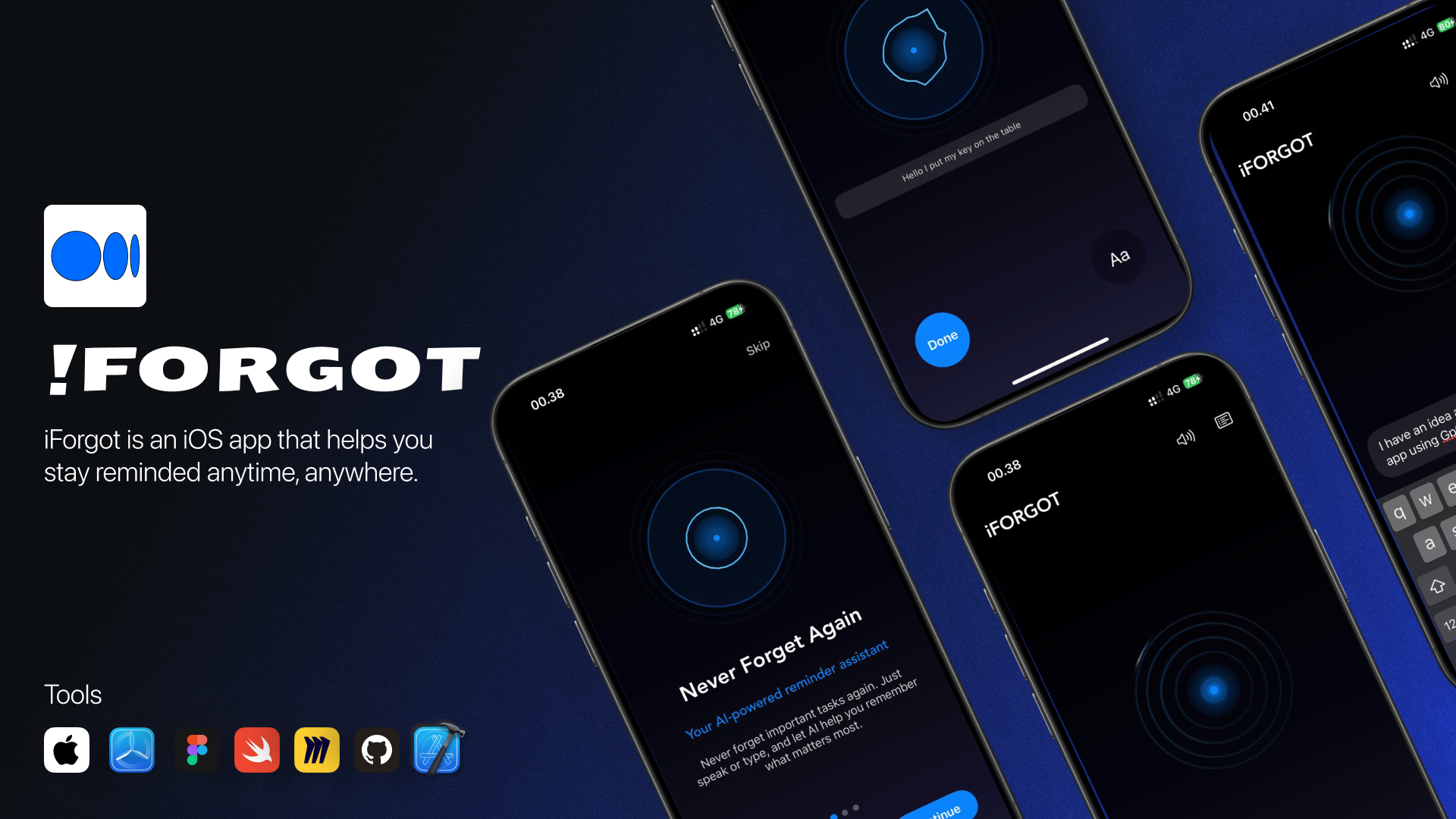
iForgot is an iOS-based mobile application designed to function as a smart reminder, almost like a friend, a companion, or even a mother who never fails to remind us of the important things we should not forget. The application consists of two main features, namely speech mode and text mode, which allow users to input anything they need the app to remember, either through voice or text. Once input is provided, the app automatically generates a reminder, stores it, and sets the schedule through push notifications to notify the users. In addition to reminding, the application is also capable of learning and tracing back all the reminders in the task list so that it can respond to user questions such as “What do I need to do next?” or “What did I forget and need to do immediately?”
How we built it
The app was developed by a solo developer using Apple’s framework technologies, starting with SwiftUI to build the interface, along with AVFoundation for audio technology, AudioToolbox for haptic technology on the Apple Watch, and UserNotifications for implementing push notifications. The central brain of the application is powered by the GPT OSS 120B model, integrated via a third-party platform through OpenRouter. The development process followed a Challenge-Based Learning approach, in which I first identified my personal problem, conducted research, and carried out testing to validate the application idea with target users (those who frequently forget important things). I also designed prototypes in both low-fidelity and high-fidelity forms before implementing them into code. All of this was approached with the mindset of solving a small but potentially fatal problem through an application, while also exploring how GPT OSS could be effectively integrated into this use case.
Challenges we ran into
During development, I encountered several challenges, and I expect more to come in the future. A significant challenge was determining whether the GPT OSS model required fine-tuning to achieve optimal performance, or whether applying contextual engineering alone would be sufficient to optimize the model’s output for the given problem. Beyond the technical considerations, working solo also meant I had to balance research, design, and coding, which was difficult, especially during the design stage where I struggled to transform ideas into tangible application interfaces. Looking ahead, I anticipate further challenges such as whether integration with third-party productivity apps will enhance or reduce user experience, and how best to expand iForgot without compromising its core simplicity.
Accomplishments that we're proud of
One of the accomplishments I am most proud of is the successful use of GPT OSS 120B, which turned out to be an excellent fit for this use case. I had never expected the model to be so effective in producing clear and accurate reminders directly from user input without requiring fine-tuning. With just contextual engineering, the application was already able to learn and provide highly relevant reminders to users, showcasing how powerful and adaptable the model could be in this context.
What we learned
From this project, I learned a great deal about being a solo developer, how to remain meticulous, creative, and critical when selecting ideas and executing them in the best way possible. I also learned that not every model with advanced technology or massive numbers of parameters is automatically the best choice. Ultimately, the effectiveness of a model depends on the appropriateness of its application to the right problem. As I see each model has its strengths and weaknesses, and the key is to be wise in choosing, testing, and applying it effectively within the right context.
What's next for iForgot App
Looking to the future, iForgot will integrate with productivity applications such as email, notes, and social media to provide a more seamless user experience. I am also considering integration with Apple Health to enable reminders related to users’ health progress. This could be particularly important today, given how many of us struggle with maintaining healthy habits such as exercising, staying hydrated, or eating well. With these future directions, iForgot has the potential to grow into not just a reminder app, but a smart companion that improves productivity and well-being.
Built With
- audiotoolbox
- avfoundation
- openrouter
- speechframework
- swift
- swiftui
- usernotifications


Log in or sign up for Devpost to join the conversation.