-
-
Intake Information
-
Main Options
-
This Week
-
This month
-
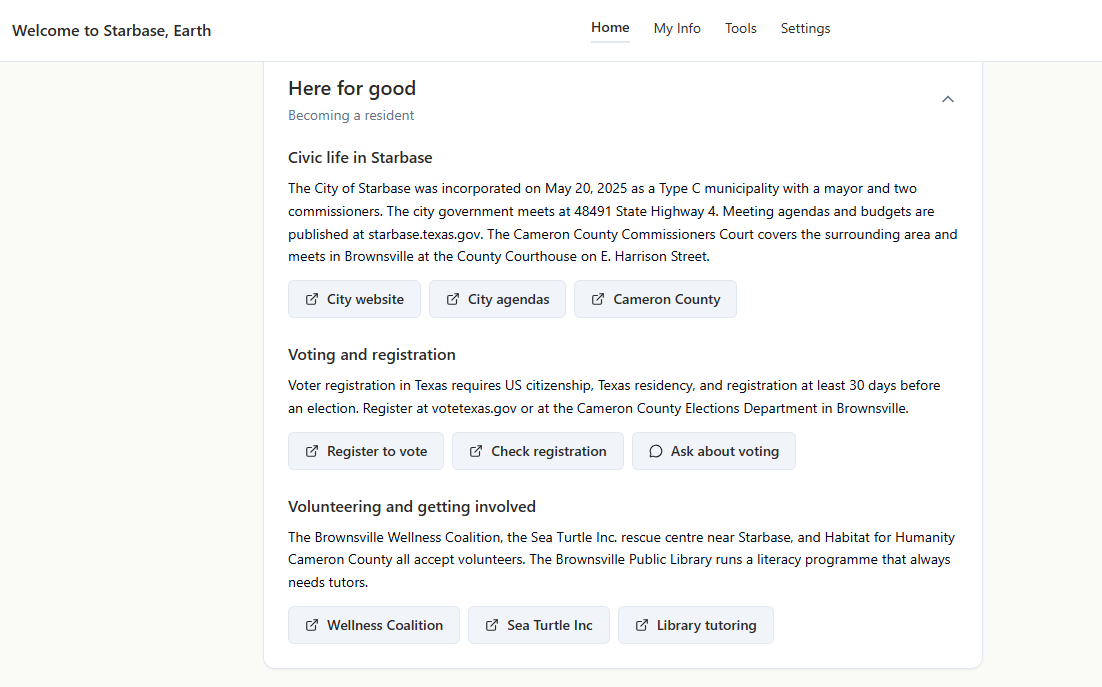
Here for Good
-
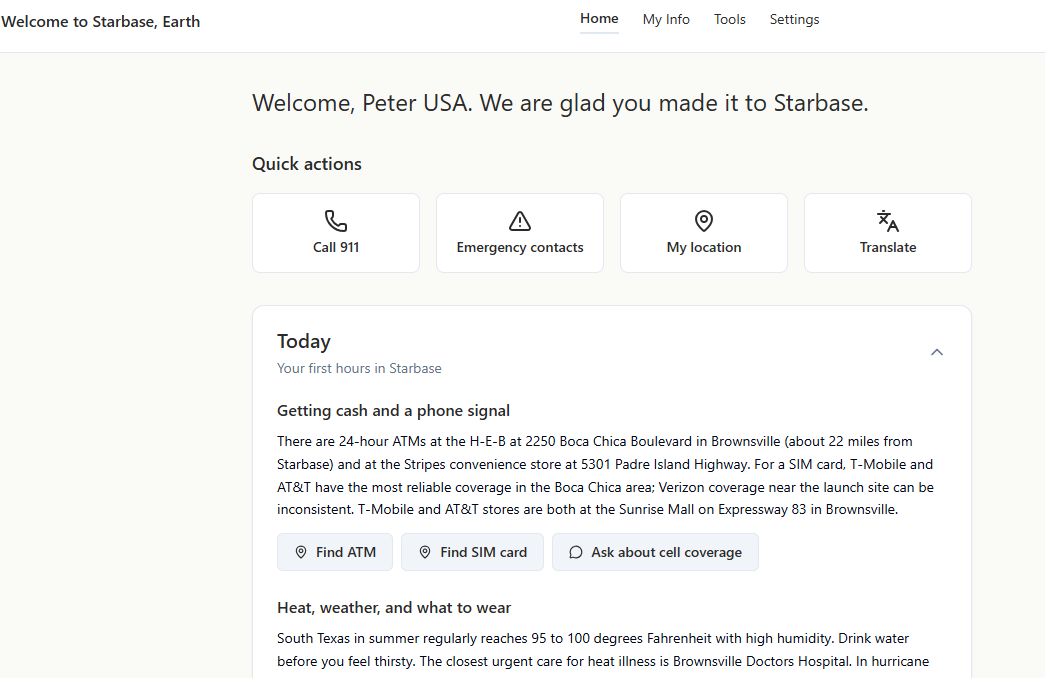
Today
-
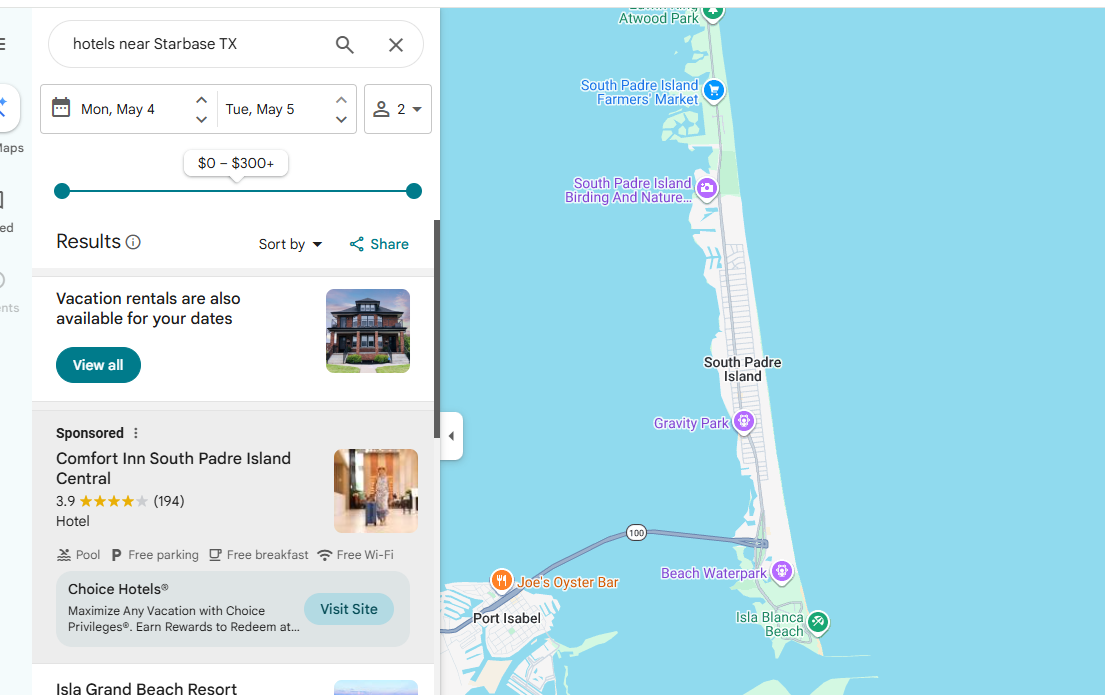
local hotels
-
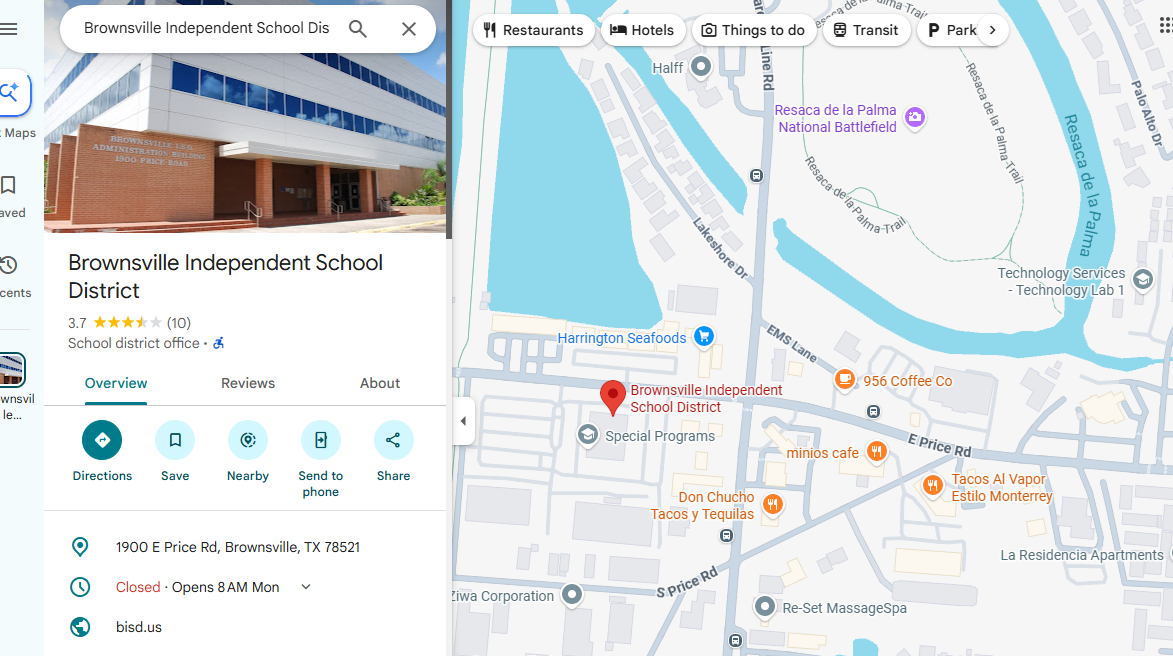
local schools
Inspiration
Newly arrived immigrants, visitors, and travelers need help acclimatizing to new surroundings. No more so than those arriving by land, sea, air, and spaceship. Soon, travelers from the Moon and Mars will need a place to stay. We should prepare well in advance.
What it does
"Welcome to Starbase, Earth" is a web application designed for newcomers arriving in the newest incorporated city in America. The City of Starbase, Texas, was officially established on May 20, 2025, in the Rio Grande Valley about 25 miles east of Brownsville, and people have been arriving every week ever since: SpaceX employees and their families, contractors, scientists, construction workers, and visitors who come for a launch and stay for the work.
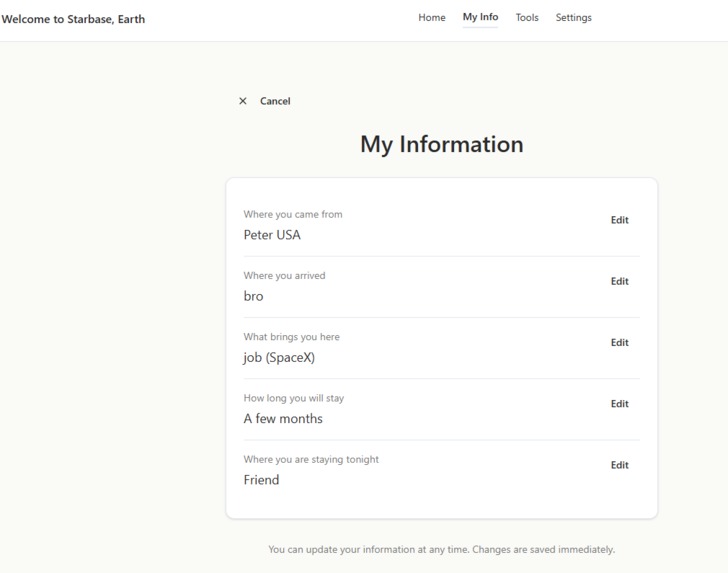
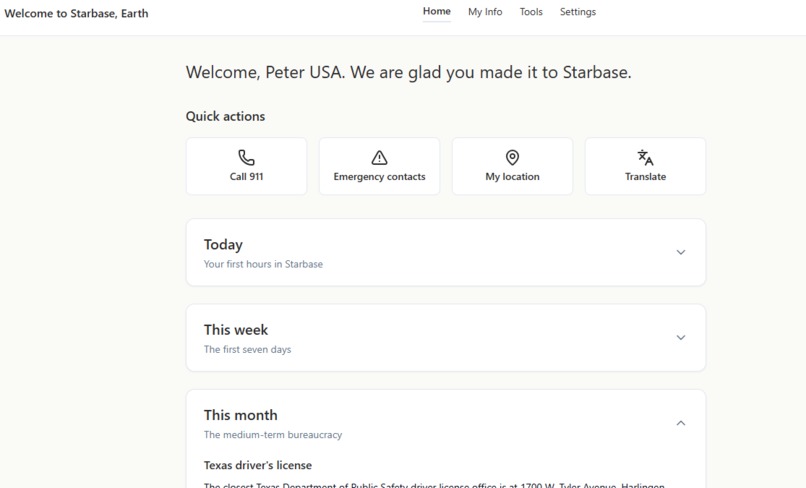
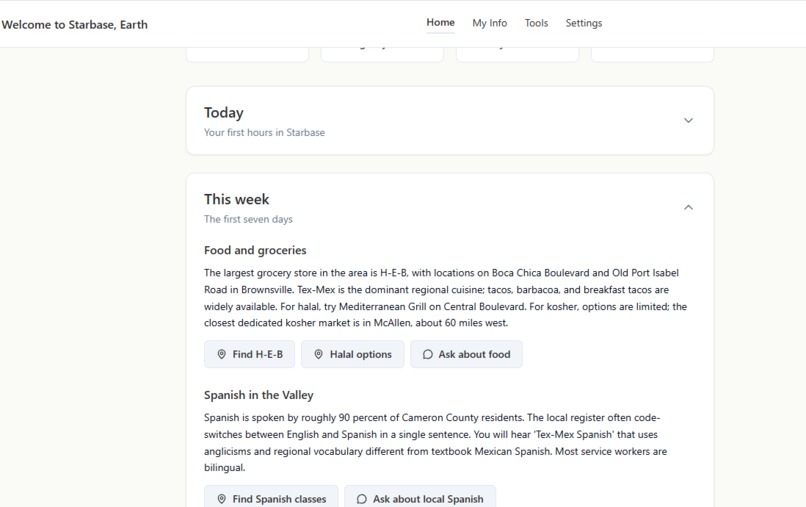
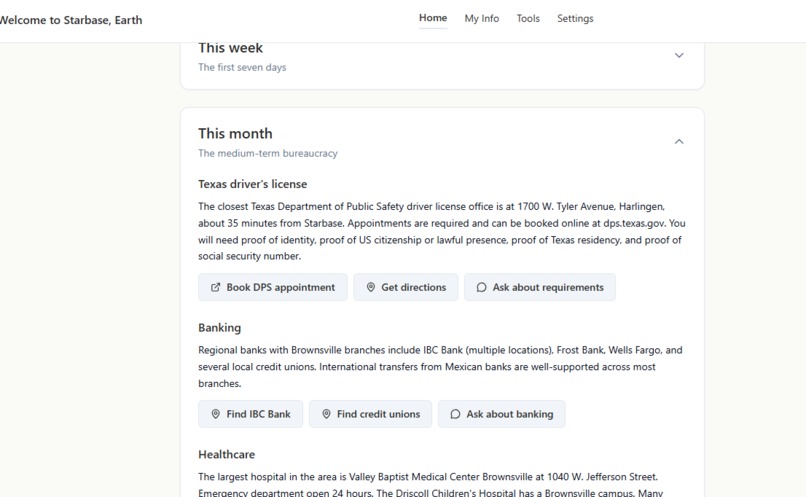
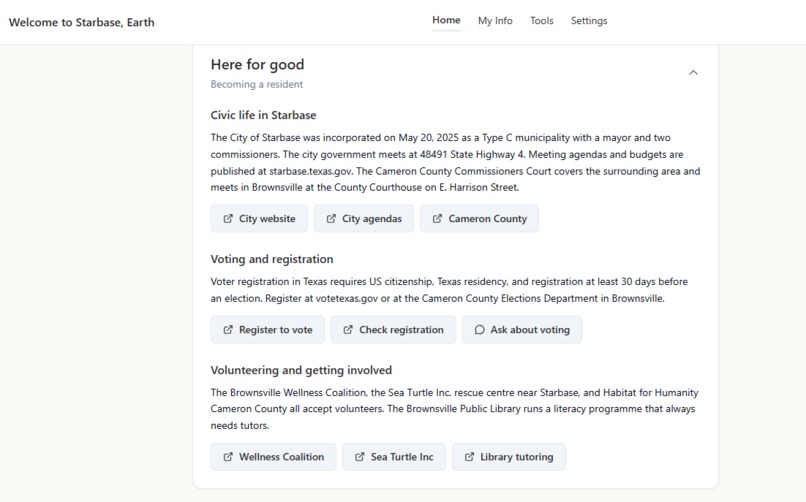
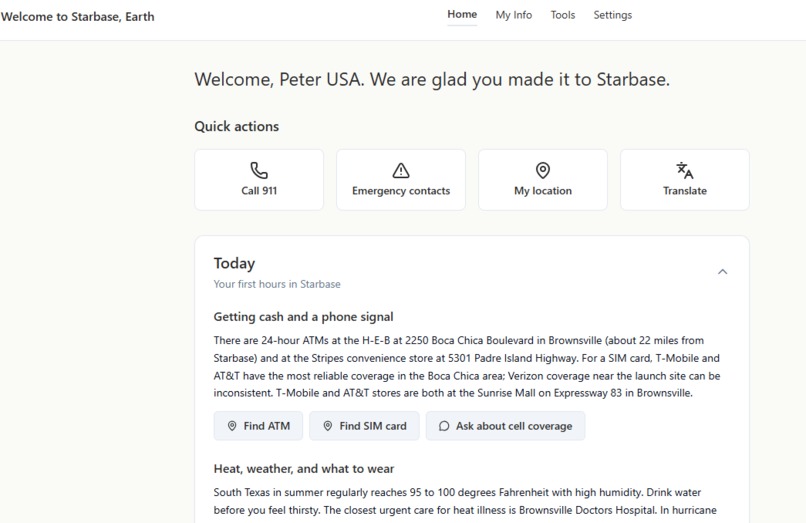
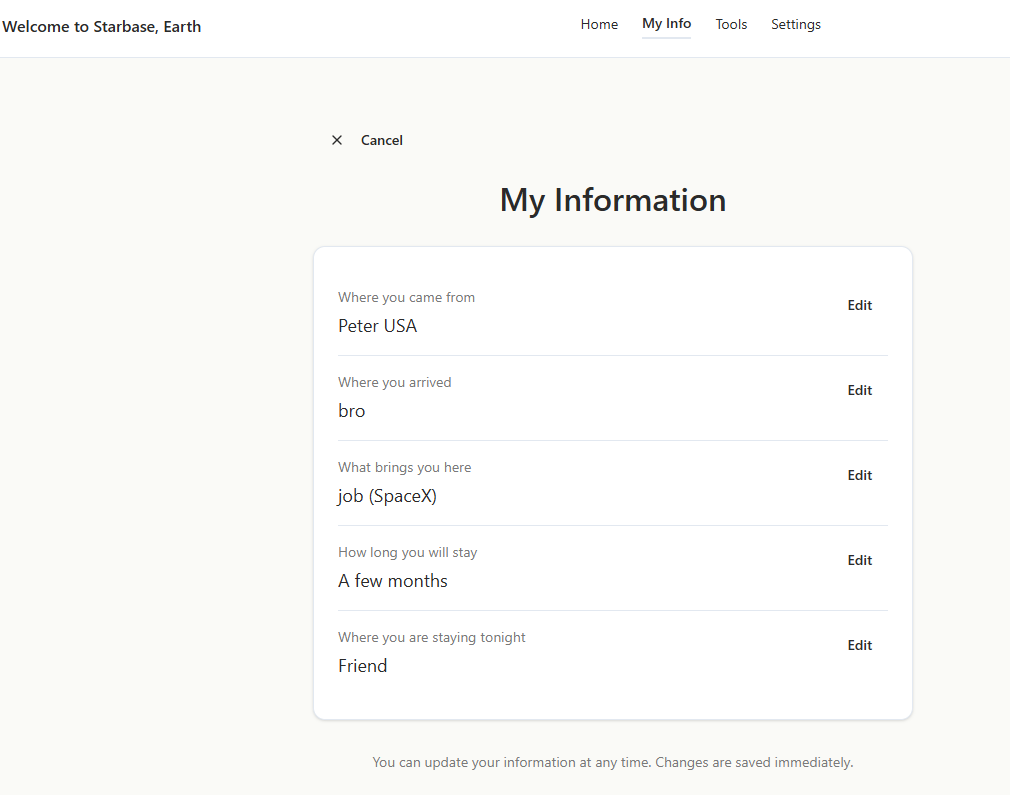
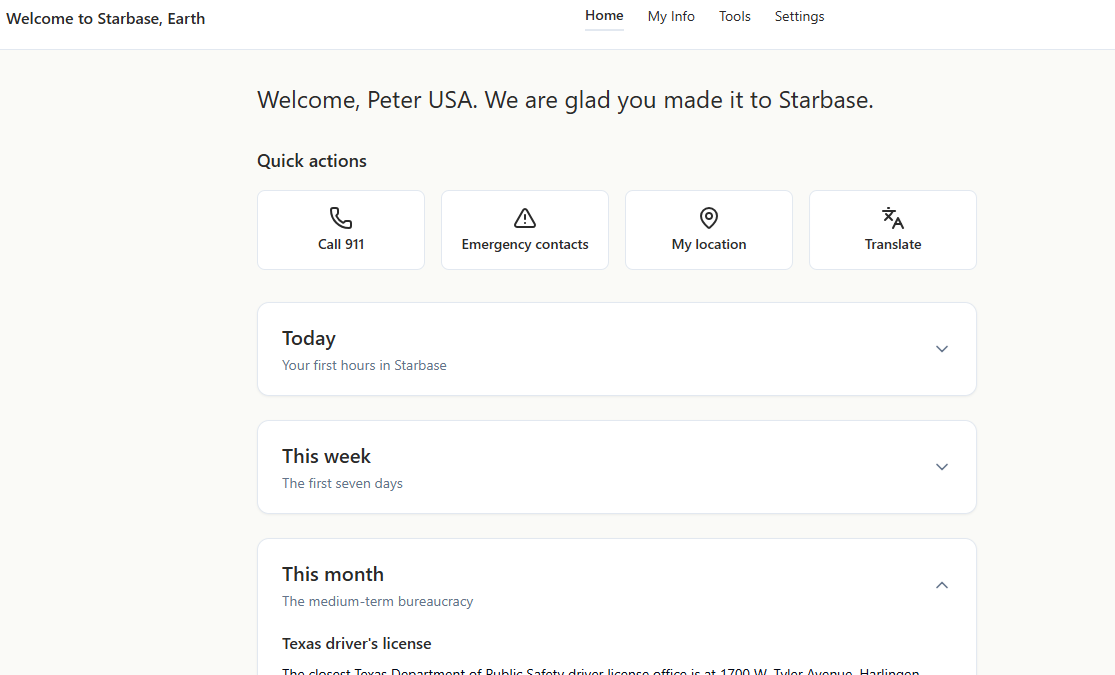
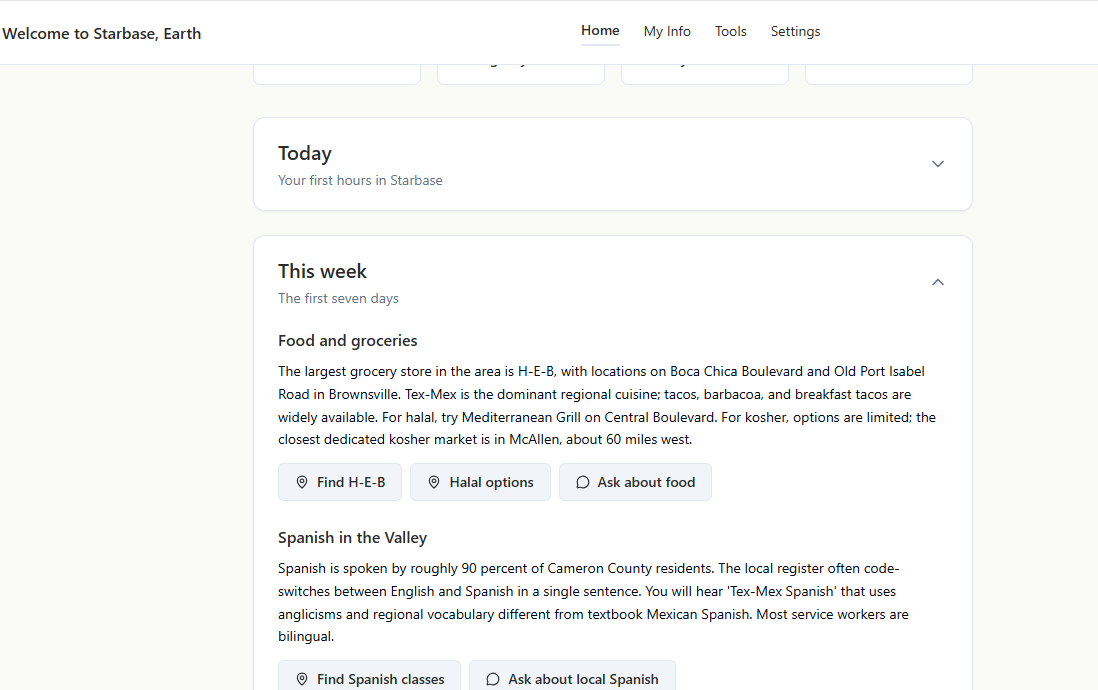
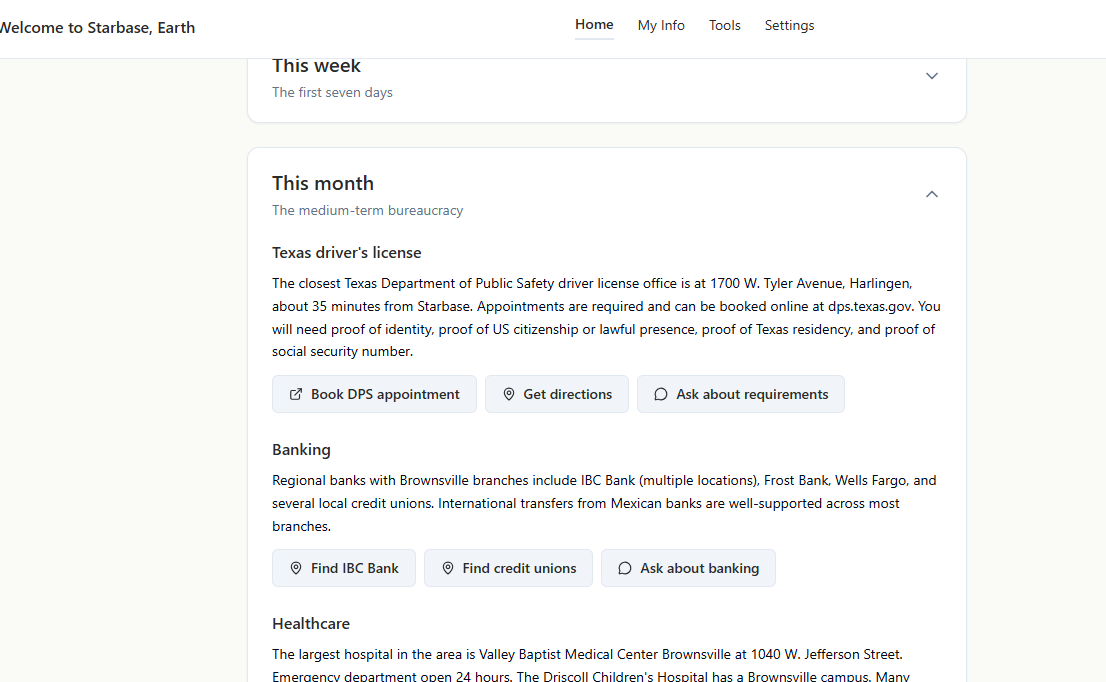
The application is structured as a digital arrival service modeled on the experience of an international traveler at JFK, refined into a form. A welcome screen greets every visitor in three languages with a warm 45-second audio introduction. Five small intake questions, modeled on the questions a customs officer asks at JFK, take under a minute to answer, and personalize everything that follows. The dashboard then organizes practical information across four time horizons: Today, This Week, This Month, and Here For Good. The card matching the user's stated duration auto-expands to put the most relevant information at the top.
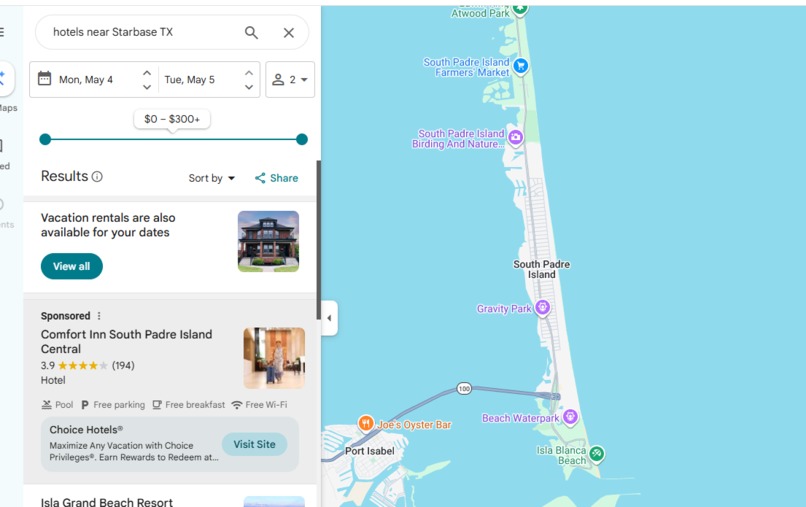
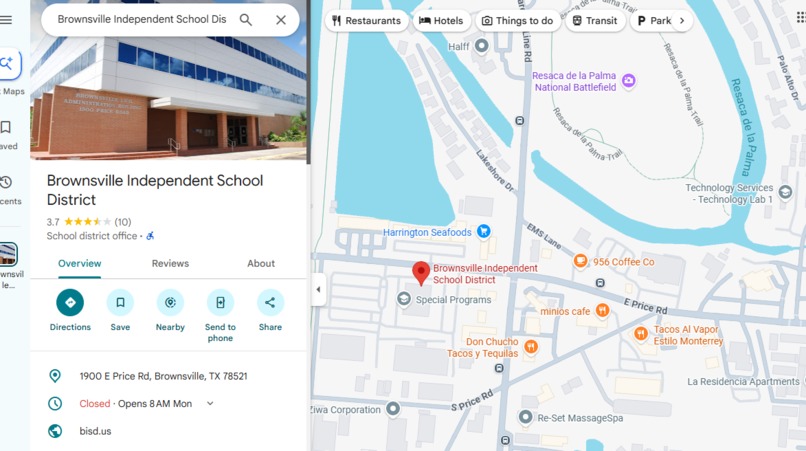
Every card is grounded in real local information about Starbase, Brownsville, and Cameron County. The nearest hospital has a 24-hour emergency department. The 24-hour ATM at H-E-B. The Texas DPS office for a driver's license. The Tex-Mex food culture and the bilingual register newcomers will hear in the Valley. The Brownsville Independent School District enrolment office. Every section has action buttons that open Google Maps for directions, dial a phone number, or visit the official government website.
The Tools page provides three additional utilities: a translator that supports English, Spanish, and the regional bilingual register; a place finder for nearby businesses or services; and a documents vault where users can upload photos of their I-94, visa, or other paperwork to keep them accessible. A chat companion is available throughout the application, grounded in the same local dataset, refusing to answer what it does not know, citing sources for every factual claim, and matching the user's preferred language. The application is free, requires no login, stores all data privately in the user's own browser session, and is automatically deleted after 90 days of inactivity.
How we built it
Welcome to Starbase, Earth was built entirely on MeDo over several days, by one person, using natural language conversation. No code was written by hand.
The build proceeded in seven small phases, each tested before the next was added. The first phase established the welcome screen visual identity: a soft, warm dawn gradient, three stacked greeting sentences in English, Spanish, and Mandarin, and a single Begin button. The second phase wired the JFK-style intake flow with five questions and persistent state across page navigations. The third phase added a summary review screen that allowed users to verify and edit their answers before continuing. The fourth phase populated the four-card dashboard from a hardcoded dataset of accurate Brownsville and Starbase information, deliberately avoiding live web search dependencies that would have introduced latency and unreliability.
The fifth phase wired the chat companion using MeDo's Add Real AI Chat feature, with a comprehensive system prompt grounding it in the local dataset. The sixth phase added a persistent navigation header so users could move between Home, My Info, Tools, and Settings on every page. The seventh phase added the audio welcome and the action buttons that connect the static dashboard to live external services, such as Google Maps and the Texas Secretary of State.
The pattern across all seven phases was the same: describe the change in plain English, let MeDo scaffold it, walk through a manual test, repair anything broken before adding more functionality on top. The application was published mid-build to verify that the deployed environment behaved as expected, and several external link bugs were diagnosed by comparing preview-pane behavior against the live URL.
Challenges we ran into
The first challenge was that the original single-prompt build attempt was too ambitious for MeDo to scaffold cleanly in one pass. The platform built the early screens but took shortcuts on later screens, leaving rendered buttons without working click handlers. The repair broke the work into seven small phases with explicit test gates, which traded elegance for reliability, and was the right trade for a hackathon timeline.
The second challenge was that external links to Google Maps and government websites failed in the MeDo preview pane, returning ERR_BLOCKED_BY_RESPONSE errors. Diagnosis revealed that the preview runs the application inside a sandboxed iframe, and that modern browser security policies, along with Google's X-Frame-Options header, combined to block any external page from loading. The fix was to verify these features in the deployed application rather than the preview, where iframe restrictions do not apply, and to add target="_blank" with appropriate security flags so external links open as new tabs.
The third challenge was the audio welcome. The first implementation attempted to generate audio via a TTS plugin at build time, but it failed silently. The second implementation expected MeDo to bundle a locally uploaded MP3 file into the deployment, which also failed. The reliable fix was to host the audio externally and point the application at a public URL, which works on the first try in every environment. The fourth challenge was scoping discipline. Several features that started in the design (a complaints workshop, a printable wallet card, a town hall PDF briefer) were deferred to optional post-MVP work because each would have introduced platform dependencies that were not load-bearing for the demo. The discipline of cutting unnecessary features is what got the application across the finish line.
Accomplishments that we're proud of
The application treats every newcomer with the same care, regardless of whether they arrived from Mexico City, Brownsville, or somewhere far out in outer space. The intake form accepts both an international airport code and a US state.
The visual identity is calm enough to feel like a published product rather than a hackathon weekend output. The dawn gradient on the welcome screen, the restraint with color and ornament throughout the dashboard, and the humanist typography all combine into something dignified, which matters because the people this application serves are often arriving in difficult circumstances and deserve a calm landing.
The chat companion refuses to answer what it does not know and cites a source for every factual claim it makes, which is unusual for hackathon AI chat features. Most demo chat assistants will confidently make things up. This one does not, because the system prompt explicitly forbids it and grounds the model in a fixed local dataset.
The application is free and stays free. Every piece of functionality, including the translator, place finder, document storage, chat companion, and live news tracker, is available to every visitor. There is no login, no payment integration, no upselling, and no advertising. The privacy posture is honest about itself: data is stored only in the user's browser session and is deleted after 90 days of inactivity.
What we learned
The most important thing I learned is that constraint is a feature. The reason the chat companion feels trustworthy is that it can only speak about a fixed local dataset. The reason the dashboard renders fast and reliably is that it pulls from hardcoded local information rather than live web search. The reason the intake produces useful personalization is that it converts free-form user input into a strict five-field schema before it ever touches the dashboard.
The second thing I learned is that incremental builds beat ambitious builds in no-code platforms. Seven small phases with test gates between them got further than any single comprehensive specification ever did, and the pattern is generalizable to any conversational build platform.
The third thing I learned is that the deployed application is the only thing that matters. The MeDo preview pane is a development convenience but not the user's real experience, and several issues that appeared catastrophic inside the preview disappeared the moment the application was published and tested in a normal browser tab. Future MeDo builds should publish early, publish often, and treat the live URL as the source of truth.
What's next for Welcome to Starbase, Earth
The next milestone is broadening beyond Starbase to other small new cities in similar circumstances. The shape of the application generalizes: any newly incorporated municipality with a growing influx of workers, any college town accepting international students, any military base community welcoming new families. The hardcoded local dataset is the only piece that would change. Everything else is the same.
The second milestone is expanding the audio welcome into a full multilingual library, with native voices recording the welcome in each of the languages shown in the cycling sentence. A Spanish-speaking arrival from Mexico City should hear the welcome in Spanish, not in English with Spanish text underneath.
The third milestone is offline mode. Many of the people the application serves are arriving with limited mobile data plans or unreliable connectivity. A version of the dashboard that loads its full local dataset into the browser on first visit, then runs entirely offline, would be a meaningful improvement for users who do not have the luxury of always-on internet.
The fourth milestone is a small companion mobile application, built to share the same data model and codebase, that delivers push notifications for road closures around launches, hurricane warnings during storm season, and other location-specific alerts that make sense for a Boca Chica resident.
Built With
- accessibility
- audio
- baidu-ai
- browser-storage
- conversational-ai
- css-animation
- css3
- dm-sans
- ernie
- full-stack
- google-maps
- gps
- html5
- inter
- javascript
- json-schema
- medo
- mp3
- multilingual
- no-code
- svg
- tailwindcss
- wcag-aa
- web-search

Log in or sign up for Devpost to join the conversation.