-
-
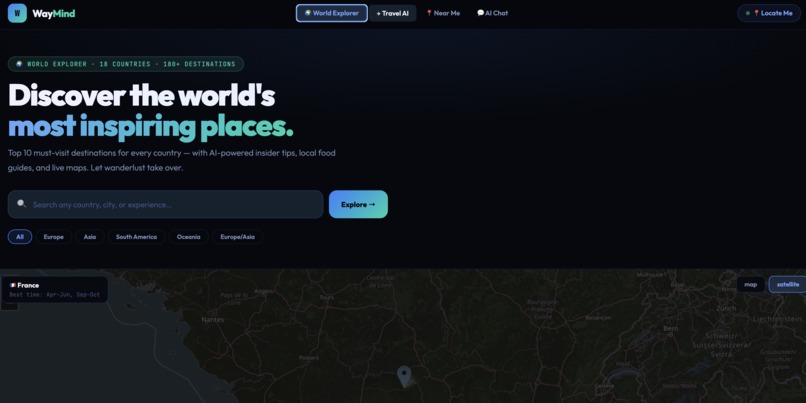
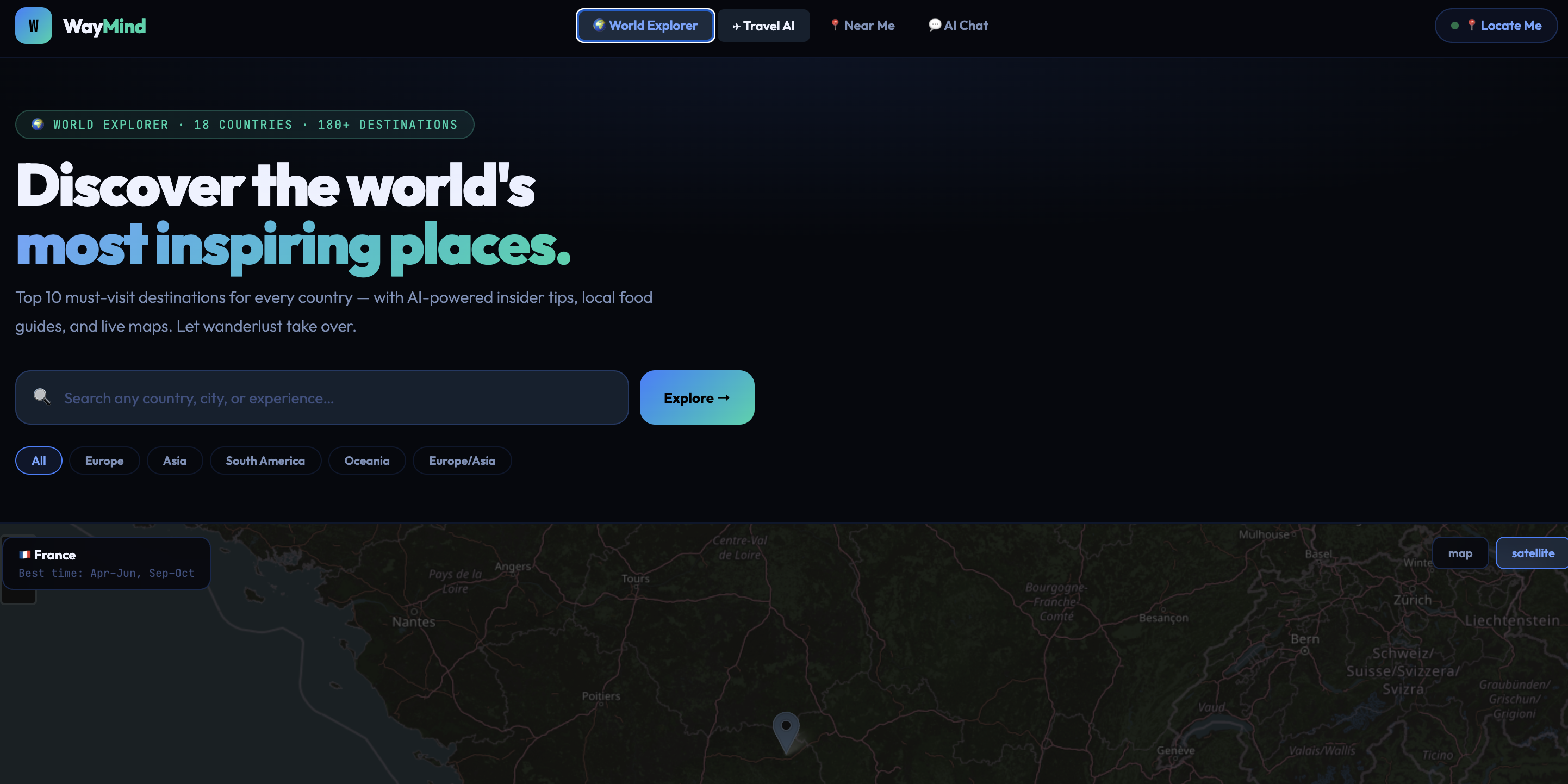
opening page of our website
-
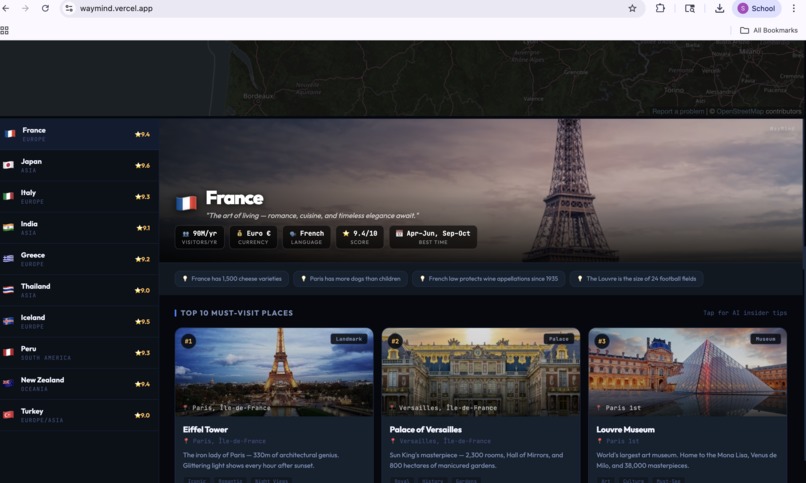
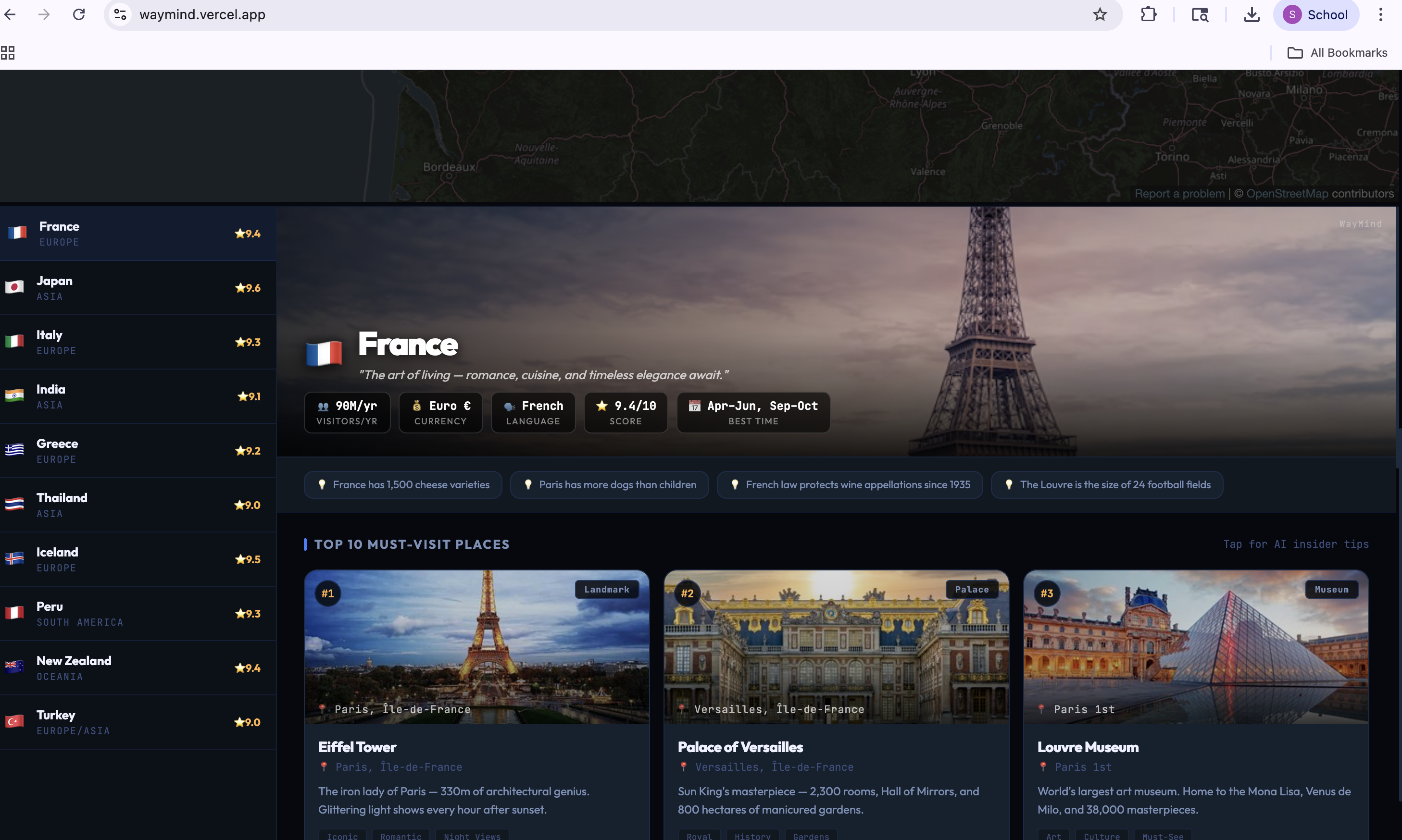
it is map area it contains world famous places across the world
Inspiration
Stuck at an airport for 6 hours due to a flight delay, watching hundreds of frustrated travelers scramble to rebook flights, find hotels, and figure out what to do next — all on their own. That moment sparked WayMind. We asked: why is the traveler still doing all of this manually in 2025? Combined with the frustration of landing in a new city and spending the first hour Googling "what to do near me," we knew there was a smarter way to travel.
What it does
WayMind is a real-time AI travel intelligence platform with four core features. The World Explorer lets users browse top 10 must-visit destinations across 10 countries with real photography, AI insider tips, live maps, and local food guides. The Travel Disruption AI autonomously detects flight delays and cancellations, finds alternative flights, rebooks the best option, updates the itinerary, and notifies contacts — without the traveler lifting a finger. Near Me uses GPS to proactively suggest restaurants, cafés, sightseeing spots, and business lounges based on location, time of day, and trip purpose. The AI Chat assistant answers any travel question instantly using Claude AI — from visa requirements to hidden gems.
How we built it
We built WayMind as a full-stack React application powered by Claude AI. The frontend uses React 18 with Vite for fast builds, custom CSS design system with a dark navy aesthetic, and OpenStreetMap embedded iframes for live maps — completely free with no API key required. Claude AI handles three intelligent layers: personalized destination insights via vision analysis, real-time travel chat responses, and disruption resolution logic. Photos are embedded as base64 data URIs directly in the component for zero broken images. The entire app is deployed on Vercel with GitHub CI/CD for instant updates.
Challenges we ran into
The biggest challenge was embedding 80+ real travel photographs without external image hosting — every URL-based approach resulted in broken images or CORS failures. We solved this by converting screenshots to base64 and embedding them directly in the JSX component, making the app fully self-contained. Managing a 2.5MB React component file and transferring it reliably between environments was another major hurdle. We also had to carefully balance Claude AI API calls — ensuring responses were fast, contextual, and genuinely useful rather than generic. Building the autonomous disruption handler required simulating realistic flight data, itinerary logic, and notification flows without a live flight API.
Accomplishments that we're proud of
We're proud of building a fully functional AI travel platform in a single hackathon session — from idea to live deployment at waymind.vercel.app. The autonomous disruption AI that detects a delay and resolves everything end-to-end without user input is something no consumer travel app does today. Embedding 80 real iconic photographs of 100 destinations across 10 countries — Eiffel Tower, Taj Mahal, Machu Picchu, Northern Lights — permanently in the app with zero external dependencies was a creative engineering win. The AI Chat powered by Claude gives genuinely useful, specific travel advice that feels like talking to an expert friend rather than a search engine.
What we learned
We learned that the hardest part of building AI products isn't the AI — it's the data pipeline and the user experience around it. Getting real photos to display reliably taught us more about browser security, base64 encoding, and file size constraints than any tutorial. We learned that Claude AI is exceptionally good at contextual, conversational travel advice when given a well-crafted system prompt. We also learned that the best hackathon projects solve a problem the builder has personally experienced — the frustration of managing travel disruptions was our north star throughout.
What's next for WayMind — Travel Partner Around the Globe
in future we arrange an tour for people to around the global with fair price. The vision is to make WayMind the world's first truly autonomous travel agent. Next steps include integrating real-time flight APIs (Amadeus, Skyscanner) for live disruption detection and actual rebooking, adding Google Maps for precise navigation and place discovery, and launching WhatsApp/SMS notifications so travelers get updates without opening the app. We plan to expand to 50+ countries with AI-generated destination content, add a personal travel profile that remembers preferences, past trips, and allergies, and introduce multilingual support for 10+ Indian languages. The ultimate goal — WayMind should handle your entire trip from booking to landing, invisibly and intelligently, so you can focus on experiencing the world.
Built With
- browsergeolocationapi
- css3
- github
- html5
- javascript
- node.js
- openstreetmap
- python
- react
- vercel
- vite


Log in or sign up for Devpost to join the conversation.