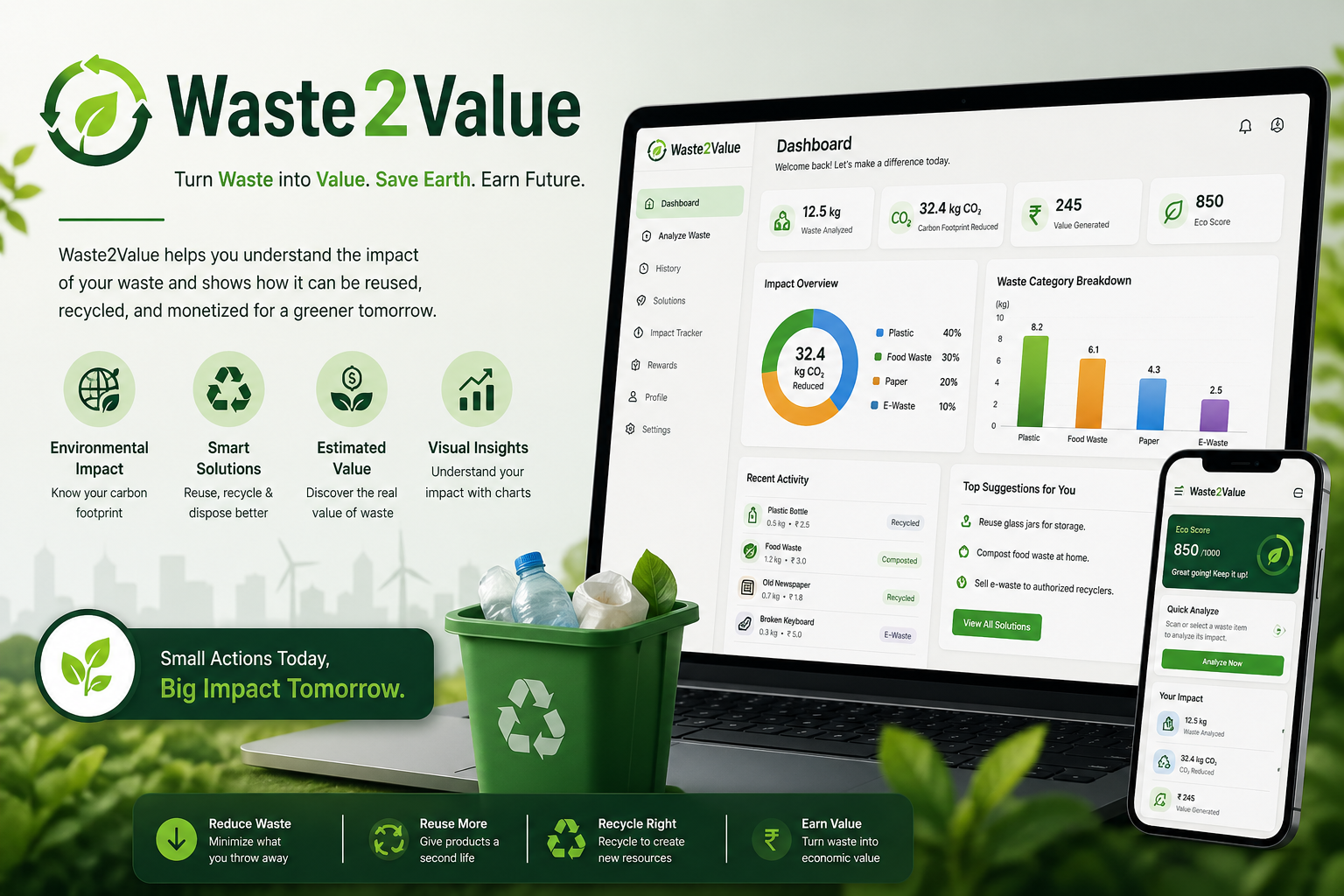
Waste2Value was inspired by the realization that most waste is not truly useless but simply underutilized. Everyday items like plastic bottles food waste and e waste contribute significantly to pollution and the Carbon Footprint yet many people are unaware of their true impact or potential value. We wanted to change this perspective by creating a solution that not only highlights the environmental cost of waste but also shows how it can be reused recycled or even monetized. This idea aims to shift behavior from disposal to resource optimization making sustainability more practical accessible and rewarding for everyone.
Waste2Value is a web based application that helps users understand and transform waste into useful value by analyzing different types of waste such as plastic food waste paper and e waste. Users can input or select a waste item and the system provides insights including environmental impact decomposition time recycling methods reuse ideas and estimated value. It also calculates the impact in terms of reduced Carbon Footprint and presents the results through simple visualizations and eco scores. The platform guides users with smart suggestions to encourage responsible waste management and promote sustainable habits in everyday life.
We built Waste2Value as a lightweight web application using HTML CSS and JavaScript to ensure fast development and smooth performance during the hackathon. We designed a clean multi page structure with a landing page and an interactive dashboard where users can input waste types or simulate image based detection. The core logic was implemented using predefined data models that map each waste category to decomposition time environmental impact and estimated value allowing real time analysis. To make the insights more engaging we integrated Chart.js for visualizing impact and eco scores. We also added rule based smart suggestions to simulate AI driven recommendations and used browser LocalStorage to manage user data and personalization. The interface was built with responsive design principles modern styling and smooth interactions to create a polished user experience while keeping the project easy to deploy and extend.
One of the main challenges was simplifying complex waste management and environmental concepts into something users can easily understand while still keeping it meaningful especially when dealing with the idea of a Carbon Footprint. We also faced time constraints during the hackathon which required us to prioritize core features like analysis visualization and user experience instead of building everything we initially planned. Integrating dynamic charts using Chart.js and ensuring they updated correctly based on user input was another technical hurdle. Designing smart suggestions without full AI integration required creating effective rule based logic that still feels intelligent. Additionally making the interface responsive visually appealing and smooth across devices while maintaining performance required continuous adjustments and testing.
We are proud that Waste2Value transforms everyday waste into meaningful environmental and economic insights in a simple and accessible way while reinforcing the concept of a Carbon Footprint. Within a limited hackathon timeframe we built a complete working application with a polished user interface real time analysis and interactive visualizations using Chart.js. One of our key achievements was simplifying complex waste and sustainability data into clear actionable insights along with smart suggestions that guide users toward better decisions. We also successfully integrated multiple features such as personalization impact scoring and responsive design into a cohesive and functional product that goes beyond a basic prototype and demonstrates real world applicability.
Through building Waste2Value we learned that solving real world sustainability problems is less about complexity and more about clarity and usability especially when working with concepts like the Carbon Footprint. We learned how to break down a large problem into a simple functional solution by focusing on core features and user experience. The project improved our frontend development skills and our ability to present data effectively using tools like Chart.js. We also learned how to simulate intelligent behavior using rule based logic without full AI integration and how to manage time and priorities effectively in a fast paced hackathon environment while building a complete and meaningful product.
Waste2Value will evolve from a prototype into a smarter and more scalable platform by improving the accuracy of waste analysis and expanding its ability to measure environmental impact through more detailed Carbon Footprint calculations. The next step is to integrate real AI based image recognition so users can scan waste items directly and receive instant insights. We also plan to add real time data such as nearby recycling centers and market prices for recyclable materials to make the platform more practical and useful. Future versions will include advanced analytics and visualization using tools like Chart.js along with gamification features such as challenges leaderboards and rewards to encourage continuous engagement. In the long term Waste2Value can expand into a mobile application and integrate with smart systems to automatically track and optimize waste management creating a complete ecosystem for sustainable living.


Log in or sign up for Devpost to join the conversation.