-
-
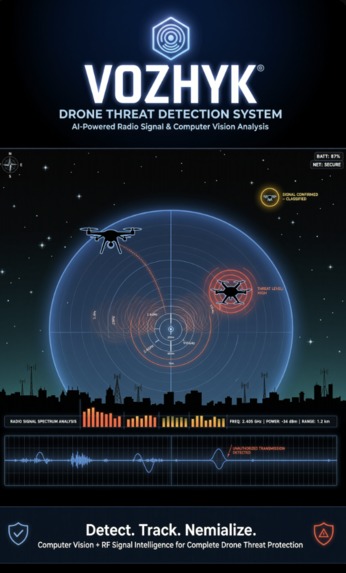
Start application screen
-
application logo
About Project
Inspiration
Drones have become increasingly common in both civilian and emergency situations. While they provide many benefits, they can also introduce safety risks when operating near people or sensitive areas. We wanted to explore how modern AI running on an everyday smartphone could help improve situational awareness without requiring specialized equipment.
Our goal was to build a mobile application that can recognize potential drone activity using the sensors already available on an iPhone. We named the project Vozhyk ("Hedgehog" in Ukrainian), representing a small but vigilant defender that helps people stay aware of their surroundings.
What it does
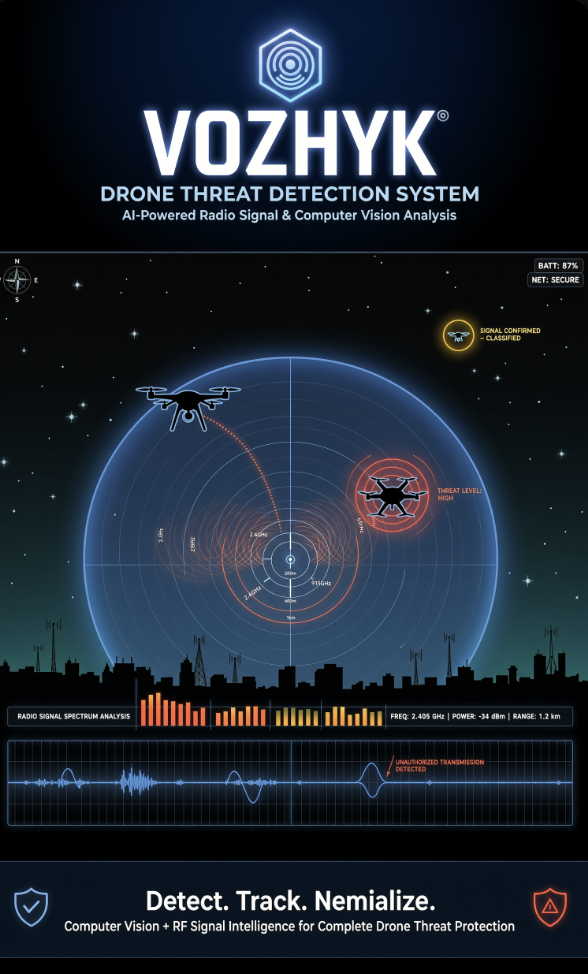
Vozhyk is an AI-powered iPhone application that detects possible drone activity by combining live camera AI with radio signal checks available on iOS.
The app continuously analyzes the live camera feed using Apple's Vision framework and Core ML. It runs a dual-model detection pipeline:
- A preserved YOLO model for general object detection, including autos, humans, trucks, buses, motorcycles, birds, and planes.
- A custom fine-tuned
plane_dronemodel trained from our own reviewed drone video dataset.
This lets Vozhyk keep useful general scene awareness while improving detection of the specific drone/plane target class.
To help with long-distance detection, Vozhyk also includes automatic camera zoom. When the user holds the iPhone stable for a short moment, the app gradually zooms the real camera feed up to 5x, making small distant flying objects easier for the model to inspect. If the phone moves or turns again, zoom resets back to the default view.
At the same time, the application scans Bluetooth Low Energy devices and checks for known drone-related Wi-Fi network names that iOS makes available. By combining visual and radio observations, Vozhyk estimates the likelihood that a drone is nearby and displays a clear threat indicator:
- CLEAR
- POSSIBLE DRONE
- DRONE DETECTED
This multi-sensor approach provides users with improved situational awareness while running entirely on an iPhone.
How we built it
The application was developed as a native SwiftUI iOS application.
Major technologies include:
- SwiftUI for the user interface
- AVFoundation for camera access and real camera zoom control
- Vision framework for real-time image processing
- Core ML with YOLO-based object detection
- A custom fine-tuned
plane_droneCore ML model - CoreBluetooth for BLE scanning
- Network framework for Wi-Fi identification where supported by iOS
- CoreMotion to detect when the iPhone is stable and trigger automatic zoom
- Flask and OpenCV for the dataset preparation workflow
- OpenAI Codex to accelerate development, generate code, troubleshoot issues, fine-tune workflows, and iterate on implementation throughout the project
We also built a standalone Flask dataset preparation application. It allows us to upload drone videos, split them into frames, generate automatic mask proposals, manually redraw masks, approve or reject frames, and export YOLO-ready training datasets. Approved frames are accumulated into a persistent master dataset across multiple videos and Flask sessions, so future model improvements can continue from newly collected footage.
The iOS architecture separates camera processing, AI inference, radio scanning, settings, and user interface modules. The detection system also separates the custom drone model from the general YOLO model, which helps prevent a weak custom model from interfering with reliable general object detection.
Challenges we ran into
Building a drone detector on iOS presented several challenges.
Apple intentionally limits access to low-level radio hardware for privacy and security reasons, so raw RF spectrum analysis is not available. We addressed this by combining the information that iOS does expose: Bluetooth devices, Wi-Fi identifiers, and computer vision.
Another challenge was detecting very small distant drones. A drone can be visible to a human but still too small for the camera model to classify confidently. To improve this, we added automatic real camera zoom that activates when the phone is stable and resets when the user moves.
Training data quality was also a major challenge. The first custom drone model was not good enough, so we built a dedicated dataset preparation tool, reviewed masks manually, trained a new plane_drone model, converted it to Core ML, integrated it into the iPhone app, and later fine-tuned it with additional reviewed data.
Finally, distinguishing drones from birds, airplanes, and other flying objects remains an active machine learning problem. We designed the application so improved custom models can be fine-tuned and integrated without changing the rest of the app architecture.
Accomplishments that we're proud of
We're proud that Vozhyk demonstrates how multiple sensing techniques can work together inside a single mobile application.
Highlights include:
- Real-time iPhone camera detection
- On-device AI inference with Core ML
- Dual-model detection: general YOLO model plus custom fine-tuned
plane_dronemodel - Automatic camera zoom for long-distance object inspection
- Bluetooth-based drone/controller signature detection
- Wi-Fi network identification where iOS allows it
- A simple threat dashboard designed for quick interpretation
- A standalone dataset preparation app for improving the model from new videos
- Manual mask review and correction for higher-quality training data
- A persistent master dataset workflow that supports future fine-tuning
- A modular architecture ready for future expansion
Most importantly, we built a working prototype that runs on standard iPhones without requiring specialized external hardware.
What we learned
This project gave us hands-on experience combining computer vision, mobile AI, Bluetooth scanning, iOS system frameworks, model conversion, and dataset preparation into a single real-time application.
We learned that model quality depends heavily on the dataset preparation workflow. Simply training a model is not enough; reviewing frames, correcting masks, removing bad samples, and preserving class mappings are all critical for making the model usable inside a real app.
We also learned the practical limitations of mobile operating systems for RF detection and how combining multiple independent signals can provide more reliable results than relying on a single source.
Using OpenAI Codex significantly accelerated development by helping us prototype components, refactor code, build the Flask dataset tool, debug Core ML integration, update the iOS detection pipeline, and iterate through training and fine-tuning workflows throughout the hackathon.
What's next for Vozhyk
Our roadmap includes:
- Collecting more real drone videos in different environments.
- Adding negative/background training frames such as empty sky, birds, normal planes, glare, and moving-camera scenes.
- Continuing to fine-tune the custom
plane_dronemodel instead of restarting from generic weights. - Improving detection confidence by intelligently fusing camera and radio observations.
- Expanding support for additional drone manufacturers and communication protocols.
- Reducing false positives in complex environments.
- Improving the automatic zoom behavior based on real field testing.
- Creating an iPhone BLE connection to an STM32 board.
- Sending detected drone position/target data from the iPhone to the STM32 module.
- Using the STM32 with servos to control an external positioning ray toward the detected drone location.
- Mounting the iPhone on a mobile system where the phone acts as the visual "eyes" and the STM32-controlled hardware responds when a drone is detected in the air.
- Adding offline event logging and optional location-based incident history.
- Integrating with external RF sensors for broader spectrum coverage where supported.
Ultimately, we envision Vozhyk becoming an accessible mobile safety tool that helps people better understand drone activity in their environment through responsible, privacy-conscious AI.
Built With
- artificialintelligence
- avfoundation
- ble
- bluetooth
- codex
- computervision
- corebluetooth
- coreml
- gpt-5
- ios
- machine-learning
- network
- openai
- swift
- swiftui
- vision
- wifi
- xcode
- yolov8

Log in or sign up for Devpost to join the conversation.