-
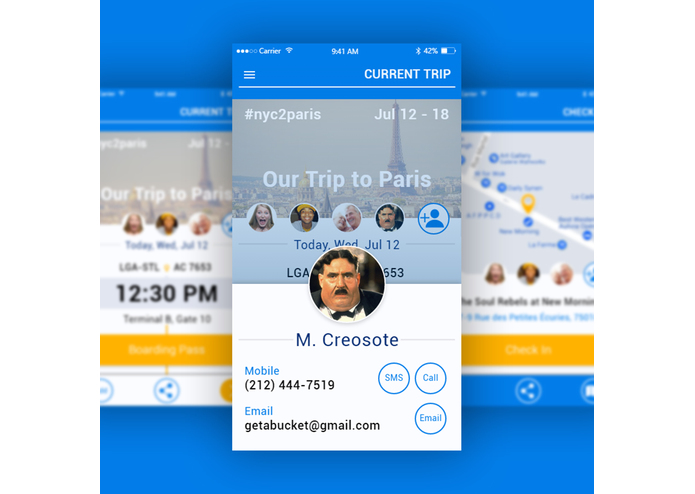
Contact information
-

Location sharing and navigation
-

Current trip itinerary
-

Document and reservation management


Inspiration
The general problem for Viaggio to solve revolved around some emerging opportunities within the travel industry anticipated a shift in how people plan and share their travels. In particular, they hoped to gain a foothold within a specific segment of travel, transit and documents. Essentially, they needed an innovative solution to address the when, where, and how travelers reach their destinations.
The target demographic, so-called “Adventurers”, consisted of individuals between 20 and 40 years of age, occasional group travellers, single or newly married with no children and limited disposable income.
What it does
Viaggio is a cross platform, transit and document management app for travelers that allows them the freedom to travel with confidence and stay in touch with those who matter most. My prototype is intended to be used as a one-stop-shop for keeping track of your travel plans and sharing updates with friends and family.
How I built it
Some of the tools I utilized in the development of the Viaggio prototype included: *Sketch *Adobe XD *Photoshop *Illustrator *Camtasia 8 *Good 'ol pencil and paper
Challenges I ran into
Building a form language that could compete with the paper.
What I learned
I think the one of the most profound takeaways for me was that I fully realized the power of lists. That is, how much easier it is to implement a function utilizing them and how they are more readily understood by users as a form. Based on my research into this project, I also came to discover that for all the advanced features and computing power available in modern devices most people still rely on old-school, analogues, i.e., physical documents when travelling.
What's next for Viaggio
More user research, specifically A/B testing of various portions of the app (for instance, contact sharing, itinerary view), and perhaps a more functional, web-based prototype.
Built With
- adobe-illustrator
- adobe-xd
- invision
- photoshop
- sketch
