-
-
Welcome Page (Cropped)
-
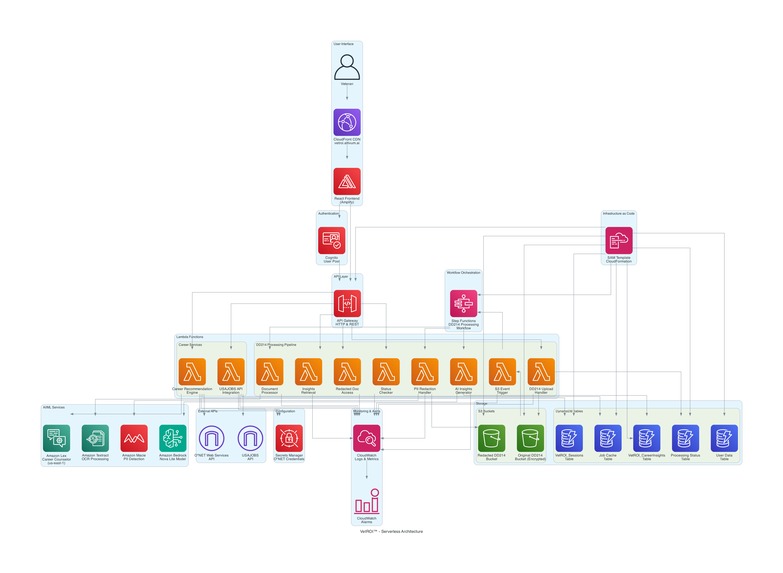
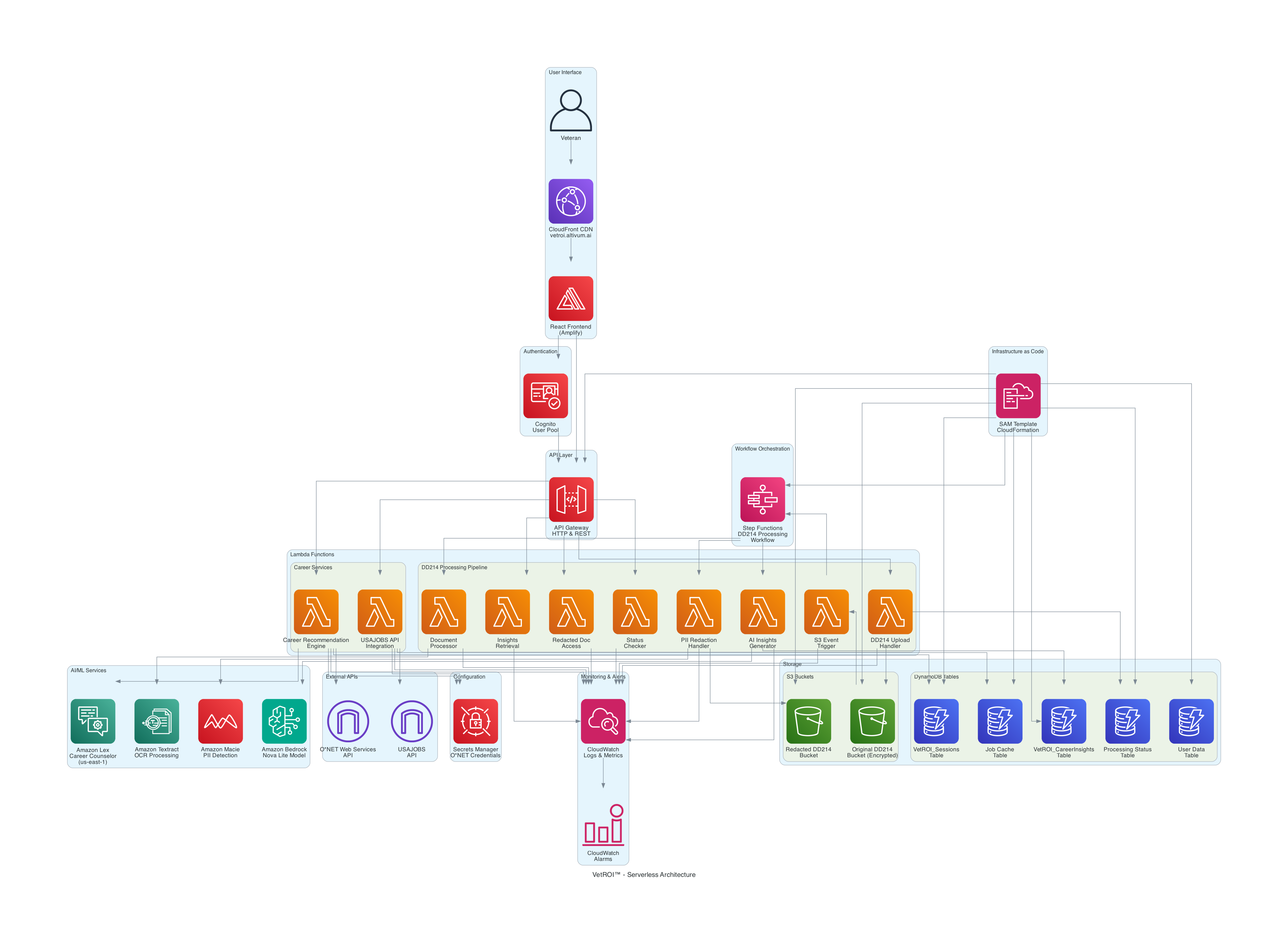
VetROI Architecture (Updated 28JUN to include USAJOBS API integration which provides veterans with personalized job listings)
-
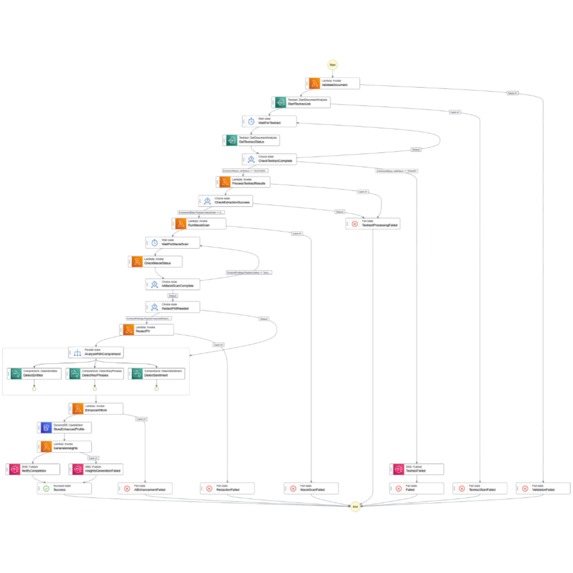
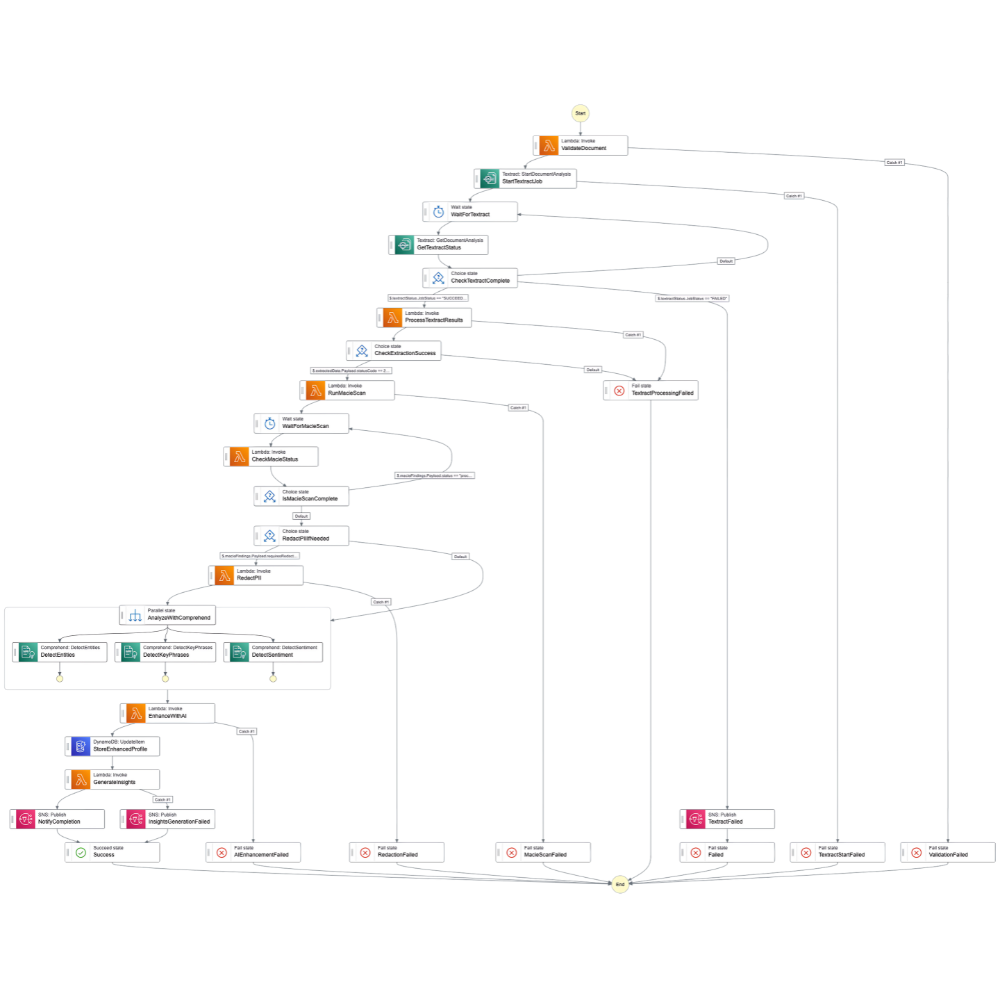
VetROI™ Step Function (Updated with phase-based fail states 29JUN)
-
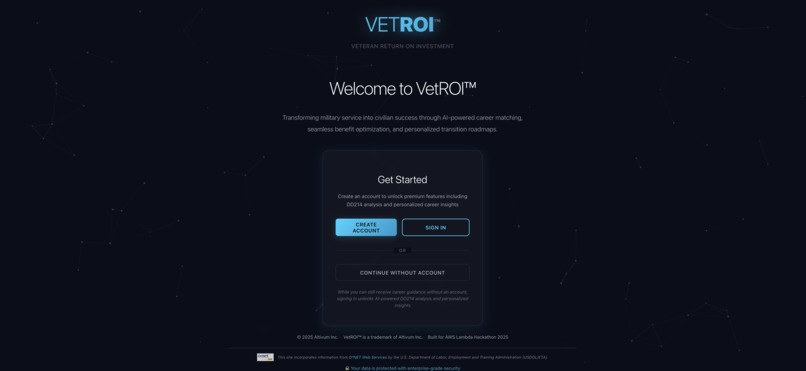
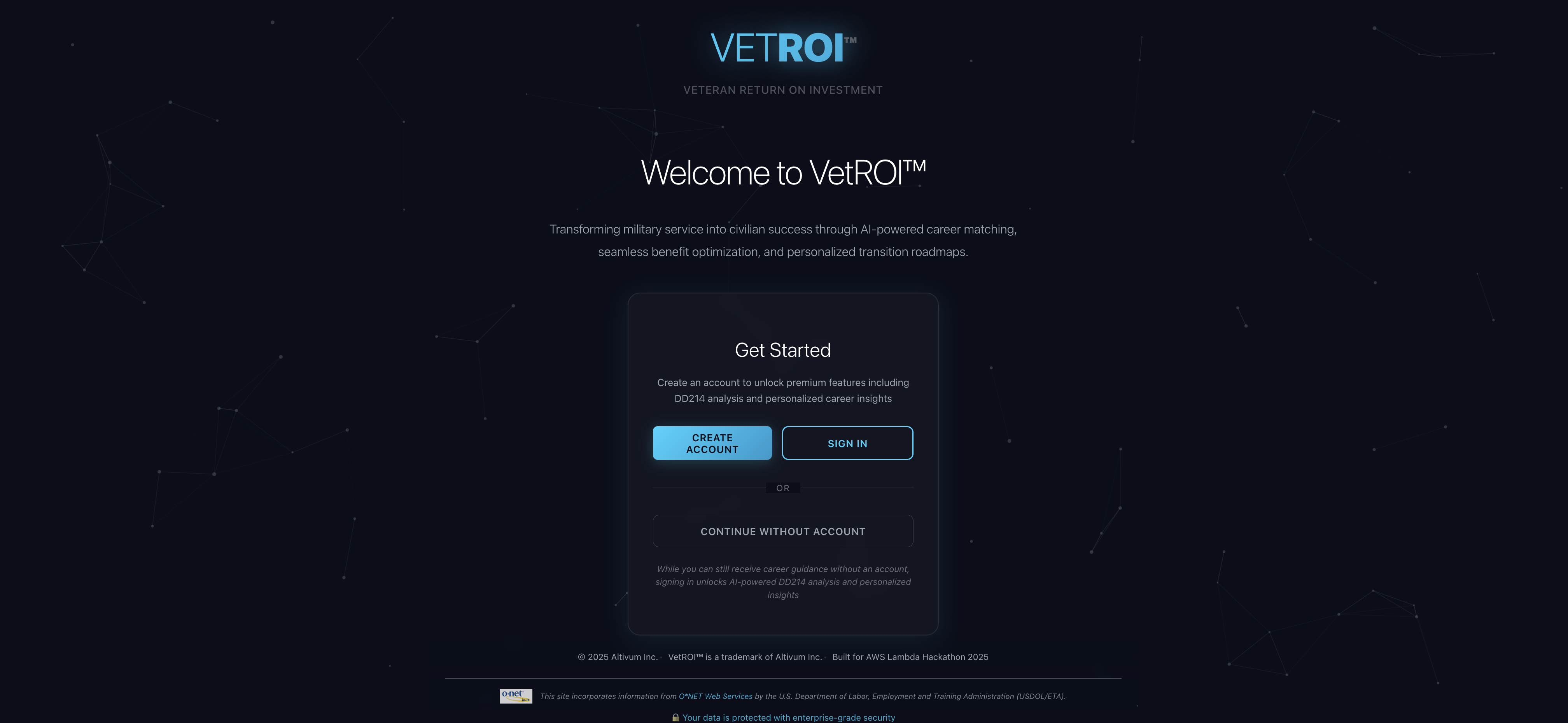
Welcome Page (Full)
-
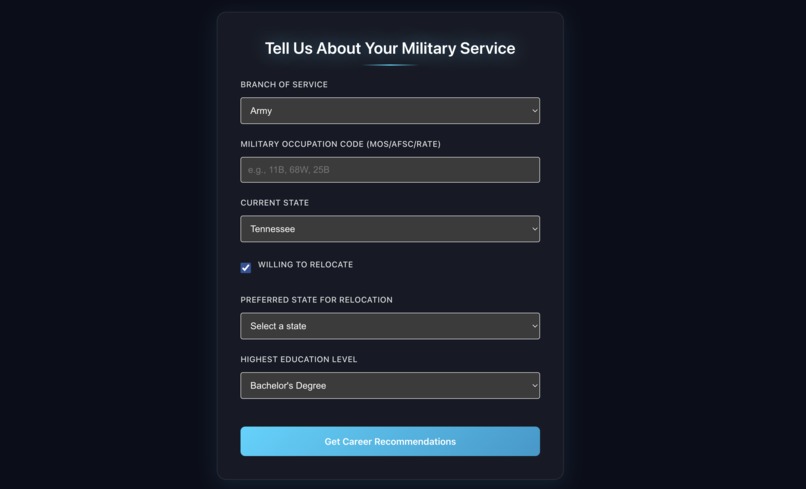
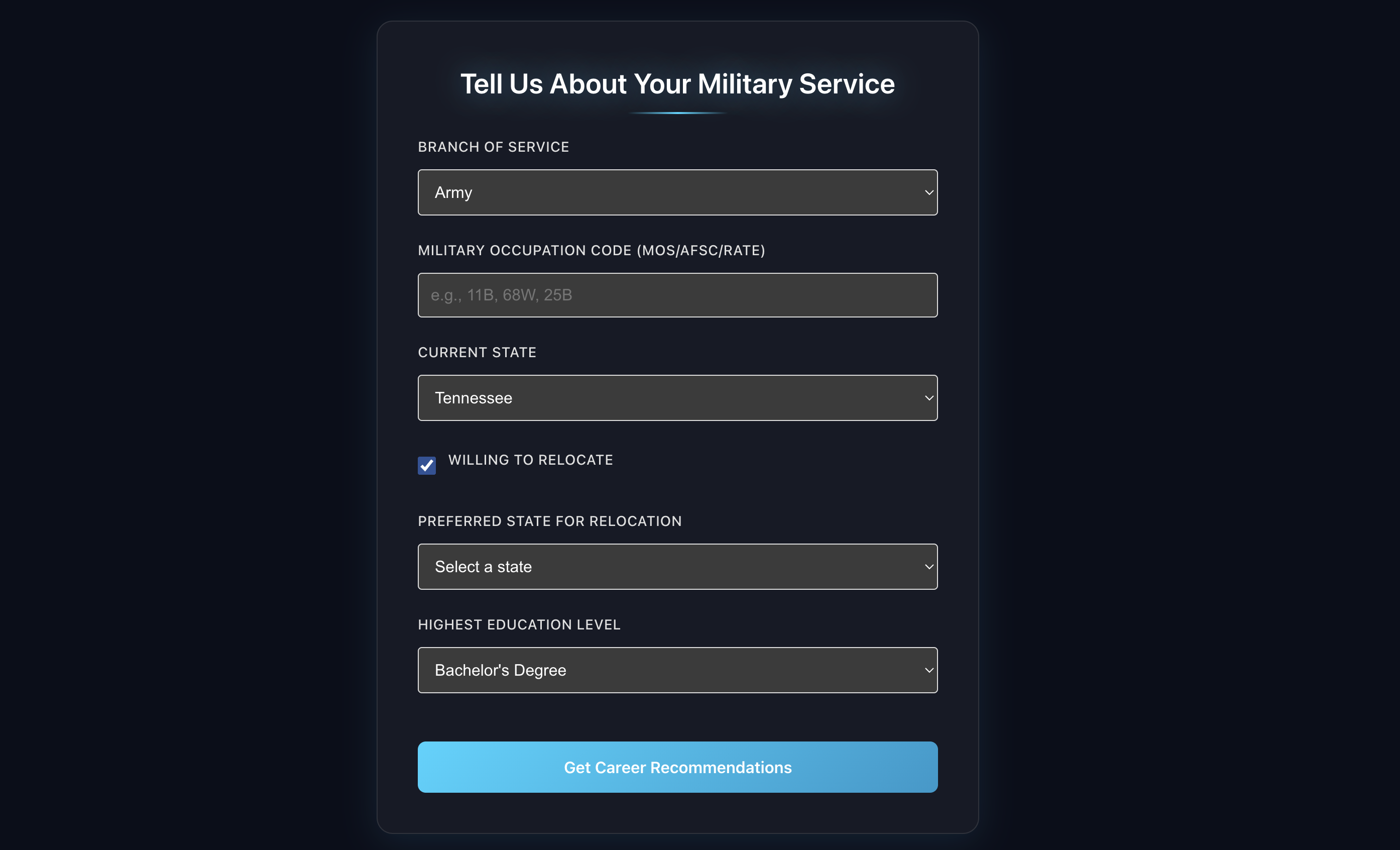
Initial data input
-
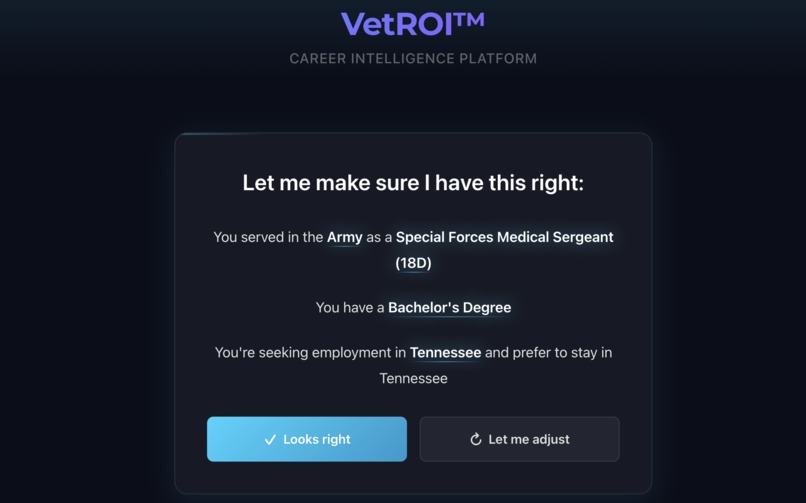
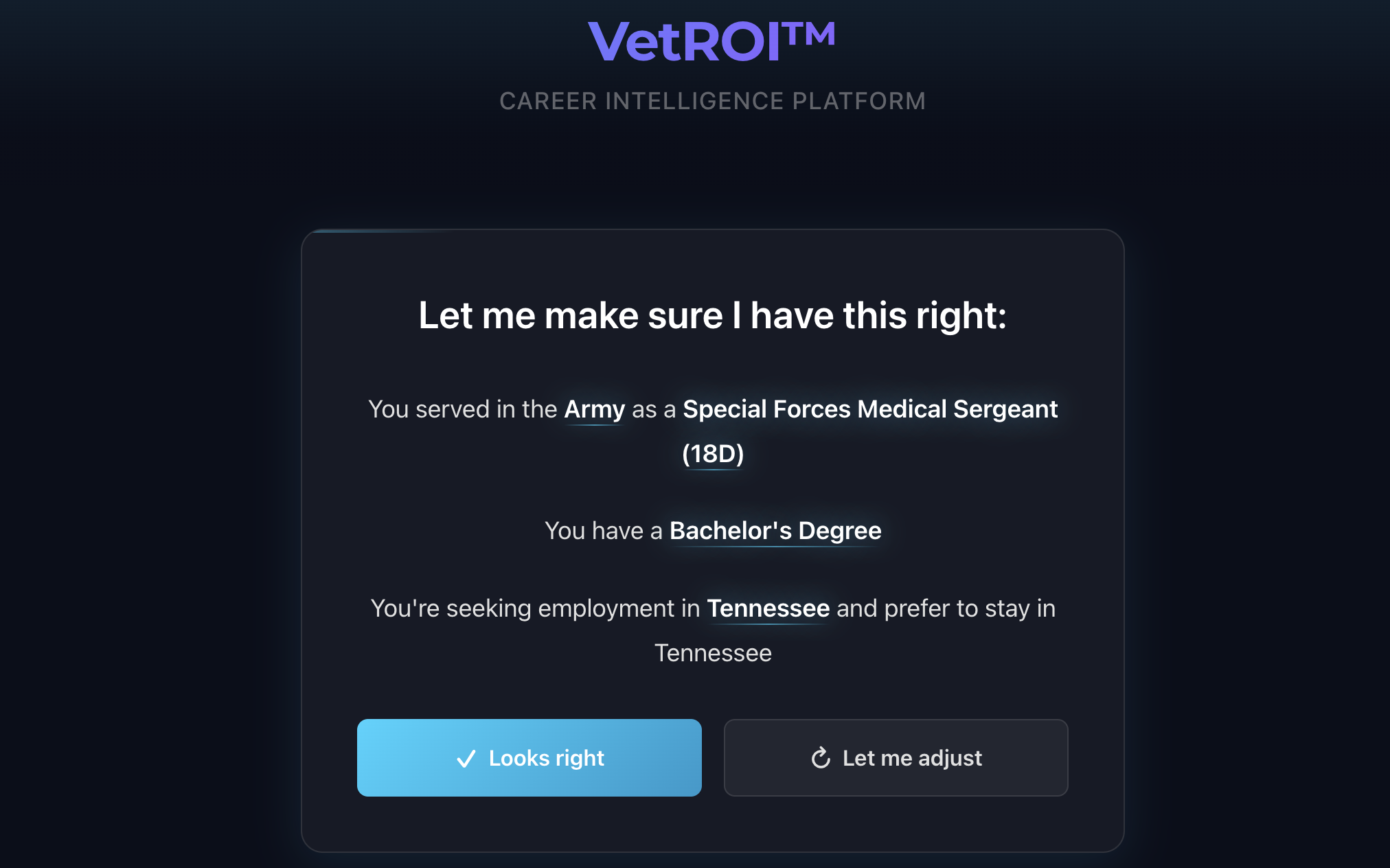
System confirmation after ONET API contact
-
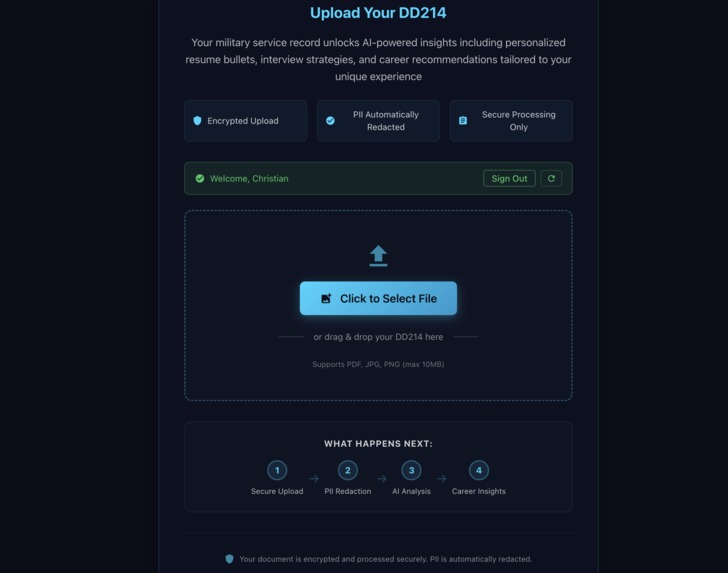
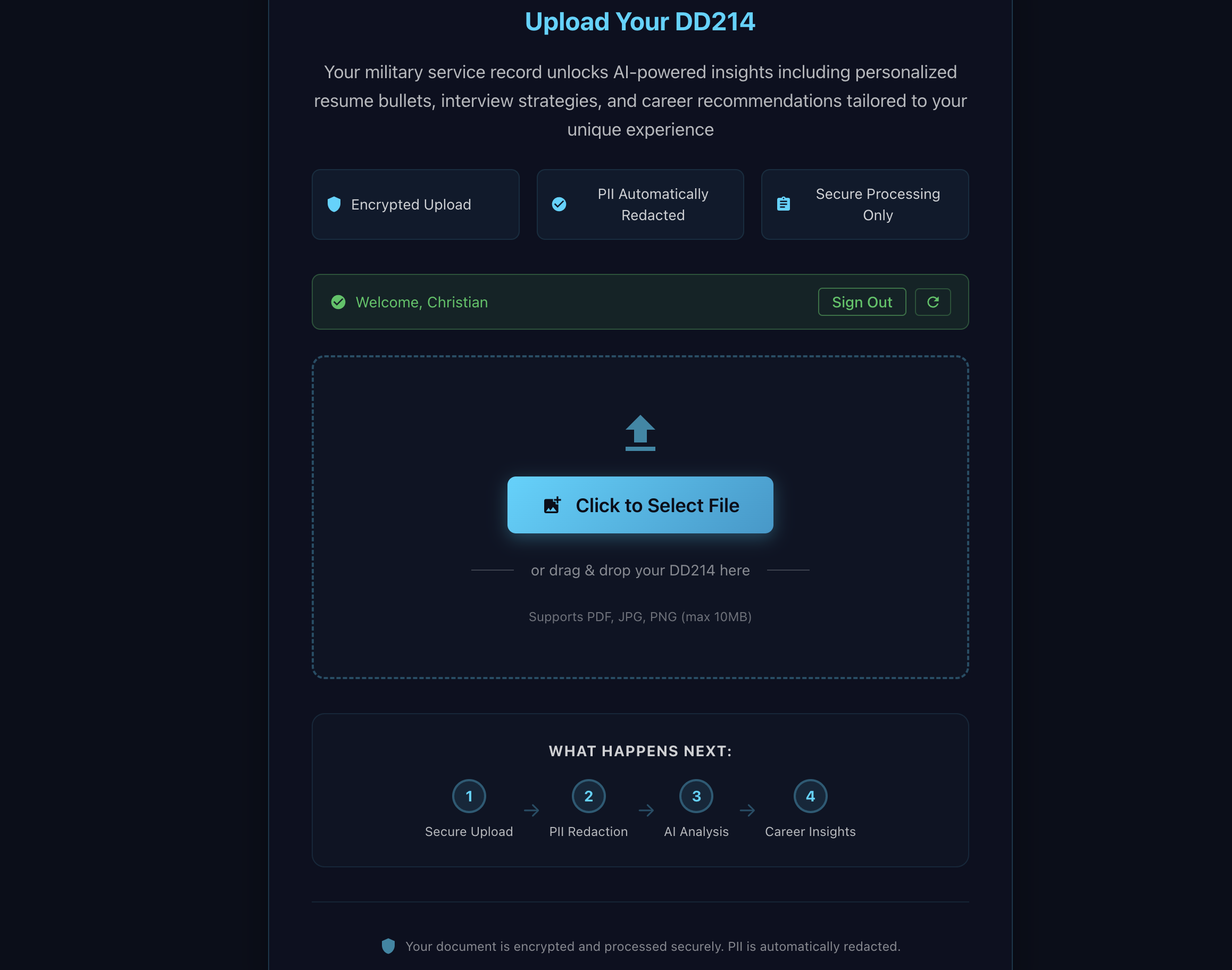
DD214 Upload Page
-
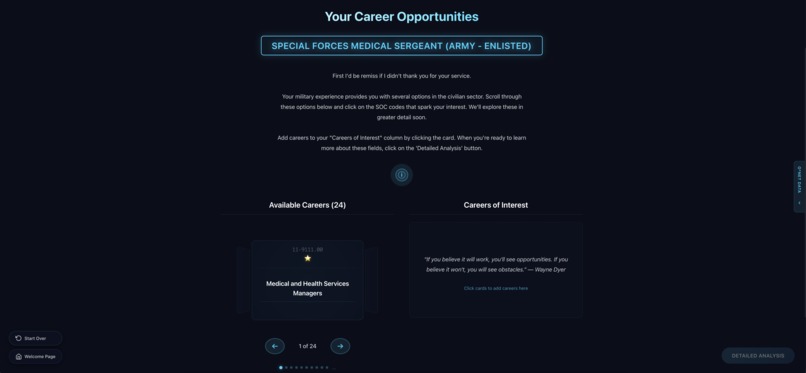
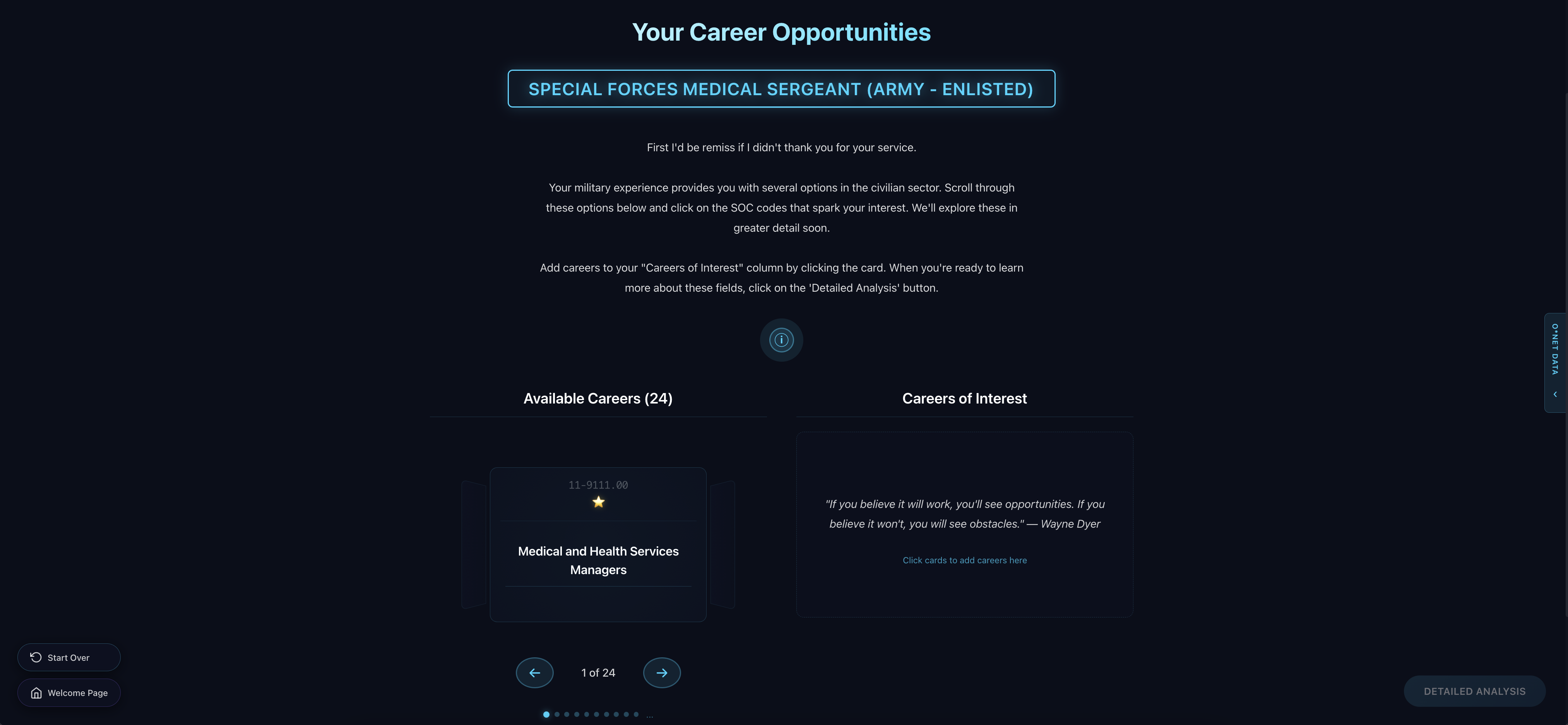
Career Opportunities Selection Page
-
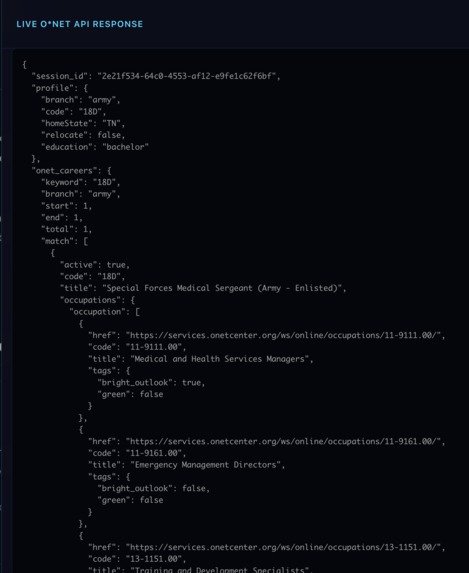
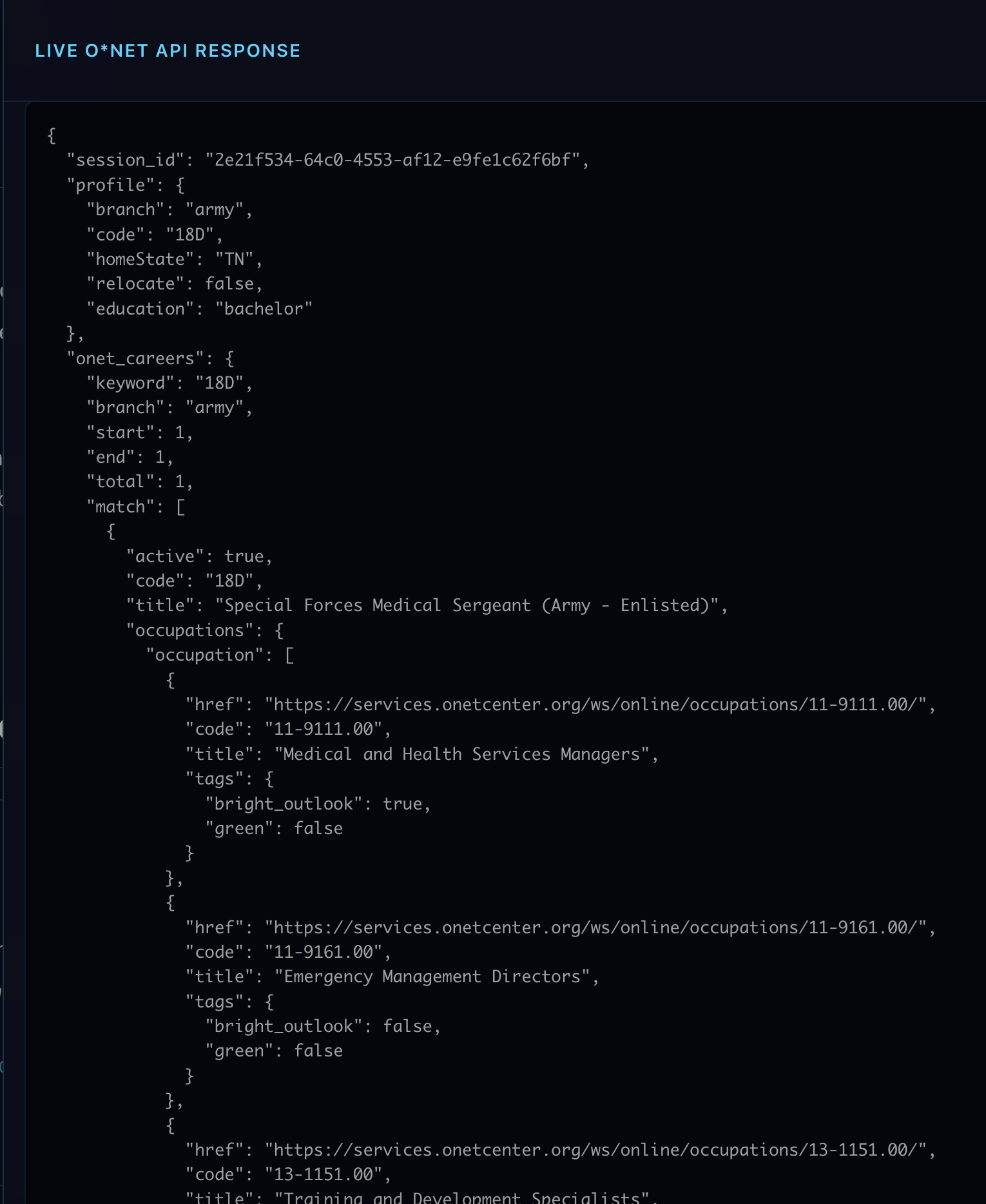
Sample Live ONET Data (Real API Call-Lists civilian sector SOC Codes that directly align with veteran's military job)
-
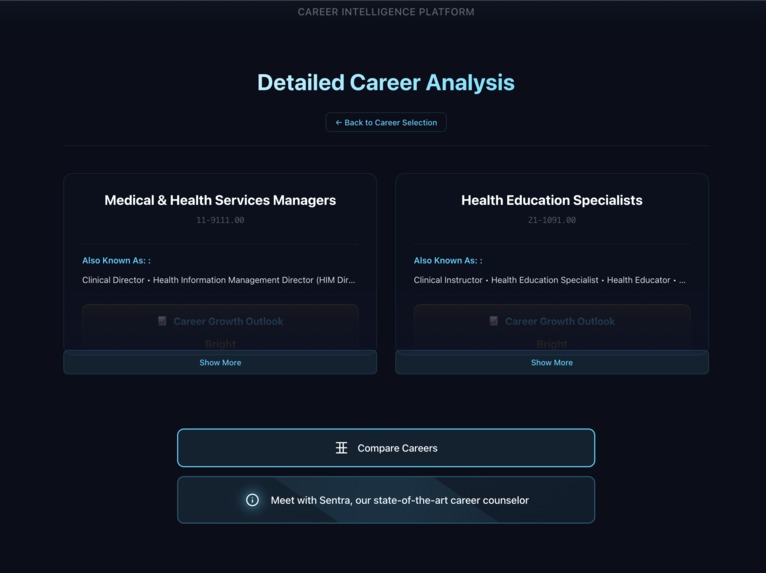
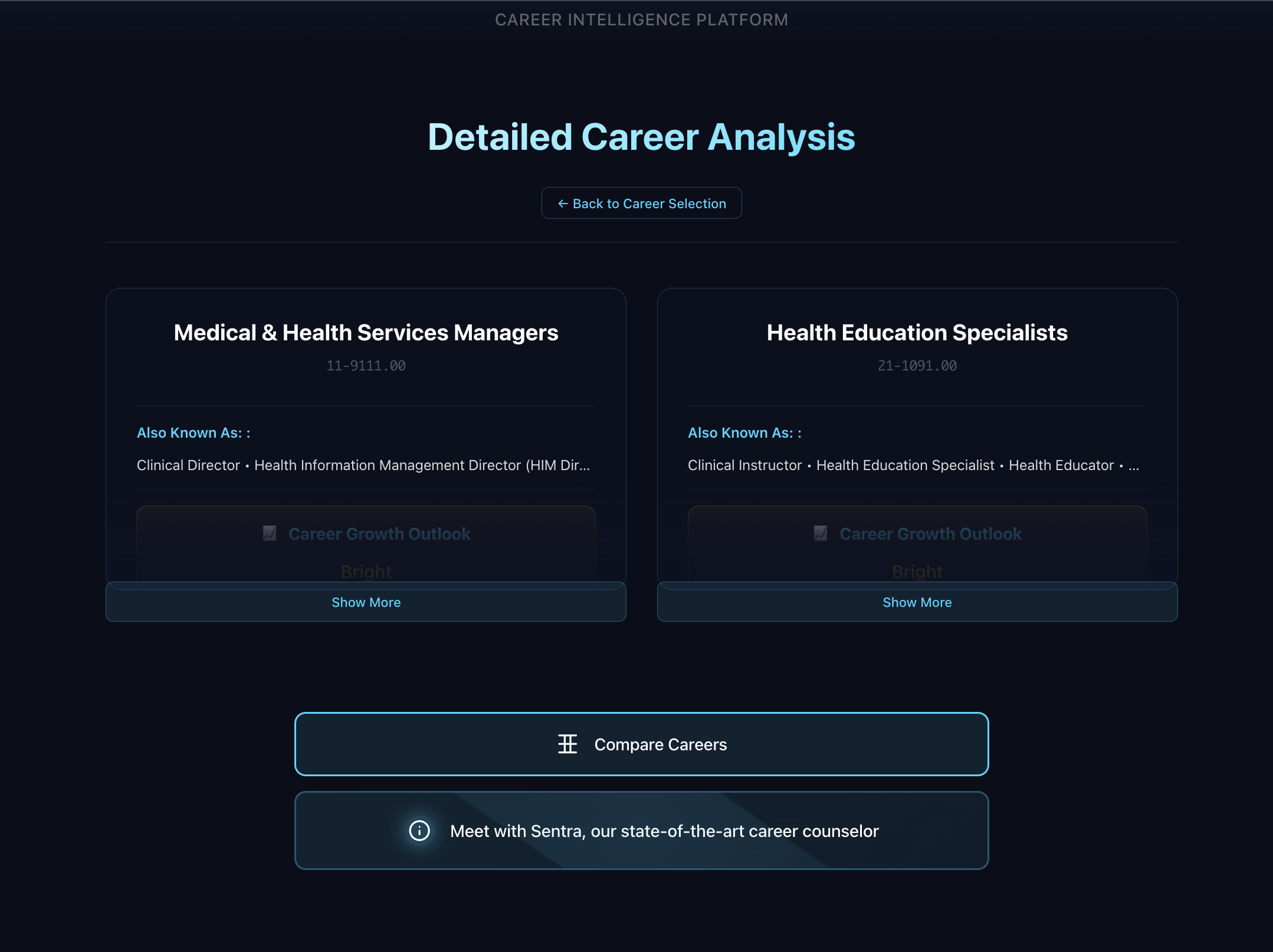
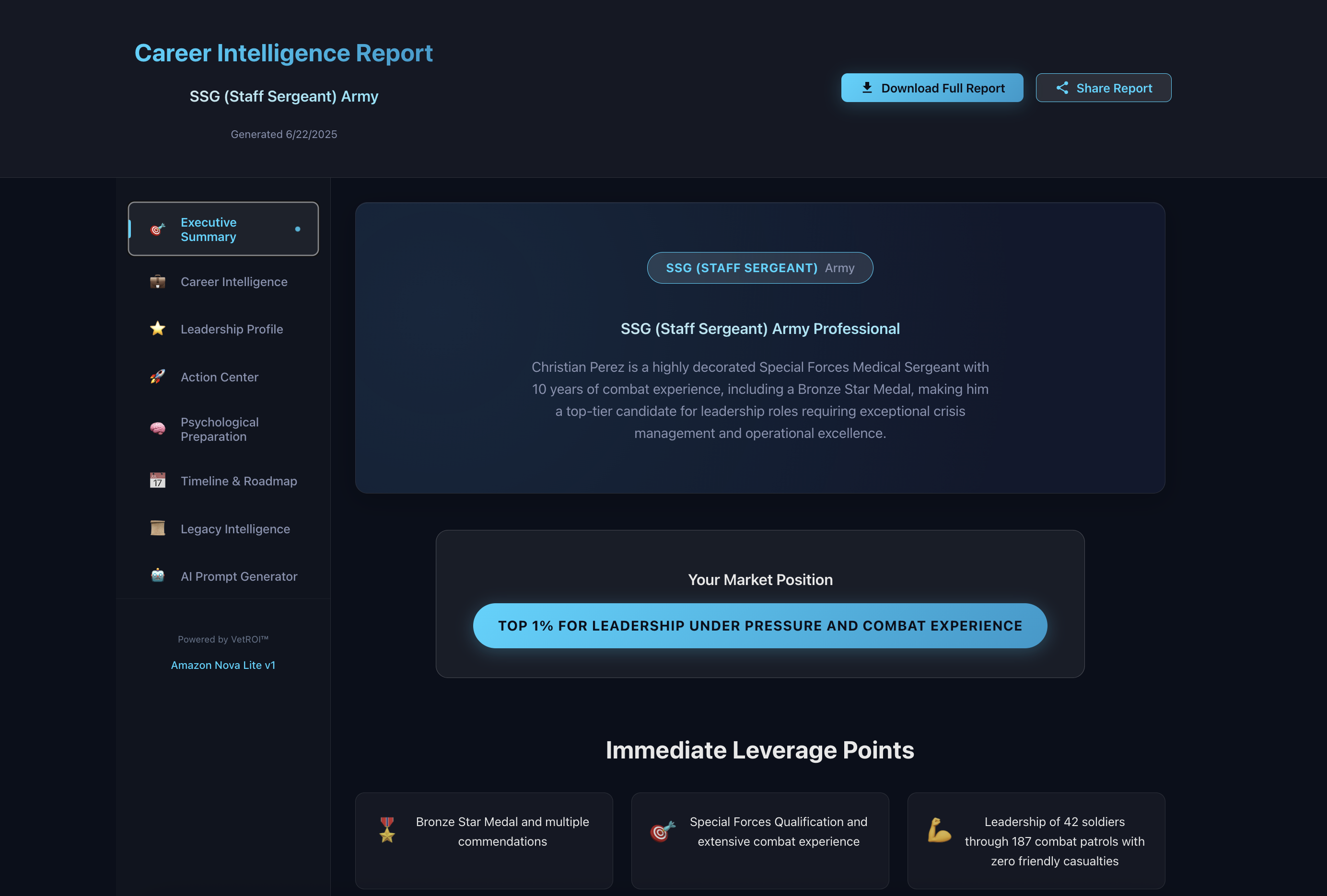
Sample career analysis (Cards Collapsed)
-
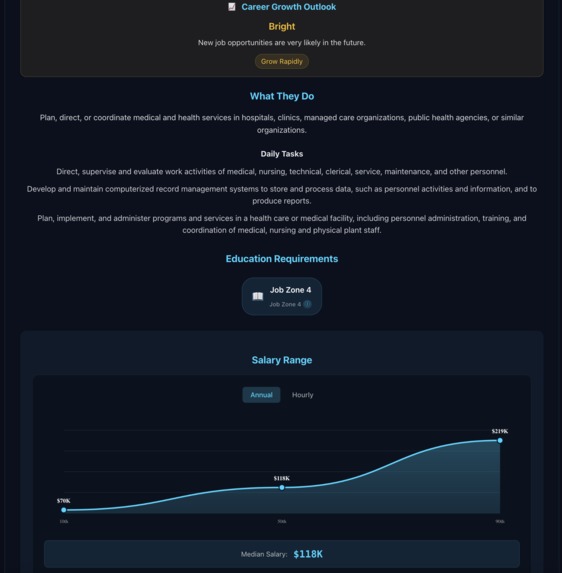
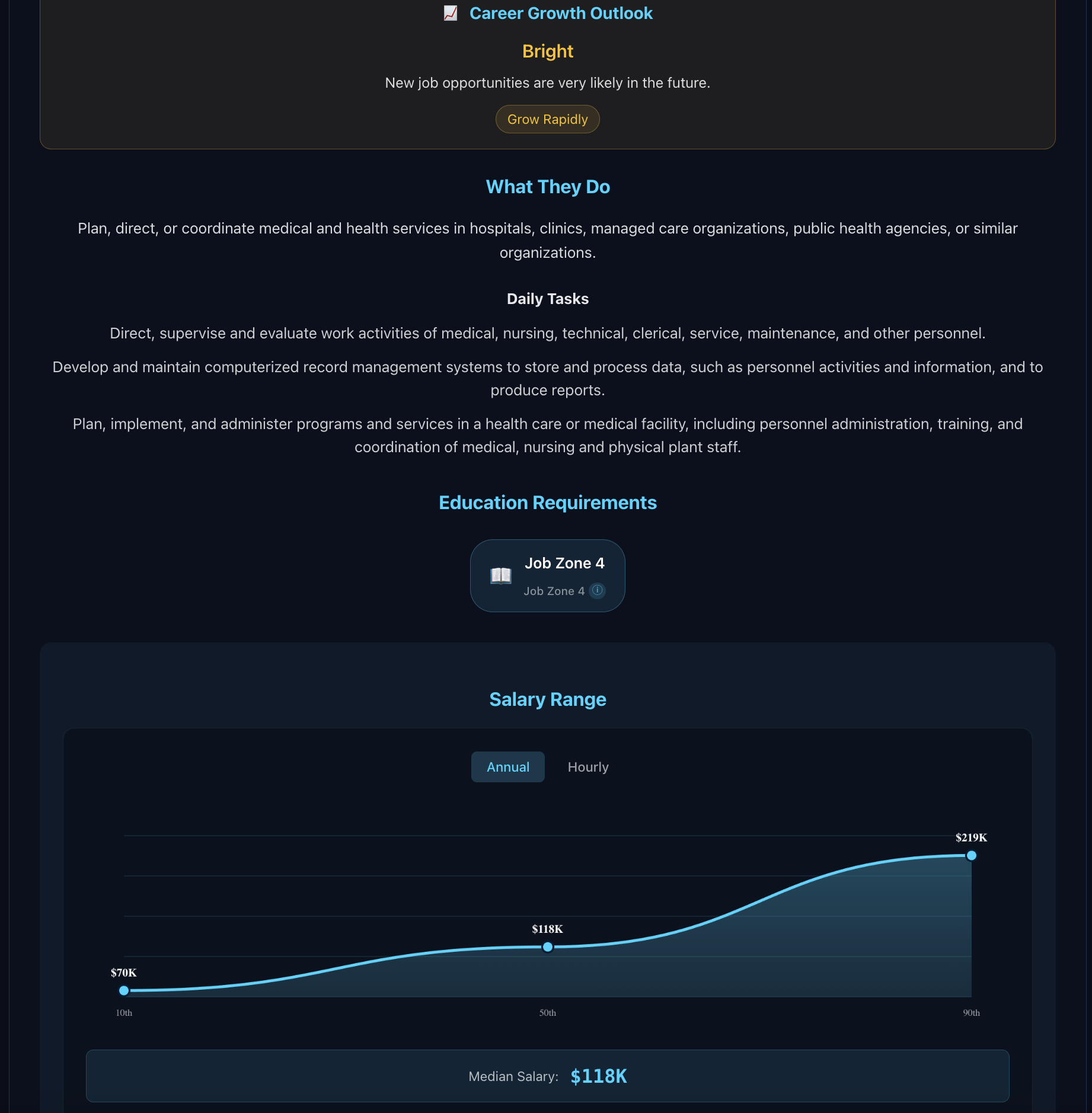
Excerpt sample of a detailed career analysis (Card Expanded)
-
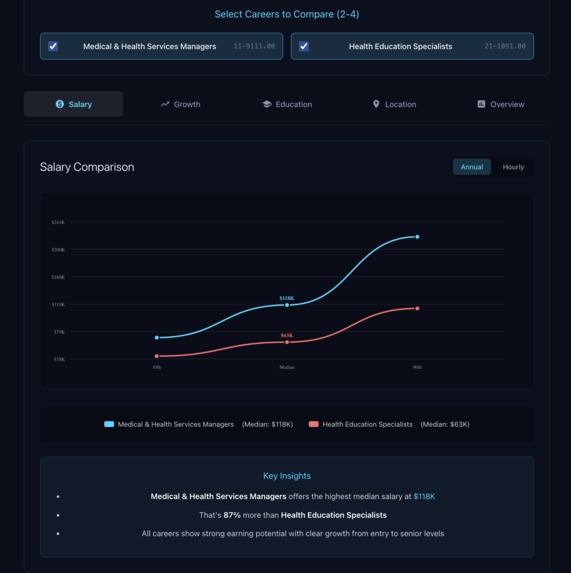
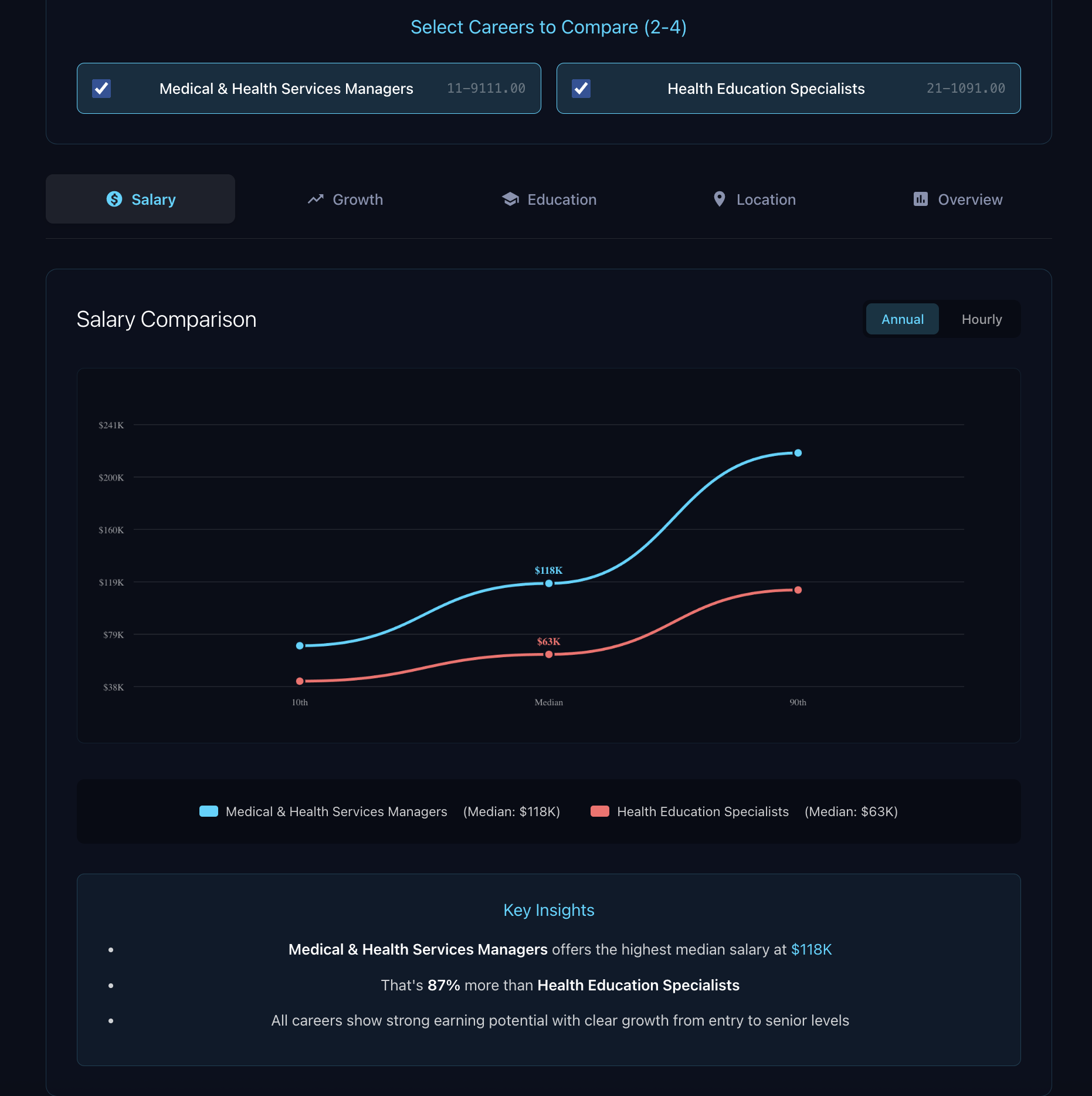
Excerpt sample of career comparative analysis (automatically enabled when 2 or more careers selected)
-
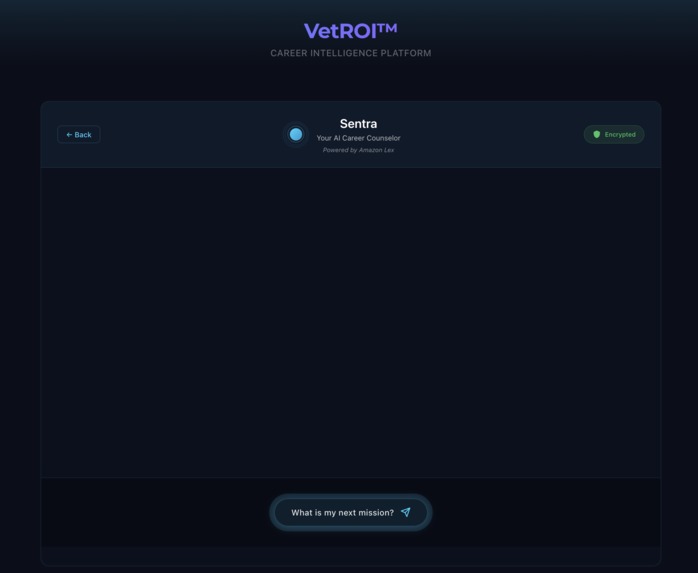
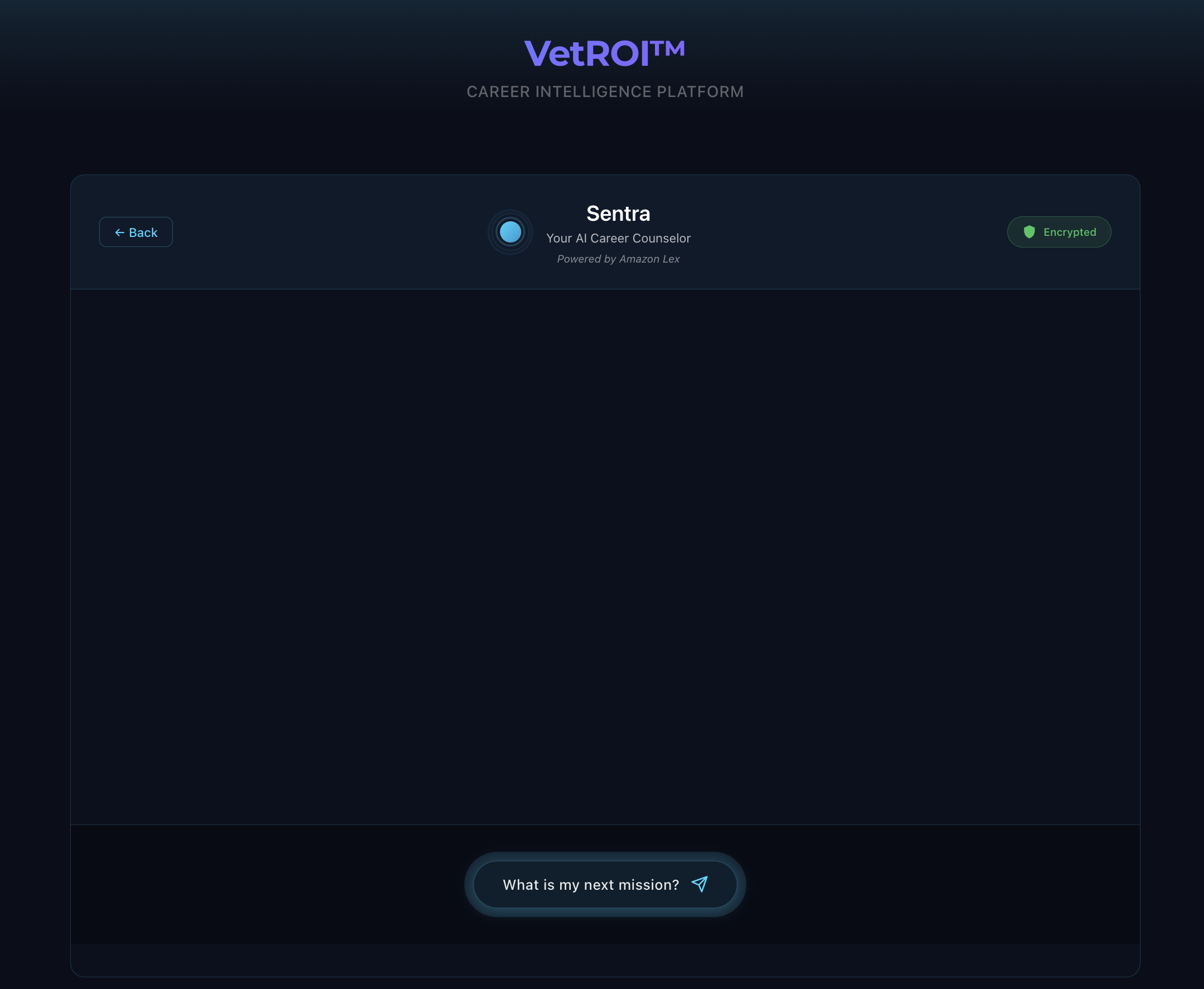
Sentra - Career Counselor chatbot beta
-
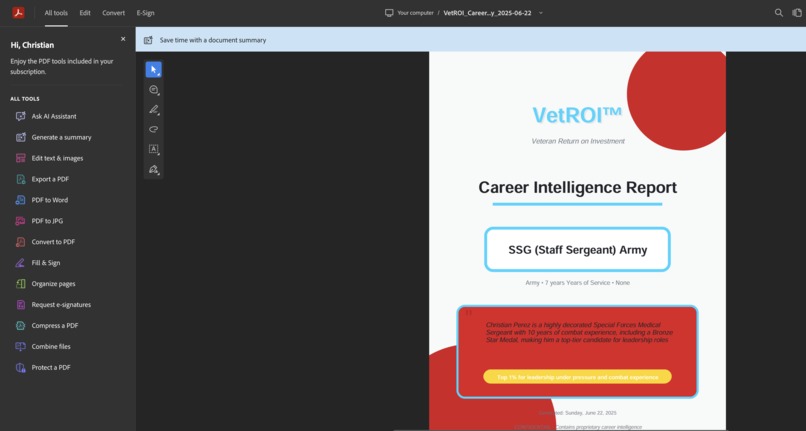
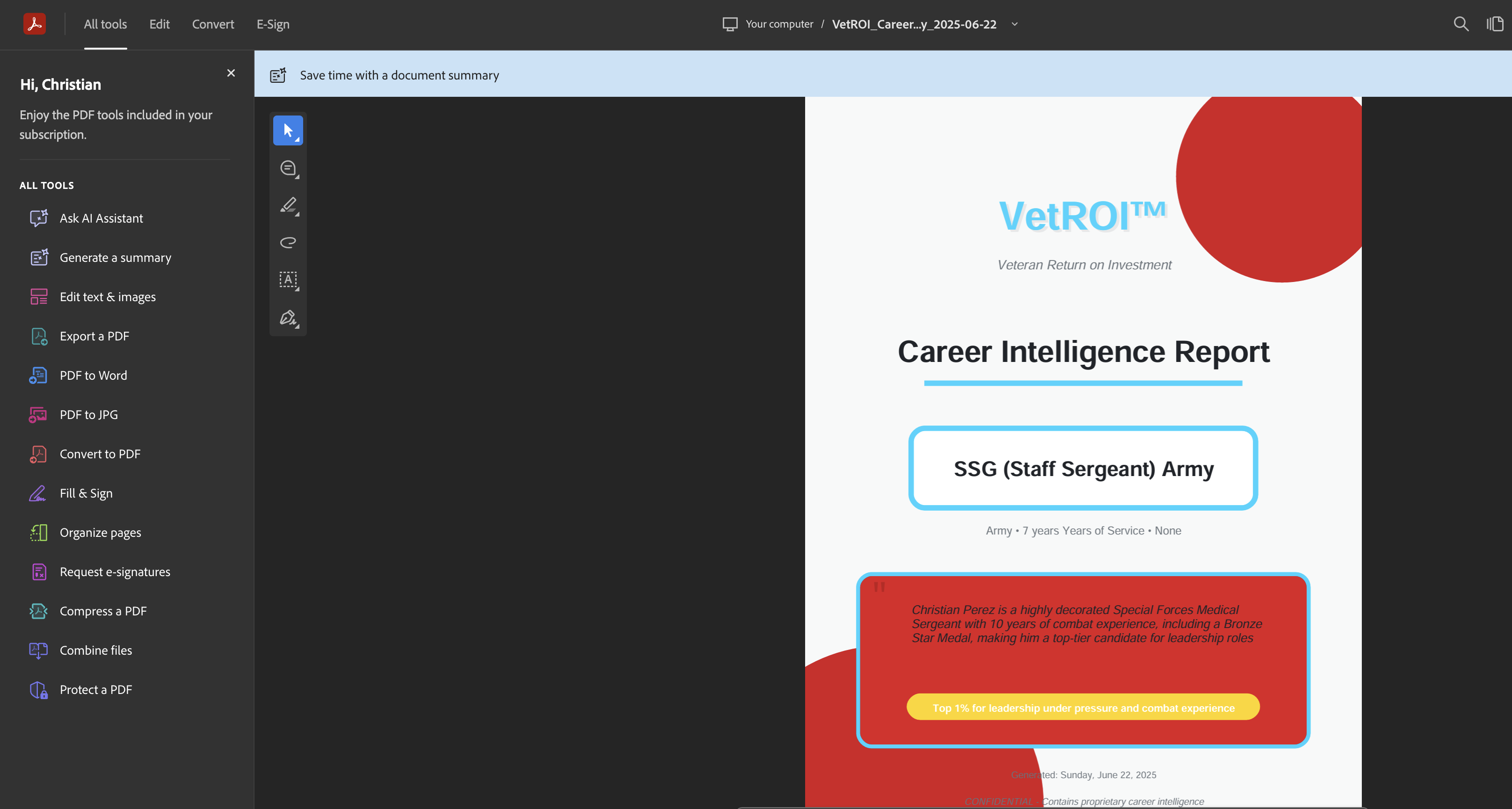
Sample Downloadable Career Report (Tailored to individual DD214)
-
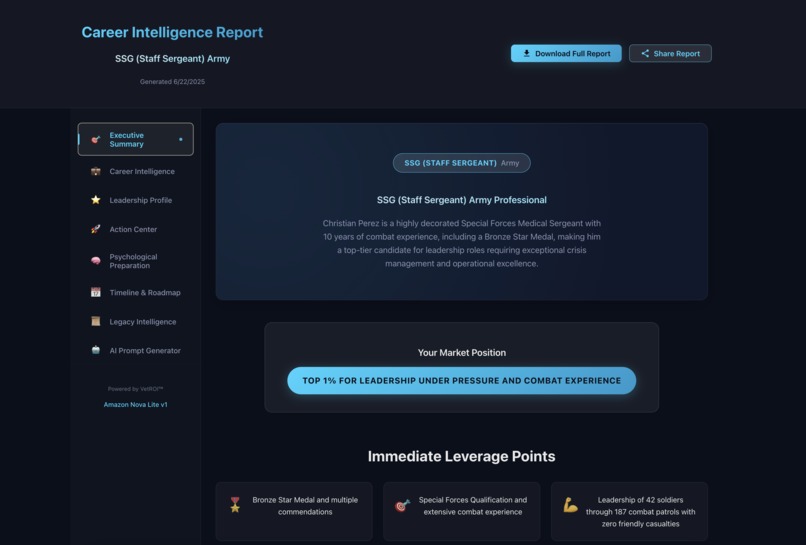
Sample DD214-Specific Career Analysis Report
-
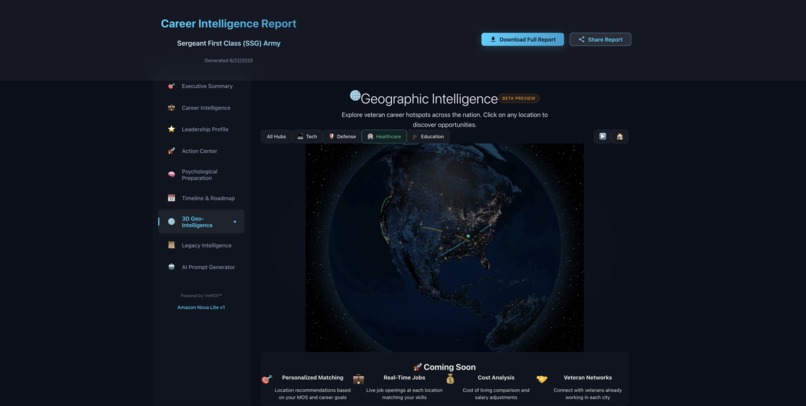
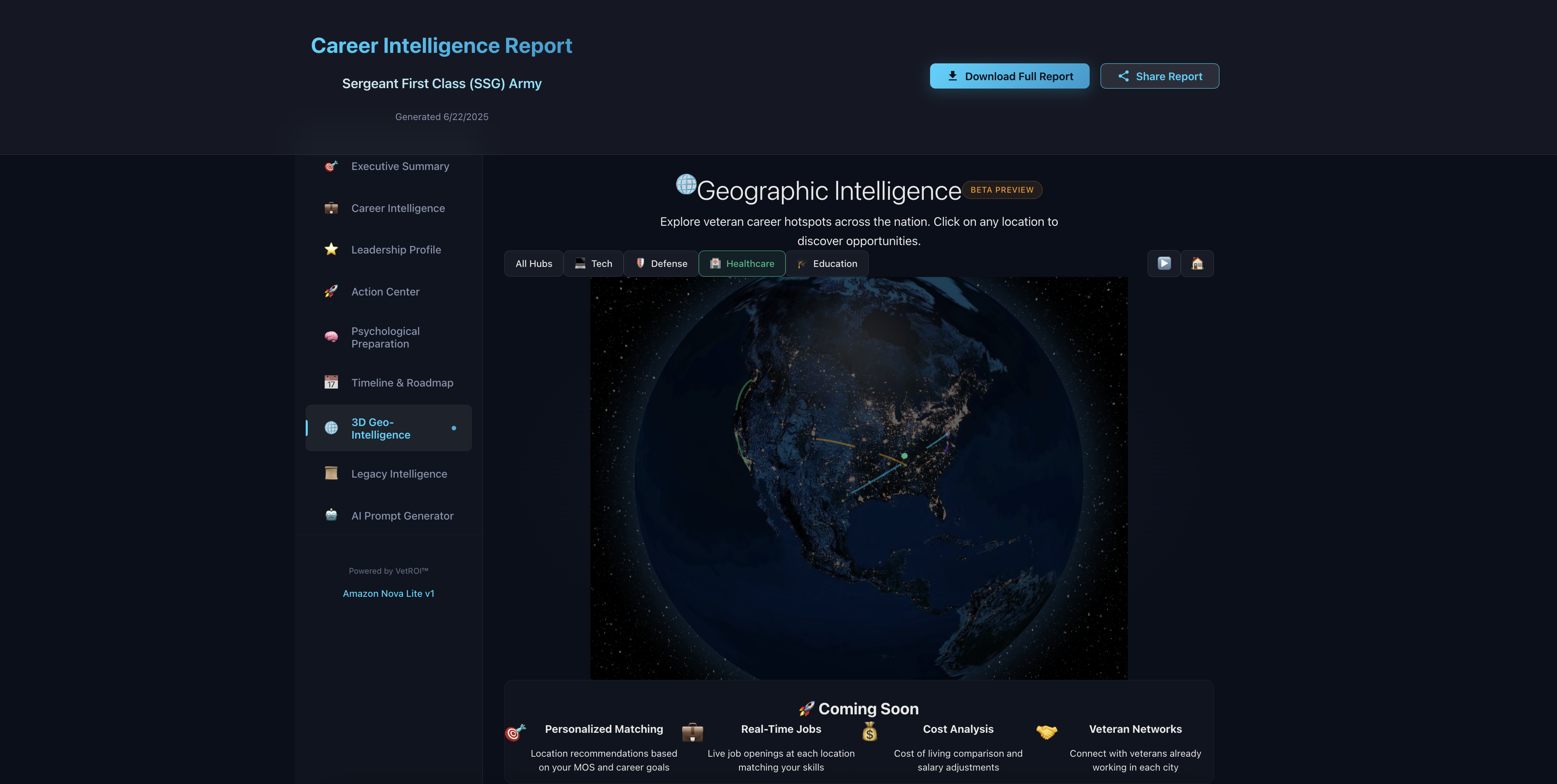
Geographic Intelligence (beta)
Inspiration
From a young age, I knew I wanted to serve my country. I felt a real inspiration and a calling to do so. As such I dedicated the second decade of my life to serving in the U.S. Army. The military shaped much of who I am today. It gave me discipline, purpose, and a profound respect for human life. In 2019, I deployed to Afghanistan and was awarded the Bronze Star—a moment I hold with deep humility and pride.
My name is Christian Perez, and my inspiration for VetROI™ begins where I thought my story of a career of service in the military had ended. I served as a Green Beret; a Special Forces Medic in the United States Army. After over a decade of service, I made the difficult decision to transition out of the military. In 2022, I was honorably discharged, and like every service member before me, I was handed my DD214—a single sheet of paper that attempts to summarize a lifetime of service. On it are your awards, deployments, duty stations, qualifications, and trainings. It's both a resume and a memorial to everything you did in uniform.
But here’s the hard truth: that story is a difficult one to articulate outside of the military.
Despite my background in trauma medicine, and high-stakes decision-making, I struggled to enter the civilian workforce. For more than a year, I sent out resumes, I interviewed, and I networked. Despite these efforts, I began to feel what so many veterans feel after leaving the service: a loss of identity, a loss of relevance, and a creeping fear that my best years were behind me.
I wasn't broken. I was invisible.
That’s when I made a decision—not to give up, but to reinvent.
In February 2025, I stumbled into the world of cloud computing. I had never written a line of code. I had never taken a computer science class. But what I found in AWS was a revelation: a platform powerful enough to build real systems—and accessible enough that someone like me could do it.
I learned everything I could. I earned my AWS Cloud Practitioner and AI Practitioner certifications through Skill Builder. I learned about Lambda, API Gateway, DynamoDB, and Bedrock. I built my first prototype using PartyRock. I wasn’t just building tech—I was rebuilding my identity.
Out of that journey came Altivum Inc., a public benefit corporation I founded with a mission to help veterans rediscover purpose through AI.
VetROI™—Veteran Return on Investment—is the embodiment of that mission. It’s a system that looks at your DD214 not as a document of the past, but as a blueprint for your future. A tool that translates your military experience into real civilian opportunity.
What it does
VetROI™ (Veteran Return on Investment) is a serverless AI-powered career intelligence system that redefines how veterans transition from military to civilian careers. Rather than providing generic job suggestions or résumé tips, VetROI delivers data-driven, personalized insights rooted in each veteran’s unique service record.
The DD214.
This one-page discharge form holds everything—awards, deployments, MOS codes, qualifications, and leadership roles. But to most employers and job platforms, it’s unreadable. VetROI unlocks the story inside.
Privacy and Security
Military records contain highly sensitive information. VetROI uses Amazon Macie to automatically detect and redact PII, such as Social Security numbers and home addresses. Documents are stored in encrypted S3 buckets with tightly scoped IAM access, ensuring full privacy protection for each veteran.
Intelligent Document Parsing
With Amazon Textract, VetROI converts the unstructured DD214 into structured data, identifying:
- Military Occupational Specialties (MOS)
- Rank and duty station history
- Specialized training and certifications
- Deployment cycles and combat tours
- Awards, commendations, and leadership roles
This information forms the foundation of a veteran’s career intelligence profile.
Military-to-Civilian Translation
VetROI’s translation engine recognizes that “Squad Leader” doesn’t just mean supervising a few people—it means managing personnel, equipment, logistics, and crisis decision-making in complex environments. The system quantifies these responsibilities and translates them into business-relevant, high-impact civilian competencies.
O*NET Mapping & Market Intelligence
Using the Department of Labor’s O*NET database, VetROI maps military experience to over 1,000 civilian careers. But it doesn’t stop at simple skill matching. It analyzes:
- Salary distributions by location and skillset
- Industry growth trends and automation risk
- Location quotients for wage premiums
- “Bright Outlook” occupations with long-term relevance
This creates a strategic career map, not just a list of jobs.
AI-Powered Career Summaries
Using Amazon Bedrock and the Amazon Nova Lite v1 LLM, VetROI generates narrative summaries that:
- Translate experience into executive-caliber career stories
- Recommend specific job titles, companies, and certifications
- Position security clearances as $20–40K annual compensation multipliers
- Frame military achievements in corporate-ready language
- Guide veterans through interview prep, networking scripts, and self-advocacy strategies
Beyond Skills Matching: Total Transition Intelligence
VetROI doesn't stop at “you’d be good at logistics” or “you should try management.” It produces a comprehensive career intelligence report, including:
- Personalized civilian career summaries
- Salary forecasts (conservative, market, aggressive)
- Role-specific breakdowns and rationale
- 30-60-90 day transition plans
- Psychological support tips for imposter syndrome and reintegration
- Certification recommendations to close skill gaps
- Interactive dashboards linking MOS codes to career outcomes
Transparency + Control
The VetROI interface shows source data (e.g., raw ONET JSON response) side-by-side with transformed output. Veterans can trace each insight back to its origin and validate their next step with confidence.
Mission-Driven by Design
The military doesn’t just produce soldiers—it produces leaders, strategists, and problem-solvers. VetROI ensures those traits are recognized, translated, and rewarded.
How we built it
VetROI™ was architected as a serverless, event-driven system leveraging AWS's most advanced AI and machine learning services. I started with the core challenge: how do I transform a PDF document containing decades of military service into actionable career intelligence? My solution orchestrates multiple AWS services in a sophisticated pipeline that prioritizes security, scalability, and user experience.
The foundation begins with AWS Amplify hosting my React TypeScript frontend, providing a seamless CI/CD pipeline that deploys directly from our GitHub repository. When veterans upload their DD214, the system generates pre-signed S3 URLs through API Gateway and Lambda, ensuring secure direct uploads without exposing AWS credentials. This triggers our Step Functions workflow—the brain of the processing pipeline.
The Step Functions state machine coordinates a complex dance of services. First, Amazon Textract performs optical character recognition, extracting not just text but understanding the document's structure and identifying key fields like rank, MOS, and decorations. Simultaneously, Amazon Macie scans for personally identifiable information, automatically redacting SSNs, addresses, and other sensitive data. This dual-processing approach ensures we extract maximum intelligence while maintaining absolute privacy.
The extracted data flows into the Lambda functions, written in Python with careful attention to error handling. The system integrates with the U.S. Department of Labor, Employment and Training Administration's (USDOL/ETA) ONET Web Services API, mapping military occupational specialties to over 1,000 civilian careers. This isn't simple keyword matching—the system analyzes the deep relationships between military roles and their civilian equivalents, understanding that a "Combat Medic" maps not just to "EMT" but to roles in crisis management, healthcare administration, and emergency response leadership.
The crown jewel of this architecture is the integration with Amazon Bedrock and the Nova Lite v1 model. I engineered prompts that transform raw military data into compelling narratives. The prompts evolved from 500 to over 2,000 words, instructing Nova Lite to think like an elite military career strategist. The AI generates structured JSON responses with 50+ data points per veteran, including salary targets, company recommendations, and personalized action plans.
For data persistence, I chose DynamoDB for its serverless scaling and consistent performance. Everything from session data, processing status, and generated insights with careful attention to data modeling and access patterns are stored here. The CloudFormation templates ensure infrastructure as code, making the entire system reproducible and maintainable. The frontend receives real-time updates through polling, showing veterans their processing progress with an engaging interface that includes book promotions and survey questions during the 2–3 minute wait time.
I would be remiss if I did not express genuine appreciation for the sophisticated AI technologies we have today. I don’t have a team to work with nor do I have the coding experience to seamlessly write every line of code in this software. As such I had to leverage every available resource to bring to the forefront a product that truly can impact lives. I am truly grateful to have been able to leverage Amazon Q Developer Pro and Claude Code. This highly iterative and complex process would take weeks if not months to put together. With the help of these state-of-the-art systems, iterating, debugging, and refining became infinitely less tedious which allowed me to go from first line of code to full production in less than one month. The AI assistants helped debug Lambda integration issues, optimize DynamoDB queries, and even refine the UI components—turning what would traditionally be a large team effort into a solo developer's achievable mission.
Challenges we ran into
The journey building VetROI™ encountered several significant technical and design challenges that pushed me to innovate.
One particularly complex challenge was preventing AI hallucination while maintaining engaging, personalized output. Early iterations of the Nova Lite prompts produced generic recommendations that could apply to any veteran. I discovered that the AI would sometimes invent military experiences or assign achievements that weren't in the source document. This led to a complete prompt engineering overhaul, where I implemented strict JSON schema validation and explicit instructions to only use verified DD214 data.
Security and privacy presented another layer of complexity. Military documents contain highly sensitive information, and veterans rightfully expect maximum protection.
Performance optimization became critical when I expanded the AI responses from simple career matches to comprehensive reports.
The frontend presented unique challenges in creating an interface that honored military service while appealing to modern design sensibilities. The initial designs were too bland, lacking the gravitas veterans deserved. Through multiple iterations, I opted for a dark glassmorphic theme with cyan accents that convey both technological sophistication and military precision. The TypeScript migration added complexity but proved essential for maintaining code quality as our component library grew.
Accomplishments that we're proud of
I cannot express anything short of genuine gratitude for the opportunity to create a system that transforms a simple document upload into comprehensive career intelligence in under three minutes. But far more important than the technological coordination this project required, VetROI and the AI-powered insights it generates understand the hidden value in military service. When a former medic like myself uploads their DD214, VetROI doesn't just suggest EMT jobs; it identifies opportunities in crisis management, security consulting, and healthcare technology.
One of VetROI™'s most impactful achievements is its remarkably efficient cost structure. Leveraging AWS's serverless infrastructure, we've optimized our architecture to deliver DD214 analysis at an average estimated cost of approximately $0.25 (at the high end) per document. This cost encompasses the full end-to-end workflow, including Amazon Textract OCR (~$0.015), Amazon Macie PII scanning (~$0.040), Lambda execution time across all processing functions (~$0.087), Bedrock inference using Nova Lite (~$0.100), and S3 storage (~$0.005). These figures represent averages based on observed benchmarks across test cases and early usage patterns. The per-document cost includes everything from secure upload through AI-powered career intelligence generation, including multi-thousand-token responses with personalized civilian career pathways.
It’s important to note that these costs will become more precise and actionable with granular system observability. As we continue to implement more robust tagging, usage attribution, and cost monitoring, we’ll gain even deeper visibility into function-level compute performance and memory efficiency. This will allow us to identify targeted optimization opportunities, from reducing payload size and cold start latency in Lambda, to refining AI inference strategies. Even so, the existing model already demonstrates scalability: serving 1,000 veterans per month would cost approximately $250 in AWS infrastructure, while serving 10,000 veterans—roughly 5% of all annual transitions—would cost just $2,500 per month. With serverless pricing, we incur no idle overhead; we only pay for what we use. This architecture enables us to offer free or low-cost access to all veterans, pursue sustainable monetization through premium features, and even support federal contracts—while maintaining the potential to serve all 200,000+ transitioning veterans annually for under $50,000 in infrastructure spend.
The privacy-first architecture stands as a significant achievement. By implementing automatic PII redaction with Amazon Macie, we've created a system veterans can trust with their most sensitive documents. The redacted documents maintain all career-relevant information while protecting personal data—a balance that took considerable engineering effort to achieve.
The sophistication of our AI prompts represents a breakthrough in military-to-civilian translation. Nova Lite can understand military culture, recognizing that "sustained superior performance" means top 10% and that "Joint Task Force experience" signals exceptional stakeholder management skills. Our prompts generate not just job recommendations but complete narratives—1,500-word legacy reports that transform military service into compelling civilian value propositions.
The user interface showcases our commitment to honoring veterans while delivering modern functionality. The refined design system with its 8-pixel grid, smooth animations, and glassmorphism effects creates an experience that feels premium yet approachable. Every data point from our AI-enhanced responses displays beautifully, from the executive summary's shimmer effects to the interactive timeline showing 30-60-90 day roadmaps.
I am particularly proud of our PDF generation system, which produces professional reports rivaling those from expensive career consultancies. The enhanced generator creates visually stunning documents with gradient backgrounds, modern typography, and data visualizations that veterans can confidently share with potential employers. This isn't just a printout—it's a career intelligence dossier that commands attention.
What we learned
Building VetROI™ taught me that the intersection of military experience and artificial intelligence requires deep domain knowledge and cultural sensitivity. This insight drove every technical decision, from security-first architecture to nuanced AI prompts. This insight is what I believe will not only shape the way my company operates but also set the tone for how start-ups can potentially find success. Key insight into a niche domain opens the door to incredible opportunities for innovation.
I discovered the critical importance of prompt engineering in production AI systems. The difference between a 500-word prompt and our refined prompts was transformational. Specific instructions like "think like an elite military career strategist who has placed 500+ veterans into six-figure roles" produced dramatically better outputs than generic career advice prompts. I learned to treat prompts as code—version controlled, tested, and continuously refined.
The serverless architecture taught me valuable lessons about event-driven design and service orchestration. Step Functions proved invaluable for managing complex workflows, but I learned the importance of proper error handling and retry logic. My initial optimistic approach failed when services occasionally returned errors or timeouts. Building resilience into every step of the pipeline was essential for production reliability.
Working with veterans' data reinforced the paramount importance of security and privacy. Every architectural decision had to consider data protection, from encrypted S3 buckets to IAM policies following least-privilege principles. I learned that veterans will only trust systems that demonstrate military-grade security—half-measures weren't acceptable.
Perhaps most importantly, I learned that successful veteran transition tools must bridge two worlds. The military speaks in acronyms, ranks, and operational terms. The civilian world speaks in ROI, stakeholder management, and business impact. Our system had to be perfectly bilingual, translating not just words but cultural contexts. This deep translation—powered by AI but guided by human understanding—became VetROI's core value proposition.
What's next for VetROI™
The immediate goal of VetROI™ is bring this technology to the end-user, the veteran currently sitting at his computer wondering what is their next mission. As we earn the trust of more veterans, we'll be able to expand far beyond career analysis at the end of veteran's military career. The questions I ask myself are, "What if veterans could entrust us with their NCOER (Noncommissioned Officer Evaluation Report) or OER (Officer Evaluation Report)?" These are yearly evaluation reports used within the US Army to assess the performance and potential of its personnel. We could help soldiers map the trajectory of their military careers as they progress through it rather than trying to summarize everything at the end.
As we then begin to operate within the security parameters of AWS GovCloud, we can also provide data that could help the Department of Veteran's Affairs understand the current state of veterans at a granular level and better determine where to allocate valuable assets.
Suffice it to say that the future of VetROI™ that I envision extends far beyond individual career transitions. I envision this becoming the definitive platform for military-to-civilian career intelligence, partnering with the Department of Defense's Transition Assistance Program (TAP) to reach all 200,000+ veterans transitioning annually. My immediate roadmap includes integrating with military installation career centers, providing on-base kiosks where veterans can access VetROI™ before separation.
I'd like to develop VetROI™ Enterprise—a B2B solution for companies serious about veteran hiring. This platform will help HR departments understand military qualifications, suggest salary ranges based on actual military experience, and provide interview guides for civilian managers. By educating employers while empowering veterans, we'll create more successful placements and higher retention rates.
Artificial intelligence capabilities will expand significantly. We're planning integration with more complex chatbot software for interactive career coaching, allowing veterans to have conversational sessions about their transitions. Imagine asking, "How do I explain my combat leadership experience in a tech company interview?" and receiving personalized, contextual guidance. I’d also like to implement continuous learning through the machine learning capabilities that AWS offers, where successful placement outcomes feed back into our AI models, improving recommendations for future veterans with similar backgrounds.
Refined Mobile applications for iOS and Android would largely scale the reach of VetROI™, recognizing that many veterans manage their transitions on smartphones. While VetROI is accessible through a smartphone now, a dedicated app would include push notifications for job opportunities, document scanning capabilities, and offline access to generated reports. I’m also building VetROI™ Connect—a mentorship platform matching transitioning veterans with successfully placed alumni in their target industries emphasizing the importance of human-in-the-loop approaches to complex AI integrations.
Looking further ahead, I envision VetROI™ becoming a lifelong career companion for veterans. Beyond initial transition, the platform will provide continuous career intelligence—alerting veterans to new opportunities, suggesting certifications based on industry trends, and even predicting optimal times for career moves based on market conditions. How VetROI™ evolves will be shaped by how hardware, robotics, and computers evolve. I truly believe that modern day computers were developed in a world without AI. As computer hardware, sensors, real-time data, and the way we interact with AI evolves, VetROI™ will evolve with it. Ultimately, by maintaining an ongoing relationship with our client base, VetROI™ will ensure veterans don't just transition successfully but thrive throughout their civilian careers, maximizing the return on their investment.
Built With
- amazon-api-gateway
- amazon-bedrock
- amazon-cloudwatch
- amazon-cognito
- amazon-dynamodb
- amazon-lex
- amazon-macie
- amazon-q-developer-pro
- amazon-textract
- amazon-web-services
- aws-amplify
- aws-cloudformation
- aws-lambda
- aws-sdk
- aws-secrets-manager
- aws-step-functions
- axios
- claude-code
- framer-motion
- github
- github-api
- jspdf
- jspdf-autotable
- node.js
- onet-web-services-api
- python3.12
- react-globe.jl
- react-router
- react18
- three.js
- typescript
- vite

Log in or sign up for Devpost to join the conversation.