-
-
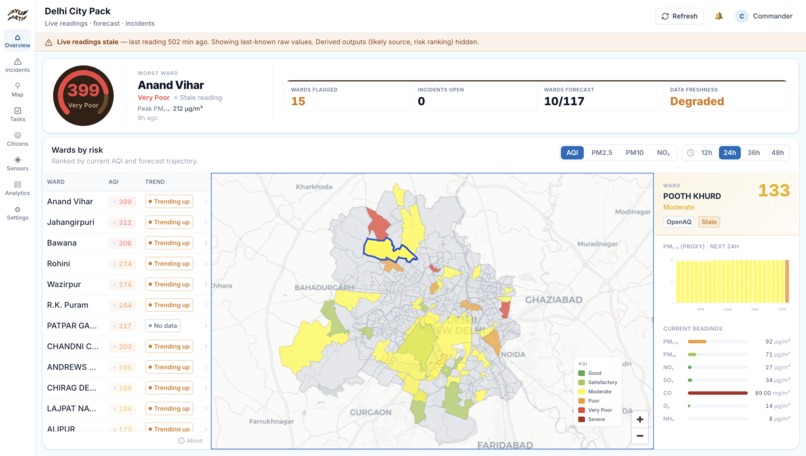
Dashboard
-
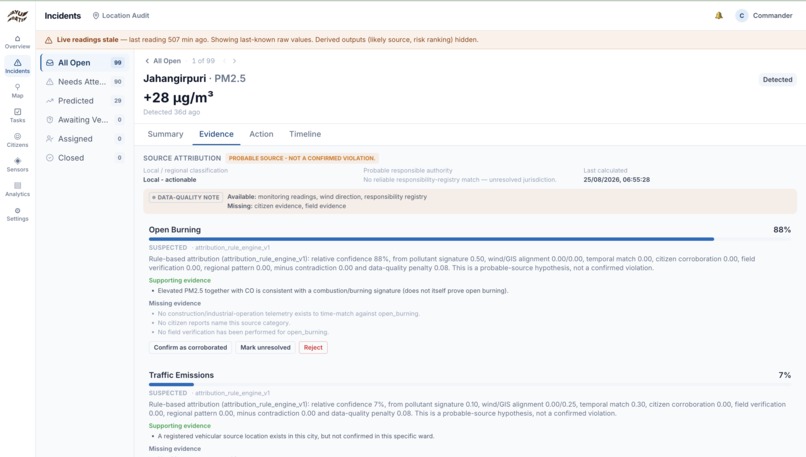
Incident Log
-
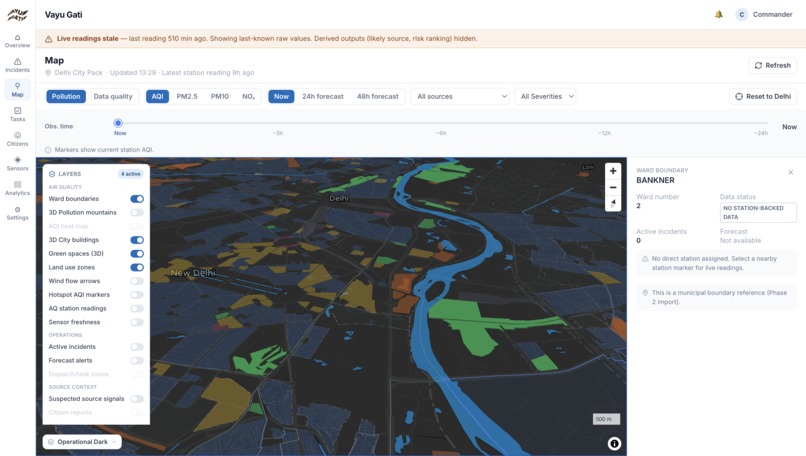
3d GIS Enabled Map View
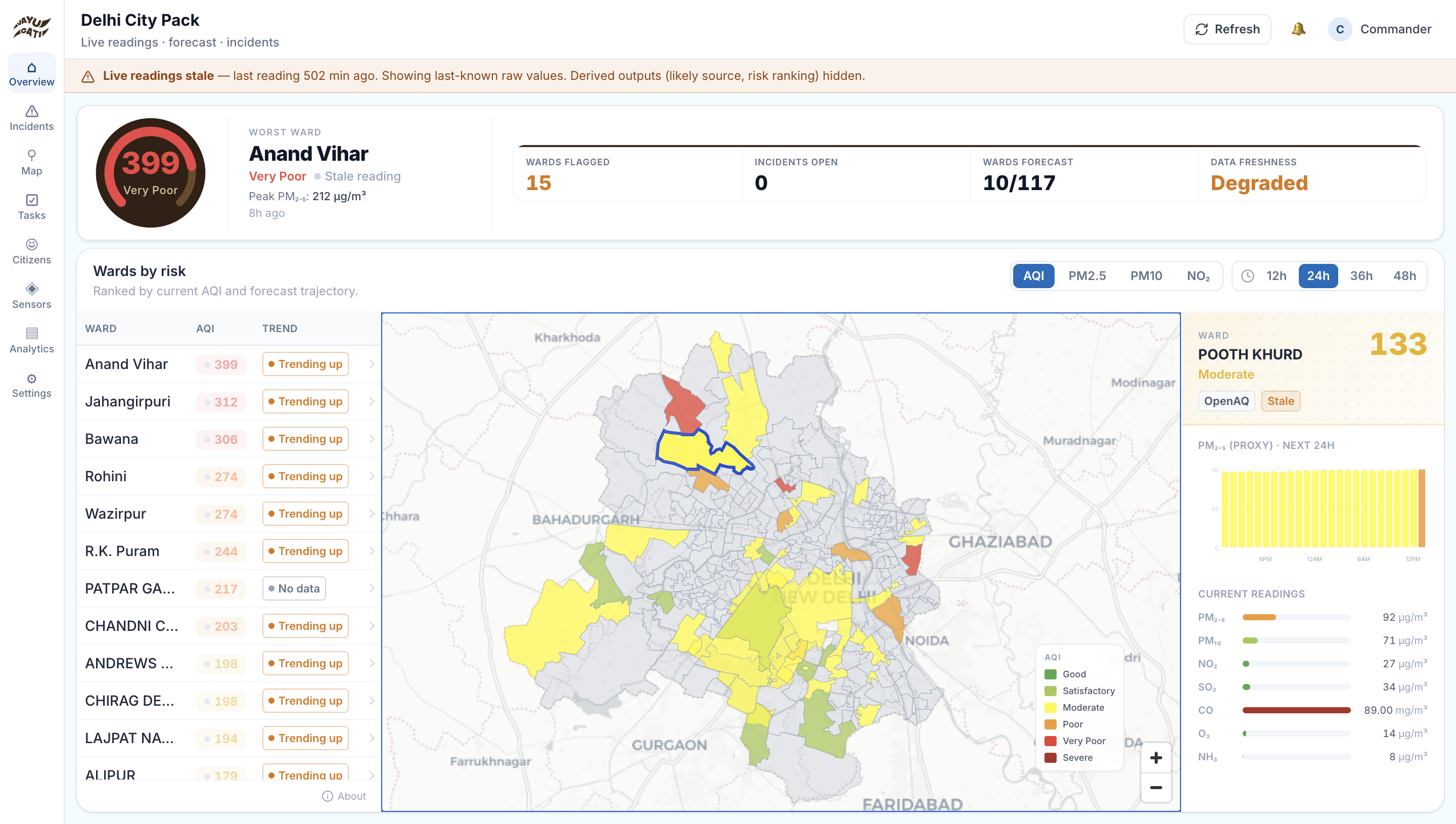
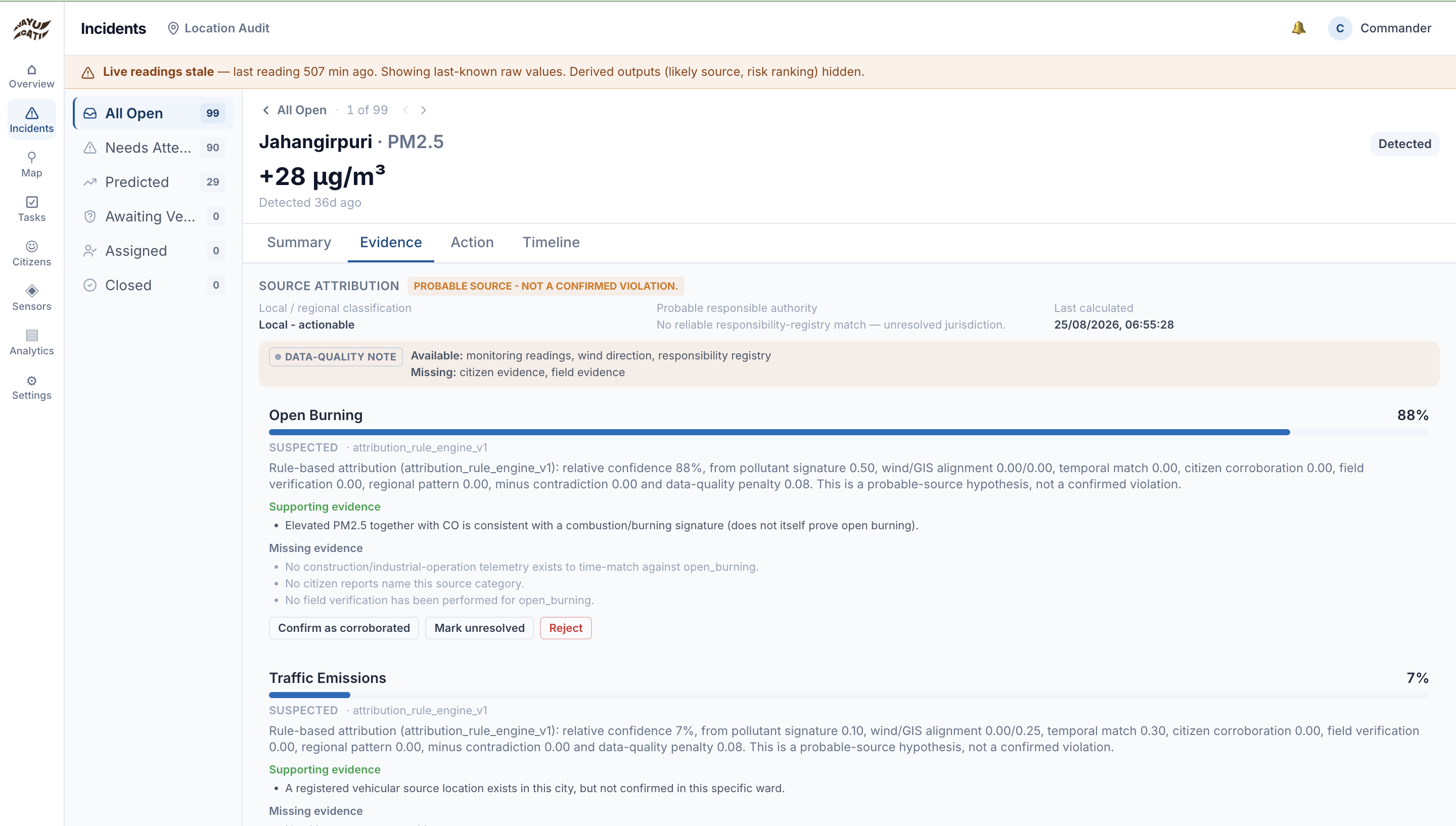
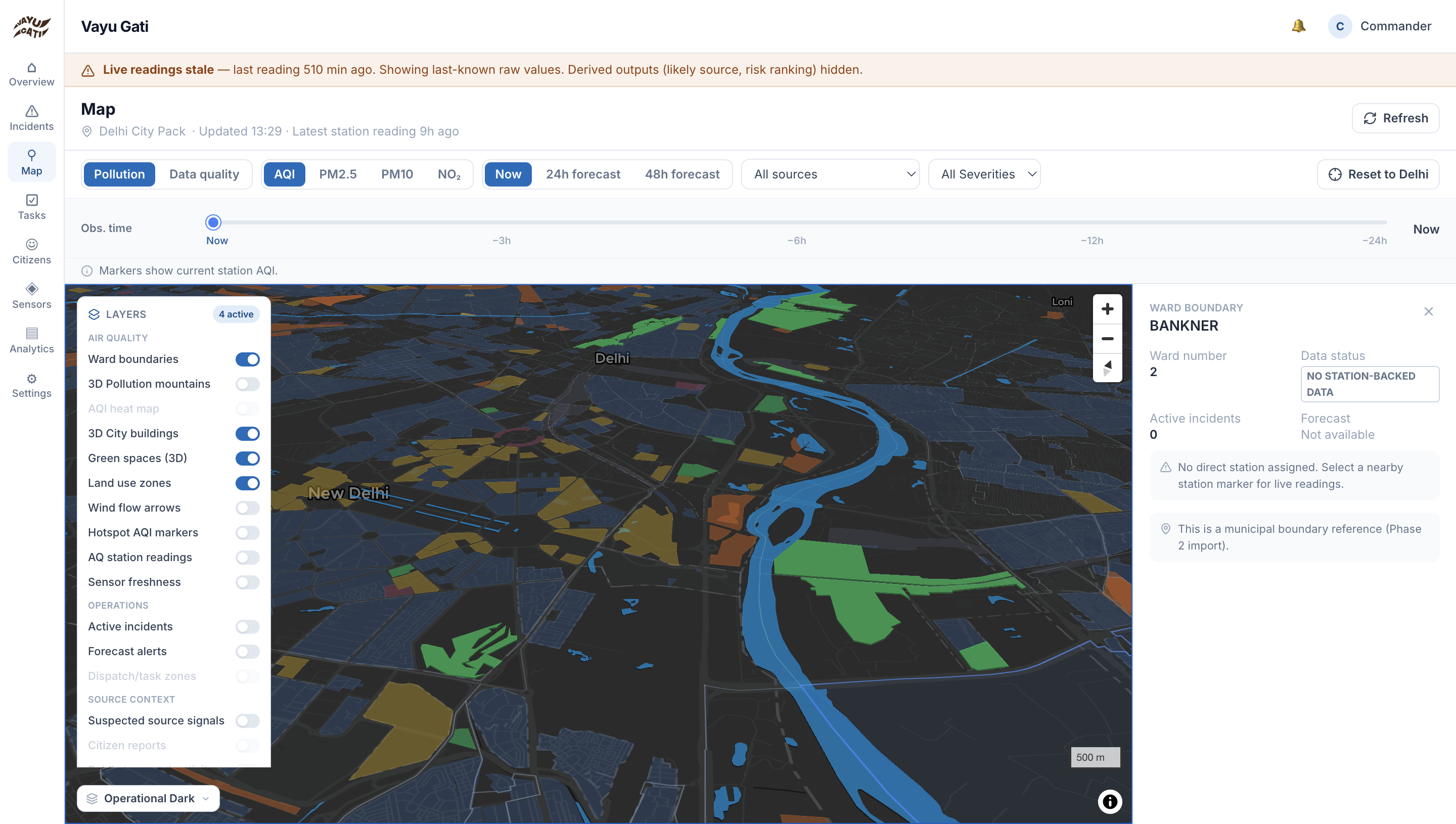
Inspiration
Vayu Gati began with a simple question: Why do we use one AQI number to describe an entire city?
Air pollution can change significantly between neighbourhoods, roads, industrial areas, and residential zones. However, most public platforms show data around monitoring stations or provide a broad city-level picture. Citizens may know that the air is polluted, but not what conditions are like in their ward. City officials may see multiple data points, but still lack a clear way to decide which areas require attention first.
My research on clean air and my experience at the India Clean Air Summit 2026 made this gap even clearer. Air-quality data exists, but it is often fragmented, technically complex, and difficult to convert into local action.
That inspired Vayu Gati, a city-level air-quality intelligence system designed to make pollution data more local, understandable, and actionable.
What it does
Vayu Gati converts air-quality measurements into ward-level intelligence for cities.
Through a city command view, users can:
- Identify wards that may require immediate attention
- See the pollutants contributing most to the AQI
- Compare air-quality conditions across wards
- Check when the underlying data was last updated
- Understand whether an estimate is based on sufficient data
- Receive simple explanations instead of only technical numbers
The agentic layer is designed to monitor incoming records, check data quality, prioritise affected areas, and convert validated information into clear briefings and possible next steps.
An important principle behind Vayu Gati is that AI should not invent or calculate the AQI. AQI calculations remain deterministic and follow established CPCB rules. The AI agent works on top of the validated results to explain patterns, identify priorities, and help users understand what action may be needed.
How we built it
Vayu Gati is built as a multi-layer system.
The data pipeline collects pollutant information from the CPCB data source, with OpenAQ considered as a fallback source where appropriate. Before using a record, the system checks timestamps, pollutant names, units, negative values, duplicate observations, and data freshness.
The AQI engine calculates sub-indices for pollutants including PM2.5, PM10, NO₂, SO₂, O₃, CO, and NH₃ using CPCB breakpoints. It also handles the different averaging requirements for pollutants such as CO and O₃.
The system separates live AQI calculations from daily AQI calculations. For daily values, it checks whether there are enough valid hourly observations and enough pollutant sub-indices before producing an overall AQI. This prevents incomplete data from being presented as a reliable result.
The ward-intelligence layer connects monitoring information with ward boundaries to create local estimates. The interface then organises wards by urgency and presents the results through a simple city command view.
Challenges we faced
The biggest challenge was not building the dashboard. It was deciding when the data could actually be trusted.
Some public records provide a field called pollutant_avg, but it is not always clear whether it represents an hourly value, a shorter observation window, or an existing 24-hour average. Averaging an already averaged value could produce an incorrect, overly smoothed result.
Repeated records with the same timestamp could also create false data coverage. CO presented another challenge because using the wrong unit can significantly distort its AQI sub-index.
Ward-level estimation was equally challenging because monitoring stations are limited and unevenly distributed. We did not want to present an estimate with false precision. Vayu Gati therefore treats data coverage, freshness, and uncertainty as part of the result rather than hiding them.
We also learned that AQI alone cannot accurately identify the source of pollution. Reliable source attribution requires additional information such as emission inventories, meteorological data, dispersion models, and local activity data.
What we learned
The most important lesson was that more data does not automatically mean better intelligence. A useful system must understand the quality, timing, coverage, and limitations of its inputs.
We also learned that air-quality technology is not only a data-science problem. It is a public-systems problem. The information must reach the right people in a form they can understand and act upon.
Vayu Gati is our attempt to bridge that gap by moving from a citywide pollution number to transparent, ward-level air-quality intelligence that can support better decisions and stronger public participation.
Built With
- aqi
- cpcb
- cpcb-data-api
- geojson
- geospatial-analysis
- openaq-api
- postgresql
- python
- react
- rest-apis
- typescript

Log in or sign up for Devpost to join the conversation.