
Inspiration
Imagine walking through a street on a Monday morning. You see a garbage bin completely full, waste scattered around it, and people passing by without knowing where to complain. Maybe the garbage collection team has already visited that area, or maybe they simply don't know that the bin is full.
This is a common situation in many cities. We often notice the problem, but the real issue is that waste management is still mostly reactive. People take action after the problem becomes visible.
We started thinking: What if we could predict when a garbage bin might become full instead of waiting for it to overflow?
That simple question became the inspiration behind UrbanPulse AI.
Our goal is to use AI and technology to make waste management smarter, more organized, and more sustainable.
What it does
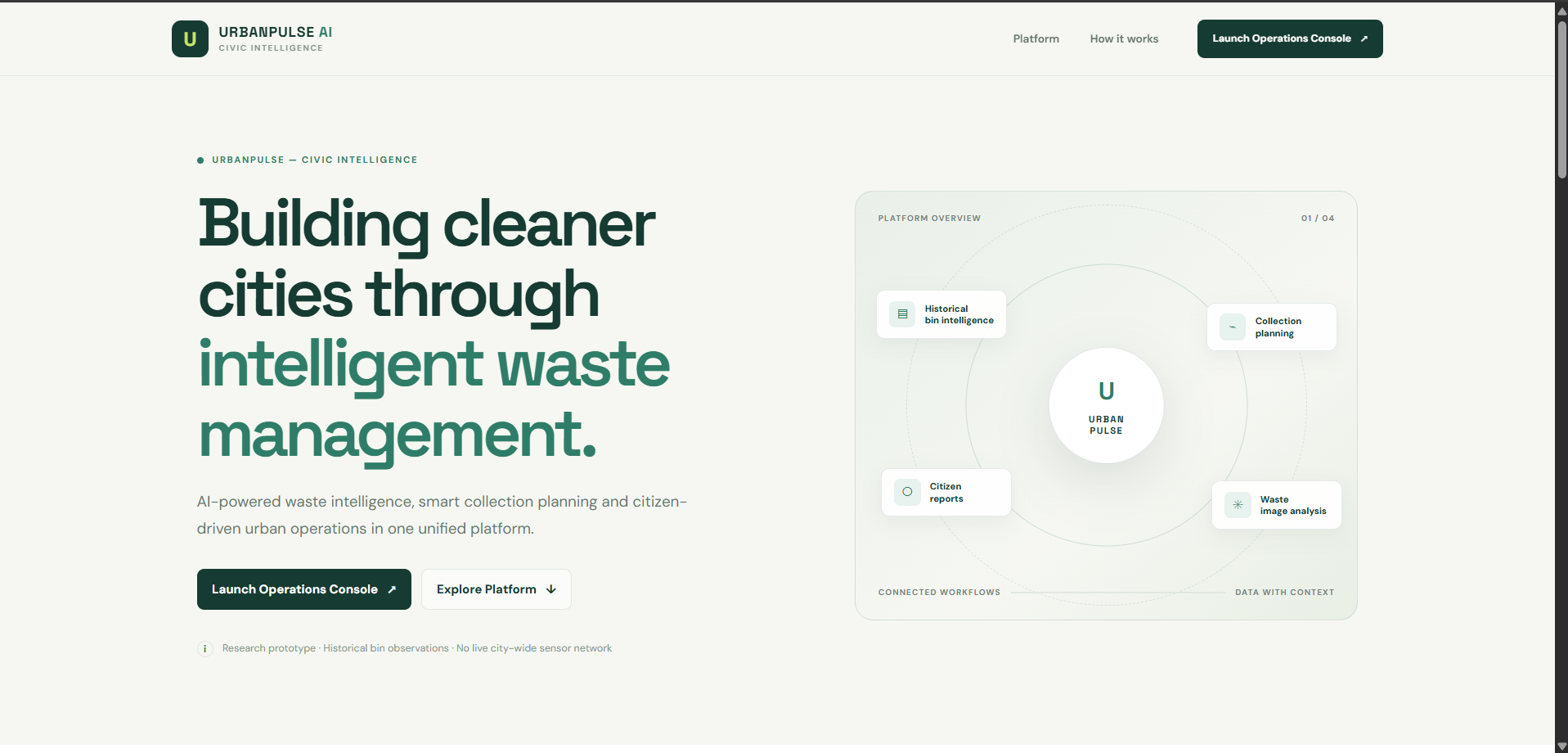
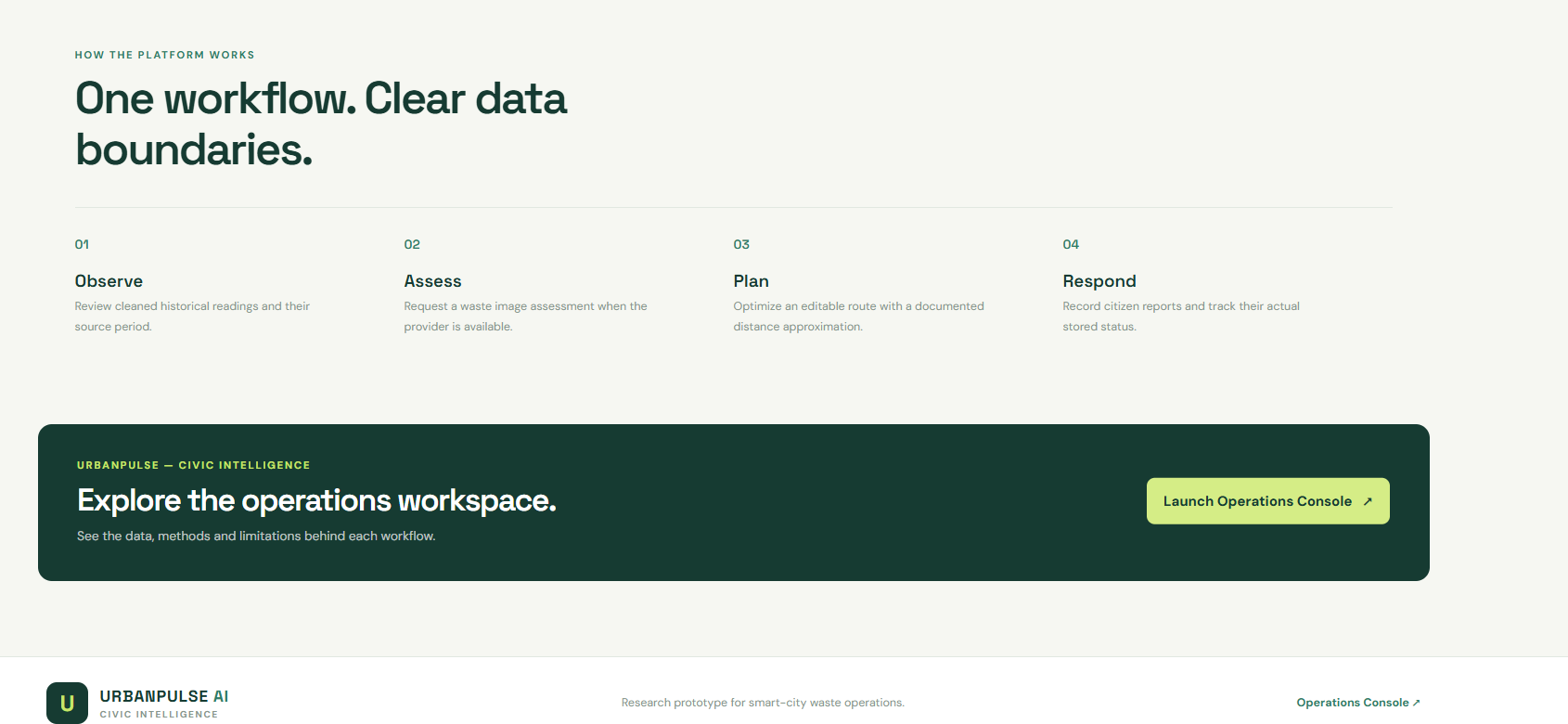
UrbanPulse AI is an AI-powered smart waste management platform designed to help cities manage garbage more efficiently.
Instead of depending only on manual monitoring, our platform focuses on using data and intelligent predictions to support better decisions.
Some of its main capabilities include:
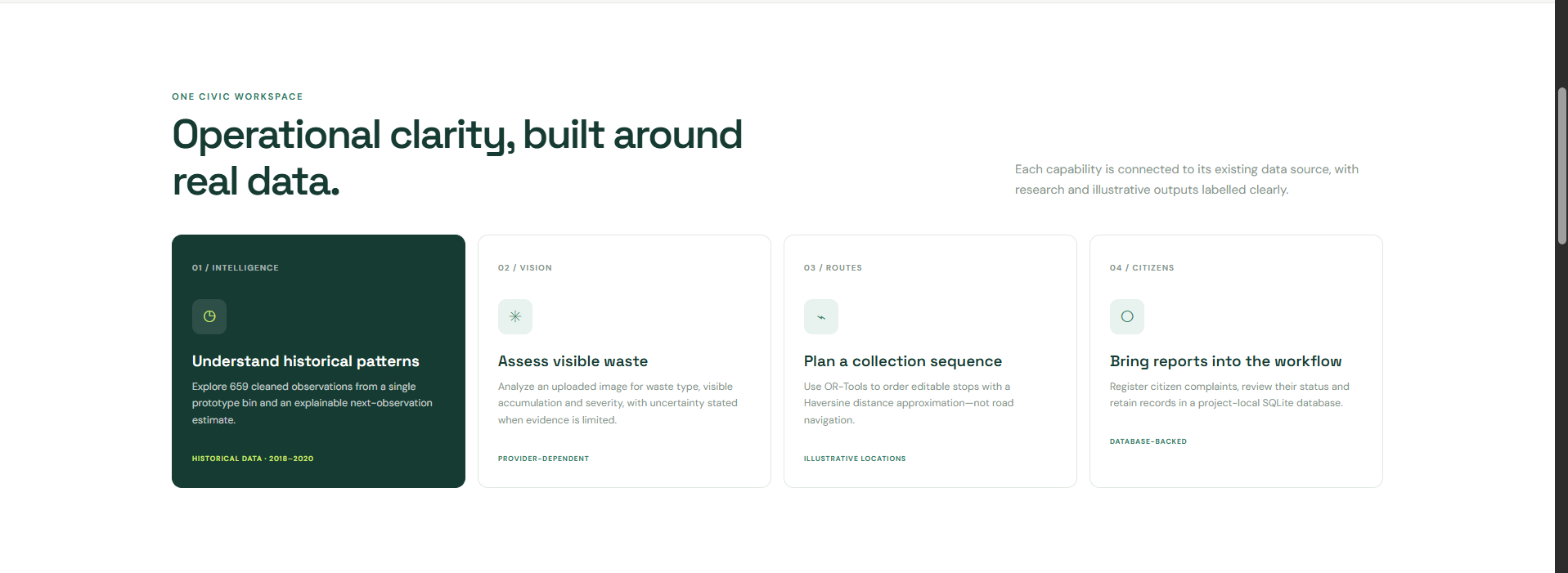
Smart Bin Prediction: Uses Machine Learning to predict garbage bin fill levels based on historical data.
AI Waste Analysis: Planned integration of Gemini Vision to analyze waste images and provide useful insights.
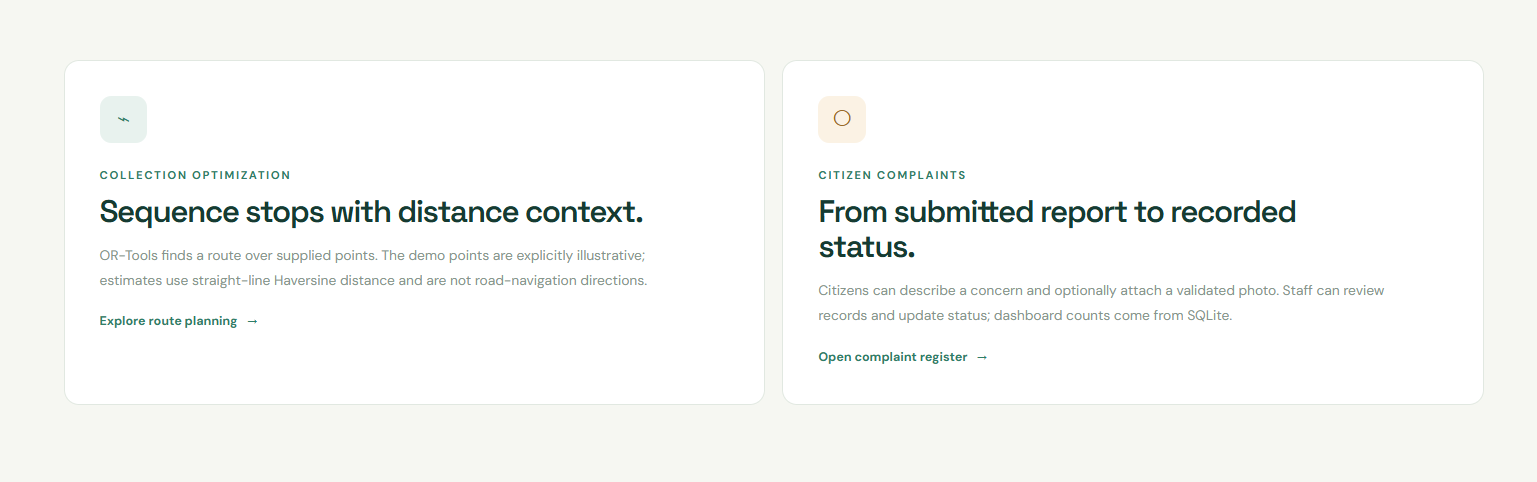
Smart Route Optimization: Uses Google OR-Tools to explore better garbage collection routes and reduce unnecessary travel.
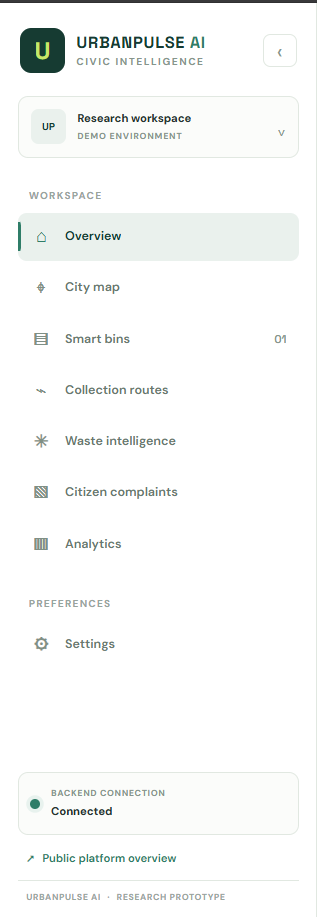
Centralized Dashboard: Provides a single place to view waste management information and predictions.
Data-Based Decisions: Helps move from guesswork towards more informed waste management decisions.
Our vision is simple: identify problems earlier, plan better, and keep our cities cleaner.
How we built it
We wanted to build something practical rather than just create a presentation with big ideas.
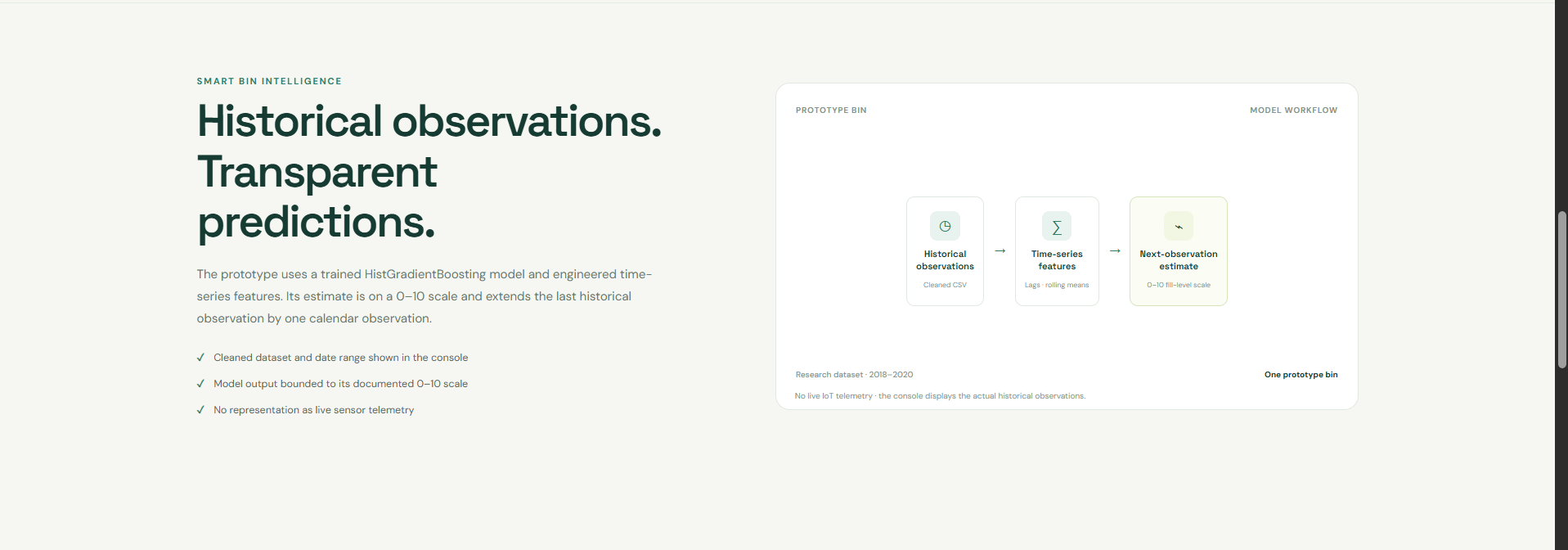
We started by exploring a smart-bin dataset containing historical garbage fill-level observations. We cleaned the data, handled duplicate timestamps, studied missing values, and prepared it for Machine Learning.
We experimented with different ML approaches and selected HistGradientBoostingRegressor as our final model.
The model uses historical patterns, previous fill levels, rolling averages, and date-related features to predict future fill levels.
Our current model achieved:
RMSE: 1.764
R² Score: 0.393
We then connected the model with a FastAPI backend and developed a web dashboard using HTML, CSS, and JavaScript.
Our technology stack includes:
Python and Scikit-learn for Machine Learning.
FastAPI for backend development.
HTML, CSS, and JavaScript for the frontend.
Gemini Vision API for planned AI-based waste image analysis.
Google OR-Tools for route optimization.
SQLite for data management.
Leaflet and OpenStreetMap for map integration.
We are building UrbanPulse AI in phases, making sure each part works before moving towards the next.
Challenges we ran into
Building UrbanPulse AI was not as simple as we initially thought.
One of our biggest challenges was working with the smart-bin dataset. The data contained duplicate timestamps and missing observations, so we had to spend time understanding and cleaning it before training our model.
Another challenge was choosing the right Machine Learning model. We experimented with different approaches and compared their performance instead of selecting a model randomly.
Connecting the ML model with FastAPI and displaying its predictions on the frontend was another important learning experience.
We also realized that historical data is not the same as real-time IoT data. Our current prototype uses historical observations, and connecting actual smart bins is something we want to work on in the future.
These challenges helped us understand that building a useful product requires much more than writing code.
Accomplishments that we're proud of
We are proud that UrbanPulse AI has moved beyond just an idea.
Some achievements we are happy about:
Successfully explored and processed a real smart-bin dataset.
Built a Machine Learning pipeline for garbage fill-level prediction.
Compared different models and selected HistGradientBoostingRegressor.
Connected our trained ML model with a FastAPI backend.
Developed a working web dashboard.
Created a modular project structure that allows us to add more features gradually.
One thing we are especially proud of is turning an ordinary dataset into something that can support a real-world problem.
For us, UrbanPulse AI is not just about building a model. It is about creating something that could eventually make everyday city life better.
What we learned
This project taught us that real-world problems are often more complicated than they look.
We learned how important data cleaning and preprocessing are before training a Machine Learning model.
We also gained practical experience in:
Training and evaluating Machine Learning models.
Building APIs using FastAPI.
Connecting frontend and backend components.
Working with historical datasets.
Understanding the limitations of ML predictions.
Building and improving a project step by step.
Most importantly, we learned that a good AI project should solve a meaningful problem rather than simply use the latest technology.
What's next for UrbanPulse-AI
We believe this is just the beginning.
There is still a lot we want to build and improve.
Our future plans include:
Gemini Vision Integration: Allow users to upload waste images and get AI-powered waste analysis.
Smart Route Optimization: Develop an intelligent collection planning system using Google OR-Tools.
Real-Time IoT Integration: Connect actual smart bins to monitor garbage levels in real time.
Interactive City Map: Display bin locations and their status using Leaflet and OpenStreetMap.
Database Integration: Store waste records, predictions, and complaints using SQLite.
Historical Analytics: Add charts and reports to understand waste generation patterns.
Scalable Deployment: Make the platform accessible to real users and eventually test it in actual communities.
Our long-term dream is to make UrbanPulse AI useful for municipalities, waste collection teams, and local communities.
Because a cleaner city should not depend only on cleaning waste after it appears. It should also depend on predicting problems and preventing them before they grow.
That's the future we want to build with UrbanPulse AI.
Built With
- ai
- artificial
- computer
- css
- fastapi
- gemini
- generative
- html
- intelligence
- javascript
- leaflet.js
- learning
- machine
- numpy
- openstreetmap
- or-tools
- pandas
- python
- scikit-learn
- sqlite
- vision
