-
-
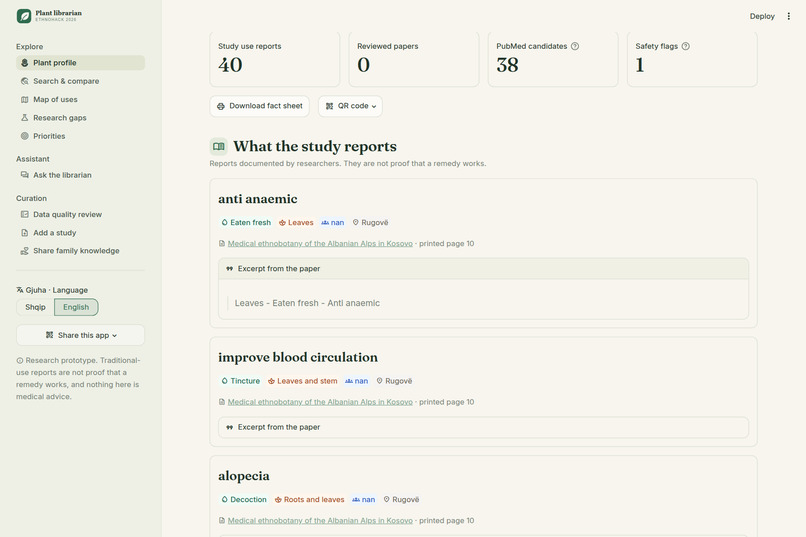
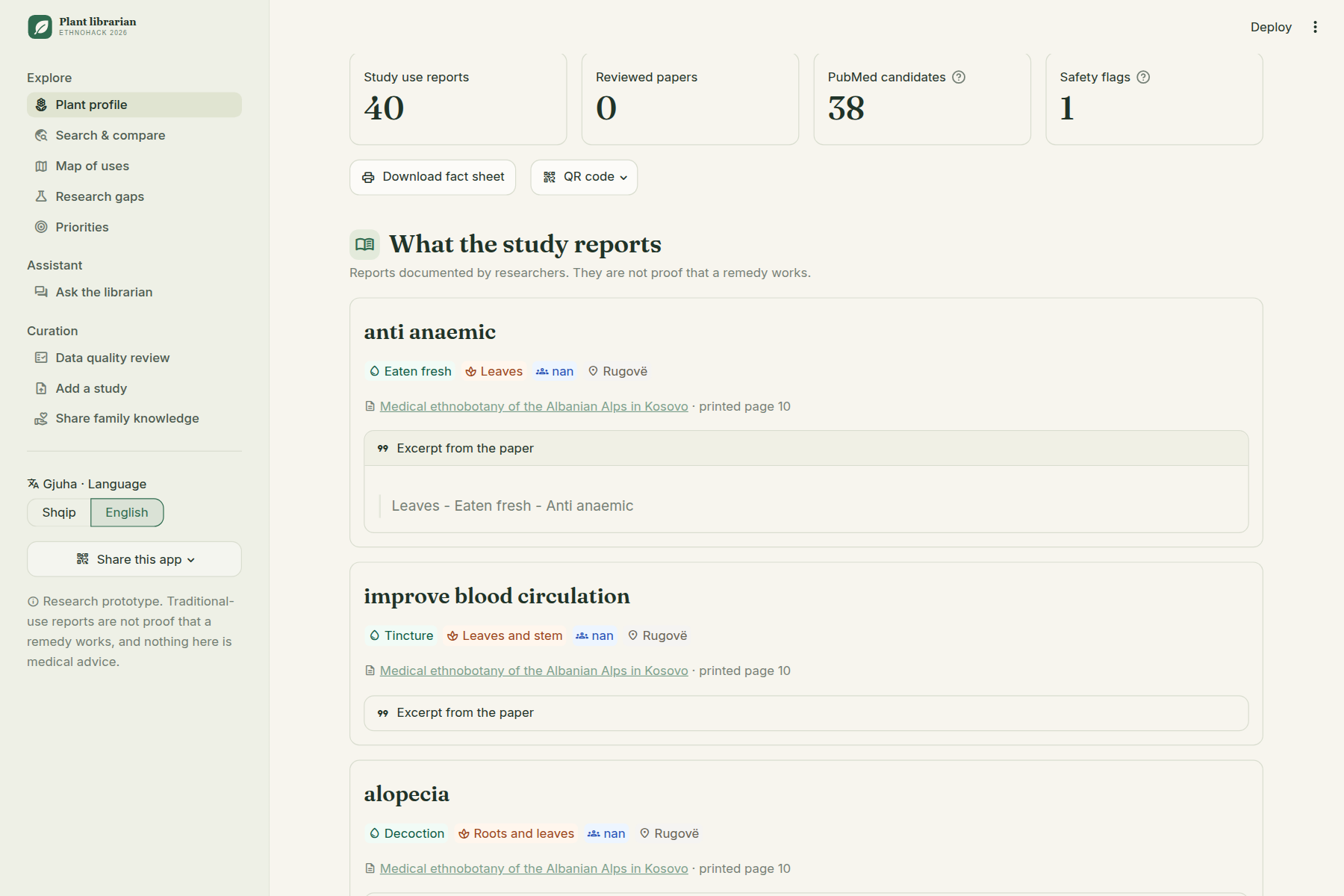
Every use comes with its study, page and exact quote.
-
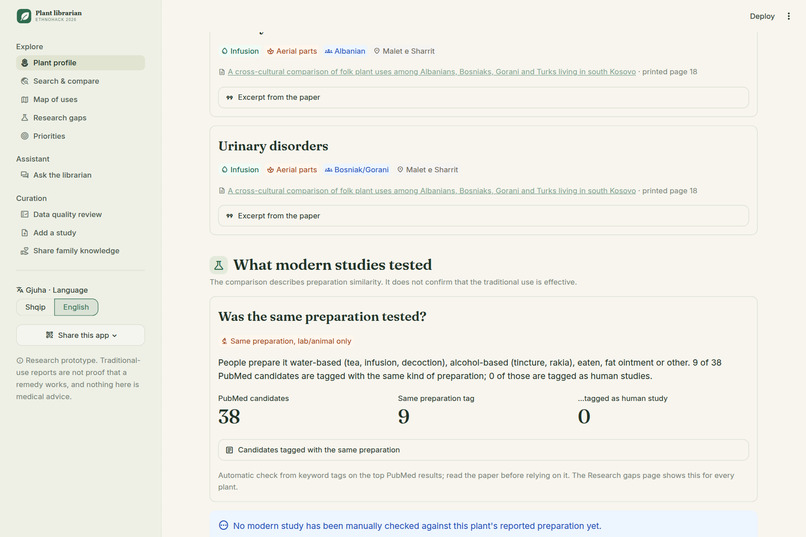
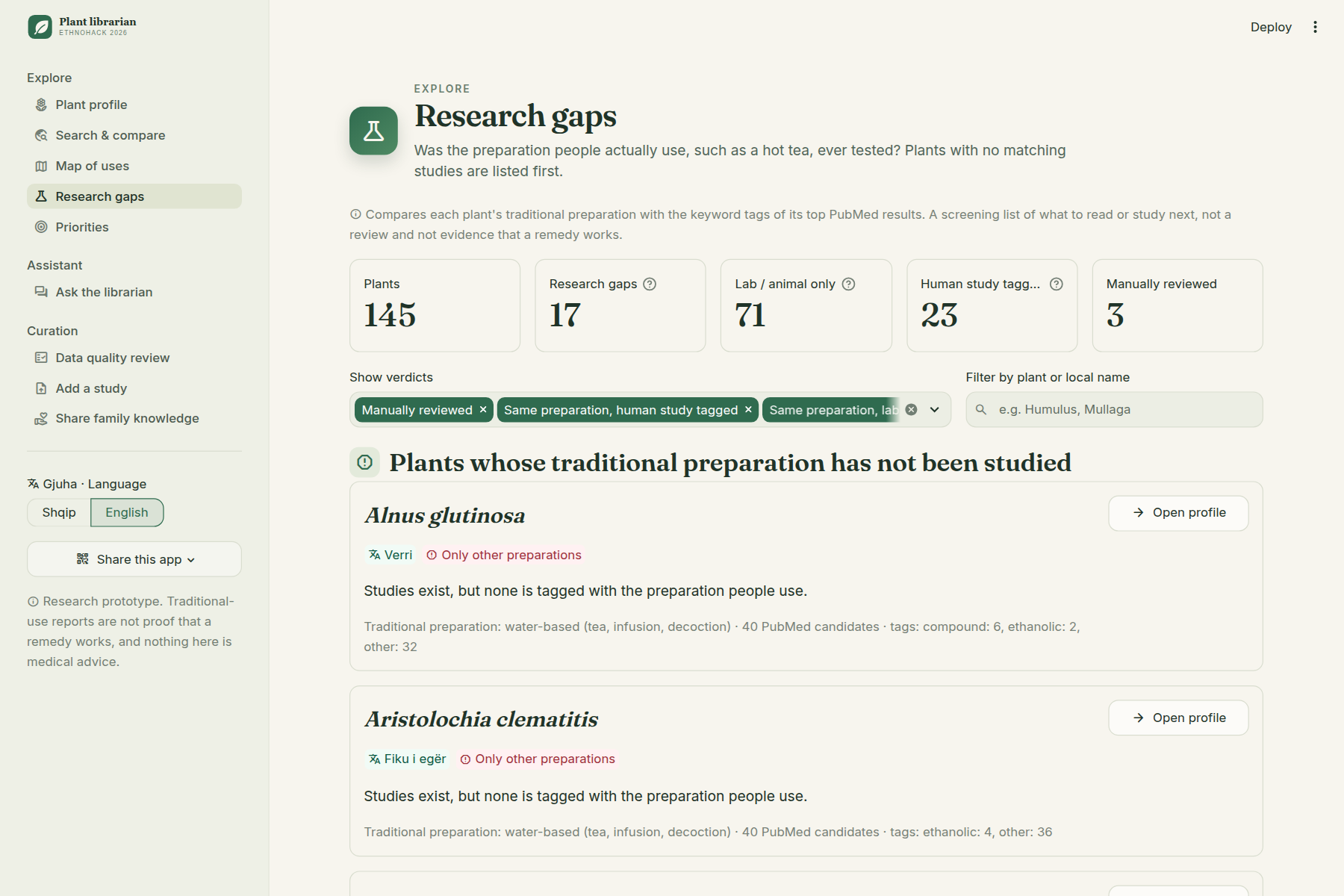
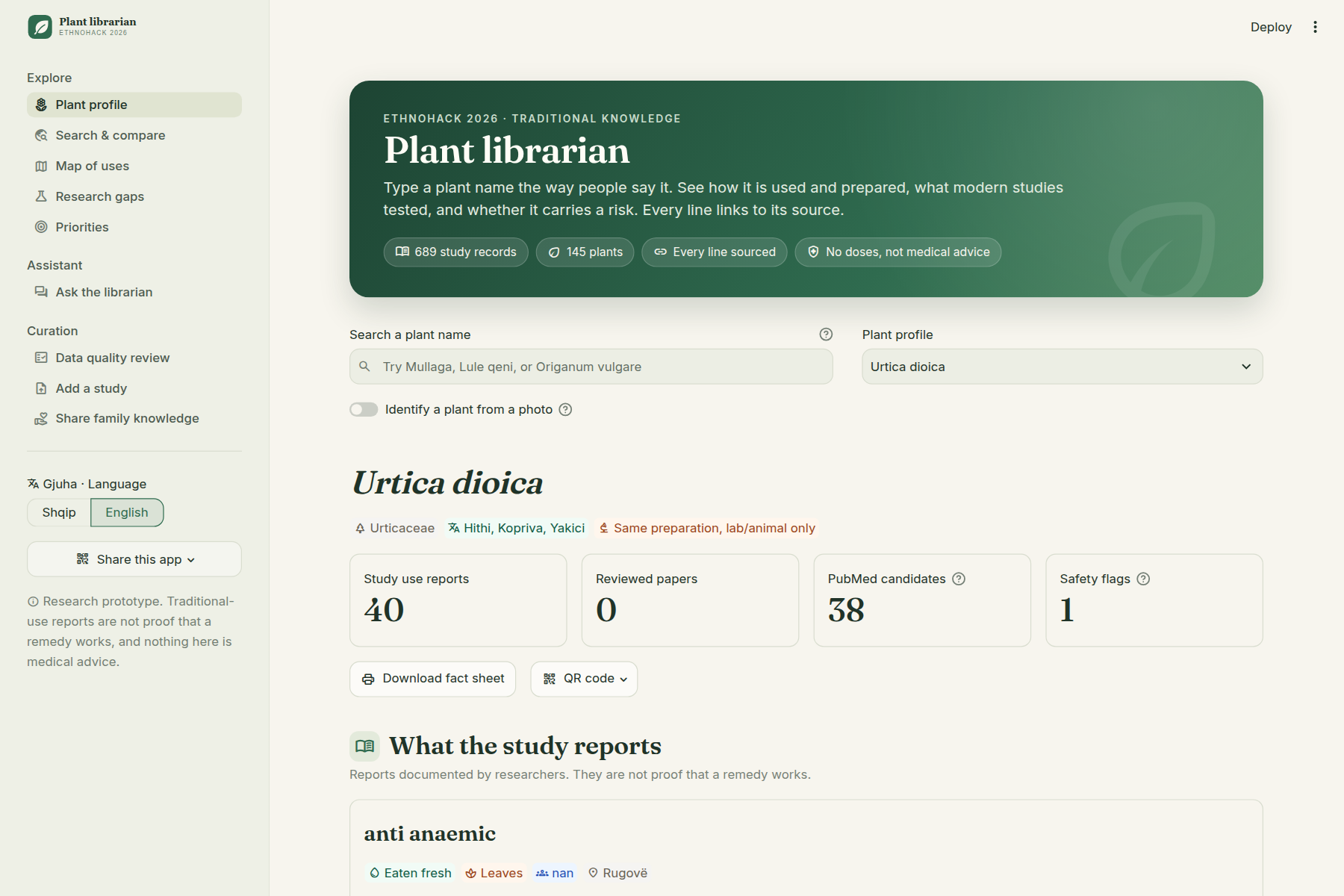
Was the same preparation tested? People drink nettle as a tea, but the tea was tested only in the lab or in animals.
-
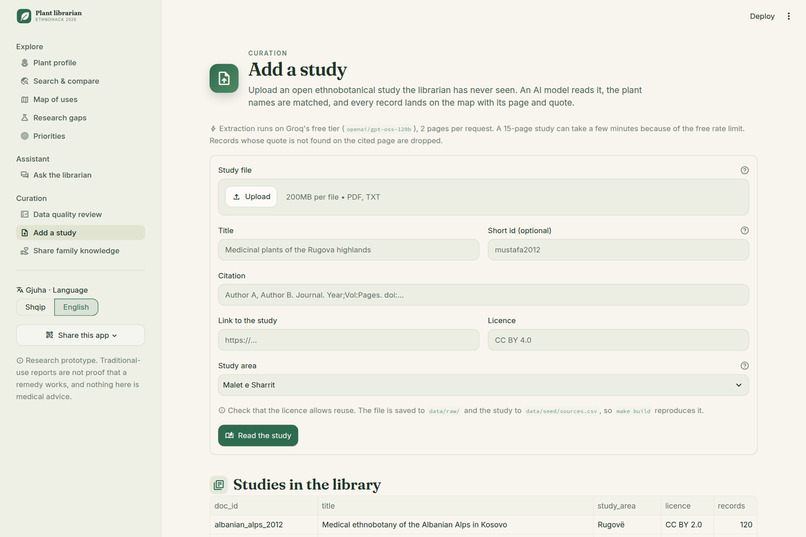
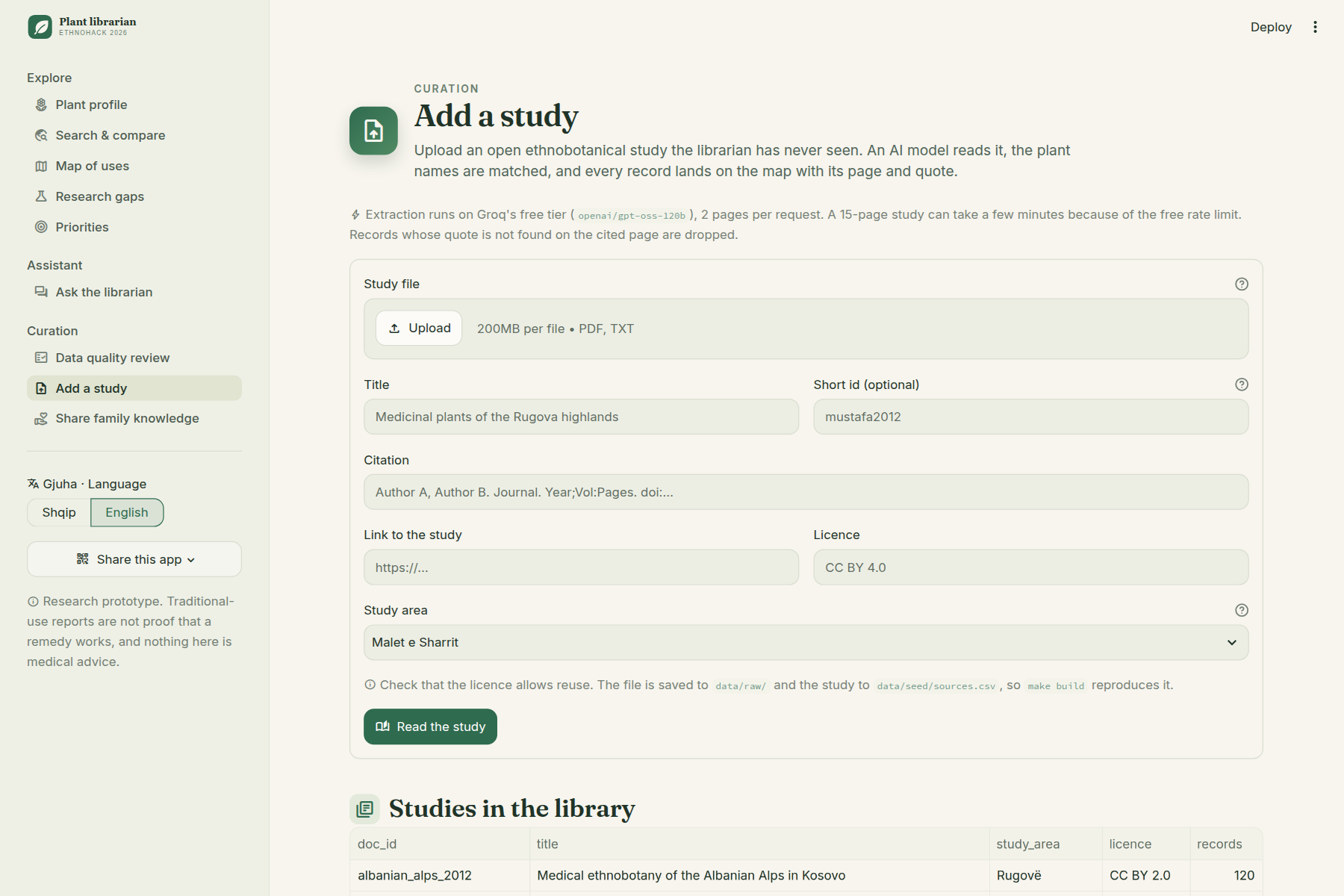
Add a new study: AI reads it, every row is checked against its page.
-
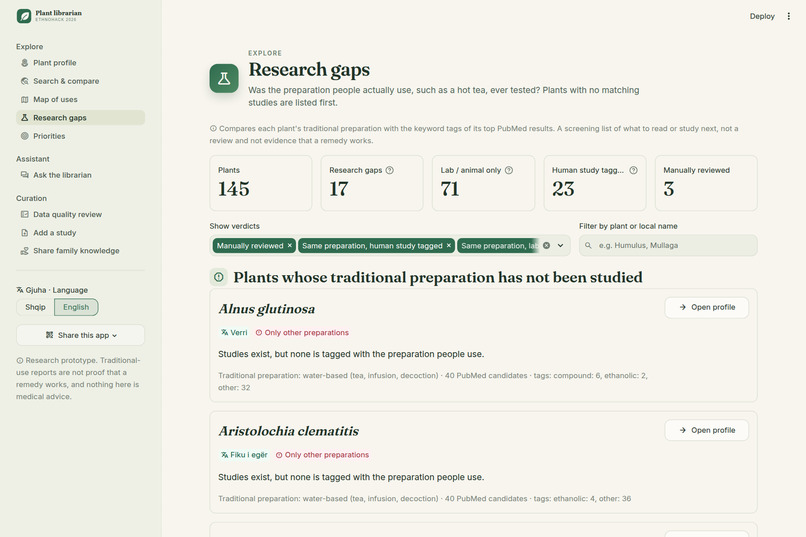
17 research gaps: studies exist, but none tests the preparation people use.
-
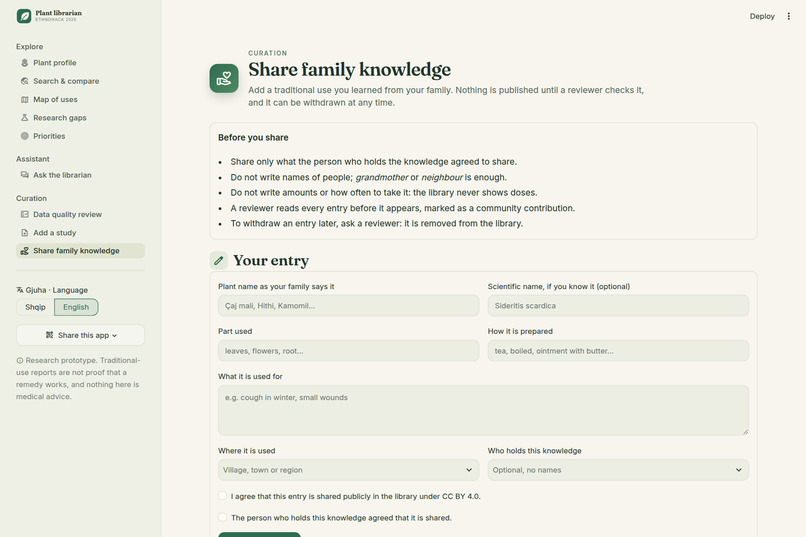
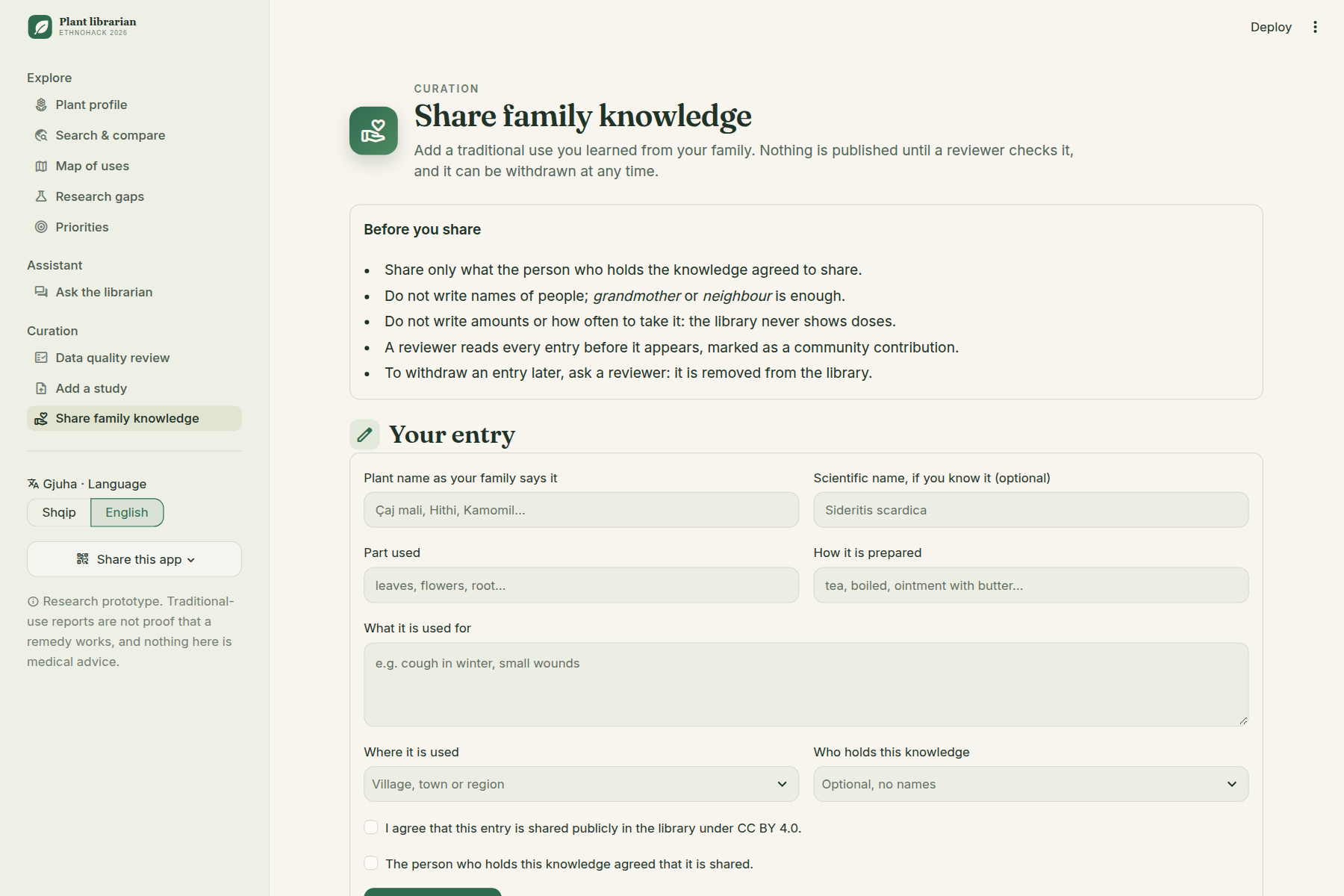
Share family knowledge with consent: no names, no doses, reviewed before publishing.
-
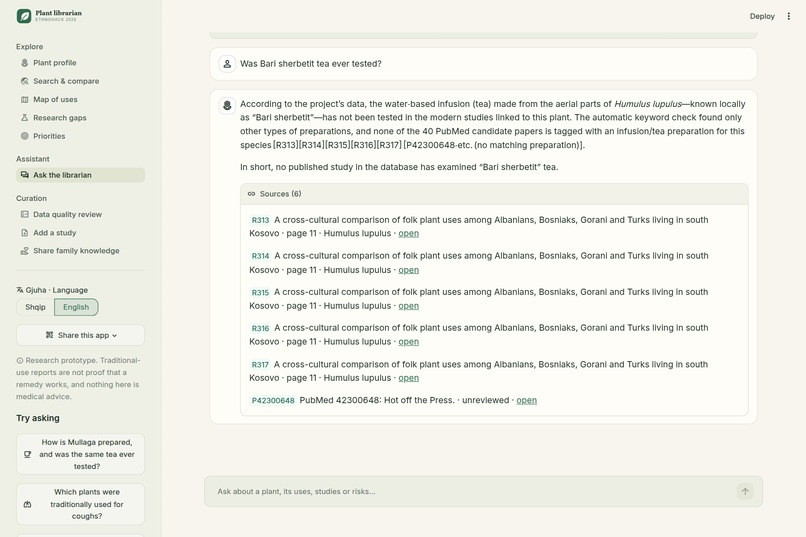
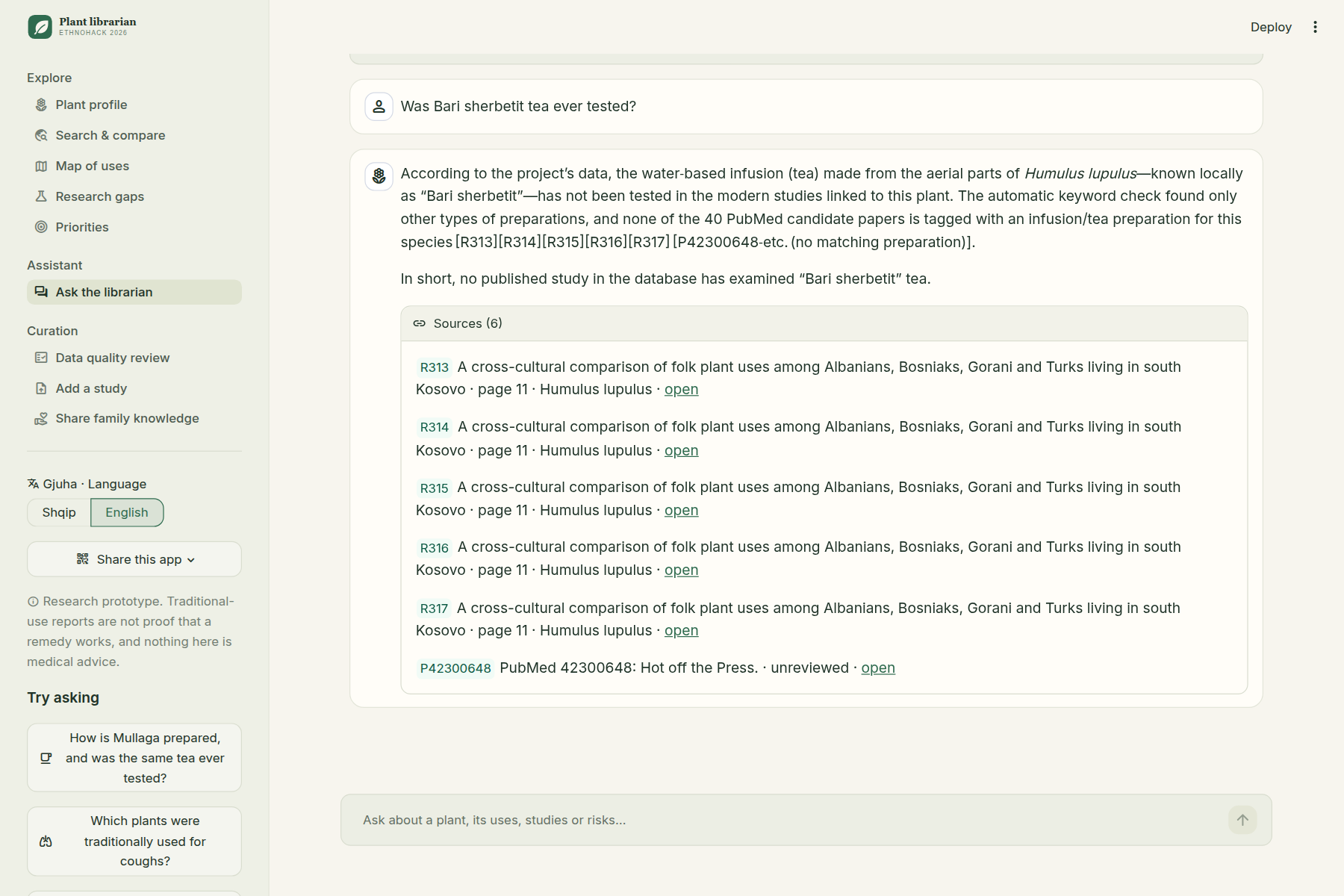
Ask the librarian: answers only from the library, each with its sources, no doses.
-
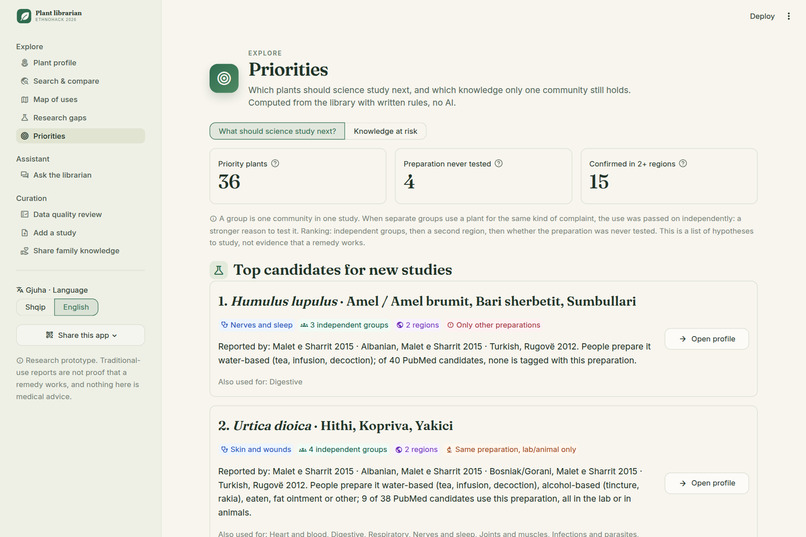
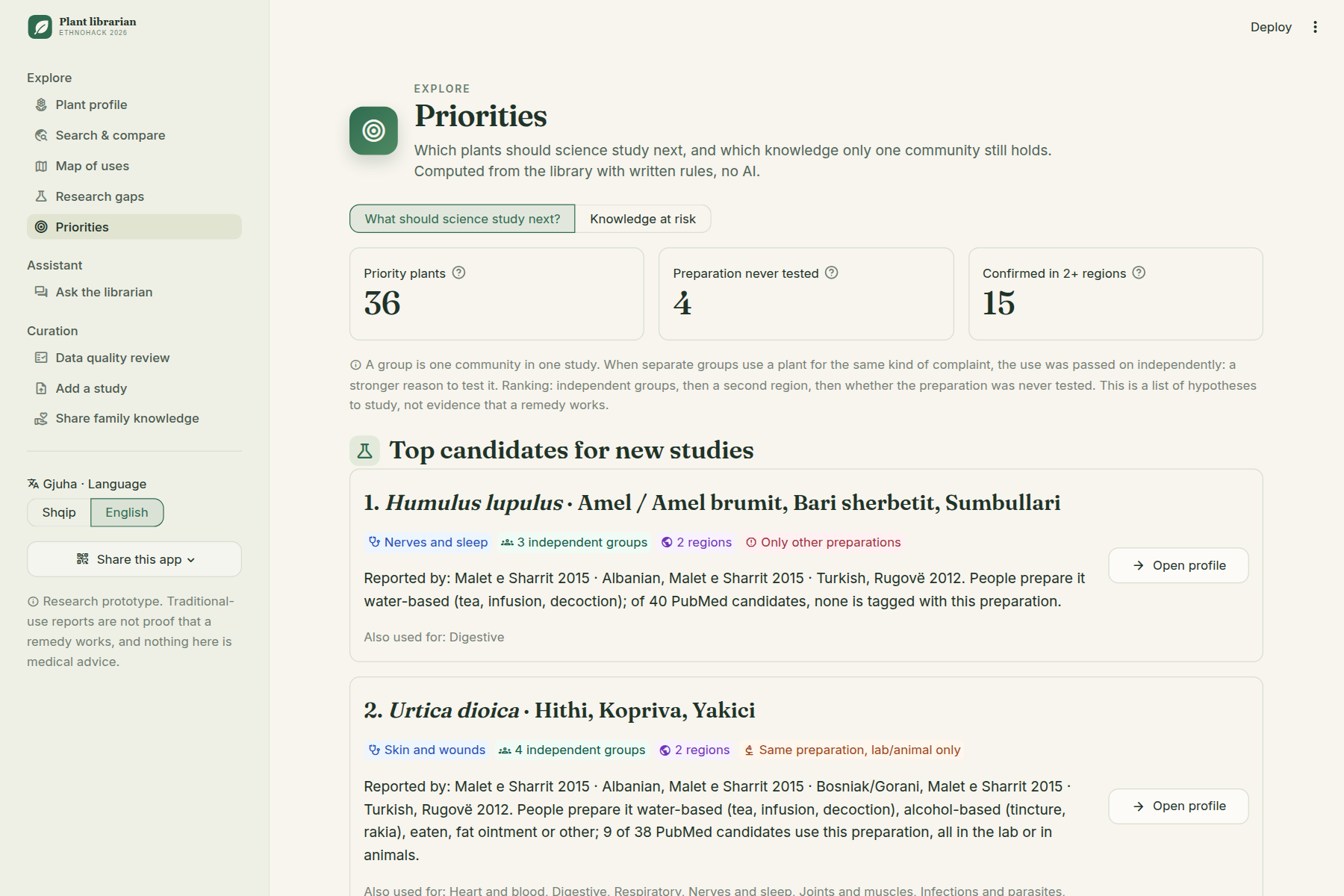
36 priority plants. #1 is hop (Bari sherbetit): a tea for sleep, and none of 40 papers tests the tea.
-
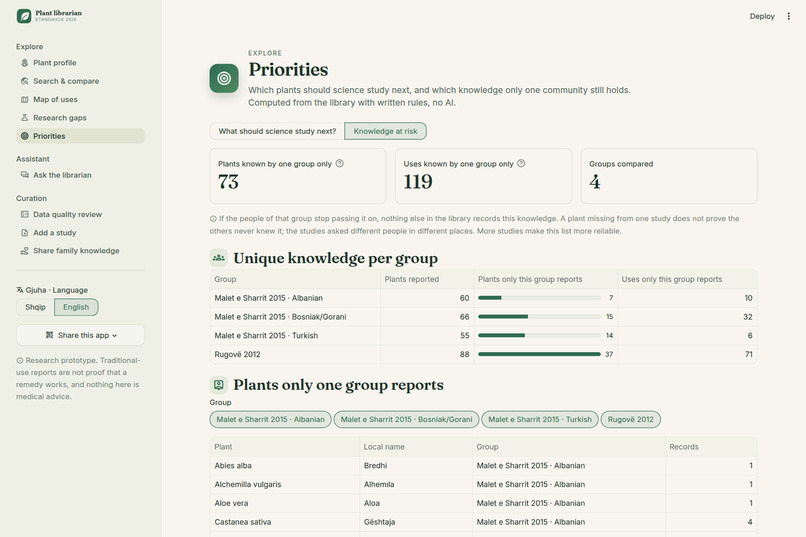
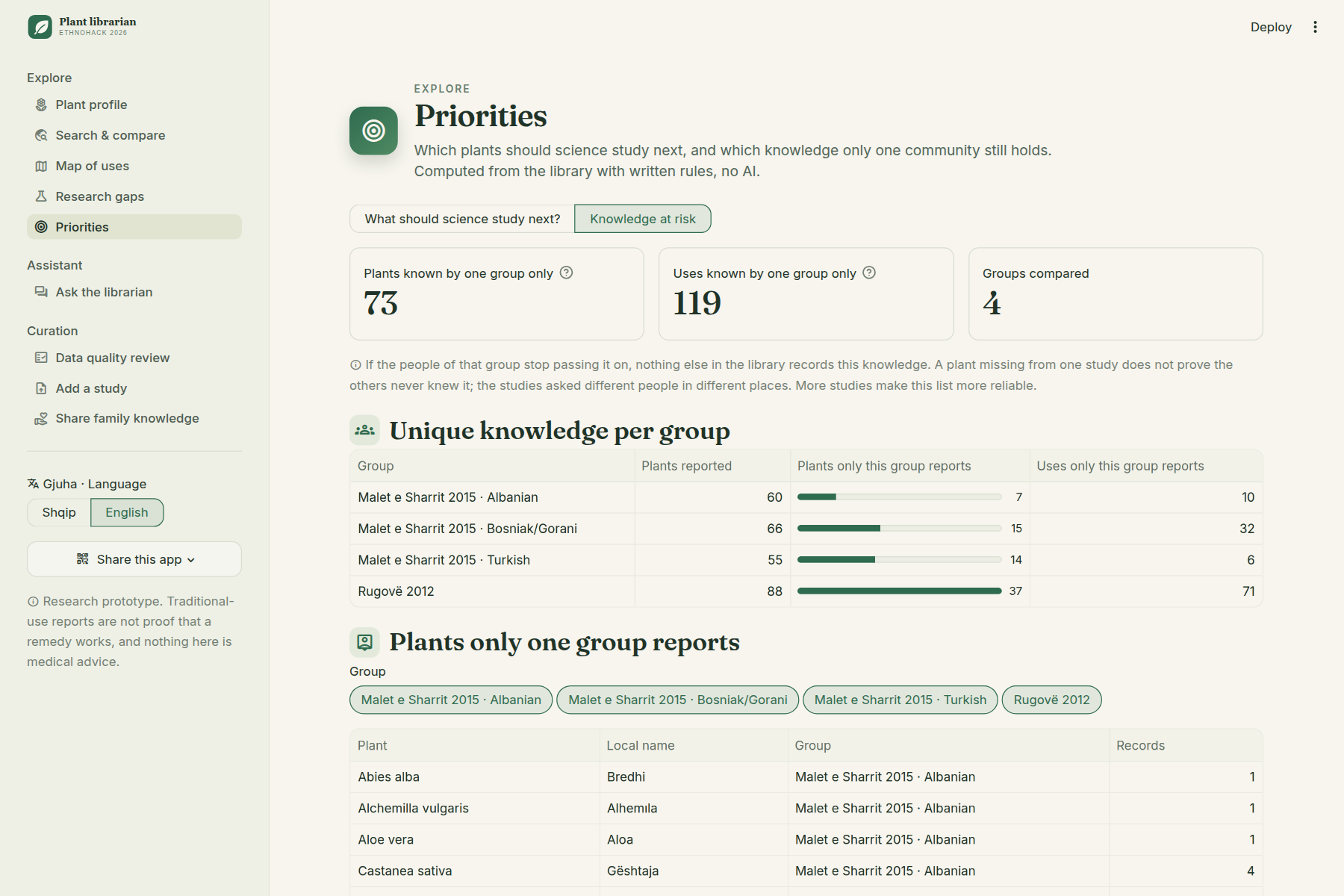
Knowledge at risk: 73 plants and 119 uses are reported by one group only.
-
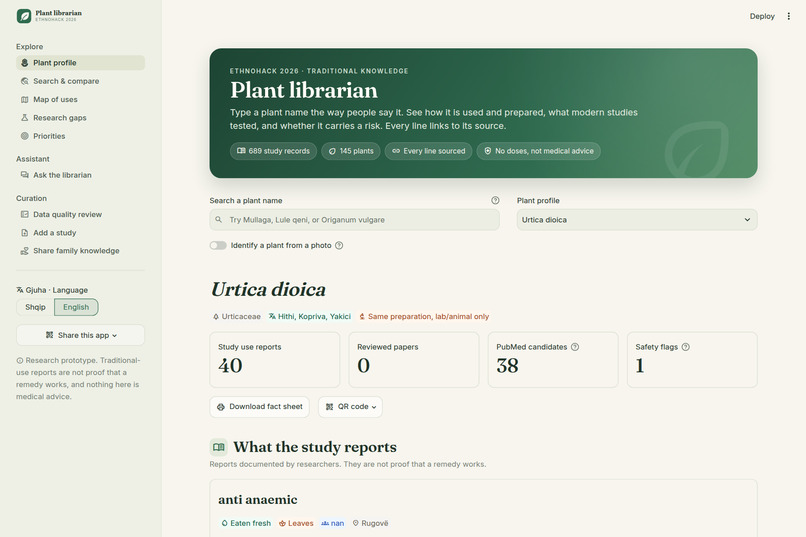
Type a plant's name the way people say it: Hithi is nettle, known as Hithi, Kopriva and Yakici.
-
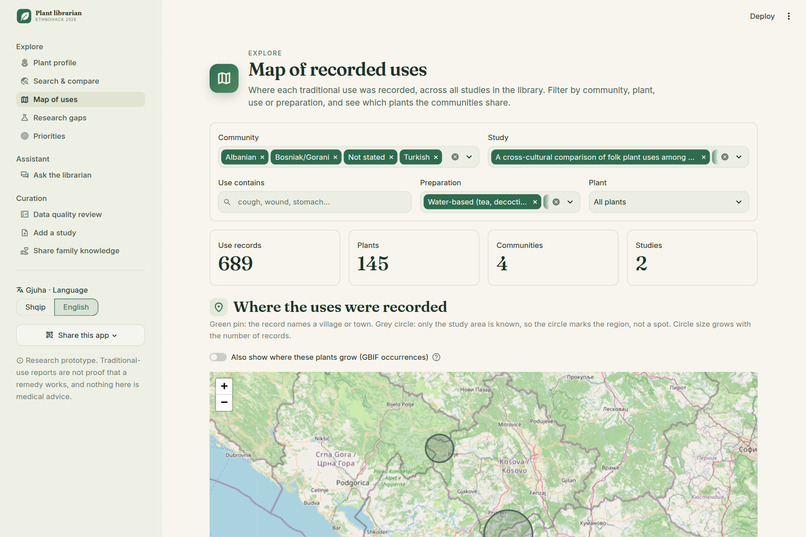
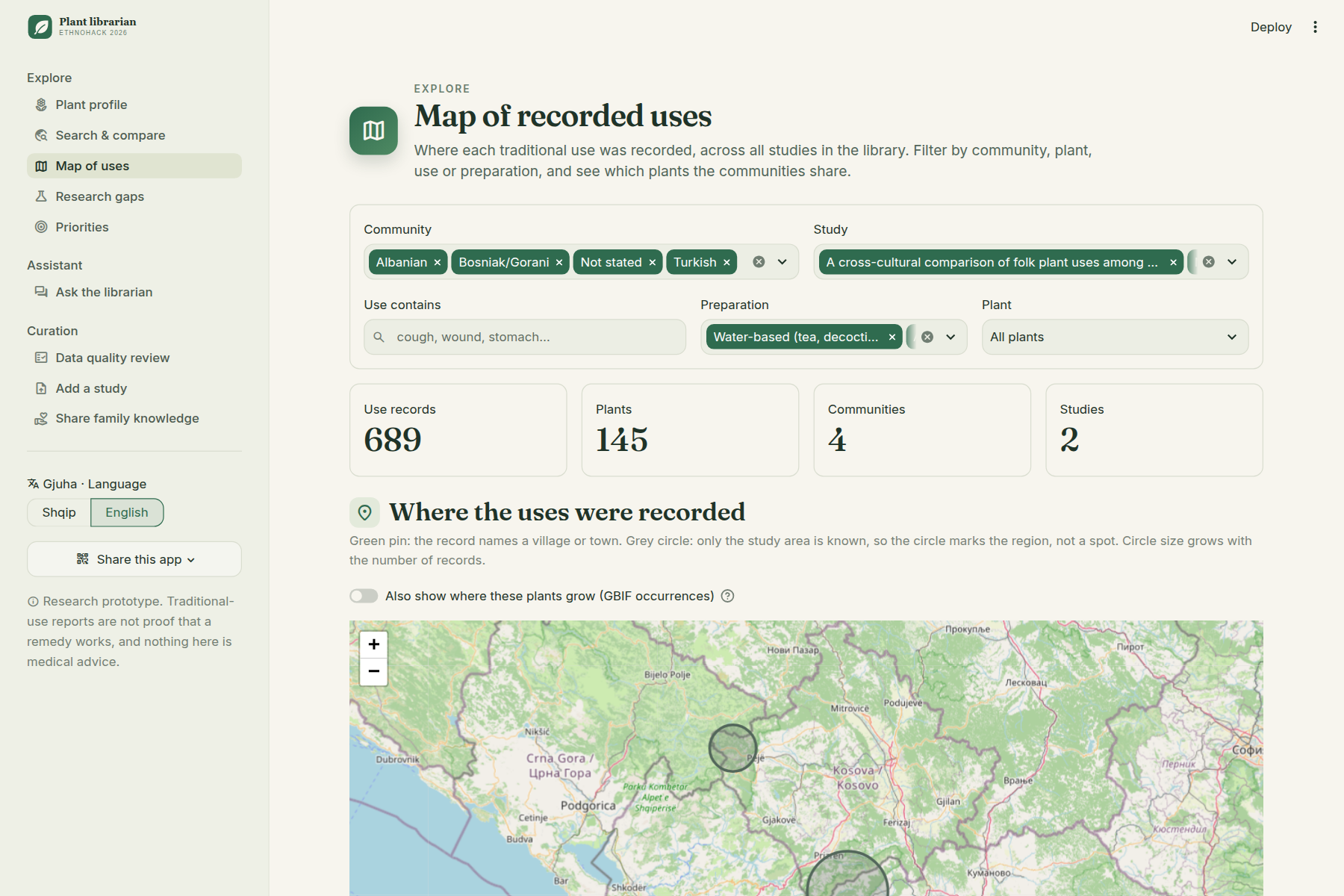
Map of where each traditional use was recorded.
-
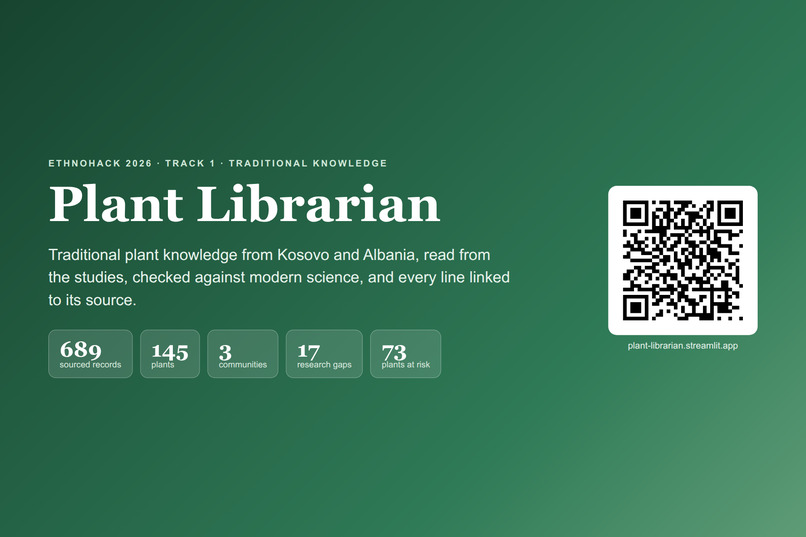
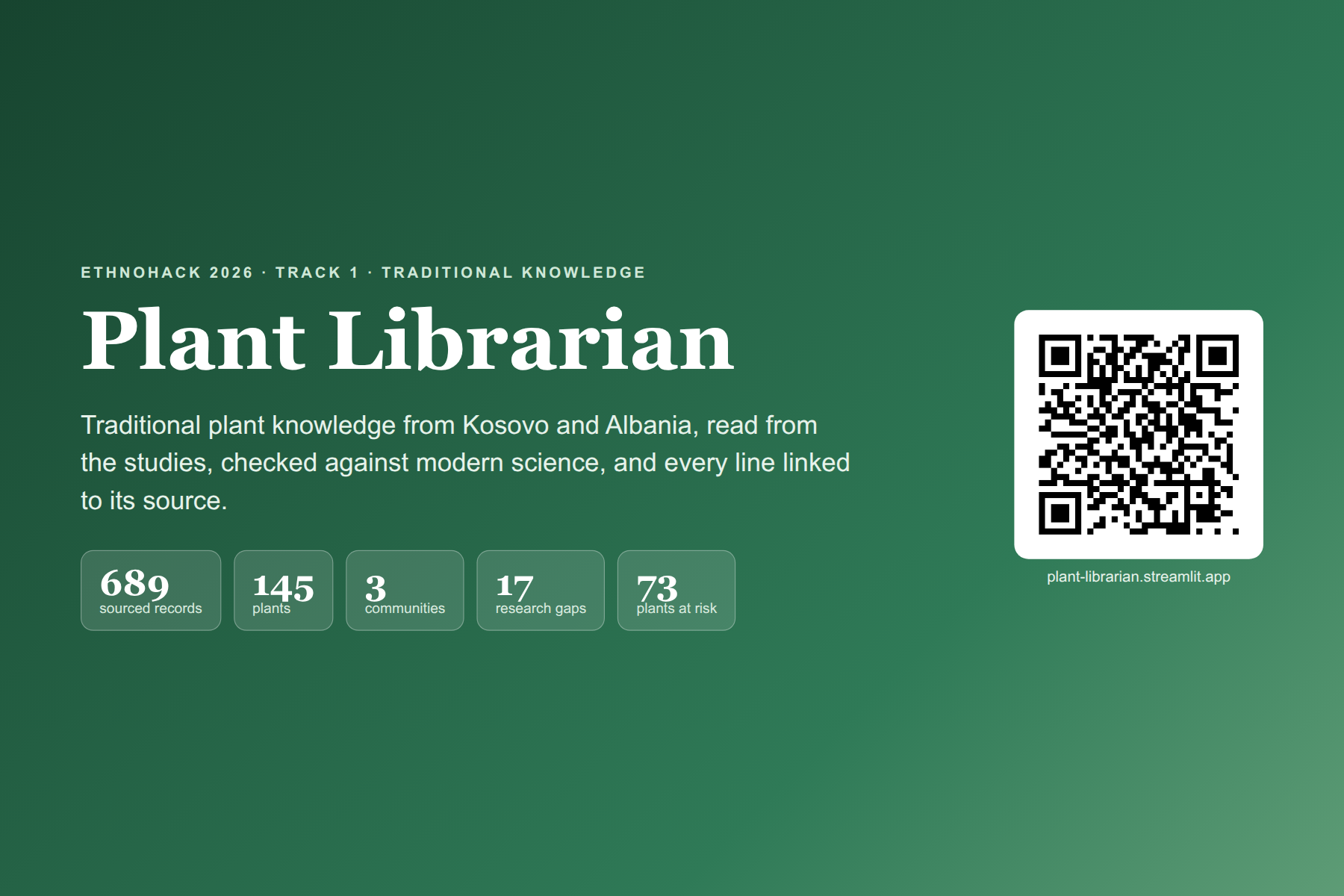
Plant Librarian: traditional plant knowledge from Kosovo and Albania, every line sourced.
-
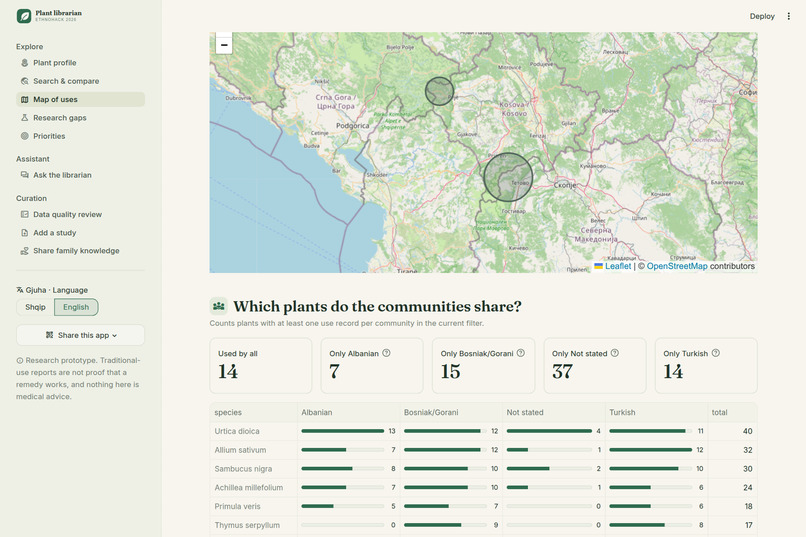
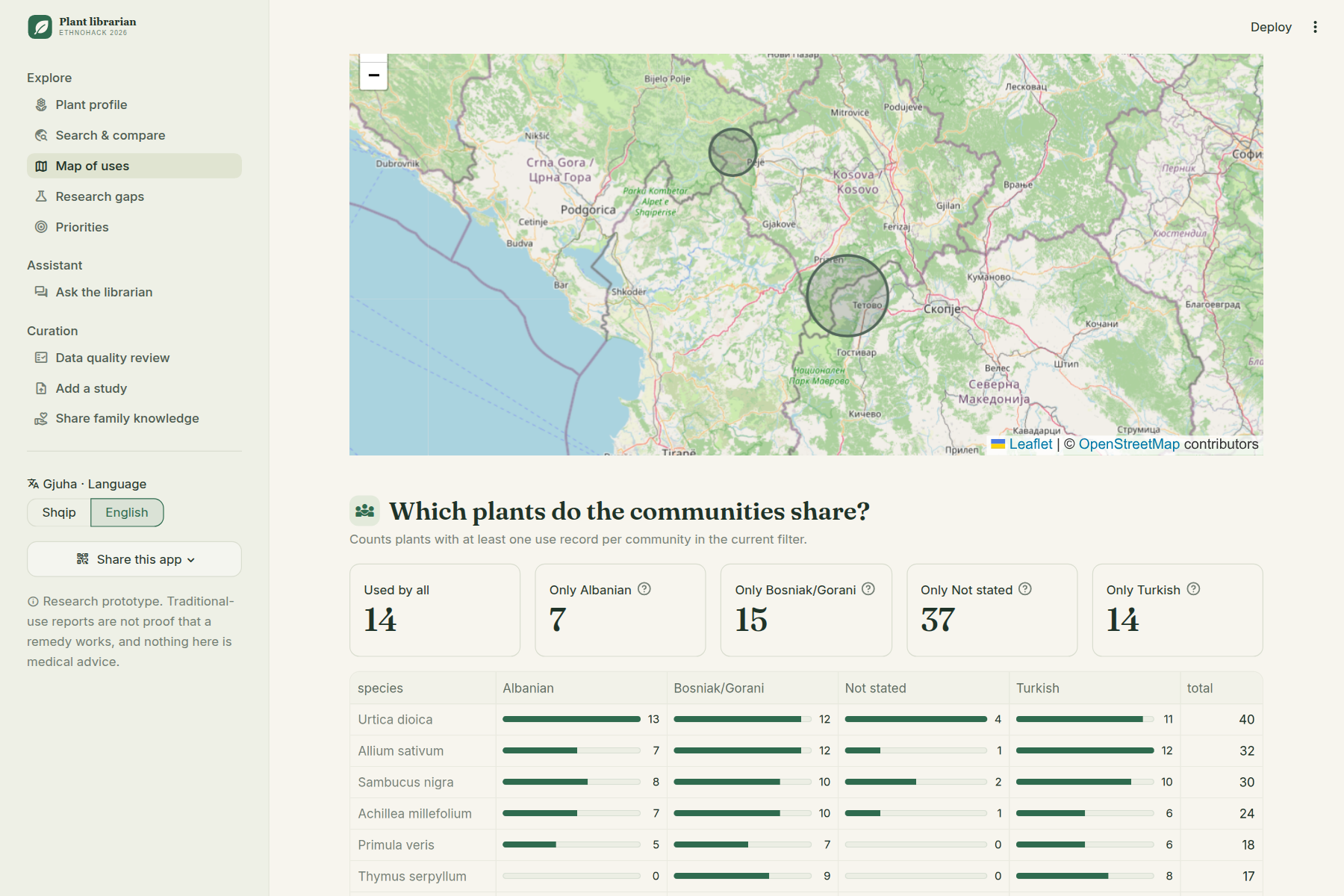
Which plants do the Albanian, Bosniak/Gorani and Turkish communities share?

Inspiration
In the villages of the Sharr Mountains and the Albanian Alps, older people still know which plant to pick for a cough, for sleep or for a wound. Researchers have written this knowledge down in open-access studies, and scientists publish thousands of papers on the same plants. But nobody connects the two.
The knowledge is scattered across PDFs with different table formats. The same plant has a different name in every village: Hithi, Kopriva and Yakici are all nettle. And modern studies usually test something people never use, such as an essential oil or an alcohol extract instead of the tea a grandmother actually drinks.
We wanted one question to take seconds instead of days: "Was the tea my grandmother drinks ever tested?"
What it does
Plant Librarian is a bilingual (Albanian and English) web app built on traditional-use records from open studies of Kosovo.
- Plant profile: type a plant's name the way people say it, or identify it from a photo. See how each community uses and prepares it, the study page and exact quote behind every line, what modern studies tested, and any safety flag. It never shows a dose.
- Was the same preparation tested? For every plant, we compare the traditional preparation (tea, decoction, ointment…) with the preparations tested in PubMed papers. 17 plants are research gaps: studies exist, but none tests what people actually use.
- Priorities: 36 plants are used for the same complaint by two or more independent groups, and their preparation was never tested in people. Number one is hop (Bari sherbetit), drunk as a tea for sleep in both regions; none of 40 PubMed papers tests the tea.
- Knowledge at risk: 73 plants and 119 uses are reported by one group only. If that group stops passing them on, nothing else records them.
- Map of uses: where each use was recorded, and which plants the Albanian, Bosniak/Gorani and Turkish communities share.
- Ask the librarian: a chat in Albanian or English, by text or voice, that answers only from our fact sheets and cites every claim.
- Add a study: upload a new open-access PDF, and its plants appear on the map.
- Share family knowledge: families add what they know, with two consents, no names and no doses. Entries are published only after a reviewer approves them, and they can be withdrawn.
- Fact sheet and QR code: print a sourced fact sheet for any plant, or share it with a QR code.
How we built it
- Read: two open-access studies, Sharr Mountains (Mustafa et al. 2015) and Albanian Alps/Rugovë (Mustafa et al. 2012). The Sharr table is parsed with rules. The Alps study is extracted by a free LLM on Groq (
gpt-oss-120b) with a strict JSON schema. - Ground: every extracted row must quote the study, and it is kept only if that quote is found on the cited PDF page. An automatic check runs on every build.
- Name: dialect names are matched with fuzzy search, and every plant is confirmed against GBIF.
- Compare: we pull in PubMed candidates, GBIF occurrences, Wikidata/LOTUS compounds and EMA/HMPC safety rules. Verdicts, priorities and knowledge at risk come from written rules, not AI.
- Show: a Streamlit app on SQLite, with Folium maps, Groq Whisper for voice and Pl@ntNet for photos, deployed for free on Streamlit Community Cloud.
AI is used only where text has to become a table, or speech has to become text. Everything that must be right (safety, evidence level, priorities) comes from rules and open databases. Every API response is cached, so one command rebuilds the whole library offline. 65 tests run in GitHub Actions, and the whole project uses only free services.
Challenges we ran into
- Dialect names: one plant has many local names, and one name can mean different plants. We combined fuzzy matching, a curated list of Albanian names and GBIF confirmation.
- Hallucinations: an LLM can invent a plausible use. We made the quote mandatory and drop any row whose quote is not on the cited page.
- Messy PDFs: table rows split across pages, scanned appendices with no text, and the free tier's rate limits. We made extraction resumable, so a rejected chunk is retried page by page.
- Honesty: a machine check is not a human verification. Records stay "Needs review" until a named person verifies them, and the app always says that traditional use is not proof that a remedy works.
Accomplishments that we're proud of
- 689 use records, 145 plants, 3 communities, each record with its page and quote.
- 95% recall (40 of 42) on hand-checked rows. 677 of 689 records pass the automatic PDF check, and the 12 that fail are flagged for a person to fix.
- A concrete, sourced list of plants that science should test next, built from what communities actually do.
- Knowledge from three communities side by side, showing both shared heritage and what only one group still remembers.
- Fully bilingual and usable by voice, so anyone can use it, not only researchers, while every line stays traceable to a page in a study.
What we learned
Traditional knowledge and modern science often talk about the same plant but not the same preparation. Making the AI prove every row with a quote from the cited page is what made it safe to use. Consent and "no doses" have to be designed in from the start, not added later. And a small, honest, checked dataset convinces more than a big unverified one.
Data sources and attribution
- Traditional uses: Mustafa B. et al. (2015). A cross-cultural comparison of folk plant uses among Albanians, Bosniaks, Gorani and Turks living in south Kosovo. J Ethnobiol Ethnomed 11:39. doi:10.1186/s13002-015-0023-5 (CC BY 4.0). Mustafa B. et al. (2012). Medical ethnobotany of the Albanian Alps in Kosovo. J Ethnobiol Ethnomed 8:6. doi:10.1186/1746-4269-8-6 (CC BY 2.0).
- Plant names and occurrences: GBIF (CC BY 4.0 / per dataset). Modern studies: PubMed E-utilities (NLM terms). Compounds: Wikidata / LOTUS (CC0). Safety: EMA/HMPC herbal monographs.
- Photo identification: Pl@ntNet API (free, non-commercial). LLM and speech to text: Groq free tier (gpt-oss-120b, Whisper).
Limitations and assumptions
- Two studies so far, both from Kosovo; knowledge at risk only compares the studies in the library, so absence from a study does not prove a community never knew a plant.
- "Was the same preparation tested?" uses keyword tags on PubMed abstracts: it points to papers to read and is not a systematic review.
- Records are machine-checked against their PDF page (677 of 689 pass), but none is verified by a domain expert yet; they stay "Needs review" until a person signs them.
- The Albanian name list and the place gazetteer are small and hand-made; conservation status is not yet included.
- Photo identification and speech to text come from external models and can be wrong.
What's next for Plant Librarian
- More open studies from Kosovo and Albania (Gollobordo, southern Kosovo).
- Verification of records with local experts and universities.
- Conservation status, to show whether a plant itself is at risk.
- The priority list offered to pharmacy and biology students as thesis topics.
- Collecting family knowledge in schools and villages, with consent.
Research prototype. Traditional use is not proof that a remedy works, and nothing here is medical advice.
Built With
- folium
- gbif
- github-actions
- gpt-oss-120b
- groq
- leaflet.js
- openstreetmap
- pandas
- plantnet
- pubmed
- pymupdf
- python
- qrcode
- rapidfuzz
- sqlite
- streamlit
- whisper
- wikidata


