Inspiration
We thought, let's make a service for students, by students! After conducting some market research, we realized that for many tutor services, while having many tutors readily available, the way they are managed makes it hard for students to find the right match. Many of these apps did not have enough room for personalization, or sufficient filters to narrow down the search for tutors. Of course, as post-secondary students ourselves, we saw this as an exciting opportunity to build our own tutor-finder app with a keen focus on personalization.
What it does
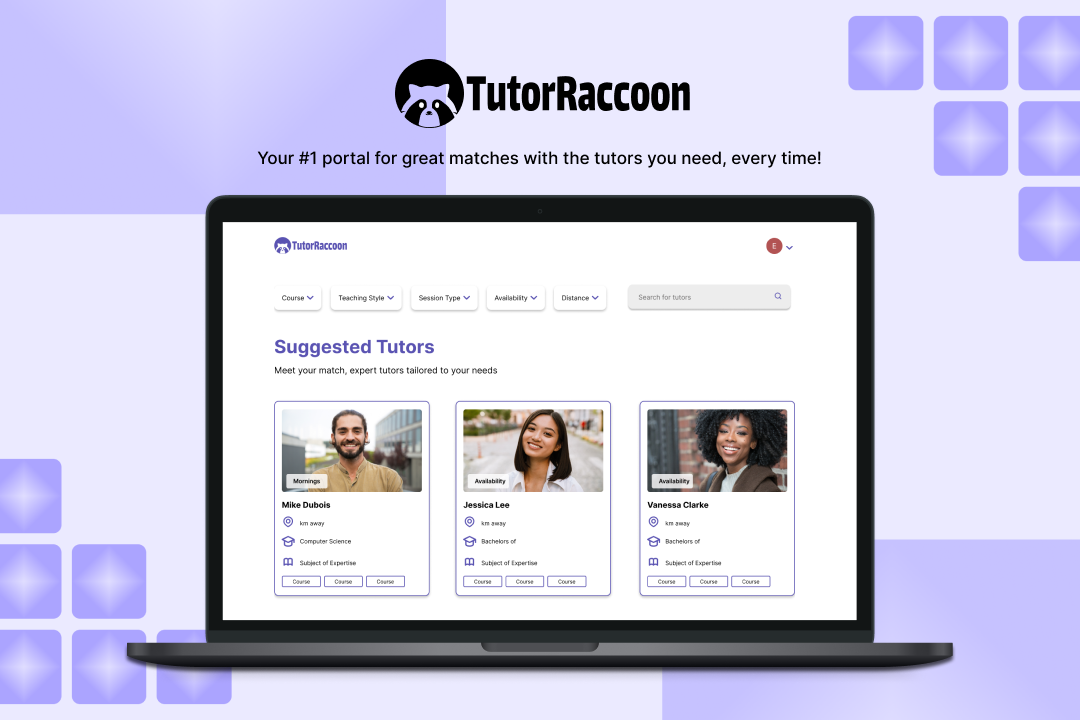
Get started with TutorRaccoon - a tutor-finding app targeted towards post-secondary students! Our service makes matching with a tutor easier than ever. Once you register a new account, you will be prompted to fill in 12 short onboarding questions (subjects range from personality type, budget, how far you're willing to travel, and more). This information will be used to serve you a personalized feed, where tutors are ranked by how closely they match your preferences. If you are not satisfied with your feed, you can still narrow down your search through 6 unique filters including the tutor's name, personality type, and availability. Our goal is to make studying more accessible, efficient, and enjoyable for all students!
How we built it
We used Figma for our sketches and prototypes. Then, we built our app with a React.js + Vite frontend and a Python Flask backend. We found a free API called ZipCodeBase which allowed us to retrieve distances between two ZIP codes. This made it easy to find the user's distance from all nearby tutors. We used Git for version control throughout development. MongoDB was used for databasing, to store all of the tutor profiles.
Challenges we ran into
We faced most of our challenges when connecting the frontend to the backend. Most notably, we would repeatedly receive CORS errors and other external errors related to MongoDB and axios. As a result, our project is currently a proof-of-concept. Additionally, we dealt with merge conflicts when committing to our repository, which hindered development.
Accomplishments that we're proud of
Overall, we are proud that we were able to create a backend API and link it to a React project. We are also pleased that most of the tutor search filters are functional. In addition, we are proud of how much detail we put into the onboarding questions, as this was the main selling point of our project. Our backend developers are proud that they were able to get MongoDB working for our tutor profile database.
What we learned
We learned how to make the frontend and backend communicate with each other through API routes. We also developed our skills in Figma, ReactJS, CSS, and Python. Specifically, frontend developers learned more React hooks such as useContext, while backend developers learned how to use a new API: ZipCodeBase.
What's next for TutorRaccoon
In the future, we will work on fixing the errors that arise when making HTTP requests to the backend. We hope to evolve our app by creating an AI chatbot or test, which can match tutors with users based on personality. Also, we want to make our app more flexible for users, allowing students to create a tutor account and vice versa. Some other ideas we have are: a messaging feature, a rating system for tutors, built-in video conferencing, and creating a mobile version of our app.
Built With
- adobe-illustrator
- css3
- figma
- flask
- html5
- javascript
- mongodb
- python
- react
- zipcodebase-api


Log in or sign up for Devpost to join the conversation.